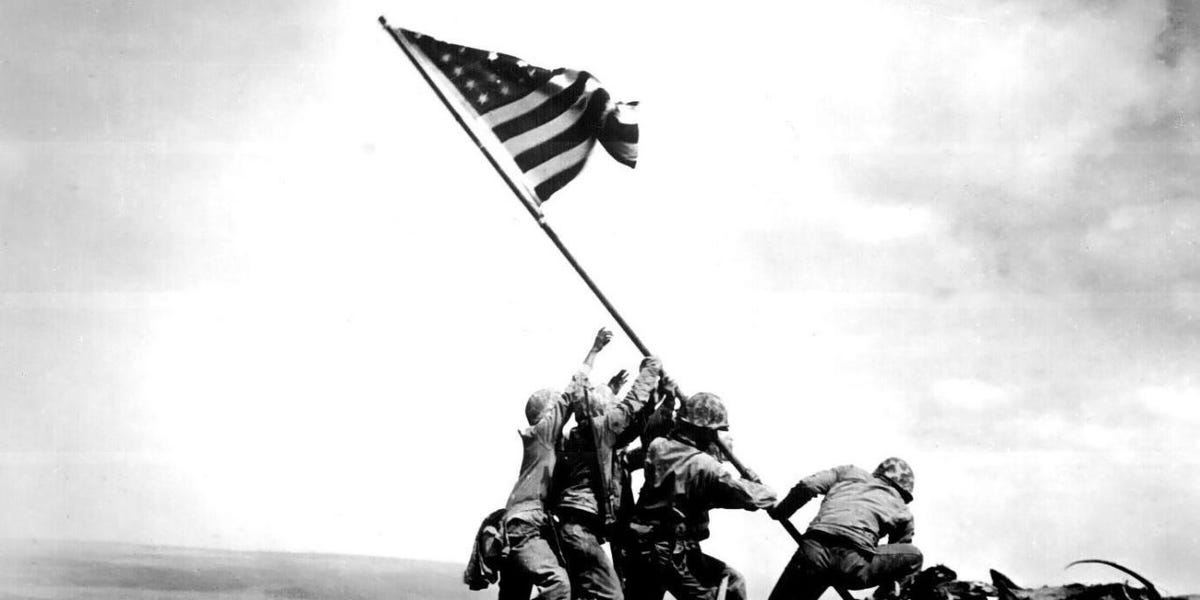
The photograph seems simple: six servicemen strain together, a flagpole rises at a dramatic angle, and the Stars and Stripes begins to catch the wind above Mount Suribachi. Yet behind Joe Rosenthal’s famous image lies a historical detective story involving two flags, several mistaken identities, combat confusion, private photographs, restored film footage, and decades of arguments over whose hands were actually on the pole.
For generations, textbooks confidently named the men in the picture. Then historians began noticing inconvenient details. A helmet did not match. A uniform looked wrong. One man’s build seemed inconsistent with the official identification. History, apparently, had left a few loose threads dangling from its combat jacket.
So, who raised the flag at Iwo Jima? The most accurate answer requires distinguishing the first flag raising from the secondand understanding why the official record changed more than once.
The Battle Behind the Famous Iwo Jima Photograph
American forces landed on Iwo Jima on February 19, 1945, during Operation Detachment. The small volcanic island, located between the Mariana Islands and Japan, contained airfields that the United States hoped to use in support of operations against the Japanese home islands.
Small did not mean easy. Japanese Lieutenant General Tadamichi Kuribayashi had transformed Iwo Jima into a maze of tunnels, caves, bunkers, concealed artillery positions, and mutually supporting defenses. Instead of trying to stop the invasion at the shoreline, many Japanese troops remained underground and waited for American forces to move inland.
Mount Suribachi dominated the island’s southern end. Marines cut it off from the main Japanese defensive network and fought toward its summit while brutal combat continued elsewhere. On February 23, the fifth day of the invasion, a patrol reached the top and raised an American flag.
The sight electrified the battlefield. Marines below cheered. Ships sounded whistles and horns. Yet the flag did not signal the end of the battle. Fighting continued for approximately another month, leaving nearly 7,000 Marines dead and roughly 20,000 wounded before Iwo Jima was declared secured on March 26.
There Were Two Flag Raisings on Mount Suribachi
Much of the confusion begins with a basic fact that popular memory often skips: the famous photograph shows the second flag raising of February 23, not the first.
The First Flag Raising
Lieutenant Colonel Chandler Johnson ordered First Lieutenant Harold G. Schrier to lead a patrol up Mount Suribachi, secure the summit, and raise an American flag. The flag, measuring approximately 54 by 28 inches, reportedly came from the attack transport USS Missoula. It was attached to a section of pipe and raised at about 10:20 a.m.
Marine photographer Staff Sergeant Louis Lowery photographed scenes surrounding the first event. His images captured the men and the flag immediately afterward, but they did not produce the perfectly composed, instantly recognizable image that would soon circle the globe.
Following a 2016 review of photographs, testimony, and historical records, the Marine Corps identified the six men who physically raised the first flag as:
- First Lieutenant Harold G. Schrier
- Platoon Sergeant Ernest I. Thomas Jr.
- Sergeant Henry O. Hansen
- Pharmacist’s Mate Second Class John H. Bradley
- Corporal Charles W. Lindberg
- Private Philip L. Ward
This correction removed Pfc. Louis C. Charlo and Pfc. James R. Michels from the official list of first flag raisers. Both still played meaningful roles on the mountain: Charlo participated in reconnaissance and later returned as part of a security force, while Michels provided security close to the flag-raising site. History corrected their specific actions without erasing their service.
Why a Second Flag Was Raised
The first flag was difficult to see from much of the island. A larger replacement flagan eight-foot battle ensign obtained from LST-779was sent to the summit. The smaller flag would be brought down as the larger one went up.
This was not a theatrical re-creation designed for reporters. It was a practical replacement carried out while the battle was still raging. Fortunately for history, Associated Press photographer Joe Rosenthal arrived as the second group prepared to lift the larger flag.
Who Raised the Second Flag in Joe Rosenthal’s Photo?
According to the Marine Corps’ corrected official record, the six Marines pictured raising the second flag were:
- Sergeant Michael Strank
- Corporal Harlon H. Block
- Private First Class Franklin R. Sousley
- Private First Class Ira H. Hayes
- Private First Class Harold H. Schultz
- Corporal Harold P. Keller
All six men in the photograph are now officially identified as Marines. Earlier versions of the story included Navy corpsman John Bradley, but the Marine Corps concluded in 2016 that Bradley had participated in the first raising, not the photographed second one.
Three of the six men in Rosenthal’s imageStrank, Block, and Sousleywere killed during the subsequent fighting on Iwo Jima. Hayes, Schultz, and Keller survived the war.
Michael Strank
Sergeant Michael Strank was the senior Marine in the group and led the wire-laying detail that became involved in the replacement flag raising. Born in Czechoslovakia and raised in Pennsylvania, he was respected as an experienced, steady squad leader. He was killed on March 1, only days after the photograph was taken.
Harlon Block
Corporal Harlon Block, a young Texan, appears near the base of the flagpole. He was killed on March 1 as well. For nearly two years, however, officials believed that the man in his position was Sergeant Henry Hansen.
Franklin Sousley
Pfc. Franklin Sousley came from Kentucky and was only 19 when he died on Iwo Jima on March 21. His position in the photograph was also rearranged in diagrams after the 2016 investigation corrected the identification of Harold Schultz.
Ira Hayes
Pfc. Ira Hayes, a Pima Marine from Arizona, became the most publicly recognized member of the group. After returning to the United States, he joined the Seventh War Loan tour but struggled with the attention and with the loss of fellow Marines. He repeatedly insisted that Harlon Blocknot Henry Hansenhad been pictured at the base of the pole.
Harold Schultz
Pfc. Harold Schultz survived the battle and later lived quietly, working for the U.S. Postal Service. He apparently did not pursue recognition as a flag raiser. In 2016, after researchers compared photographs and high-resolution scans of combat film, the Marine Corps concluded that Schultz had been mistaken for John Bradley in Rosenthal’s image.
Harold Keller
Corporal Harold “Pie” Keller was officially added to the photograph’s roster in 2019. For decades, the partially obscured figure on the far side of the pole had been identified as Rene Gagnon. New private photographs, forensic comparisons, and assistance from the FBI persuaded a Marine Corps review board that the man was Keller.
How the Official Identifications Went Wrong
The errors were not caused by one careless historian with bad eyesight and a lunch appointment. The original identification process took place amid wartime urgency, incomplete records, conflicting memories, and terrible casualties.
The men’s faces are largely hidden in Rosenthal’s photograph. Their bodies overlap. Helmets, packs, and bulky uniforms obscure their shapes. Several Marines involved in the flag raising were killed before they could provide detailed testimony. Others had participated in activities surrounding both flags, making memories easy to blend together.
Officials also wanted to identify surviving flag raisers quickly for a national war bond campaign. The photograph had become famous before investigators had time to conduct the kind of frame-by-frame analysis possible today.
The First Major Correction: Harlon Block Replaces Henry Hansen
The first official roster named Henry Hansen as the Marine at the base of the pole. Ira Hayes knew that identification was wrong but was initially reluctant to challenge the official story. He later informed Harlon Block’s family that their son was the man in the photograph.
A Marine Corps board reviewed the matter in late 1946, and in January 1947 the official record was changed to recognize Block. That early correction should have served as a warning: even eyewitness testimony can be unreliable when people are exhausted, traumatized, and asked to reconstruct a few seconds of chaotic movement.
The 2016 Correction: Harold Schultz Replaces John Bradley
Decades later, private researchers questioned whether John Bradley appeared in the second flag-raising photograph. They compared Rosenthal’s still images with other photographs and color film shot by Marine combat cameraman Sergeant William Genaust.
The investigation examined equipment, clothing, physical positioning, and the sequence in which individuals approached the pole. High-resolution 4K scans of Genaust’s footage allowed analysts to study details that earlier generations could barely see.
In June 2016, the Marine Corps announced that Harold Schultz was in the photograph and John Bradley was not. Bradley’s genuine participation in the first flag raising remained unquestioned. The correction changed one celebrated image, not his honorable service.
The 2019 Correction: Harold Keller Replaces Rene Gagnon
The reopened investigation encouraged additional scrutiny. In 2018, private historians submitted dozens of photographs suggesting that the partly hidden figure long identified as Rene Gagnon was actually Harold Keller.
A Marine Corps board evaluated the evidence and received forensic assistance from the FBI. In October 2019, the Corps formally recognized Keller as the sixth man in Rosenthal’s photograph.
Gagnon was not simply written out of the day. He carried the larger flag to the summit and returned the first flag for safekeeping. His contribution helped make the second raising possible, even though he was not one of the six Marines caught in Rosenthal’s famous fraction of a second.
Was the Iwo Jima Flag-Raising Photo Staged?
No credible evidence shows that Rosenthal staged the famous flag-raising photograph.
The rumor arose partly because Rosenthal took a separate posed group photograph after the flag was raised. In that image, often called the “gung ho” photograph, Marines gathered beneath the flag and faced the camera. When someone later asked Rosenthal whether he had posed “the picture,” he initially thought the question referred to that group shot and answered yes.
That misunderstanding followed him for decades. Genaust’s motion-picture footage, however, records the second flag raising as a continuous event from another angle. It confirms that the men were actually lifting the pole while Rosenthal photographed them.
Rosenthal nearly missed the moment. He set his bulky Speed Graphic camera on a pile of stones to improve his angle and pressed the shutter as the pole rose. The composition feels designed because the bodies form a powerful diagonal and no face dominates the scene. In reality, timing, teamwork, and luck did the art directing. Sometimes history hires an excellent photographer and then refuses to give him a second take.
Why the Photograph Became an American Icon
Rosenthal’s image traveled with remarkable speed. The Associated Press transmitted it to newspapers roughly 17½ hours after it was taken, and it appeared on front pages across the United States. It won the 1945 Pulitzer Prize for Photography only a little more than two months later.
The photograph became the centerpiece of the Seventh War Loan campaign, which raised approximately $26 billion. It appeared on a postage stamp before the war ended and later inspired sculptor Felix de Weldon’s Marine Corps War Memorial near Arlington National Cemetery.
Its power comes partly from what it does not show. There are no visible faces, no triumphant individual standing above the others, and no officer posing with a sword. The men lean together. Their identities seem less important than their shared effortwhich is emotionally effective but historically inconvenient when families deserve to know exactly who was there.
The picture also creates a misleading sense of conclusion. Mount Suribachi had been captured, but most of Iwo Jima remained contested. The flag rose near the beginning of the battle, not at its victorious finale. Rosenthal captured hope amid ongoing catastrophe, not a tidy Hollywood ending.
Why Correcting the Iwo Jima Flag Raisers Matters
Some people argue that the precise names are less important than what the photograph symbolizes. Symbolism matters, but accuracy matters too. A national icon should not require real servicemen to disappear behind convenient mistakes.
Correcting the record does not reduce the courage of Bradley, Gagnon, Hansen, Charlo, Michels, or anyone else who fought on Iwo Jima. It distinguishes among their actions. Bradley helped raise the first flag. Gagnon delivered the larger flag and retrieved the smaller one. Michels guarded the summit. Other Marines secured the route, maintained communications, photographed the event, and continued fighting after the cameras left.
The revisions also demonstrate how historical research should work. An official conclusion is not a sacred artifact sealed in glass. When better evidence appears, responsible institutions should review it openly. The Marine Corps’ willingness to amend its records shows respect for both history and the families connected to it.
Conclusion: The Flag Raisers, Correctly Remembered
The answer to “Who raised the flag at Iwo Jima?” depends on which flag is being discussed.
The first flag was raised by Harold Schrier, Ernest Thomas Jr., Henry Hansen, John Bradley, Charles Lindberg, and Philip Ward. The second, larger flag shown in Joe Rosenthal’s famous photograph was raised by Michael Strank, Harlon Block, Franklin Sousley, Ira Hayes, Harold Schultz, and Harold Keller.
The controversy survived for more than 70 years because wartime confusion hardened into accepted history. New research, private photographs, restored film, and forensic analysis eventually corrected the record. The image itself did not change. Our ability to see the people inside it did.
Editorial note: The identifications in this article reflect the official Marine Corps corrections announced in 2016 and 2019. Future discoveries should be judged by the same standard that produced those revisions: strong evidence, careful review, and respect for everyone who served at Iwo Jima.