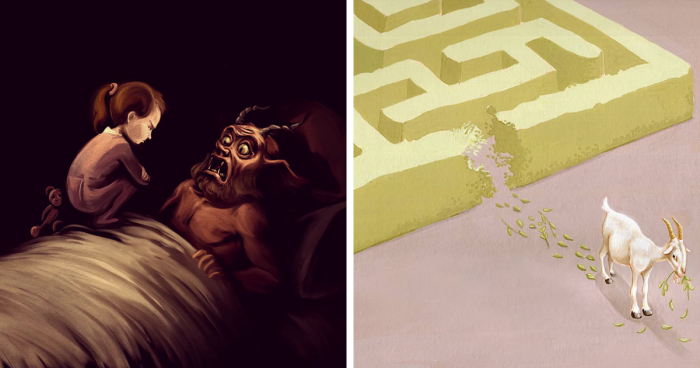
Some illustrations are pleasant little decorations. They match the couch, behave politely, and neveinto the room, point at humanity’s weird habits, and quietly ask, “So… are we really doing this?”
This collection of 37 thought-provoking illustrations belongs firmly in the second category. With sharp visual metaphors, dark humor, and a knack for turning everyday objects into uncomfortable symbols, the artist examines modern realities such as screen addiction, consumer culture, political power, loneliness, artificial intelligence, climate anxiety, and the strange pressure to look happy while life is buffering.
Note: This is an original editorial analysis of social-commentary illustration. It does not reproduce the artworks or replace the creator’s original visual work.
Modern Reality, Illustrated Without the Sugar Coating
Modern life has no shortage of absurd moments. We carry tiny computers that can connect us with almost anyone on Earth, then use them to ignore the person sitting across from us. We complain about being exhausted while scrolling until 2 a.m. We worry that machines may replace us, then eagerly ask them to write our emails, choose our movies, and suggest what kind of pasta feels emotionally appropriate on a Thursday.
That contradiction is where powerful social commentary art thrives. Instead of giving viewers a lecture with a megaphone, these illustrations use a single surprising image to make an idea land. A phone may become a cage. A crowd may become a product. A smiling character may reveal a much darker shadow. The message is often simple, but the aftertaste lingers.
The 37 images feel less like separate drawings and more like snapshots from one enormous, slightly alarming group chat called Humanity in the 2020s. Some are funny at first glance. Others are unsettling immediately. The strongest ones manage both, which is a difficult trick. It is like serving a joke with a side of existential dread.
Why Thought-Provoking Illustrations Hit So Hard
Words usually ask us to move in a straight line. We read a sentence, consider a point, and decide whether we agree. Visual storytelling takes a different route. It lets the brain spot something odd, make a connection, and then realize that the joke may be about us.
A good metaphorical illustration does not need an instruction manual. It gives viewers enough information to understand the scene, then leaves a little space for personal interpretation. That space matters. One person may see an image about social media and think about online comparison. Another may see the same image and think about privacy, fake intimacy, or the way people document a concert instead of hearing it.
That flexibility makes visual commentary art unusually durable. A drawing about isolation can feel relevant to a student overwhelmed by messages, a parent burned out by work, or an office employee who has attended so many video meetings that a human face now seems suspicious without a “mute” button.
The best illustrations do not pretend to solve every problem. They simply make the problem harder to ignore. In a world full of content designed to disappear after three seconds, that is a small act of rebellion.
37 Illustrations, One Big Mirror
1. Screens That Promise Connection but Deliver Distance
One of the strongest themes in modern reality illustrations is the paradox of digital connection. Screens allow people to communicate across countries, share ideas, build communities, and discover creative work that might otherwise stay invisible. At the same time, they can turn attention into a commodity and conversation into a performance.
In this kind of artwork, a smartphone is rarely just a smartphone. It may become a wall, a leash, a mask, a spotlight, or a tiny glowing throne. The object is familiar enough that viewers recognize it instantly, but the altered context exposes the behavior attached to it. Suddenly, a harmless swipe begins to look less harmless.
The humor works because most people have lived the joke. Nearly everyone has checked a notification during a conversation, refreshed a feed for no good reason, or felt oddly disappointed when a carefully chosen post received less attention than a stranger’s photo of breakfast. The avocado toast was not even that impressive, but apparently it had excellent lighting.
2. Consumerism and the Endless Shopping Cart of the Soul
Another recurring target is consumer culture: the belief that happiness may be just one purchase away, preferably with free shipping. Thought-provoking illustrations often show people swallowed by brands, trapped inside packaging, or transformed into obedient shoppers marching toward the next “limited-time offer.”
The criticism is not simply about buying things. People need useful products, good tools, warm clothes, and occasionally a lamp that does not look like it was designed by a villain from a science-fiction movie. The deeper question is whether consumption has become a substitute for identity, rest, meaning, or belonging.
When an illustration makes a person look smaller than the product they desire, it flips the usual advertising message. Instead of asking, “What does this item say about you?” the image asks, “What has this item convinced you to say about yourself?” That is not always a comfortable question, but neither is trying to assemble furniture with instructions that consist entirely of arrows and emotional betrayal.
3. Power, Politics, and the Performance of Control
Political imagery works best when it does not merely announce a position. It reveals a pattern. In these kinds of modern reality illustrations, authority may appear as a giant figure casting a long shadow, a leader holding a polished symbol that hides something rotten, or an ordinary citizen trying to survive under an impossible weight.
The point is not that every public issue has an easy answer. Quite the opposite. Strong visual satire acknowledges that power is complicated, systems are messy, and people often disagree for reasons that cannot fit into a three-word headline. But it also refuses to let polished language hide obvious cruelty, hypocrisy, greed, or indifference.
A single visual metaphor can make viewers pause longer than a paragraph full of carefully rehearsed talking points. It can show how fear is sold, how outrage is monetized, or how people are encouraged to cheer for rules that may eventually harm them. Sometimes the illustration’s sharpest weapon is simply making the familiar look ridiculous.
4. Technology, Artificial Intelligence, and the Uneasy Future
Technology is one of the most fertile subjects for social commentary because it changes so quickly that people often use it before they have decided what it should mean. Artificial intelligence, algorithms, automation, surveillance, and digital identity can sound abstract in a policy discussion. In an illustration, they become immediate.
A machine may be shown holding the strings while humans dance below. A face may become a barcode. A worker may be replaced by a sleek mechanical version of themselves, only with better posture and fewer coffee breaks. The image does not argue that every technological advance is bad. It asks what happens when convenience becomes obedience.
That is the unsettling beauty of visual storytelling about AI. It can hold excitement and worry in the same frame. Technology can expand creativity, improve access to information, and remove tedious tasks. It can also intensify inequality, blur the line between real and synthetic, and make people feel as though they are competing with systems that never sleep, never panic, and never accidentally send “Kind regards” to their mom.
5. Climate Anxiety and the Cost of Looking Away
Environmental themes often appear in thought-provoking illustrations through contrast. A beautiful landscape may hide a threat. A person may stand safely on a tiny island while the rest of the world floods around them. A luxury object may be built from the remains of something natural and irreplaceable.
These images matter because climate issues can feel too large to process. Numbers, reports, and headlines are necessary, but they can also become emotionally distant. Illustration pulls the issue closer. It turns a broad emergency into a scene someone can emotionally understand in a few seconds.
The strongest environmental art does not rely only on doom. It also exposes denial, delay, and the strange human talent for treating a serious warning like an optional calendar reminder. The message is not “panic forever.” It is “pay attention before the consequences become impossible to frame inside a pretty picture.”
The Secret Ingredient: Humor With Teeth
Without humor, social critique can become exhausting. Nobody wants to spend an afternoon being scolded by a drawing, even a beautifully drawn one. Humor gives the viewer an entry point. It makes hard subjects approachable without making them shallow.
That is why these thought-provoking illustrations often feel like visual punchlines. The setup is recognizable: a person, an object, a familiar public situation. Then comes the twist. The phone becomes a prison. The trophy becomes a weapon. The smile becomes a mask. The viewer laughs for half a second, then realizes the joke has quietly stolen their wallet and left them with a philosophical receipt.
Dark humor is especially useful when addressing fear, loneliness, violence, or social pressure. It does not erase the seriousness of those subjects. It gives people a way to approach them without immediately looking away. A laugh can be a defense mechanism, but it can also be a doorway.
How to Look at Social Commentary Art Without Speed-Scrolling Past It
These images reward a slower look. The first reaction may be obvious, but the details often change the meaning. Ask a few simple questions while viewing each illustration:
- What object has been transformed, exaggerated, or placed in an unexpected setting?
- Who has power in the image, and who appears trapped, ignored, or manipulated?
- What emotion arrives first: amusement, discomfort, anger, recognition, or all four?
- What part of modern life is being questioned?
- Does the image criticize an individual choice, a larger system, or the awkward dance between both?
There is no prize for decoding an illustration “correctly.” In fact, multiple interpretations are usually a sign that the image is doing its job. Art does not always need to tell viewers what to think. Sometimes it is enough to make them think more carefully.
Why These Modern Reality Illustrations Stay With You
The most memorable images in this collection do not rely on complicated detail. They use restraint. A clean composition, a strong symbol, and one visual surprise can say more than a page of explanation. That economy is part of the power.
In an age when people are bombarded with headlines, notifications, advertisements, opinions, and photos of strangers pretending they naturally wake up looking that refreshed, visual commentary creates a moment of interruption. It slows the feed. It invites viewers to notice what they have normalized.
These 37 thought-provoking illustrations are not simply about modern problems. They are about modern habits: the things people excuse, repeat, fear, buy, share, and sometimes laugh at because the alternative is admitting how strange it all has become.
That is what good social commentary art does. It does not hand over a neat answer wrapped in a bow. It hands viewers a mirror, tilts it slightly, and lets them decide whether they are ready to look.
Experiences From Living Inside the Metaphor
There is a particular experience that happens after seeing a strong illustration about modern life: the image follows you into an ordinary moment. You may close the tab, get up for coffee, and suddenly notice your hand reaching for your phone before your brain has even decided why. The drawing is no longer on the screen, but the idea is. That is the quiet power of visual metaphor. It slips past the defenses that usually appear when people feel criticized.
Imagine sitting on a train where nearly every passenger is looking down at a glowing rectangle. Nobody is necessarily doing anything wrong. One person may be messaging family, another may be reading the news, and someone else may be watching a video of a dog wearing sunglasses. Yet the scene can still feel strangely lonely. A thought-provoking illustration about screens and isolation does not need to prove that technology is evil. It simply gives shape to that small, uneasy feeling people already recognize.
The same thing happens with consumerism. After seeing an image of a person overwhelmed by possessions, a trip to the store can feel different. The bright lights, giant discounts, carefully arranged displays, and dramatic promises of “new you” suddenly seem like part of a larger performance. Buying something useful is normal. Buying something because an ad made boredom feel like a personal failure is another story. The illustration does not stand beside the shopping cart and yell. It just raises one eyebrow very slowly.
Experiences with social commentary art can also be deeply personal because viewers bring their own memories to the image. A drawing about political power may remind someone of a difficult conversation with family. A metaphor about climate anxiety may bring back the feeling of watching an extreme weather report and wondering what “normal” will mean in ten years. An illustration about artificial intelligence may make a designer, writer, student, or office worker think about how quickly their daily routines are changing.
What makes these experiences valuable is that they create a pause between reaction and habit. Instead of instantly liking, sharing, arguing, or forgetting, the viewer has a chance to sit with the idea. That pause is increasingly rare. Modern platforms are built to keep people moving, clicking, refreshing, and reacting. A strong piece of visual storytelling does the opposite. It asks the audience to stop for a moment and notice the machinery around them.
Of course, not every illustration will resonate with every person. One viewer may find an image brilliant while another may find it too bleak, too obvious, or too dramatic. That disagreement is part of the experience. Social commentary art is not a customer-service survey designed to earn five stars from everyone. It is meant to create friction. Sometimes the image that irritates you is the one that has found the most tender spot.
Ultimately, these modern realities illustrations are memorable because they transform abstract worries into scenes people can carry with them. They make invisible pressures visible. They turn habits into symbols. They use humor not to make problems disappear, but to make them easier to face. And after the laugh fades, they leave viewers with a strange but useful question: how much of this picture is really about the world, and how much of it is about me?