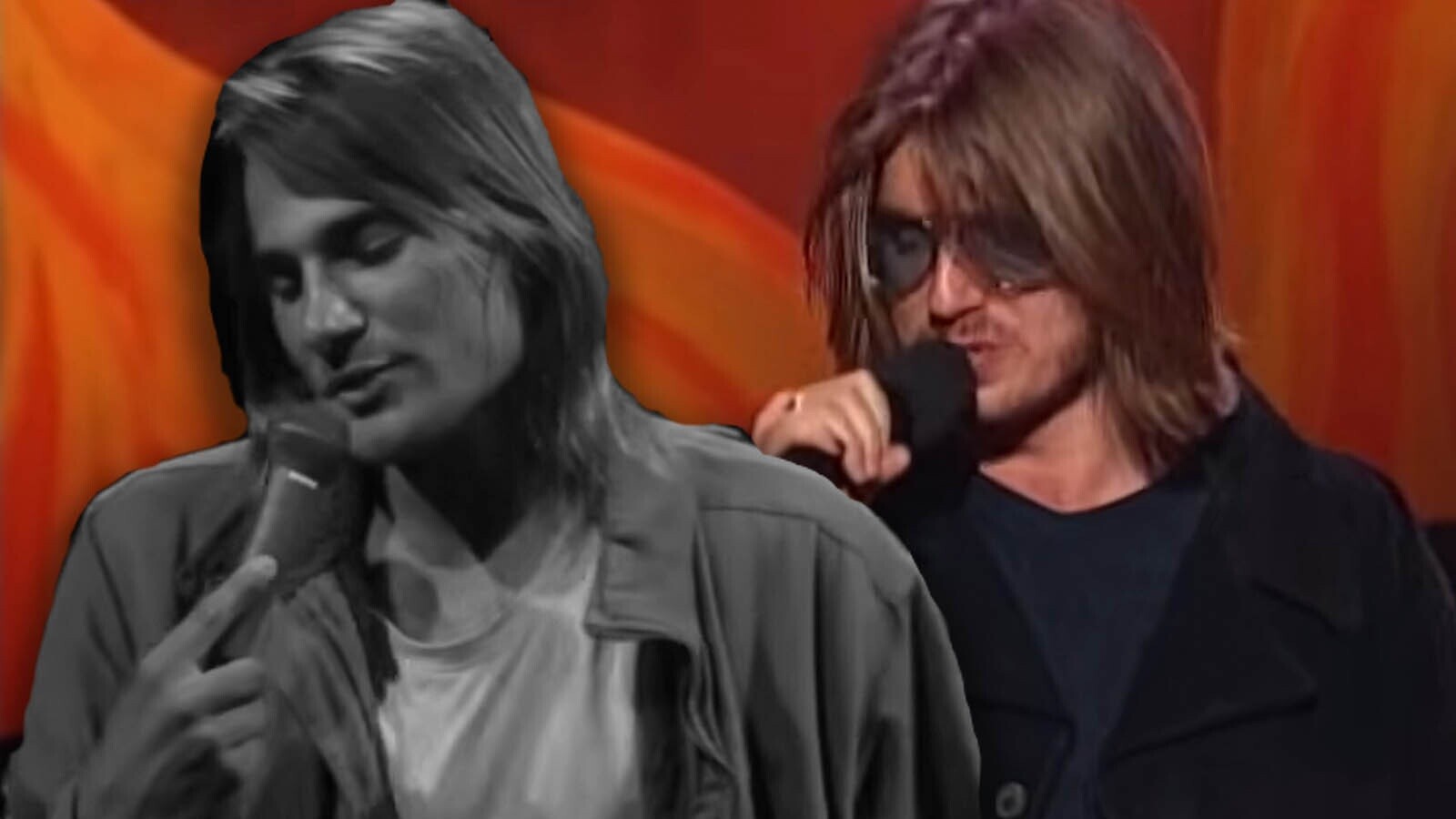
There is a very specific kind of stand-up comedian who can make an audience groan before the second joke lands. He strolls up to the microphone looking like he wandered out of a thrift store and into a fog machine. He squints at the floor. He drops a weird sentence about a sandwich, a parking lot, or a lamp. Then he waits, hoping the room will do the rest of the work for him. The vibe is obvious: Look at me, I am delightfully off-center. The problem is that he is not delightfully off-center. He is just renting someone else’s comedic apartment and refusing to pay utilities.
That is why this Mitch Hedberg wannabe needs to go.
Not Mitch Hedberg himself, of course. The real Mitch Hedberg was a singular force in stand-up comedy: a comic with a cult following, a distinct rhythm, a surreal point of view, and a delivery so relaxed it felt like it had missed two connecting flights and still arrived exactly on time. The imitation, though? That version needs to be escorted politely but firmly out of the club, past the bar, and into the harsh light of originality.
This is not an argument against influence. Comedy has always been built on inspiration, echoes, and evolution. Every great comic learns from somebody. The issue is what happens when admiration curdles into imitation, and imitation never grows into a voice of its own. At that point, the act stops feeling like homage and starts feeling like cosplay with a microphone.
Why Mitch Hedberg Worked in the First Place
To understand why the copycats fail, you have to understand what made Mitch Hedberg work. On the surface, his act looked simple: short jokes, deadpan observations, odd turns of logic, a dreamy stage presence, and a tone that suggested he had just discovered the universe was slightly crooked and found that pretty funny. But underneath that loose, offhand style was real craft.
Hedberg’s best material did not rely on random weirdness for the sake of weirdness. His jokes had architecture. He would begin with a familiar object or everyday moment, twist it a few degrees, and suddenly reveal how strange ordinary life really is. That is harder than it sounds. A lot harder. Plenty of comics can say absurd things. Very few can say absurd things that feel both surprising and inevitable, as if the joke was hiding in plain sight the whole time.
That is the first lesson the wannabes miss: Mitch Hedberg was not merely “quirky.” He was precise. His laid-back delivery made the jokes seem tossed off, but the writing was tight. Even his public image points to that discipline. Stories about his notebooks, his constant writing habit, and his attachment to the tools of joke writing tell the same story: the casual aura was real, but it was supported by obsessive work.
He also had something many imitators lack: an authentic inner rhythm. Hedberg was not doing deadpan because deadpan was trendy. He was doing it because that cadence belonged to him. His pauses, phrasing, and sideways logic were not accessories clipped onto an act. They were the act. That distinction matters. When the original speaks, the audience feels a worldview. When the imitator speaks, the audience feels a costume.
The Difference Between Influence and Theft
Every comic borrows at first. That is normal. Young musicians learn songs by other people. Young painters imitate styles. Young comedians absorb timing, structure, confidence, and perspective from comics they love. There is nothing wrong with that. In fact, it is part of the apprenticeship.
The trouble begins when a performer mistakes a style for a personality.
A Mitch Hedberg wannabe usually grabs the most visible parts first: the slow delivery, the detached tone, the one-liner format, the “I’m just a confused guy noticing stuff” energy. But copying those surface elements without the original mind behind them is like buying a chef’s apron and assuming risotto will start respecting you. It will not. Risotto is ruthless. So is stand-up.
Influence asks, “What can I learn from this comic?” Theft asks, “How much of this can I wear before people notice?” Influence eventually leads inward. Theft stays external. One produces artists. The other produces open-mic déjà vu.
What Real Influence Looks Like
Real influence from Hedberg shows up in comics who learned from his efficiency, his confidence in small ideas, and his willingness to trust language. Some later performers took that lesson and went in wildly different directions. They did not become discount Mitch. They became more fully themselves. That is how influence is supposed to work. You inherit the permission, not the person.
A good comic might watch Hedberg and think, I don’t need to shout to be funny. Or, A tiny observation can become a huge laugh if I attack it from the right angle. Great. That is growth. The bad comic watches Hedberg and thinks, I should stare at my shoes and say something about a vending machine. That is not growth. That is theft wearing vintage sunglasses.
Why the Hedberg Clone Bombs So Hard
Audiences may not always know comedy theory, but they know when something feels borrowed. They can sense when a joke arrives alive and when it arrives in a used box. A Hedberg clone often gets an early chuckle because the rhythm feels familiar. Then the room turns cautious. Then quiet. Then someone coughs with the authority of a negative review.
Why does the copycat fail?
First, because the surprise disappears. Mitch Hedberg’s comedy worked partly because his brain seemed to move in a way you had not seen before. The copycat is already secondhand by definition. Even if the specific joke is new, the engine driving it feels old. Audiences do not just want a different sentence. They want a different mind.
Second, the clone usually overestimates how “easy” the form looks. One-liner comedy appears deceptively simple because the final product is compact. But compression is difficult. A short joke has no room to hide. There is no dramatic backstory, no high-volume performance, no extended character work to cover weak writing. If the line is not sharp, it lies there like a spoon on the sidewalk. Technically present. Spiritually inactive.
Third, imitation often drains the joke of stakes. The real Hedberg was not just telling odd little thoughts; he was showing you a particular way of being in the world. His shyness, timing, restraint, and oddball clarity were all part of the effect. When another comic copies the form without the emotional core, the material feels weightless. It becomes a series of decorative shrugs.
Originality Still Wins in Stand-Up Comedy
Stand-up has changed a lot over the years. The industry has grown, clubs have shifted, podcasts have exploded, and social media has created a strange ecosystem where a comedian can become famous for one clip, one crowd-work moment, or one joke about airport pretzels. Through all of that change, one rule has remained stubbornly intact: originality travels.
That is why Hedberg’s legacy lasts. He was not just funny in the room. He was quotable, memorable, and unmistakable. His jokes moved from clubs to college dorms to message boards to conversations because people recognized a comic voice that belonged only to him. That kind of identity is rare. It is also exactly what a copycat can never manufacture.
The internet has actually made the wannabe problem worse. Today, a young comic can watch endless clips, absorb timing by osmosis, and unconsciously remix another performer’s entire energy before even realizing it. That means self-awareness matters more than ever. If your set sounds like it was assembled from another comic’s album, a few old TV clips, and a thrift-store scarf, that is not a brand. That is a warning sign.
How Comics Can Escape the Clone Zone
If a comedian recognizes a little too much Mitch in the mirror, all is not lost. The cure is brutally simple and annoyingly unglamorous: write more, live more, and pay closer attention to what only you would notice.
Talk about the world as it actually filters through your mind. What do you obsess over? What annoys you? What tiny details keep snagging on your brain? What rhythm do you naturally speak in when you are not trying to sound like somebody with a cult following and a poster in a dorm room?
Comedy gets better the moment the performer stops asking, “How do I sound like a comic?” and starts asking, “What is honestly strange to me?” That shift can be scary because it removes the safety net of imitation. But it is also the only road to work that lasts.
The best tribute to Mitch Hedberg is not doing his act with worse hair. It is honoring what he actually represented: originality, compression, commitment to craft, and the confidence to sound unlike everybody else.
The Real Problem Is Laziness Disguised as Taste
Let’s be honest. Sometimes when a comic imitates Hedberg, it is not just admiration. It is strategy. A copied deadpan style can look smart. It can create the illusion of depth before the joke has earned it. It can make weak material seem intentionally minimal, as if the audience just failed to appreciate genius. That is very convenient for the performer and very exhausting for everyone holding a drink ticket.
But comedy is not interior decoration. You cannot arrange a few eccentric details around a bare room and call it a home. Eventually the audience notices there is no furniture. A real joke has to live somewhere.
The harsh truth is that “Mitch Hedberg wannabe” is not usually an insult aimed at originality gone wrong. It is an accusation of artistic laziness. It means the comic found a beloved tone, copied the packaging, and hoped nostalgia would do the rest. That approach might survive one open mic. It will not survive a career.
Final Verdict: Keep the Influence, Kill the Imitation
Mitch Hedberg mattered because he was unmistakably Mitch Hedberg. He had the writing, the discipline, the stage presence, the vulnerability, the cult appeal, and the strange little lightning bolt of a comic perspective that cannot be mass-produced. He was not a format. He was a voice.
So yes, this Mitch Hedberg wannabe needs to go.
Not because stand-up should be purified of influence. Not because one-liners are dead. Not because deadpan is over. And not because audiences are too snobbish to accept resemblance. He needs to go because comedy deserves better than photocopies of brilliance. The audience deserves better. Mitch’s legacy deserves better. And honestly, the comedian deserves better too.
Drop the borrowed rhythm. Lose the cosplay weirdness. Burn the fake mystique. Keep the notebook, keep the curiosity, keep the faith in sharp short jokes if that is your lane, but build a voice that actually belongs to you. That is how comedy survives. That is how influence becomes art. That is how a comic stops being a wannabe and becomes worth watching.
Experience: What It Feels Like to Watch a Mitch Hedberg Clone in the Wild
If you spend enough time around stand-up comedy, you eventually encounter the Mitch Hedberg imitator in his natural habitat. The setting is usually an open mic, a small showcase, a bar with questionable lighting, or a room where the microphone stand has seen things it will never discuss. The comic walks up with the energy of a guy who wants to seem accidental. He adjusts the mic once, maybe twice, looks toward the floor like the carpet has the set list, and starts talking in that half-drowsy, side-angle rhythm that practically announces, “Please compare me to a legend, but in a chill way.”
At first, the audience is willing. A crowd is generous in the opening seconds. Everyone wants to laugh. Everyone wants the night to work. The first line gets a small pop because the structure is recognizable. The second line gets a polite reaction. By the third line, the room starts doing math. Not literal math, though that would be exciting. More like emotional math. People begin calculating whether they are watching a comic discover a voice or a fan perform a tribute act nobody requested.
Then comes the strange tension that only borrowed comedy can create. Nobody wants to be the villain who refuses to laugh at a young comedian trying something different. But people also know when the “different” thing is actually a refurbished version of somebody else’s brilliance. So the room gets quieter, but not hostile. It becomes observational. You can almost hear the audience thinking, Okay, what do you sound like when you stop doing that?
The most uncomfortable part is that the clone often has potential. That is what makes it frustrating rather than merely embarrassing. You can sense a real comic somewhere underneath the imitation. Maybe there is one original tag buried in the set. Maybe one aside sounds genuinely personal. Maybe one joke lands with a weirdness that does not feel borrowed. That is the moment you realize the act is not failing because the comic lacks talent. It is failing because the comic does not trust the talent enough to step out without a disguise.
And that is the audience experience in a nutshell: less anger, more disappointment. Watching a Hedberg clone is like watching somebody bring a karaoke machine to a poetry reading. The tools are not the issue. The mismatch is. You keep waiting for the performer to stop channeling a ghost and start speaking as a human being. When that finally happens, even for a second, the room wakes up. People lean in. The laughter gets warmer. Suddenly the comic is no longer a copy. Suddenly there is a person onstage.
That is why the whole thing matters. The audience is not begging for perfection. It is begging for presence. People can forgive a rough joke, a weird pause, a line that almost works, or even a complete bomb if the set feels honest. What they struggle to forgive is borrowed identity. It creates distance. It keeps the performer hidden. And stand-up, for all its performance tricks, still lives or dies on whether the audience feels like it met a real mind. The minute the comic drops the imitation and sounds like nobody but themselves, the room almost always gets better. Funny how that works.