Hollywood loves anime the way a raccoon loves a shiny object: intensely, impulsively, and with absolutely no understanding of how to take it home without getting bitten.
Every few years, a studio executive discovers a beloved anime, sees the built-in fanbase, hears the word “franchise,” and immediately starts printing money in their imagination.
Then reality arrives like a slap from a giant robot hand: the adaptation is awkward, the fans are furious, and the general audience is confused about why everyone is wearing a wig that looks like it lost a fight with a leaf blower.
To be fair, adapting anime into live action is genuinely hard. Anime isn’t just “a cartoon you can copy with real people.”
It’s a medium with its own language: exaggerated motion, stylized faces, heightened emotion, and pacing that can swing from quiet character work to planet-cracking chaos in a single episode.
When Hollywood treats that language like it’s a simple translation problem, the result often feels like someone ran your favorite series through a fax machine and then asked a committee to color it in.
So let’s talk about the messy, frequently hilarious, occasionally painful history of Hollywood’s live-action anime adaptationswhat keeps going wrong, why it keeps happening, and what it would take to finally stop stepping on the same rake.
Why Live-Action Anime Adaptations Are a Trap (Even When Everyone Means Well)
The core issue isn’t that anime “can’t” work in live action. It’s that studios often adapt the wrong parts.
They’ll copy the hair, the costumes, the iconographythen strip out the rhythm, tone, and cultural context that made the story click in the first place.
That’s how you end up with something that looks like the source material in screenshots but feels like a totally different show while you’re watching it.
The Three Big Translation Problems
- Visual logic vs. real-world physics: Anime characters can land a 40-foot jump and still look cool. Humans doing that in live action look like a wire gagunless you have a jaw-dropping budget and the time to use it wisely.
- Pacing mismatch: Many anime stories are built to breathe over episodes. Condense that into a two-hour film (or even a short season), and character arcs start sprinting like they’re late for the last train.
- Tone is fragile: Anime can pivot between sincere melodrama and absurd comedy without breaking. Live action can do it toobut only if the filmmakers commit to a consistent voice instead of apologizing for the weirdness.
The “We Can Totally Do This” Era (And the First Big Faceplants)
Hollywood has been flirting with anime and manga adaptations for decades, but the modern live-action push really took shape when studios realized two things:
(1) these stories come pre-tested with passionate fans, and (2) they often contain franchise-ready worlds.
Unfortunately, Hollywood’s early attempts also revealed the first law of live-action anime: the more you chase “mass appeal” by sanding off the edges, the more you alienate both fans and newcomers.
Speed Racer: The Movie That Was Too Anime for Hollywood (And Too Weird for 2008)
The Wachowskis’ Speed Racer is the weird cousin in this family history: not a cynical cash-in, but a maximalist, candy-colored swing that tried to honor the source’s hyper-stylized vibe.
Critics largely bounced off the sensory overload, and the box office didn’t reward the ambition.
Yet over time, it’s earned a cult reputationpartly because it committed to its own reality instead of trying to “normalize” itself for people who think anime begins and ends with “big eyes.”
The lesson Hollywood took from this, unfortunately, wasn’t “be bold and specific.” It was “be less anime.”
And that leads us to the Hall of Fame of Unforced Errors.
The Hall of Fame of Unforced Errors
Dragonball Evolution: When “Not a Fan” Becomes the Plot Twist
If you want a single symbol for Hollywood’s early misunderstanding of anime, Dragonball Evolution is basically the mascotwearing a torn gi, holding a broken scouter, and whispering,
“You should’ve left me in the vault.”
The film didn’t just miss the spirit of Dragon Ball; it seemed to actively avoid it.
The tone was a confused mash of teen fantasy clichés, the world felt small, and the energy that makes the franchise belovedjoyful escalation, comedic confidence, mythic martial-arts spectaclegot replaced with “generic YA adventure.”
Even years later, the movie’s legacy is so notorious that its screenwriter publicly apologized, basically admitting the project was approached like a paycheck rather than a passion.
When the person who wrote it says, “Yeah, my bad,” you’re not in “mixed reception” territory. You’re in “cinematic cautionary tale” territory.
What makes Dragonball Evolution such an important failure is that it shows Hollywood’s default approach at the time:
take the brand name, toss the weird parts, squeeze the story into a familiar Western template, and hope the logo does the heavy lifting.
It doesn’t. The logo gets mad at you.
Ghost in the Shell: Big Budget, Bigger Debate, and a Box Office Hangover
Ghost in the Shell is where Hollywood’s adaptation problem collided with a larger conversation about representation.
The project became a lightning rod long before release, with criticism focused on casting and the broader industry pattern of sidelining Asian leads.
The controversy didn’t just live on social media; it shaped the film’s narrative in public discourse, making it difficult for the adaptation to be judged purely as a sci-fi action thriller.
The frustrating part is that the source material’s appeal isn’t just cool cyberpunk aesthetics.
It’s philosophical: identity, embodiment, autonomy, and the uneasy boundary between human and machine.
The live-action film looked expensive and glossy, but many viewers felt it struggled to capture the depth and eerie introspection that made the original resonate.
When you adapt a story that’s basically an existential crisis in a trench coat, you can’t treat the ideas like optional accessories.
Then the box office arrived with the emotional warmth of a spreadsheet.
Despite the scale and star power, it underperformed relative to expectationsfueling the industry’s “anime doesn’t sell” takeaway,
instead of the more accurate “controversy, muddled positioning, and diluted themes don’t sell.”
Netflix’s Death Note: A Great Premise, a Crowded Canvas, and a Tone Problem You Can’t CGI Away
Death Note is a concept that should be adaptation-proof: a notebook that kills anyone whose name you write in it.
Moral corruption! Cat-and-mouse mind games! The seductive thrill of power!
You could set it anywhere and still keep the spine of the storyif you respect what the story is actually about.
The Netflix film tried to cram big ideas and big plot turns into a tight runtime, and it often felt like it was sprinting to the next twist before the tension could marinate.
The original story’s hook isn’t just “supernatural murder tool.”
It’s watching a brilliant, controlled protagonist rationalize his descent while an equally brilliant detective closes in.
When the adaptation shifts toward a more conventional teen-thriller vibe, it changes the flavor of the entire meal.
You can still eat it, but you’re definitely not eating what you ordered.
And because this is Hollywood adaptation bingo, the film also stumbled into the representation debate,
with critics and audiences calling out how “Americanization” can become a euphemism for sanding down cultural specificity.
Cowboy Bebop (Live Action): The Costume Was Right, the Vibe Was… Not
Cowboy Bebop is one of the most vibe-dependent anime ever made.
It’s cool without trying, melancholic without begging for tears, and stylish in a way that’s more jazz than cosplay.
That’s a hard thing to bottle. The Netflix series triedsometimes admirably!but many viewers felt it replaced the original’s soulful restraint with louder, winkier, more self-aware “Netflix energy.”
The cast had chemistry. The production had love for the aesthetics. The soundtrack callback potential alone could make fans emotional.
But Bebop isn’t just a set of iconographic poses.
It’s the quiet space between the posesthe loneliness, the regret, the humor that masks pain.
When that gets swapped for punchier dialogue and broader characterization, the show can start feeling like an imitation of itself.
The result: polarizing reception, endless online debates, and a short lifespan.
The adaptation became yet another example of how “faithful visuals” can’t compensate for a mismatch in tone and storytelling philosophy.
Development Hell: The Most Accurate Live-Action Anime Genre
Sometimes Hollywood doesn’t fail on screenit fails in pre-production for 20 years like it’s training for an endurance event.
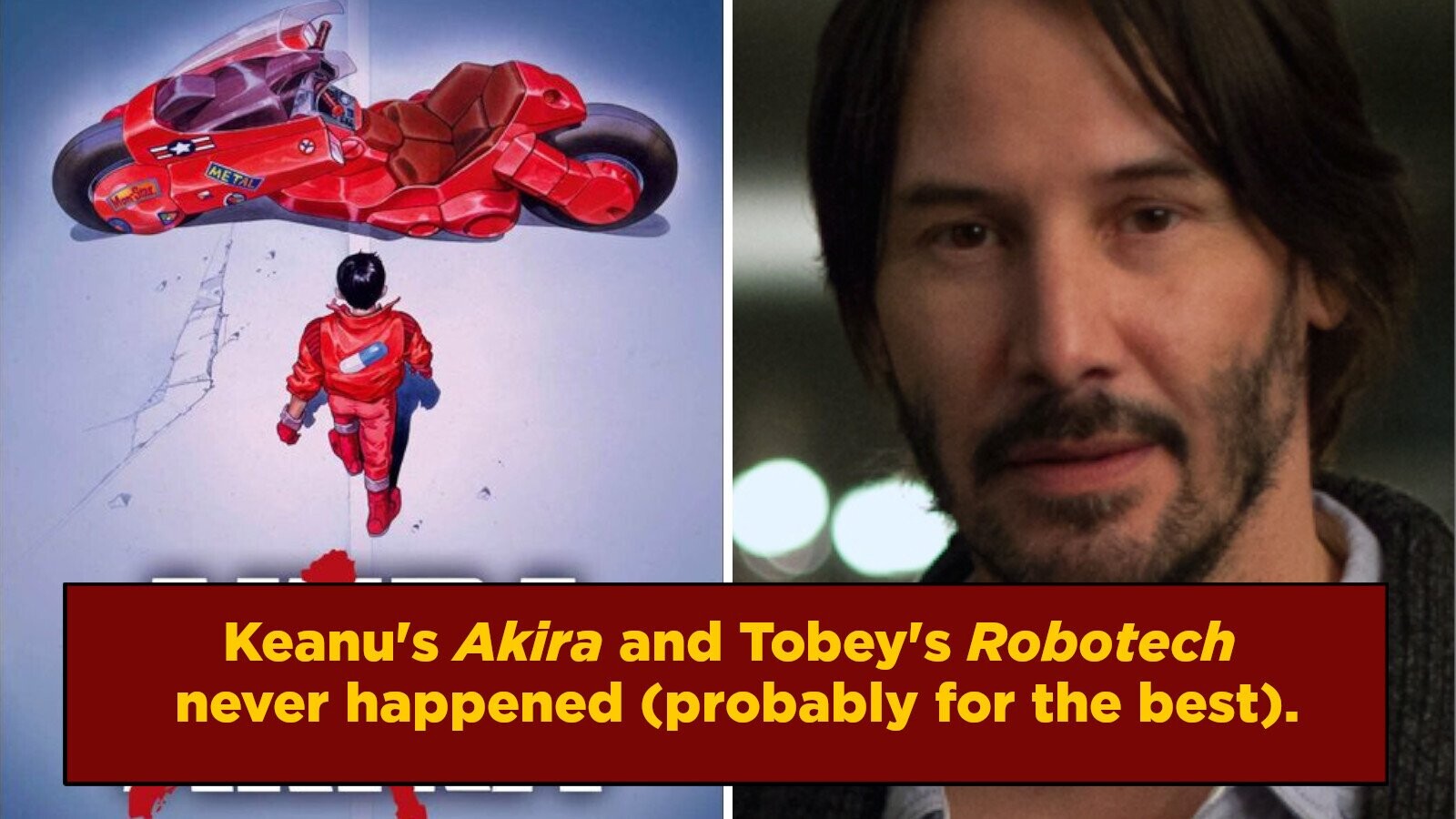
No title embodies this better than Akira, the legendary cyberpunk property that studios have circled for decades.
Akira has been attached to major talent, announced, delayed, rewritten, put on hold, rescheduled, and generally treated like a football that keeps slipping out of everyone’s hands.
And in 2025, after more than two decades of trying, Warner Bros. let the film rights lapsemeaning the adaptation basically returned to the open market like a rare collectible nobody could figure out how to safely unbox.
In a weird way, that might be the healthiest outcome.
If Hollywood can’t commit to the scale, specificity, and cultural grounding Akira demands, not making it is better than making a glossy compromise that pleases no one.
What Hollywood Keeps Getting Wrong (So Consistently It Feels Like a Ritual)
1) Mistaking “Fandom” for “Brand Recognition”
Anime fans aren’t just buying a logo; they’re attached to character dynamics, worldview, humor, and emotional architecture.
If you remove those and keep only the names, you’re not “broadening the audience.”
You’re selling a knockoff to the only people who can spot the difference from space.
2) Overcorrecting the Weirdness
A lot of anime is heightened. That’s the point. When adaptations become embarrassed by their own source material,
they flatten the very qualities that made the story worth adapting.
The result often feels like a generic action movie wearing anime’s clothes.
3) Compressing Stories Until They Lose Oxygen
Condensing a long-running series into a single film is like trying to summarize a whole relationship in a text message:
you can hit the major beats, but the nuancethe reason anyone caresgets lost.
If the story needs room, give it room. Not everything is a two-hour movie.
4) Treating Cultural Context as Optional
Anime and manga often reflect specific social norms, cities, histories, and emotional sensibilities.
When adaptations relocate the story without rethinking how those themes function in a new setting, the narrative can feel hollow.
“Universal themes” still live inside specific choices.
5) Chasing “Four Quadrants” and Catching None
Many failed adaptations have an identity crisis: part teen romance, part grimdark thriller, part joke, part sincere tribute.
That’s not “complex.” That’s indecision.
Successful adaptations pick a laneor at least build a highway with clear rules.
So… Can Hollywood Ever Get It Right?
Yes. And the proof is that when adaptations commit to a clear vision, they can earn real loveeven from skeptics.
Alita: Battle Angel didn’t become a universal critics’ darling, but it attracted a passionate fanbase and demonstrated that audiences will show up
for a stylized sci-fi world when the craft and emotional throughline are strong.
Meanwhile, Netflix’s One Piece live-action series became a modern example of “it can be done,”
largely because it treated the source material as a tonal blueprint rather than a list of props.
The secret isn’t to copy anime frame-by-frame or to “fix” it for live action.
The secret is to adapt the intent:
the emotional truth of the characters, the storytelling cadence, the way the world feels to live in.
That’s harder than replicating a haircutbut it’s the only thing that actually matters.
of Extremely Relatable Experiences (If You’ve Lived Through These Adaptations)
If you’ve been an anime fan for more than five minutes, you’ve probably experienced the Hollywood adaptation cycle like it’s seasonal weather.
It starts with a rumor: “They’re making a live-action version.” You laugh it offbecause self-preservation is important.
Then a trade confirms it, and your group chat turns into a support group. Someone posts, “This could be amazing!”
Another person replies, “Remember what happened last time,” like a veteran staring into the middle distance.
Next comes casting. This is where you learn who among your friends is an optimist and who is a disaster historian.
The optimists say, “Let’s see the trailer first.” The historians pull up a spreadsheet of past mistakes.
Then the first look images drop. The wigs are either surprisingly good or deeply cursed, with no middle ground.
You zoom in like you’re enhancing security footage. You search for signs of competence. You find… a leather jacket.
The trailer arrives. The comments section becomes a gladiator arena.
Half the internet says, “It looks fun!” The other half says, “They murdered my childhood,” even if they discovered the anime last year.
You watch the trailer three times: once to enjoy it, once to hate it, and once to figure out why you had both reactions in the same 90 seconds.
Release week is pure chaos. Non-fans ask, “Is this based on a cartoon?” and you inhale deeply through your nose.
Fans are divided into three camps: the hopeful, the furious, and the exhausted.
You, meanwhile, enter the viewing experience with the cautious posture of someone opening a package labeled “FRAGILE: EMOTIONAL INVESTMENT.”
There’s always a momentusually earlywhere you think, “Wait… is this actually working?”
And then five minutes later, someone delivers a line of dialogue that sounds like it was written by a committee trying to invent coolness in a lab.
Afterward, you do the post-mortem. You talk about what the adaptation got right (a set piece, a casting choice, a single scene that briefly captures the soul of the original).
You talk about what it got wrong (tone, pacing, character motivation, the decision to explain everything like the audience is a goldfish).
You make jokes to cope. You share memes. You swear off future adaptationsuntil the next announcement drops and the cycle begins again,
because hope is irrational and fandom is forever.
And honestly? That last part is the most revealing.
Even after the stumbles, fans still want these stories to work in new forms.
Not because anime needs Hollywood’s approval, but because great stories are great storiesand seeing them reimagined well would feel like a celebration, not an extraction.