Comic books have always loved a dramatic entrance. A shadow falls across the alley. A cape snaps in the wind. A radioactive spider bites the wrong teenager. And then, every once in a while, a real celebrity strolls into the panel like they got lost on the way to craft services.
Celebrity comic book cameos can be charming, clever, shameless, or so bizarre they make you check the cover twice to make sure you did not accidentally buy a fever dream with staples. The best ones are not just “famous person waves from the background” moments. They bend the fictional universe around the celebrity. They ask questions no sane person asked, such as: Could Spider-Man survive a late-night host’s motorcycle stunt? Should a rock band’s blood be mixed into comic ink? Can Muhammad Ali outbox Superman if the Man of Steel turns off the cheat codes?
This list focuses on real celebrity appearances in comics that are strange, memorable, historically interesting, and deeply fun to talk about. Some are official marketing stunts. Some are satire. Some are heroic team-ups that should have required a permission slip from reality itself. Together, they show why celebrity cameos in comic books remain one of pop culture’s weirdest little art forms.
5. Barack Obama Meets Spider-Man in The Amazing Spider-Man #583
In 2009, Marvel did something that was both oddly wholesome and completely ridiculous: it put President-elect Barack Obama into The Amazing Spider-Man #583. The issue included a short backup story in which Peter Parker is covering the inauguration when Spider-Man discovers a fake Obama. Naturally, because this is a Spider-Man comic and not a C-SPAN broadcast, the impostor turns out to be the Chameleon.
The premise is simple, but the cultural timing made it explode. Obama was entering the White House, Marvel knew he had publicly expressed affection for Spider-Man, and the comic became a collector’s frenzy almost immediately. Multiple printings followed, and the issue became one of Marvel’s biggest mainstream comic moments of the 2000s.
Why This Cameo Is Insane
The wild part is not that a president appeared in a comic. Presidents have been popping into superhero stories for decades. The wild part is that the story turns inauguration security into a superhero identity quiz. Spider-Man essentially has to figure out which Obama is real, like the world’s highest-stakes “spot the difference” puzzle.
It also captures a very specific moment when superhero culture, politics, internet hype, and comic collecting collided. The story is respectful, brief, and lighthearted, but it still belongs on this list because it transformed a regular Spider-Man issue into a national pop-culture souvenir. Most politicians hope for a flattering magazine cover. Obama got a fist bump from Spider-Man. That is not a bad upgrade.
4. Jay Leno Teams Up With Spider-Man in One Night Only
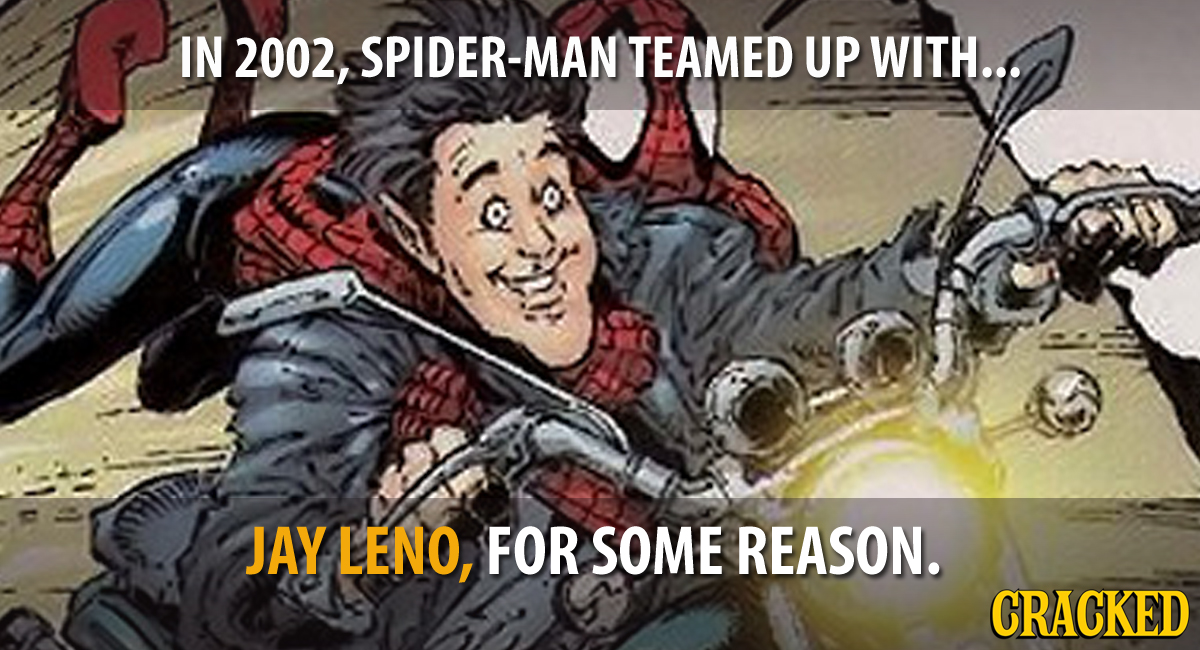
Spider-Man has fought goblins, symbiotes, mad scientists, vampires, clones, and his own rent. But in 2002, Marvel gave him one of his strangest partners: Jay Leno.
The crossover, usually remembered as Jay Leno & Spider-Man: One Night Only, appeared as a backup story across several Marvel titles. The setup involves Spider-Man and Leno working together on a car commercial. That alone is already beautifully weird. Spider-Man doing a commercial? Jay Leno as a co-star? Somewhere, J. Jonah Jameson’s mustache probably tried to leave his face in protest.
Then the story escalates. There are attacks, chases, and ninja-style danger. Instead of merely standing around telling jokes, Leno becomes part of the action. The result feels less like a normal Spider-Man adventure and more like a promotional stunt that escaped containment and started doing backflips.
Why This Cameo Is Insane
This cameo is a perfect example of early-2000s comic-book marketing logic: Spider-Man is hot because of the movie, Jay Leno is famous because of late-night television, cars exist, therefore ninjas. It is not a traditional superhero story. It is a celebrity crossover wearing a Spider-Man mask and revving a motorcycle outside the studio.
And yet, that is what makes it memorable. Comics are often at their most fascinating when they are not elegant. Sometimes the oddball commercial tie-in becomes more fun to discuss than a perfectly crafted issue. The Jay Leno crossover is not “insane” because it changed Marvel history. It is insane because it feels like someone in a meeting said, “What if The Tonight Show had web-shooters?” and nobody stopped them.
3. Eminem Meets The Punisher in Eminem/Punisher
Rapper Eminem and Marvel’s Punisher are not an obvious duo, unless your idea of team chemistry is “two angry men in black clothing having a terrible day.” Still, Marvel made it happen in 2009 with Eminem/Punisher, a one-shot connected to XXL magazine and Marvel Digital Comics.
The story is exactly as over-the-top as the pairing suggests. A fictional group called the Parents Music Council wants Eminem eliminated. The mercenary Barracuda enters the chaos. Frank Castle gets involved. Eminem and the Punisher fight, argue, get captured, and eventually move into the classic comic-book rhythm of “we hate each other, therefore we must team up.”
The most unforgettable detail is that Eminem returns with a chainsaw to help rescue Frank Castle. Read that sentence again. It is not a rejected lyric. It is comic-book history.
Why This Cameo Is Insane
This cameo works because it understands the absurdity and leans into it. Eminem’s public image at the time was already built around controversy, outrage, dark comedy, and violent exaggeration. The Punisher’s world is gritty, brutal, and morally grim. Put them together, and the result is not tasteful. It is not subtle. It is a comic book equivalent of a bass speaker falling down the stairs.
Unlike a background cameo, Eminem is central to the plot. He is not just signing autographs while Spider-Man swings by. He is surviving a murder attempt, bickering with the Punisher, and entering action-movie territory. The whole thing feels like a bizarre capsule of 2009: music culture, edgy comics, digital publishing, and celebrity branding all shoved into one violent little package.
2. KISS Gets Superpowers, Fights Doctor Doom, and Adds Blood to the Ink
If celebrity comic cameos had a hall of fame, KISS would not merely be inside it. They would be on the roof breathing fire while Gene Simmons pointed at the parking lot.
KISS first appeared in Marvel’s Howard the Duck and later received the full spotlight in Marvel Comics Super Special #1 in 1977. The band’s stage personas already looked like comic-book characters: The Demon, The Starchild, The Catman, and The Spaceman. Marvel did not have to stretch reality very far. KISS had basically arrived pre-packaged as a superhero team with guitars.
The most famous legend around the comic is also the most wonderfully unhinged: blood from the band members was reportedly drawn and mixed into the red ink used for the issue. Whether fans treat that as marketing mythology, rock-and-roll ritual, or the most dramatic printing note in publishing history, it remains one of the strangest promotional hooks ever attached to a comic book.
Why This Cameo Is Insane
The KISS comic is not just a cameo. It is celebrity branding turned into superhero mythology. The band members are not portrayed as ordinary musicians who happen to meet a hero. They are presented as larger-than-life figures who belong naturally in Marvel’s world of cosmic weirdness, magic, monsters, and Doctor Doom-level melodrama.
And that is what makes it brilliant. KISS understood that rock stardom and superhero comics share the same basic language: costumes, symbols, origin stories, loyal fans, exaggerated conflict, and poses that would look ridiculous at the grocery store. Their Marvel appearance did not feel like a celebrity interrupting a comic. It felt like the comic finally admitted what the concert already knew.
1. Muhammad Ali Boxes Superman in Superman vs. Muhammad Ali
At the top of the list is the heavyweight champion of celebrity comic book cameos: Superman vs. Muhammad Ali, published by DC Comics in 1978.
The concept sounds like something invented by two kids arguing on a playground: Who would win, Superman or Muhammad Ali? DC answered with an oversized treasury edition that treated the question with surprising grandeur. An alien race called the Scrubb demands that Earth choose its greatest fighter. Superman steps forward. Muhammad Ali also steps forward, because of course he does. To make the fight fair, Superman temporarily loses his powers, and the two icons face each other in the ring.
The story, associated with creators including Dennis O’Neil and Neal Adams, is much bigger than a gimmick. It is a science-fiction boxing epic, a celebrity crossover, and a cultural artifact from an era when Ali was not merely an athlete but a global symbol. The famous wraparound cover also became part of the legend, packed with celebrities, DC heroes, and recognizable figures watching the match like the universe’s most exclusive ringside crowd.
Why This Cameo Is Insane
Because it asks the impossible question and then actually builds an entire story around it. Superman is the ultimate fictional powerhouse. Muhammad Ali was the ultimate real-world fighter, performer, talker, and self-mythologizing champion. Putting them together should have collapsed into pure novelty, yet the comic has endured because it understands both men as icons.
The most important trick is that Ali is not treated as a decorative guest. He is central to the story’s emotional and physical logic. Superman may be the alien sun god in a cape, but Ali is the master of the ring. When Superman loses his powers, the match becomes about skill, confidence, discipline, and identity. It is absurd, yes, but it is also oddly respectful.
That is why Superman vs. Muhammad Ali still towers over other celebrity comic book appearances. It is not just “famous person meets superhero.” It is “two cultural myths collide, and somehow nobody blinks.” That takes nerve. It also takes a very large comic book.
What These Celebrity Comic Book Cameos Reveal About Pop Culture
The strangest celebrity cameos in comics usually work for one of three reasons. First, they capture a moment. Obama and Spider-Man belong to a very specific cultural atmosphere in 2009. Eminem and the Punisher capture a specific era of edgy crossover marketing. KISS at Marvel belongs to the theatrical rock explosion of the 1970s.
Second, they turn celebrity identity into story fuel. Muhammad Ali was not just famous; he was famous for confidence, skill, poetry, controversy, and athletic greatness. That made him a natural dramatic foil for Superman. KISS was not just a band; it was a set of superhero-ready personas. Eminem was not just a rapper; he was a walking moral panic with punchlines. Comics thrive on exaggerated identity, and celebrities often arrive with that already built in.
Third, these cameos remind readers that comic books have always been closer to carnival culture than museum culture. They are bold, colorful, commercial, experimental, and sometimes shameless. A celebrity cameo can be art, advertisement, satire, fan service, or all four wearing the same pair of boots.
Experience Section: Reading Celebrity Comic Cameos as a Fan, Collector, and Pop-Culture Explorer
The best way to experience celebrity comic book cameos is not to approach them like sacred literature. Approach them like you found a strange VHS tape in your uncle’s basement labeled “Spider-Man Meets Famous People” and decided to risk it. That mindset helps, because these stories often live in the wonderful gap between genius and nonsense.
For readers, the fun begins with disbelief. You open a comic expecting capes, villains, secret identities, and emotional monologues on rooftops. Then a real person appears, and suddenly your brain has to negotiate two realities at once. Is Barack Obama part of Marvel continuity now? Did Jay Leno really just become useful in a Spider-Man action sequence? Is Eminem allowed to borrow a chainsaw in a Punisher story, or does Marvel have a form for that?
That friction is the charm. Celebrity cameos make comic universes feel both bigger and sillier. They suggest that somewhere between New York traffic, alien invasions, late-night television, and arena rock, all public life belongs to one giant shared universe. It is ridiculous, but comic books have always been good at making ridiculous things feel emotionally sincere for exactly six pages longer than expected.
For collectors, these issues offer another kind of thrill. Celebrity appearances often become conversation pieces. A key Spider-Man villain debut may be historically important, but a comic where KISS reportedly put blood in the ink has a different kind of gravity. You do not need to be a price-guide expert to understand why someone would point at it and say, “Wait, what?” That reaction is valuable. It turns a comic from an object into a story about the object.
These cameos are also useful reminders that comics are time capsules. They preserve not only fictional continuity but public obsession. The Obama issue reflects a moment of political excitement and media novelty. The KISS comic reflects rock spectacle at maximum volume. The Eminem/Punisher crossover reflects an era when controversy itself could be packaged as entertainment. Even the Jay Leno story captures a strange media ecosystem where late-night hosts, car ads, and superhero movies could somehow end up in the same promotional blender.
For writers and content creators, the lesson is clear: novelty works best when it has narrative pressure. A celebrity cameo should do more than wave. It should create conflict, comedy, symbolism, or surprise. Muhammad Ali facing Superman works because the matchup turns identity into drama. KISS works because the band already had mythic alter egos. Eminem works because his public persona naturally clashes with the Punisher’s brutal world. The cameo becomes memorable when the celebrity is not pasted onto the page but baked into the madness.
And for casual fans, these comics are simply fun rabbit holes. They are perfect for trivia nights, blog posts, collector videos, and late-night debates with friends who thought they had heard every weird superhero fact already. Someone may know about Batman fighting the Joker. Fewer people are prepared for “KISS fought Doctor Doom in a comic tied to blood-infused ink.” That is the good stuff. That is where comic history stops being homework and starts being a group chat emergency.
Conclusion
Celebrity comic book cameos are not always elegant, but elegance is overrated when Spider-Man is solving presidential impostor problems and Muhammad Ali is preparing to punch Superman under alien supervision. The five appearances above prove that comics are at their best when they are fearless enough to be weird.
Some of these cameos were marketing stunts. Some were cultural celebrations. Some were gloriously awkward experiments. But all of them show how flexible the comic-book medium can be. It can turn a rock band into superheroes, a rapper into a Punisher co-star, a president into a Spider-Man plot point, and a world-famous boxer into Earth’s champion.
That is the magic of comics: one minute you are reading about justice, responsibility, and heroism; the next minute you are wondering whether alien boxing commissions have better rules than the Nevada State Athletic Commission. And somehow, both experiences belong on the same shelf.
Note: This article is written in original American English and synthesizes documented comic-book appearances without copying source text or adding source-link clutter for publication.