SaaS onboarding used to be treated like a friendly welcome mat: nice to have, easy to ignore, and usually forgotten after someone clicked “Start free trial.” That era is officially over. Today, onboarding is not a decorative ribbon tied around a product. It is a revenue lever, a retention engine, a product education system, and, when done well, the fastest path between a confused signup and a delighted customer.
The “State of SaaS Onboarding – Userpilot” discussion matters because SaaS buyers have changed. Users expect to try software before speaking with sales, reach value quickly, and receive guidance that feels personal instead of robotic. If a product drops them into an empty dashboard and whispers, “Good luck, champ,” they will not admire the minimalist interface. They will leave.
Userpilot’s research into SaaS onboarding reveals a market moving toward self-serve growth, personalized onboarding, interactive guidance, and continuous product education. Yet the same research also shows a surprising amount of friction still standing between users and value. In other words, SaaS onboarding has matured, but it has not graduated with honors. There is still homework to do.
Why SaaS Onboarding Has Become a Growth Strategy
Onboarding is often misunderstood as a beginner tutorial. In reality, SaaS onboarding is the structured journey that helps new users understand, trust, and adopt a product. It begins before signup, continues through activation, and extends into feature discovery, retention, expansion, and customer success.
The biggest shift is that onboarding is no longer owned by one department. Product teams care about activation. Customer success teams care about retention. Marketing teams care about trial conversion. Sales teams care about expansion. Executives care about revenue efficiency. Everyone has fingerprints on onboarding, which explains why messy onboarding can feel like a group project where nobody opened the shared document.
In product-led SaaS, users want evidence before commitment. They do not want a 40-minute demo just to learn whether the product can solve one obvious problem. They want to test, click, build, invite, import, publish, analyze, or automate something meaningful. The faster they reach that first meaningful outcome, the stronger the product’s chance of becoming part of their workflow.
This is why modern SaaS onboarding is measured by activation rate, time to value, checklist completion, feature adoption, trial-to-paid conversion, customer satisfaction, and early retention. If those numbers are weak, the problem may not be the product’s value. It may be that users never found the value in the first place.
What Userpilot’s State of SaaS Onboarding Reveals
Userpilot’s State of SaaS Onboarding report analyzed onboarding flows across more than 100 SaaS tools. The findings point to one major theme: SaaS companies are increasingly willing to let users experience products directly, but many still struggle to guide users effectively after the door opens.
Free Trials and Freemium Are Now Mainstream
The report found that more SaaS products are offering users a way to experience the product before buying. Over 74% of the tools reviewed offered a free trial, while nearly 41% offered a free account. Only a small share remained strictly demo-only.
This is good news for users and a warning light for SaaS companies. A free trial is not a strategy by itself. It is simply the beginning of the test. If the onboarding experience fails, the trial becomes a beautifully packaged exit ramp. Users may sign up, poke around, feel mildly confused, and vanish like a browser tab during a busy Monday.
The rise of free trials and freemium models means onboarding must do more than explain buttons. It must prove value. It must help each user complete the actions that matter most for their specific role, goal, and context.
Signup Friction Is Still a Conversion Killer
Userpilot’s research also highlighted friction in signup flows. Many SaaS products still ask too much too early. Long forms, mandatory email confirmation before dashboard access, unnecessary company questions, and password hurdles can interrupt momentum before users even see the product.
Single sign-on, especially Google login, has become one of the easiest ways to reduce friction. When users can enter quickly, they are more likely to stay curious. The golden rule is simple: ask for only what you need to personalize the journey right now. Save the interrogation-room energy for never.
A strong signup flow should feel like a helpful concierge, not a customs checkpoint. If the product needs more data later, it can ask contextually when the user understands why the information matters.
The New Standard: Personalized SaaS Onboarding
The old onboarding playbook pushed every new user through the same tour. It usually began with a modal, continued through several tooltips, and ended with the user clicking “Next” repeatedly while learning almost nothing. This is not onboarding. This is digital tap dancing.
Modern SaaS onboarding is moving toward personalization. That means asking users what they want to accomplish, segmenting them by role or job to be done, and adapting guidance based on behavior. A founder, marketer, developer, operations manager, and customer success leader may all use the same SaaS product for very different reasons. Giving them the same path is convenient for the company, but rarely useful for the user.
Welcome Screens Should Segment, Not Just Smile
Welcome screens are valuable when they do more than say hello. The best welcome flows gather one or two important signals: the user’s goal, role, company size, use case, or preferred workflow. This information can then shape the onboarding path.
For example, a project management tool might ask whether a user wants to manage client work, internal operations, software sprints, or personal tasks. A product analytics platform might ask whether the user wants to improve activation, reduce churn, track feature adoption, or build executive dashboards. Each answer should lead to a different first experience.
The point is not to collect data for the sake of collecting data. Nobody wants to answer a survey and then receive the same generic tour anyway. That is like ordering a custom sandwich and being handed plain toast. Personalization must be visible, immediate, and useful.
Microsurveys Can Improve Relevance
Short microsurveys help SaaS companies understand user intent without creating a heavy signup process. A good onboarding microsurvey asks just enough to personalize the experience. A bad one asks for a user’s life story, quarterly goals, favorite cloud provider, and possibly their childhood pet’s middle name.
Effective microsurveys are brief, specific, and tied to action. The answers should influence checklists, in-app messages, recommended templates, email sequences, and support prompts. When users see that their answers shape the experience, trust increases.
Interactive Walkthroughs Beat Passive Product Tours
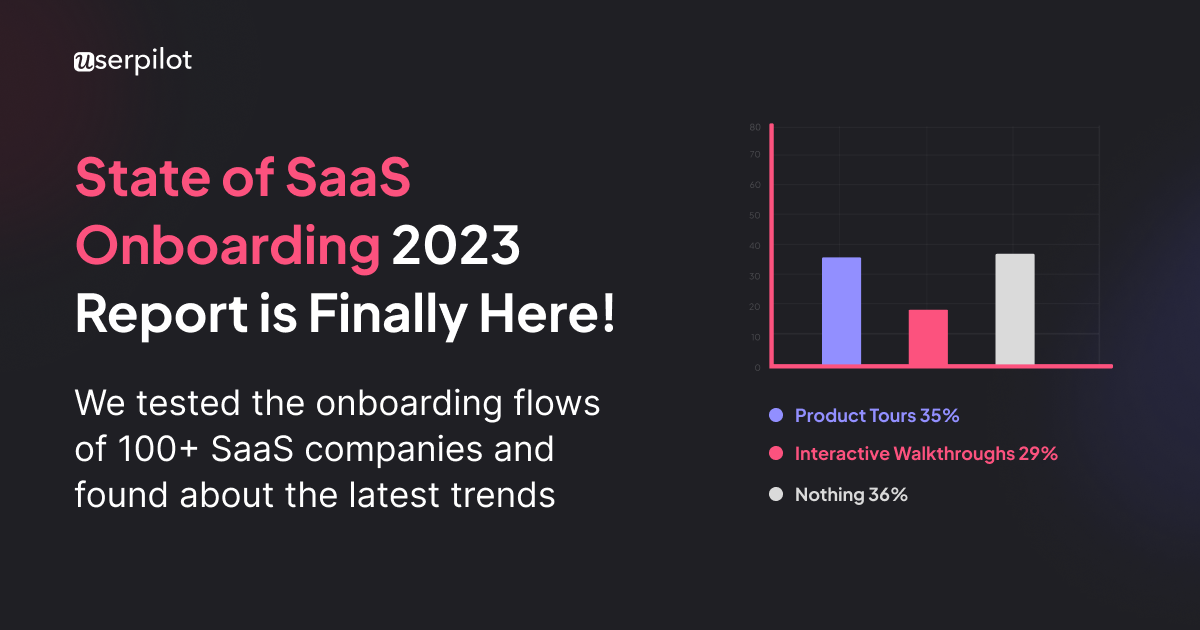
One of the strongest messages from Userpilot’s onboarding research is that learning by doing is better than front-loading information. Traditional product tours point at interface elements and explain what they are. Interactive walkthroughs guide users through meaningful actions step by step.
The difference is huge. A product tour says, “Here is the dashboard.” An interactive walkthrough says, “Let’s create your first report.” A product tour says, “This is the automation tab.” An interactive walkthrough says, “Let’s build your first automation and send a test.” One teaches vocabulary. The other builds momentum.
Userpilot’s report found that a notable share of SaaS tools still provided no in-app guidance at all. That creates a major opportunity. A product does not need theatrical onboarding with fireworks, dancing mascots, and a marching band. It does need clear guidance that helps users complete the actions most closely tied to activation.
When Product Tours Still Make Sense
Product tours are not useless. They can work well for simple feature announcements, light orientation, or showing users where to find something new. The problem begins when companies use long tours as the main onboarding experience.
If users can click through a tour without doing anything meaningful, the tour may create a false sense of progress. The user saw the product, but did not adopt it. They completed the tour, but did not reach value. Congratulations, they now know where the settings menu lives. Unfortunately, that does not pay the invoice.
Why Interactive Onboarding Works Better
Interactive onboarding works because it creates behavioral progress. Users take real steps inside the product. They import data, customize a workspace, invite teammates, publish a first asset, connect an integration, or complete another activation event.
This approach also reduces cognitive load. Instead of explaining everything at once, the product reveals information only when it becomes relevant. Users are not forced to memorize a product encyclopedia before they know why they need it.
Checklists, Progress Bars, and the Psychology of Completion
Onboarding checklists remain popular because they turn an unfamiliar product into a manageable path. A good checklist tells users what to do next, why it matters, and how close they are to completing setup.
Userpilot’s benchmark data shows that checklist completion is an important onboarding metric, with average completion rates leaving plenty of room for improvement across many SaaS categories. The lesson is not that checklists are magic. The lesson is that checklists must be designed around activation, not administrative tidiness.
A weak checklist says: complete profile, upload logo, read documentation, invite team, visit settings. A stronger checklist says: connect your data source, create your first dashboard, share it with a teammate, set your first alert. The second version moves users toward value instead of asking them to decorate the lobby.
Use Endowed Progress Carefully
One practical tactic is to pre-check one or two completed steps, such as “account created.” This uses the endowed progress effect, where people are more motivated to finish something once they feel they have already started. It is a small psychological nudge, not a dark pattern. The key is honesty. Do not pretend users completed meaningful work they did not do.
Keep the Checklist Short
Long checklists create pressure instead of clarity. The best onboarding checklists focus on a few actions that predict activation. If your checklist has 17 items, it is not a checklist. It is a cry for product strategy help.
Metrics That Define the State of SaaS Onboarding
Modern onboarding needs measurement. Without data, teams often debate opinions: the designer thinks the flow is elegant, the product manager thinks it is too long, sales wants more qualification questions, and customer success wants more training prompts. Analytics turns the conversation from “I feel” to “users do.”
Activation Rate
Activation rate measures the percentage of users who reach a defined value milestone. Userpilot’s activation benchmark research reported an average activation rate around 37.5% and a median around 37% among the analyzed B2B SaaS companies. That means many users still sign up without reaching the first meaningful outcome.
Every SaaS product should define activation clearly. For an email platform, it may be sending the first campaign. For a design tool, it may be creating and sharing the first design. For a product analytics platform, it may be tracking the first event and viewing the first insight.
Time to Value
Time to value measures how long it takes users to experience the product’s benefit. Shorter is usually better. If users need three days, four help docs, and a support ticket to understand the product, onboarding is leaking momentum.
The goal is not always instant value. Complex B2B products may require setup. The goal is visible progress. Users need to feel that every step moves them closer to a business outcome.
Feature Adoption
Feature adoption measures whether users engage with important product capabilities. Pendo’s research has shown that a small portion of features often drives most product usage, which should make every product team pause before shipping “just one more feature.” Onboarding should guide users toward the features that create retention, not simply showcase everything the team built during a heroic sprint.
Checklist Completion and Drop-Off
Checklist completion reveals whether users are following the intended path. Drop-off points show where confusion, friction, or low motivation appears. If users consistently abandon onboarding after connecting an integration, the integration step may be too hard. If they leave after a welcome survey, the survey may feel pointless. The data is usually whispering the answer before the team schedules a three-hour meeting to find it.
AI Is Reshaping SaaS Onboarding
AI is becoming a major force in SaaS products, and onboarding is one of the places where it can create immediate value. AI can help personalize onboarding paths, recommend next steps, summarize documentation, generate templates, answer user questions, and identify users at risk of dropping off.
However, AI should not become a glitter cannon sprayed over weak onboarding. A chatbot cannot fix a confusing activation path. A recommendation engine cannot rescue a product that does not understand its users. AI works best when the onboarding strategy is already clear.
The future of SaaS onboarding will likely combine behavioral data, lifecycle messaging, in-app guidance, and AI assistance. Instead of every user receiving the same checklist, the product can adapt based on what the user has done, ignored, completed, or struggled with. That is where onboarding becomes less like a tour and more like a smart coach.
Best Practices for Better SaaS Onboarding
1. Start With the User’s Desired Outcome
Do not begin onboarding by showing features. Begin by understanding what the user wants to accomplish. Every tooltip, checklist item, email, and help prompt should connect to that goal.
2. Remove Unnecessary Signup Friction
Use SSO when possible, delay nonessential questions, and avoid blocking dashboard access with avoidable steps. The sooner users enter the product, the sooner they can experience value.
3. Personalize the First Session
Ask one or two useful questions, then actually adapt the experience. Role-based and goal-based onboarding usually beats one-size-fits-all tours.
4. Guide Users Through Actions, Not Explanations
Use interactive walkthroughs to help users complete activation events. Let users learn by doing instead of reading a tooltip parade.
5. Use Checklists Strategically
Build checklists around the few actions that lead to value. Keep them short, clear, and rewarding. Progress should feel achievable, not like assembling furniture with missing screws.
6. Combine In-App Guidance With Email
Email can bring users back when they drop off, reinforce key actions, and provide deeper education. In-app messages are great for context; email is useful for re-engagement and follow-up.
7. Measure, Test, and Improve Continuously
Onboarding is not a one-time project. It should be tested, measured, and refined as the product, audience, pricing, and market evolve. Continuous onboarding is especially important when products add new features or serve multiple user roles.
Common SaaS Onboarding Mistakes
The first mistake is overwhelming users. Too many pop-ups, steps, and explanations can make a product feel harder than it is. The second mistake is under-guiding users, especially in complex products where an empty dashboard can feel like a haunted house with better typography.
The third mistake is treating onboarding as a feature tour rather than a value journey. Users do not care about every tab. They care about solving the problem that made them sign up.
The fourth mistake is failing to connect onboarding with retention. Activation is not the finish line. Once users reach initial value, onboarding should continue with deeper feature discovery, advanced use cases, team adoption, and expansion opportunities.
The fifth mistake is not measuring the right events. Page views and tour completions can be useful, but they do not always prove value. Track meaningful behaviors that correlate with retention and revenue.
Practical Experiences Related to the State of SaaS Onboarding – Userpilot
In real SaaS environments, onboarding rarely fails because teams are careless. It fails because teams are too close to the product. What feels obvious to the product team may feel like a puzzle box to a first-time user. Internal teams know the logic behind every menu, label, and workflow. New users only know that they signed up hoping to solve a problem before their coffee gets cold.
One common experience is the “blank dashboard problem.” A user signs up, logs in, and lands on a clean interface with no data, no examples, and no clear next step. The company may be proud of the simple design, but the user sees emptiness. A better experience would offer sample data, templates, a guided setup, or a checklist that helps the user create something useful immediately.
Another familiar scenario is the “tour overload problem.” A SaaS product launches a seven-step product tour explaining navigation, reports, settings, integrations, billing, team roles, and advanced automation before the user has completed one meaningful task. By step four, the user is clicking “Next” like they are defusing a boring bomb. The fix is to replace passive explanation with action-based guidance. Help the user complete one valuable workflow first. Teach the rest later.
There is also the “fake personalization problem.” The product asks, “What is your goal?” The user chooses “Improve retention.” Then the product shows the exact same onboarding flow as everyone else. This creates disappointment because the user gave information and received no benefit. If a SaaS company asks a question, it should use the answer. Goal-based onboarding should change checklist items, recommended templates, tooltips, lifecycle emails, and success milestones.
Customer success teams often experience onboarding problems after the product team thinks onboarding is complete. A user may activate once but never build a habit. They may complete setup but fail to invite teammates. They may try one feature but never discover the sticky feature that drives renewal. This is why continuous onboarding matters. A good SaaS onboarding system does not stop after day one. It continues through day seven, day thirty, and beyond, helping users deepen adoption over time.
From a growth perspective, the best onboarding improvements often come from watching real user behavior. Session recordings, funnel analysis, support tickets, survey responses, and user interviews reveal friction that dashboards alone may miss. For example, analytics may show that users drop off during integration setup. A session recording may show that the button label is confusing. A support ticket may reveal that users do not understand what permissions are required. Together, the evidence tells a clear story.
Teams also learn that onboarding should not be built only for the “average user.” The average user is a myth wearing a spreadsheet costume. Different segments need different paths. A solo founder may want speed. An enterprise admin may need security and permissions. A marketer may want templates. A developer may want API documentation. A customer success leader may want reporting. Great onboarding respects those differences without making the product feel fragmented.
Userpilot’s approach is relevant here because it emphasizes in-app experiences, segmentation, product analytics, feedback, and no-code experimentation. That matters for teams that need to improve onboarding without waiting for engineering every time a tooltip, checklist, or survey needs to change. Speed matters. The best onboarding teams test small changes, measure outcomes, and keep improving. They do not treat onboarding like a mural painted once and admired forever.
The most practical lesson is simple: users do not want onboarding. They want progress. Onboarding is just the bridge. If the bridge is short, clear, and sturdy, users cross it happily. If it is confusing, full of pop-ups, and asks for their company size three times, they turn around. The state of SaaS onboarding is therefore the state of SaaS empathy. The companies that understand user intent, reduce friction, and guide people toward real value will win more trials, retain more customers, and spend less time wondering why “qualified signups” keep disappearing.
Conclusion
The State of SaaS Onboarding – Userpilot shows a market that has moved far beyond static tutorials. SaaS companies are embracing free trials, freemium experiences, in-app guidance, checklists, microsurveys, product analytics, and AI-powered personalization. But the gap between average onboarding and excellent onboarding remains wide.
The winners will be companies that reduce signup friction, personalize the first session, guide users through meaningful actions, measure activation carefully, and continue educating users after the first login. Strong onboarding is not about showing every feature. It is about helping every user reach the right value moment faster.
In a crowded SaaS market, onboarding may be one of the most underrated competitive advantages. Products that teach themselves clearly feel easier, more valuable, and more trustworthy. And when users feel progress quickly, they are far more likely to stick around. That is the real state of SaaS onboarding: less talking, more doing, and absolutely no 20-step tooltip marathons before breakfast.
Note: This article is written as original, publish-ready content based on current public SaaS onboarding research, product-led growth benchmarks, and industry best practices. No source links, citation artifacts, or unnecessary publishing elements are embedded in the article body.