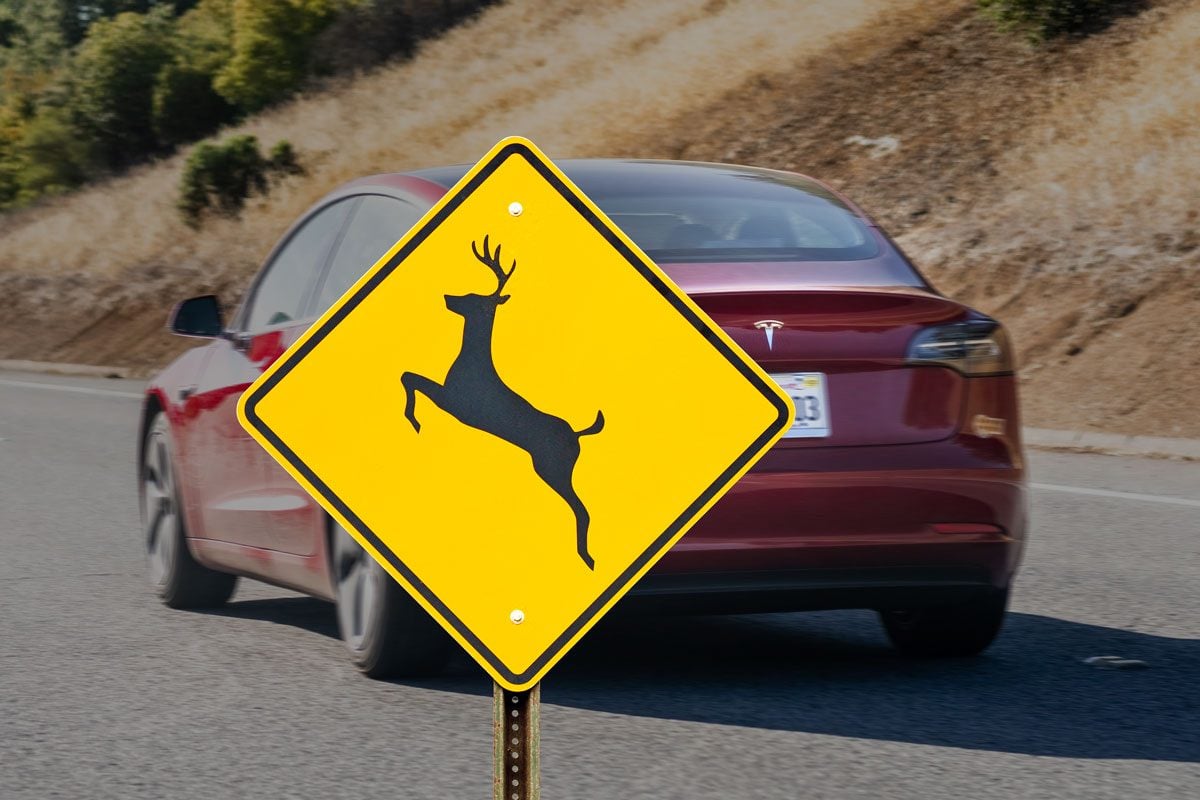
A deer stands in the lane. A Tesla approaches with Full Self-Driving active. The car appears not to slow, strikes the animal, and keeps moving. That is the unsettling sequence shown in a dashcam clip posted in October 2024a grim reminder that real roads do not arrive with tidy labels and predictable actors.
One video cannot prove that every Tesla will miss every deer, and a deer is not the same detection target as a pedestrian. Still, when advanced driver assistance apparently fails to react to a large living obstacle directly ahead, it is fair to ask what the incident reveals about automatic braking, low-light perception, and the safety of people outside the vehicle.
What Happened in the Tesla Deer Collision?
The Tesla owner who shared the footage said Full Self-Driving, or FSD, was engaged when the vehicle hit the deer. The video appeared to show no meaningful braking before impact, and the car reportedly did not stop automatically afterward. The owner also complained of frequent unnecessary stops on other drives, making the failure to brake for a real obstacle especially frustrating. Reports described vehicle damage, but the clip was not a formal crash reconstruction. The exact speed, software version, camera condition, driver inputs, and animal movement were not independently established.
That uncertainty limits the conclusions. The deer may have blended into the pavement, entered the lane late, been partly obscured, or been classified incorrectly. The software may even have detected an object without deciding that emergency braking was the safest action. In automated driving, seeing pixels and understanding danger are very different accomplishments.
“Full Self-Driving” Still Requires a Driver
Tesla’s documentation calls the product Full Self-Driving (Supervised) and says it does not make the car autonomous. Drivers must watch the road and be ready to take control, particularly around pedestrians, cyclists, blind corners, debris, complex intersections, poor weather, and low light. Tesla also warns that the system can make sudden mistakes in situations that appear normal.
This creates an uncomfortable human-factors problem. The car can steer, choose lanes, follow navigation, and manage traffic for long stretches, encouraging the driver’s attention to fade. Yet that same driver may be expected to recognize a rare hazard and intervene within seconds. It is like supervising a brilliant intern who works flawlessly all morning and then, without warning, hands you a flaming toaster.
FSD and Automatic Emergency Braking Are Different Safety Layers
FSD performs the broader driving task. Automatic emergency braking, or AEB, is a last-resort collision-mitigation feature. Tesla says AEB is designed to reduce impact severity, not guarantee avoidance, and warns that road debris, partial obstructions, and other factors can cause no braking, late braking, or inappropriate braking.
Engineers must balance missed hazards against false braking for shadows, signs, road patches, or harmless objects beside the lane. The deer video suggests that, in this instance, the balance landed on the wrong side.
Why Deer, Darkness, and Camera Limits Matter
A computer-vision system must separate an animal from pavement, vegetation, headlights, shadows, and visual noise; estimate whether it occupies the vehicle’s path; predict its movement; and decide whether to brake. Night complicates every step. Contrast falls, headlights illuminate unevenly, reflective surfaces bloom, and a deer’s coat may resemble the shoulder or roadway.
A robust safety system does not need to identify the exact species. It needs to recognize a solid, collision-relevant object. That requires more than object classification: geometry, motion, free-space estimation, time-to-collision calculations, and uncertainty handling all matter. When confidence drops, the safer behavior is usually to slow down and create marginnot continue briskly while the computer thinks about it.
The Camera-Only Redundancy Debate
NHTSA’s current engineering analysis says Tesla FSD relies exclusively on vision-based cameras and software. The agency notes that Tesla began moving from combined cameras and radar to the camera-based Tesla Vision approach in mid-2021. Regulators are examining whether glare, fog, dust, and other visibility problems are detected early enough for the driver to respond.
Radar, lidar, thermal imaging, and cameras each have weaknesses, and extra sensors do not magically produce safe software. Sensor diversity can, however, offer another measurement when visible-light images become unreliable. The underlying principle is redundancy: one impaired perception channel should not quietly become the only barrier between a vulnerable road user and a two-ton car.
Does a Deer Strike Prove Pedestrians Are in Danger?
No. It is evidence of a possible perception-and-response weakness, not proof of a universal pedestrian defect. Pedestrians differ from deer in shape, movement, training-data frequency, and standardized test coverage. A vehicle might perform poorly on wildlife yet respond correctly to a personor the reverse.
The overlap still matters. Deer and pedestrians can both emerge from the roadside, appear partly outside the lane, blend into dark backgrounds, and change direction unexpectedly. If low contrast, delayed path prediction, or late braking contributed to this collision, those failure modes could also matter in pedestrian and cyclist scenarios.
The stakes are enormous. NHTSA reports that 7,080 pedestrians were killed and more than 71,000 were injured in U.S. traffic crashes in 2024. IIHS has also emphasized that pedestrian deaths are heavily concentrated after dark, when both human and machine vision are under stress.
What Independent Testing Shows
Pedestrian AEB is useful, but far from perfect. IIHS research found a 27% lower pedestrian crash rate for vehicles equipped with automatic braking that recognizes people. Even when a crash is not avoided, lower impact speed can reduce injury severity.
Darkness has historically exposed major weaknesses. In IIHS nighttime testing, many vehicles that scored well in daylight performed poorly after sundown; earlier real-world research found no clear benefit on unlit roads.
Newer systems are improving. AAA’s comparison of selected 2019 and 2025 vehicles found that a 2019 Tesla Model 3 failed to warn or brake in its nighttime pedestrian scenario. The 2025 Model 3 warned in all five runs, avoided contact in four, and reduced impact speed in the fifth. That is meaningful progress under controlled conditions, not a guarantee for every road, software build, animal, or pedestrian.
Federal Scrutiny Has Intensified
NHTSA opened a preliminary evaluation in October 2024 after four reported Tesla FSD crashes in reduced visibility, including a fatal pedestrian crash. In March 2026, the agency escalated the matter to an engineering analysis covering an estimated 3.2 million FSD-equipped Tesla vehicles. The investigation lists nine incidents and asks whether the system recognizes degraded camera visibility and alerts drivers soon enough.
NHTSA said reviewed crashes included cases in which FSD lost track of or never detected a lead vehicle, while warnings came too late for an effective takeover. An engineering analysis is not a final defect finding, but it is a major step that can precede a recall.
Federal rules also require stronger AEB and pedestrian AEB performance on new light vehicles by September 2029, including defined daylight and darkness tests. The policy message is clear: automatic braking is becoming baseline safety equipment, not a showroom party trick.
What Tesla and Other Automakers Should Improve
Respond Earlier to Uncertainty
When glare, fog, darkness, dirt, or dust impairs sensors, the vehicle should slow down, increase following distance, warn the driver clearly, and disengage assistance when necessary. A system that admits uncertainty early is safer than one that announces confusion immediately before impact.
Test the Weird Stuff
Deer, loose cargo, wheelchairs, road workers, unusual bicycles, open doors, and trailers may each be uncommon. Collectively, “edge cases” are ordinary road life. Testing should cover unfamiliar silhouettes, partial occlusion, low contrast, awkward poses, and sudden movementnot only neat targets centered in a lane.
Improve Post-Impact Behavior
The reported continuation after the deer strike is almost as troubling as the lack of braking. A vehicle should recognize a meaningful impact, warn the driver, preserve useful data, activate appropriate safety responses, and support a controlled stop. Preventing a second collision is part of preventing harm.
Design Supervision for Real Humans
Manual warnings are not enough. Strong driver monitoring, escalating alerts, sensible lockouts, and plain explanations of system limits are essential because human attention predictably fades when automation performs well. Safety design should account for that behavior rather than merely scold it afterward.
Publish Comparable Safety Data
Consumers need results broken down by road type, speed, lighting, weather, software version, and driving mode. A single “miles between crashes” figure can mislead when assisted driving is used mostly on easier roads while human driving includes parking lots, storms, and chaotic intersections.
Practical Safety Advice for FSD Drivers
- Watch the road, not the center screen. Be ready to brake or steer immediately.
- Slow down at dusk, dawn, and night, especially near woods, crosswalks, bus stops, schools, parked cars, and construction zones.
- Keep cameras, windshield glass, and headlights clean.
- Take over when visibility or behavior deteriorates. Fog, heavy rain, direct sun, confusing lane markings, or repeated odd maneuvers are reasons to disengage.
- After any impact, stop safely, use hazard lights, check for injuries, and contact authorities when appropriate.
Real-World Experiences That Put the Risk in Perspective
These are realistic composite scenarios based on common hazards and published testing conditions, not claims of personal firsthand experience.
Experience 1: The Rural Road at Dusk
You are traveling on a two-lane road bordered by trees. The sky is bright, but the pavement is dark and the headlights have not become visually dominant. A deer appears near the shoulder, angled away from the lane. A human driver eases off the accelerator because deer often move in groups and bolt unpredictably. An automated system may wait for clearer evidence that the animal occupies its planned path. That gaphuman caution based on context versus machine action based on measured collision probabilitycan consume the seconds needed to avoid impact.
Experience 2: The Pedestrian in Dark Clothing
On a poorly lit suburban street, a person in dark jeans and a gray jacket stands between parked vehicles. Their upper body is visible, but their legs are hidden. They lean forward, perhaps preparing to cross or perhaps checking traffic. A careful driver notices the uncertainty and slows. A perception system must detect a partial human shape, infer intent, calculate a possible path, and decide whether braking is justified. Pedestrian safety therefore depends on more than recognizing a person; it requires conservative prediction and enough braking margin for someone who changes plans without submitting a software ticket.
Experience 3: Low Sun Over a Hill
Morning sun sits above the crest of a road. A human squints, lowers the visor, and reduces speed because the view ahead is washed out. A camera can also lose contrast, but the crucial issue is whether the vehicle recognizes its own degraded perception. If assistance continues normally and alerts the driver only when a stopped car or pedestrian emerges from the glare, supervision becomes a reaction-time lottery. The safer response is graceful degradation: slow early, create space, and explain why confidence has fallen.
Experience 4: The False-Braking Fatigue Trap
A driver experiences unnecessary slowdowns for shadows, roadside signs, or vehicles in adjacent lanes. After enough false alarms, each intervention feels less urgent. Then a real hazard appears, and the driver hesitates because the system has unintentionally trained them to expect another mistake. Too many false positives can reduce trust; too few interventions can allow a crash. The software must improve precision without becoming timid, while the driver must resist assuming that the next warning is meaningless.
Experience 5: The Seconds After Impact
Suppose a collision happens despite every safeguard. The windshield view shakes, the hood shifts, and the driver is startled. Continuing may worsen vehicle damage, create a second crash, or leave the driver unsure what was struck. A well-designed system should recognize the impact, stabilize the vehicle, alert the driver, and support a safe stop. The human must still take control, but the software should not behave as though nothing happened. Safety includes preventing the first collision and managing the dangerous seconds that follow.
Conclusion: A Warning Sign, Not a Final Verdict
The deer video is disturbing because the apparent failure looks simple: a large animal is ahead, yet the car does not visibly brake. We do not know every input, and the clip cannot prove that Tesla FSD will miss pedestrians. Dismissing it as an irrelevant edge case would be equally careless. Roads are made of edge cases, and vulnerable road users do not receive software release notes before entering them.
Advanced driver assistance can reduce crashes, and newer pedestrian AEB systems show real improvement. Supervision remains essential. Until a vehicle is genuinely autonomous within clearly defined conditions, the person behind the wheel is not a passenger. They are the final safety systemand they should not be running in the background.