A walk on the beach can begin as a perfectly ordinary attempt to relax and end with you crouching over a mysterious object like an underfunded maritime archaeologist. Maybe it is a piece of sea glass glowing in the sand. Perhaps it is a fossilized shark tooth, a weathered toy, an antique bottle stopper, or a shell shaped so perfectly that it looks professionally designed.
That is the irresistible appeal of beachcombing. Every tide edits the shoreline, removing yesterday’s clues and delivering a fresh assortment of natural wonders, human leftovers, and objects that raise one urgent question: “What in the world is that?”
So, beach explorers, what is the coolest thing you have ever found beside the ocean? Before sharing your treasure, let’s examine why fascinating objects wash ashore, which beach finds are especially memorable, and how to explore responsibly without accidentally kidnapping a hermit crab.
Why Beach Finds Feel Like Real-Life Treasure
Most of daily life is organized. Mail arrives in a box, groceries sit on shelves, and lost socks remain permanently trapped in another dimension. A beach is different. Waves, tides, currents, storms, erosion, and human activity continuously rearrange the shoreline. Objects may travel a few feet, several miles, or across an ocean before appearing near someone’s flip-flops.
The unpredictability makes every discovery feel personal. Thousands of people may walk the same stretch of sand, yet one person notices the tiny blue shard or triangular tooth that everyone else missed. A beach find is not merely an object. It is a story whose opening chapters are missing.
The Wrack Line Is the Beach’s Lost-and-Found Department
One of the most productive places to search is the wrack line, the irregular strip of seaweed, shells, driftwood, and debris left near the previous high-tide mark. Floating materials collect there as the water retreats. It may look untidy, but it functions as a natural sorting belt and provides food and shelter for many small shoreline creatures.
Search slowly rather than marching along at airport speed. Interesting finds are often partially buried, disguised by wet sand, or surrounded by objects of similar color. Early morning, lower tides, and the days following a storm may reveal new material, although rough surf should always be admired from a safe distance.
Cool Natural Treasures People Find on Beaches
Sea Glass With a Mysterious Past
Sea glass begins as ordinary manufactured glass, but years of tumbling through sand and surf can soften its sharp edges and frost its surface. Brown, green, and clear pieces are relatively common because those colors have long been used for bottles and containers. Blue, turquoise, red, orange, yellow, and purple pieces tend to attract more excitement.
A tiny fragment can inspire an entire detective story. Was it once part of a medicine bottle, decorative tableware, a fishing float, or somebody’s soda bottle? Mold lines, lettering, thickness, curvature, and color can offer clues. Even when its origin remains unknown, sea glass feels like a collaboration between human industry and an extremely patient ocean tumbler.
Fossilized Shark Teeth
Finding a shark tooth is exciting enough. Discovering that it may be millions of years old adds a delightful layer of prehistoric drama. Sharks continually replace their teeth throughout their lives, so enormous numbers have entered marine sediments over geological time.
Modern teeth are often pale or white, while fossilized examples may appear black, brown, gray, beige, or bluish because minerals entered the tooth during fossilization. Color alone does not establish age, however. The surrounding geology and the shape of the tooth also matter.
Some fossil teeth have smooth edges, while others display fine serrations. Their shape may suggest whether they belonged to a tiger shark, mako-type shark, great white relative, or another species. Identification can be tricky, so clear photographs beside a ruler are useful when consulting a museum or fossil guide.
Perfect Shellsand the Residents Who Still Need Them
A complete shell with an undamaged lip, bold pattern, and polished surface is a classic beachcombing prize. Moon snails, whelks, scallops, olives, cockles, and sand dollars can all produce memorable discoveries, depending on the region.
Before celebrating, check whether anybody is home. Hermit crabs and other animals use empty shells as shelter, and a shell that appears abandoned may contain a deeply unimpressed tenant. Never remove a living animal simply because its apartment would look charming on your bookshelf.
Even genuinely empty shells have ecological value. They can become shelter, nesting material, camouflage, or a source of minerals as they break down. Collect selectively, follow local limits, and consider photographing exceptional shells instead of keeping them.
Sea Beans and Other Well-Traveled Seeds
Some tropical plants produce buoyant seeds that fall into rivers or coastal waters and drift long distances. These seeds, commonly called sea beans or drift seeds, may eventually wash onto beaches far from the plants that produced them.
They come in surprising shapes. Some resemble hearts, hamburgers, coins, or polished wooden buttons. Their hard outer coverings help them survive extended exposure to salt water. Finding one can feel like receiving a botanical postcard from a distant coastlinealthough the plant neglected to include a return address.
Fossils, Bones, and Geological Oddities
Beaches near fossil-bearing cliffs, river mouths, or exposed marine deposits may produce fossil shells, coral fragments, vertebrae, teeth, or pieces of ancient bone. Not every strange rock is a fossil; concretions and naturally eroded stones are talented impersonators.
Possible fossils should be photographed from several angles with an object for scale. Record the location without disturbing surrounding deposits. Museums, universities, geological surveys, and responsible fossil groups may help with identification. A scientifically important specimen is more valuable with accurate location information than as an unlabeled object rolling around in a kitchen drawer.
Driftwood Sculpted by Water
Driftwood can resemble animals, faces, miniature trees, or abstract sculptures created by a very moody artist. Water removes bark, smooths rough edges, and emphasizes the grain. Small pieces sometimes become decorations or craft materials where collection is permitted.
Large driftwood deserves caution. It may shift unexpectedly, conceal wildlife, or become dangerous when waves move it. Some protected areas prohibit removing driftwood because it contributes to habitat and natural shoreline processes. Admire first, check the rules second, and lift only when the object is legal, small, and clearly safe.
Unusual Human-Made Objects That Wash Ashore
Old Pottery, Bottle Stoppers, and Ceramic Fragments
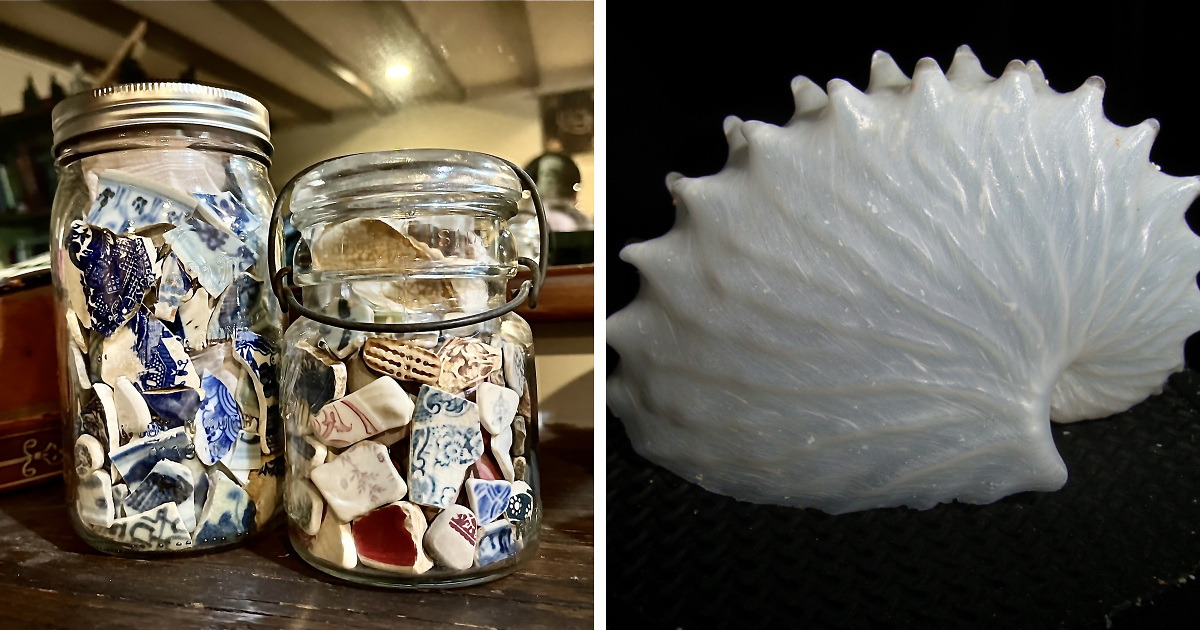
Rounded pottery fragments and ceramic pieces can be as intriguing as sea glass. A faded floral pattern, stamped maker’s mark, or unusual glaze may hint at the object’s original purpose. Some fragments are recent household debris, while others may have historical significance.
Context matters. An isolated modern fragment on a public beach is different from material concentrated near a known shipwreck, Indigenous site, historic settlement, or protected archaeological area. Objects that might be artifacts should be left where they are and reported to the appropriate land manager.
Messages in Bottles
The classic message in a bottle still captures the imagination because it transforms an unknown stranger into part of the discovery. Some contain school projects, memorial notes, scientific drift experiments, or simple greetings. Others contain nothing except seawater and a smell best described as “historic basement.”
If a message provides contact information, the finder may be able to tell the sender where and when it appeared. Photographing the bottle and recording the location can help trace its journey. Dispose of or recycle the container responsibly afterward unless keeping it is legal and sensible.
Toys That Have Survived an Improbable Journey
Plastic action figures, rubber ducks, toy cars, building blocks, and doll parts frequently become memorable finds. Time in the ocean can fade their colors and coat them with marine growth, making them look like props from a tiny post-apocalyptic movie.
Although amusing, these objects are still marine debris. Plastic can persist, break into smaller fragments, and harm wildlife. Photograph the funniest discoveries, share their strange expressions with the world, and then remove them safely when local cleanup guidance allows.
Lost Personal Items
Watches, keys, rings, cameras, phones, identification cards, and wallets occasionally turn up near swimming areas. Valuable or identifiable property should be delivered to lifeguards, park staff, police, or a local lost-and-found service. Posting a vague notice can also help, but avoid revealing every identifying detail. A genuine owner should be able to describe the item.
Metal-detector enthusiasts sometimes reunite sentimental jewelry with owners years after it disappeared. A ring may have little resale value yet carry enormous emotional importance. Returning it can be far more rewarding than adding it to a drawer labeled “Objects I May Explain Someday.”
Beach Finds You Should Not Pick Up
Curiosity is valuable, but it should occasionally be accompanied by common sense and sturdy gloves. Do not touch needles, medical waste, leaking containers, ammunition, explosives, chemical drums, sharp metal, or unidentified packages. Keep people and pets away and contact local authorities, park staff, or emergency services as appropriate.
Leave stranded or resting wildlife alone. Seal pups, sea turtles, birds, and other animals may be resting, nesting, or waiting for a parent to return. Crowding, feeding, pouring water on them, or attempting a rescue can cause harm. Contact trained wildlife responders instead.
Feathers, marine mammal bones, sea turtle material, coral, eggs, nests, archaeological artifacts, and cultural objects may be protected under federal, state, tribal, or local law. Rules vary sharply between locations. One beach may allow a small number of empty shells, while another may prohibit removing shells, rocks, fossils, driftwood, sand, and artifacts entirely.
How to Become a Better Beachcomber
Check Tides, Weather, and Local Rules
Consult a reliable tide table and weather forecast before leaving. A falling tide may expose more shoreline, but changing tides can trap visitors around headlands or against cliffs. Never assume calm-looking water will remain calm. Sneaker waves, unstable cliffs, slippery rocks, cold water, and drifting logs deserve respect.
Bring Simple Equipment
A reusable bag, phone or camera, small ruler, notebook, drinking water, sun protection, and closed-toe shoes can handle most casual expeditions. Gloves and litter grabbers are useful for safe cleanups. Avoid digging aggressively, entering closed areas, or using tools where collecting is restricted.
Photograph Before Moving Anything
A photograph in the original setting preserves useful information. Include close-ups and wider views, and place a ruler or familiar object nearby for scale. Record the date, general location, tide conditions, and any distinctive markings. This habit is particularly valuable for fossils, tagged equipment, scientific instruments, and potential artifacts.
Leave the Beach Better Than You Found It
Not every discovery needs to enter a collection. Removing a few pieces of safe litter may be more meaningful than taking home a bucket of natural objects. Marine debris can entangle animals, be swallowed by wildlife, and fragment into smaller pieces. Participating in organized coastal cleanups also turns an ordinary walk into useful citizen action.
Share Your Coolest Beach Find
Now it is your turn. Perhaps you found a cobalt-blue piece of sea glass after years of searching. Maybe your child discovered a fossil tooth and spent the rest of the vacation introducing themselves as a paleontologist. Perhaps you uncovered an old toy, an engraved ring, a perfectly round stone, or an object that nobody has successfully identified.
When sharing your story, include the general location, what the object looked like, how you spotted it, whether anyone identified it, and what eventually happened to it. Photographs are especially welcome, provided they do not reveal sensitive nesting sites, archaeological locations, or private information.
The best beach finds do not have to be rare or valuable. Sometimes the coolest object is memorable because of the person who found it, the journey it suggests, or the delight of noticing something that almost disappeared beneath the next wave.
Beachcombing Experiences: Five Finds That Became Stories
The following reader-style vignettes are illustrative composites inspired by common beachcombing experiences.
The Blue Glass That Changed an Ordinary Morning
A family had walked the same beach every morning during a weeklong vacation. Their collection consisted mainly of clam shells, smooth stones, and one bottle cap that the youngest child insisted was pirate currency. On the final morning, sunlight flashed through a tiny object beside the wrack line.
It was a thick piece of deep cobalt glass with rounded edges and a cloudy surface. Back at the rental house, everyone developed a theory. It had been a medicine bottle, a perfume container, a ship’s lantern, or possibly a wizard’s emergency jar. Nobody proved its origin, but the child displayed it beside a handwritten museum label: “Ancient Blue Treasure, Found by Me.” Its financial value was probably modest. Its vacation value was unbeatable.
The Tooth Hiding Among a Thousand Shell Fragments
A beach walker searching after a storm noticed a glossy black triangle mixed with broken shells. It was no larger than a thumbnail and nearly disappeared when the next wash of water crossed the sand. The finder initially assumed it was a sharp stone, but its symmetrical crown and root suggested a fossil shark tooth.
Clear photographs and an online museum identification guide narrowed the possibilities, although the exact species remained uncertain. That uncertainty became part of the fun. The tooth was no longer simply a souvenir; it was evidence of an ancient marine ecosystem. One careful glance had connected a modern beach walk with an animal that lived millions of years earlier.
The Wedding Ring Returned After Two Summers
A hobbyist using a metal detector near a popular swimming beach uncovered a plain gold band beneath several inches of wet sand. An inscription inside included initials and a date. Instead of selling it, the finder contacted local community groups and posted a photograph that concealed the inscription.
A man eventually described the initials, date, and location where his ring had disappeared two summers before. He had lost it while helping his daughter climb onto an inflatable raft and assumed it was gone forever. The reunion took five minutes. The story was retold for years. The finder joked that the detector had discovered only a small piece of metal, but the beach had returned an entire family memory.
The Plastic Dinosaur With an Ocean Makeover
After a windy night, volunteers conducting a beach cleanup found a green plastic dinosaur tangled in seaweed. One side had faded nearly white, and tiny marine organisms had attached themselves to its back. The toy appeared to have survived a much more adventurous life than its manufacturer intended.
The volunteers photographed it standing dramatically beside a piece of driftwood and named it Captain Brontosurf. Then they added it to the collected debris rather than returning it to the sand. The silly discovery made the cleanup memorable while illustrating a serious point: ordinary plastic objects can travel, weather, accumulate marine growth, and remain in coastal environments long after their owners forget them.
The Shell That Walked Away
A first-time shell collector found what appeared to be the perfect spiral shell. It was glossy, intact, and conveniently located beside a beach towel. The collector rinsed it, placed it in a bucket, and continued searching.
Several minutes later, the shell began climbing the side of the bucket. A hermit crab emerged, apparently ready to file a formal complaint about unlawful eviction. The shell was returned immediately to the place where it had been found.
The collector went home without the perfect souvenir but with a better story and a permanent habit: inspect every shell carefully, never assume vacancy, and remember that the beach is not a gift shop. Sometimes the coolest thing you find is something you are lucky enough to watch walk away.