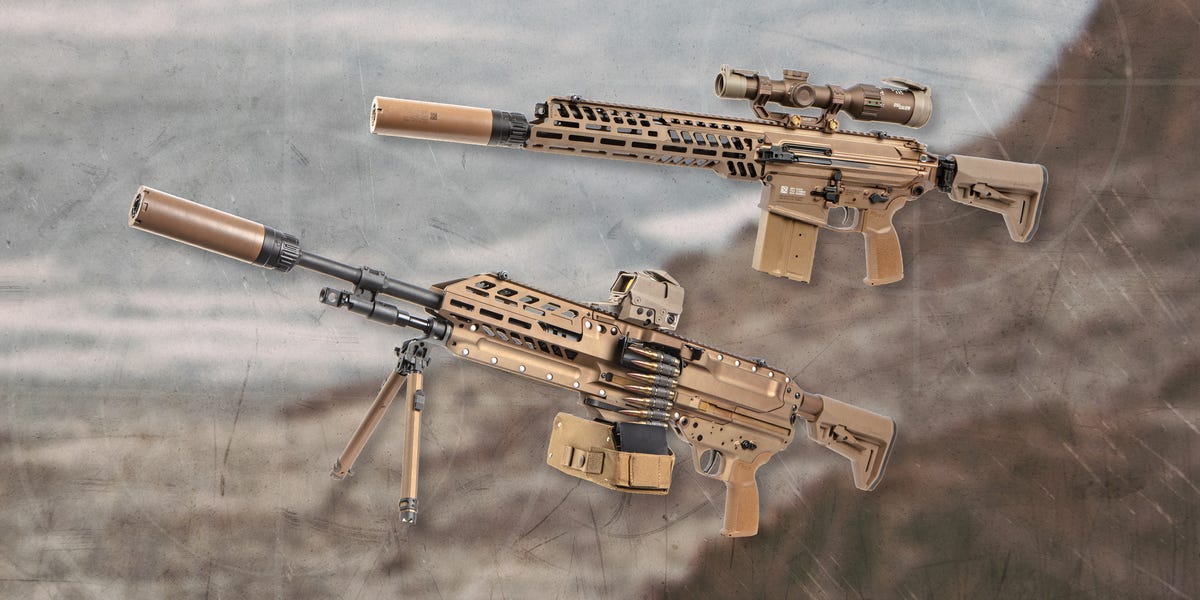
Note: This article is written as a safety-focused, non-operational editorial overview. It discusses public information, modernization context, ergonomics, logistics, and reported user impressions without providing handling instructions, tactical guidance, or weapon-use procedures.
The U.S. Army’s new M7 rifle and M250 machine gun are not just “new guns.” They are the visible tip of a much larger modernization iceberg: a new cartridge family, new fire-control technology, new soldier training demands, and a fresh argument about what infantry firepower should look like in the next decade. In other words, this is not a simple swap where the Army takes the old M4 and M249 out of the rack, drops in shinier replacements, and calls it a day. This is more like replacing a reliable pickup truck with a high-performance hybrid armored SUV. It may be more capable, but everyone still wants to know: How does it feel, how much does it weigh, and does it make the soldier’s job easier or just more complicated?
The M7 rifle and M250 automatic rifle, often casually called a light machine gun, are part of the Army’s Next Generation Squad Weapon program. The M7 is intended to replace the M4A1 carbine for close-combat troops, while the M250 is intended to replace the M249 Squad Automatic Weapon. Both use the Army’s newer 6.8mm ammunition family and are paired with advanced fire-control optics designed to help soldiers identify, range, and engage targets more effectively. That sounds very futuristic, but the real story is more human: soldiers must carry these systems, train with them, trust them, clean them, and live with them in the field.
Why the Army Wanted Something New
For decades, the M4 and M249 formed a familiar small-arms pairing across U.S. infantry formations. The M4 gave individual soldiers a compact, lightweight carbine, while the M249 gave squads a belt-fed automatic weapon for sustained fire. They were proven, familiar, and supported by a huge training and logistics ecosystem. But the Army became increasingly concerned that future battlefields would demand more range, better performance against modern protective equipment, and improved integration with sensors and optics.
The Next Generation Squad Weapon program was designed to answer those concerns. Instead of simply upgrading the M4 again, the Army selected a new rifle, a new automatic weapon, a new ammunition family, and a new fire-control system. That is a bold move. It also explains why the M7 and M250 have attracted so much attention. Any time the Army changes something carried by infantry soldiers, the conversation becomes personal fast. Boots, packs, body armor, riflesthese are not abstract acquisitions. They are daily companions.
Meet the M7 Rifle
The M7 rifle is the Army’s new individual weapon for close-combat forces. Public descriptions emphasize that it is a modular, piston-driven, magazine-fed rifle chambered for the Army’s 6.8mm ammunition family. In plain English, it is built to deliver more energy at longer distances than the older 5.56mm systems it is replacing. That is the headline advantage: more reach, more punch, and a design philosophy aimed at future threats rather than yesterday’s assumptions.
But a rifle is not only judged by ballistic charts. Soldiers care about balance, weight, controls, durability, optics, and how the weapon fits into everything else they already carry. The M7 has drawn both praise and criticism because it asks soldiers to accept a different feel. It is not simply an M4 with a new paint job. It has a more substantial presence, and that matters when a soldier is already wearing armor, carrying water, radios, batteries, medical gear, and enough miscellaneous equipment to make a hiking backpack look like a purse.
Meet the M250 Machine Gun
The M250 is the companion automatic weapon in the new system. It is intended to replace the M249 SAW, which has been a familiar squad-level workhorse for decades. The M250 uses the same 6.8mm ammunition family as the M7, giving the squad a common next-generation caliber. That commonality is one of the program’s biggest ideas: the rifleman and automatic rifleman are no longer operating across such a dramatic ammunition divide.
Reportedly, one of the M250’s most noticeable advantages is that the weapon itself is lighter than the M249 it is designed to replace. That matters because automatic riflemen often carry some of the most awkward loads in the squad. However, the overall soldier burden is more complicated than the weight of the weapon alone. Ammunition, accessories, optics, suppressors, batteries, and mission gear all count. The Army’s challenge is not just building a more capable weapon; it is building a more capable soldier system that does not turn infantry troops into overloaded pack mules with helmets.
The 6.8mm Shift: The Big Deal Behind the Big Debate
The move from 5.56mm to 6.8mm is central to the M7 and M250 story. The Army wanted a round that could improve range and terminal performance compared with the legacy systems used by close-combat forces. That is why these weapons are often described as more powerful, more capable at distance, and better suited to future threats.
Of course, every improvement comes with trade-offs. A more powerful cartridge generally means more recoil, more blast, more heat, more weight per round, and new training requirements. That does not automatically make the system good or bad. It means the Army is choosing capability in one area while accepting costs in another. The real question is whether the operational payoff is worth the burden placed on soldiers and units.
This is where the debate gets lively. Supporters see the M7 and M250 as overdue modernization. Critics worry about weight, ammunition load, cost, and whether the benefits will matter in the messy reality of combat. Both sides have a point. Military technology rarely arrives wearing a cape. More often, it arrives with a spreadsheet, a training plan, and a group of soldiers saying, “Okay, but who has to carry this?”
The M157 Fire-Control Optic: The Smart Glass on Top
The M7 and M250 are designed to work with the M157 fire-control optic, a major part of the Next Generation Squad Weapon concept. This optic is not just a simple sight. Public descriptions identify it as a variable-magnification fire-control system with advanced features intended to improve target identification and engagement.
In practical editorial terms, the optic may be as important as the weapons themselves. Modern infantry combat is increasingly shaped by sensors, data, visibility, and speed of decision-making. A rifle with a powerful cartridge is one thing. A rifle paired with an optic that helps soldiers better understand distance and aiming conditions is something else entirely. The M157 represents the Army’s bet that future small arms are not merely mechanical tools; they are part of a digital soldier ecosystem.
That said, advanced optics bring their own questions. Batteries, durability, training, cost, and maintenance all matter. A smart optic is wonderful until it becomes one more item that needs power, care, and troubleshooting. The Army’s long-term success with the M7 and M250 will depend partly on whether soldiers see the optic as a useful advantage rather than an expensive gadget with an attitude.
Reported Hands-On Impressions: More Power, More Presence
Public hands-on reporting has generally painted the M7 and M250 as serious, robust, hard-hitting systems. The phrase “heavy-metal experience” has been used for a reason: these weapons are not dainty. They are designed around greater range and energy, and they feel like tools built for a more demanding fight.
The M7’s reported feel is more substantial than the M4. That does not necessarily mean clumsy, but it does mean different. The M4 became popular partly because it was compact, light, and easy to live with. The M7 asks soldiers to accept more mass and a more forceful shooting experience in exchange for improved capability. That trade-off is the heart of the conversation.
The M250, meanwhile, appears to offer a more modern squad automatic weapon concept. If the M249 was the old reliable lunchbox of squad firepower, the M250 is the newer, sleeker tool that promises more capability without carrying over every old compromise. Still, automatic riflemen care about reliability, sustained performance, and how the system behaves after long training daysnot just how it looks in a press photo.
Soldier Feedback Matters More Than Marketing
One of the most important parts of the M7 and M250 rollout is soldier feedback. The Army has conducted operational assessments with soldiers using the systems in varied training environments. That matters because a weapon can look fantastic in a controlled demonstration and still frustrate people during realistic field use. Dust, heat, fatigue, awkward movement, night training, and long hours expose problems that a showroom never will.
Feedback from soldiers helps answer practical questions: Is the weapon too heavy for long movements? Does the optic improve confidence? Does the system integrate well with existing equipment? Does the automatic weapon help the squad without overburdening the person assigned to carry it? These are the questions that decide whether modernization becomes real capability or just a very expensive vocabulary upgrade.
Fielding the M7 and M250 Across the Close-Combat Force
The Army has emphasized that the M7 and M250 are being fielded to close-combat forces first. That makes sense. Infantry, scouts, combat engineers, and other troops closest to direct ground combat are the intended users. The Army is not handing every desk clerk a new rifle and telling them to enjoy the future by lunchtime.
Fielding also takes time. New weapons require training, spare parts, maintenance systems, ammunition distribution, armorer knowledge, range procedures, and unit-level adaptation. The weapon itself may be the star of the show, but logistics is the stage crew. Without logistics, the star forgets its lines and the curtain catches fire.
Advantages of the New System
The strongest argument for the M7 and M250 is that they give soldiers more capability against future threats. The 6.8mm ammunition family is intended to improve performance beyond legacy 5.56mm systems. The M157 optic aims to improve accuracy and target engagement. The shared ammunition concept may simplify some squad-level planning. The M250’s lighter weapon weight compared with the M249 is also an important improvement, even if total carried load remains a serious issue.
There is also a psychological element. Infantry soldiers want confidence in their equipment. If a soldier believes the weapon offers better reach and better performance, that confidence can matter. Modernization is not just about hardware; it is about trust.
Concerns and Criticism
The concerns are equally real. Weight is the loudest complaint because weight never stays on a spreadsheet. It ends up on shoulders, hips, knees, and backs. A more powerful cartridge can also mean fewer rounds carried for the same total load. That creates a classic trade-off: more capability per shot, but potentially less ammunition volume.
Cost is another issue. New weapons, ammunition, optics, suppressors, training systems, parts, and support infrastructure are expensive. The Army is not just buying rifles and machine guns; it is buying an ecosystem. Any delay, technical issue, or sustainment challenge can become expensive fast.
There have also been public discussions around testing, classification, upgrades, and refinements. That is not unusual for a major weapons program. New systems evolve. The key question is whether the Army can improve the M7 and M250 quickly enough to satisfy soldiers while preserving the performance goals that justified the program in the first place.
What the M7 and M250 Say About the Future of Infantry
The M7 and M250 show that the Army is preparing for a battlefield where range, protection, sensors, and precision matter more than ever. The shift suggests that future infantry combat is expected to be more demanding, more technologically integrated, and less forgiving of older assumptions.
At the squad level, the weapons also reflect a move toward more powerful individual and automatic fire. The Army appears willing to accept greater complexity if it means soldiers can overmatch potential adversaries. Whether that bet pays off will depend on training, reliability, ergonomics, and how well the systems perform after the excitement of introduction fades.
Experience Section: What a Hands-On Day With the M7 and M250 Feels Like
A realistic experience with the M7 and M250 begins before anyone even thinks about performance. The first impression is the system as a whole: rifle, automatic weapon, optic, suppressor, ammunition, sling, support gear, and the quiet realization that “next generation” still has to be carried by very current-generation human legs. The Army can modernize firepower, but it has not yet invented a soldier whose knees are made of titanium and optimism.
Picking up the M7, the immediate impression is seriousness. It feels like a rifle designed around power and durability rather than featherweight convenience. Compared with the familiar image of the M4, the M7 has more visual and physical presence. It looks less like a compact carbine and more like a tool built for a longer, harder fight. That presence can inspire confidence, but it also makes the weight conversation impossible to ignore.
The optic changes the entire personality of the system. Instead of feeling like a rifle with glass attached, the M7 feels like a rifle built around a broader information package. The M157 fire-control optic represents a major philosophical shift: the soldier is not just aligning sights; the soldier is using a more advanced visual and data-aided system. For experienced troops, that can feel like moving from a paper map to a navigation display. Helpful, yesbut only if the user trusts it and knows how to work with it under stress.
The M250 creates a different impression. Squad automatic weapons always carry a special kind of gravity. They are not just personal weapons; they are team tools. The person carrying the automatic weapon carries responsibility for the squad’s rhythm and confidence. The M250’s appeal is that it offers a modernized approach while aiming to reduce some of the burden associated with the older M249. In a hands-on setting, that matters. Any reduction in awkwardness is noticed immediately by the person who has to move with it.
However, the experience is not only about weight. It is about balance, setup, accessories, and how the system works with body armor and field gear. A weapon can be technically lighter but still feel awkward if the balance is poor. A slightly heavier system can feel manageable if it carries well. This is why soldier feedback is essential. Engineers can measure ounces; soldiers measure misery.
The sound, blast, and physical character of a more powerful system also shape the experience. The M7 and M250 are not casual range toys. They are military systems designed around combat requirements. Their personality is more forceful than the older 5.56mm weapons many soldiers know well. That forcefulness is part of the appeal and part of the challenge. More capability can demand more discipline, more training, and more respect for the system.
During a full day of familiarization, the biggest takeaway is likely not “this is good” or “this is bad.” It is “this is different.” The M7 and M250 require a new mindset. Soldiers must adapt to different weight, different ammunition, different optics, different sustainment needs, and different expectations. The old muscle memory built around the M4 and M249 does not disappear overnight. Any transition of this scale requires patience, repetition, and honest feedback from the people who will carry the weapons in real units.
That is why the M7 and M250 should be judged as a complete soldier system rather than as isolated objects. The rifle, machine gun, optic, ammunition, suppressor, training plan, and logistics chain all have to work together. If they do, the Army gains a more capable squad-level package. If they do not, soldiers will notice quicklyand soldiers are famously talented at giving brutally clear product reviews, usually with creative language that will never appear in a procurement brochure.
Conclusion: A Bigger Change Than It Looks
The Army’s M7 rifle and M250 machine gun represent one of the most significant small-arms transitions in generations. They are more than replacements for the M4A1 and M249. They are part of a broader shift toward greater range, improved lethality, advanced optics, and integrated soldier systems. The promise is clear: give close-combat troops better tools for future fights.
The challenge is just as clear. More capability brings more weight, cost, complexity, and training demands. The M7 and M250 will not succeed simply because they are newer. They will succeed if soldiers trust them, units can sustain them, and the Army continues refining the system based on real-world feedback.
For now, the M7 and M250 are fascinating because they sit at the intersection of technology and human endurance. They may be next-generation weapons, but the final verdict will come from the oldest test in infantry history: carrying the gear, using it in harsh conditions, and deciding whether it helps more than it hurts.