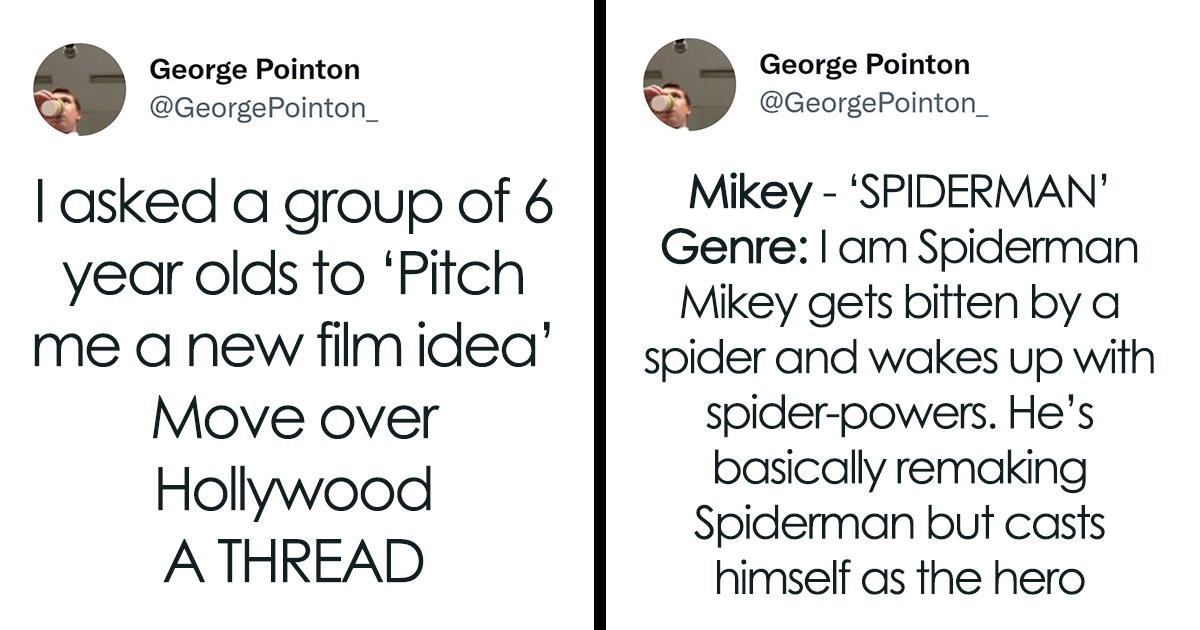
Every so often, the internet gives us a reminder that Hollywood may be overthinking things. While executives sit in glass offices debating franchise strategy, intellectual property, audience segmentation, and whether every superhero needs a multiverse, a group of 6-year-olds can casually walk into a classroom and invent a movie about a burger that eats other burgers until it becomes large enough to threaten civilization.
That is not a pitch. That is cinema wearing ketchup.
The viral story began when elementary teacher George Pointon asked his young students to pitch new movie ideas. The assignment sounded simple: create a title, choose a genre, and imagine the plot. The results were funny, surprisingly sharp, and occasionally more emotionally complicated than films with $200 million budgets. From Money Cannon to World War 100, these classroom pitches prove that children understand storytelling in a wonderfully chaotic way: big idea first, logic second, snack break whenever possible.
But beneath the laughter is something genuinely meaningful. Asking children to invent films is not just a cute classroom activity. It encourages creative thinking, oral storytelling, vocabulary development, collaboration, problem-solving, and confidence. In other words, the kids were not only making jokes. They were practicing the same core skills writers, directors, marketers, and producers use every dayjust with more ghosts, magic skateboard wheels, and suspiciously powerful burgers.
Why This Classroom Movie Pitch Went Viral
The reason this story spread so widely is easy to understand: children are natural storytellers, and their ideas often skip the boring middleman called “market research.” Adults may ask, “Who is the target demographic?” A 6-year-old asks, “What if a ghost was scary because he was really good at hide-and-seek?” Frankly, one of those questions is more useful.
Pointon’s students were asked to come up with movie titles and genres, and then the class worked together to build out the plots. That collaborative element matters. The children were not simply blurting out random sentences and running away, although that is also a respected elementary school communication style. They were shaping premises into stories with characters, stakes, settings, and conflicts.
The funniest part is that their genre choices were not always genres in the traditional sense. “Money,” “Skateboard,” “People,” and “I am Spiderman” may not appear as categories on a streaming platformyetbut they reveal how children classify stories. They think in terms of the thing that matters most to the movie. If the story is about money flying out of a cannon, the genre is obviously money. Case closed. Someone give that child a development deal and a juice box.
The 10 Movie Ideas That Deserve a Classroom Oscar
Here are the ten standout movie pitches inspired by the students’ wild, sincere, and strangely cinematic imaginations.
1. Burger Monster
In Burger Monster, a burger discovers that eating other burgers makes it grow larger. Eventually, this burger becomes so enormous that it threatens the very world that created it. Is it a monster movie? A fast-food satire? A warning about unchecked ambition? Yes. It is all of those things, served with fries.
What makes this pitch brilliant is its simple escalation. Small burger eats burger. Bigger burger eats more burgers. Giant burger becomes global problem. That is clean storytelling. The hero, villain, and theme are all wrapped in one bun.
2. World War 100
World War 100 takes place in the year 4070, after Earth as we know it has vanished. Different planets are battling for control, and a tiny leftover version of Earth must defend humanity’s legacy. That is a lot of pressure for a rock with branding issues.
This idea has real science-fiction energy. It contains world-building, stakes, history, conflict, and a setting that immediately raises questions. What happened to Earth? Who is fighting whom? Why did civilization make it through ninety-nine world wars and still think, “Let’s try one more”?
3. Skateboard Wheels
In Skateboard Wheels, an amateur skateboarder gets a magical set of wheels that helps him become a superstar. But the story asks an unexpectedly mature question: is success worth it if it comes from magic instead of hard work?
This is the kind of sports fantasy Disney Channel would have greenlit before the teacher finished reading the pitch. It has a lovable underdog, a magical object, a moral dilemma, and plenty of room for slow-motion skateboard tricks set to inspirational music.
4. Money Cannon
Money Cannon became a fan favorite for a reason. The premise is instantly memorable: a wildly rich person builds a cannon and fires money into the air. At first, it seems generous. Then greed, chaos, and destruction follow.
For a story created by a child, this pitch has surprisingly sharp social commentary. It touches on wealth, human behavior, generosity, corruption, and public panic. Also, the visual image of cash blasting from a cannon is so clear that the movie poster practically designs itself.
5. Lola Buys a Car
Lola Buys a Car follows a young girl who somehow inherits thirty pounds, uses her fortune to buy a house and a car, and then crashes the car. But it is fine. Also, it is set in America. Naturally.
This pitch is hilarious because it captures a child’s understanding of adult life: money appears, you buy big things, something goes wrong, and everyone moves on. The economics may be questionable, but the confidence is spectacular. Thirty pounds buying a house and car is not financial literacy, but it is the dreamiest real estate market ever imagined.
6. The Sea
The Sea is one of the most heartfelt ideas. The ocean is in trouble because of pollution, and people in a divided town must work together to clean it up. It is environmental, emotional, and hopeful.
This pitch shows how children absorb real-world concerns and turn them into stories. Instead of presenting climate anxiety as a lecture, the movie idea frames it through cooperation and kindness. It is a gentle reminder that kids are listening to adult conversations about the planet, and sometimes they respond with more teamwork than the adults.
7. Frozen 3
Frozen 3 imagines Elsa and Anna going on vacation, possibly to Disneyland, where they meet familiar characters and maybe even versions of themselves. That is not merely a sequel. That is a meta-comedy with identity themes and corporate synergy so powerful it can probably be seen from space.
The charm of this idea is that it understands what fans often want from beloved characters: not always bigger battles, but new situations. What happens when iconic characters take a break? What do magical sisters do on vacation? Do they buy matching ears? Does Olaf melt in line for a churro? Important questions.
8. Spiderman
In Spiderman, Mikey gets bitten by a spider, gains powers, and casts himself as the hero. He also wants to fight “the green one,” which is either the Green Goblin, a lizard, or possibly broccoli. He plans to direct the movie too, because why surrender creative control?
This pitch may not win points for originality, but it wins everything for self-belief. Children often place themselves directly into stories, and that is part of how imagination works. They are not only watching heroes; they are trying on bravery, power, danger, and identity.
9. Hide and Seek
Hide and Seek is a horror movie about a family moving into an old empty houseexcept for one ghost. The ghost torments the family, but whenever anyone searches for him, he hides. That is a clean horror-comedy concept, and honestly, better than many haunted-house plots that rely entirely on creaky doors and people making terrible decisions at 2 a.m.
The genius here is the twist. The ghost is scary not because he is loud or violent, but because he is annoyingly committed to the game. It turns a childhood activity into suspense. That is exactly how good genre storytelling works: take something familiar and make it strange.
10. A Cat. A Dog
A Cat. A Dog follows two traditional enemies who end up working at the same bank. Will they overcome nature and become colleagues, or even friends? According to the pitch, no. They will not. Sorry.
That ending is what makes the idea unforgettable. Most adults would force the story into a lesson about friendship. A child, however, may choose emotional realism: sometimes the cat and dog remain enemies, especially if spreadsheets are involved. It is bold, bleak, and possibly the first workplace comedy for pets with unresolved tension.
Why Kids Are Surprisingly Good at Movie Ideas
Children are not professional screenwriters, but they often understand the raw ingredients of a good pitch. A strong movie idea usually needs a hook, a main character, a problem, a setting, and a reason to care. These students accidentally hit those beats again and again.
Money Cannon has a clear hook. World War 100 has a huge setting. Skateboard Wheels has a moral conflict. The Sea has a social mission. Hide and Seek has a clever genre twist. Even Lola Buys a Car has character motivation: Lola gets money and immediately acts. Is it practical? No. Is it dramatic? Absolutely.
Professional writers often talk about loglines, which are short summaries designed to make someone want to hear more. These kids were basically creating tiny loglines without realizing it. Their ideas work because they are specific. “A person has an adventure” is vague. “A burger eats other burgers until it threatens the planet” is impossible to ignore.
That specificity is why adults love children’s storytelling. Kids do not sand down the weird edges. They keep the part that makes the idea memorable. They do not say, “a wealthy man causes unintended social consequences.” They say, “money cannon.” Much better. Fewer syllables. More explosions.
The Classroom Value Behind the Comedy
As funny as these pitches are, the activity itself is also smart teaching. When children pitch film ideas, they practice speaking clearly, organizing thoughts, listening to classmates, and expanding on ideas. They learn that stories need more than a title. A movie needs a character, a world, a problem, and some kind of endingeven if that ending is “the cat and dog do not become friends.”
Storytelling also helps children build vocabulary and comprehension. When a student explains why a ghost hides, why a town cleans the ocean, or why magic skateboard wheels might create temptation, that child is connecting cause and effect. They are learning sequence: first this happens, then this happens, then everything gets weird.
Creative assignments like this also make room for different kinds of learners. A child who struggles with handwriting may still be a fantastic oral storyteller. A quiet student may contribute one strange detail that transforms the whole plot. A child who loves drawing may picture the movie poster before the plot is finished. In a good classroom, creativity becomes a door with many handles.
What Adults Can Learn From These 6-Year-Old Filmmakers
The biggest lesson is simple: take children’s ideas seriously without making them too serious. A child’s story can be funny and meaningful at the same time. Burger Monster is ridiculous, but it also contains escalation and consequence. The Sea is sweet, but it also shows awareness of environmental responsibility. Money Cannon is absurd, but it also makes a point about greed.
Adults often rush to correct children’s ideas. “That genre is not real.” “A burger cannot eat another burger.” “Thirty pounds cannot buy a house.” Technically true, but creatively boring. A better response is: “Tell me more.” That phrase keeps the imagination open. It encourages children to explain, revise, expand, and defend their ideas.
Parents and teachers can recreate this activity easily. Ask children to pitch a movie in three parts: title, genre, and what happens. Then ask follow-up questions. Who is the hero? What goes wrong? What is the funniest scene? What is the scary part? How does it end? Before long, a five-minute conversation can become a full story, a drawing activity, a class performance, or a homemade trailer.
Experience-Based Reflections: Trying This Activity With Kids
If you have ever asked a young child to invent a story, you already know the first rule: do not expect a straight road. Children’s imagination travels by trampoline. You may begin with a movie about a dinosaur school and end with a submarine full of pancakes. The journey will not obey traffic laws, but it will be memorable.
One of the best ways to run a movie-pitch activity is to treat the child like a real filmmaker. Sit across from them and say, “Okay, pitch me your movie.” Give them a few simple prompts: What is the title? What kind of movie is it? Who is the main character? What is the biggest problem? What happens at the end? These questions are short enough for young children but strong enough to guide a complete story.
The most important part is resisting the urge to fix the idea too early. If a child says the movie is about a shark who becomes mayor, do not ask whether sharks can legally hold office. Ask what laws the shark wants to pass. If a child says the hero is a sandwich detective, ask what crime happened at lunch. The more seriously you treat the silly idea, the more language and reasoning the child will use.
In a classroom, this activity can become a wonderful group project. One student gives the title. Another chooses the genre. A third invents the villain. A fourth decides the ending. Suddenly, children are negotiating, listening, compromising, and building something together. That is social learning disguised as entertainment, which is the best kind because nobody has to announce, “Now we are developing interpersonal communication skills.” The kids are too busy deciding whether the moon can be stolen by a raccoon.
At home, parents can use the same idea during dinner, car rides, bedtime, or rainy afternoons. It works especially well because it does not require expensive supplies. A notebook helps. Crayons help. Popcorn helps morale. But the real tools are curiosity and patience. Ask the child to draw the movie poster, cast family members in the roles, or act out the trailer in thirty seconds. You may discover that the family dog has been cast as the villain, which is unfair but probably based on shoe-related evidence.
This kind of experience also helps adults reconnect with playful thinking. Children are not embarrassed by strange ideas until adults teach them to be. When a 6-year-old says the genre is “money,” they are not wrong in their own creative system. They are naming the story by its strongest signal. Adults can learn from that. Good ideas often begin as something too simple, too weird, or too funny to ignore.
The best outcome is not a perfect story. It is the moment when a child realizes their idea made someone listen. That feeling builds confidence. It tells them their imagination has value. Maybe they will not become filmmakers. Maybe they will become engineers, nurses, teachers, chefs, scientists, or people who responsibly avoid building actual money cannons. But the ability to imagine, explain, revise, and share an idea will follow them everywhere.
Conclusion
The viral classroom movie pitches are funny because they sound like tiny masterpieces from a world where logic wears sneakers on the wrong feet. But they are also meaningful because they show what happens when children are invited to think creatively without being boxed in by adult expectations. George Pointon’s students gave the internet Money Cannon, Burger Monster, World War 100, and several other chaotic gems. More importantly, they gave us a reminder that imagination is not childish in the negative sense. It is brave, flexible, and often much smarter than it first appears.
Whether you are a teacher, parent, writer, or movie lover, this activity is worth borrowing. Ask a child for a movie pitch. Listen carefully. Laugh kindly. Ask follow-up questions. You may not get the next Oscar winner, but you might get a ghost who hides too well, a bank run by a cat and dog, or a burger with world-ending ambition. Honestly, that is still better than another unnecessary reboot.