The ocean has never been particularly interested in posing for photographs. It moves constantly, hides its brightest creatures in the darkest places, and occasionally throws a wave directly at the person holding the camera. That makes the images honored in the 2024 Ocean Photographer of the Year competition even more remarkable.
Selected from more than 15,000 submissions spanning underwater, coastal, surf, and drone photography, the finalist collection travels from tropical coral nurseries to Arctic shorelines. It reveals feeding frenzies, intimate wildlife encounters, daring human adventures, and painful evidence of pollution, fishing pressure, and commercial whaling.
These photographs are more than attractive desktop backgrounds. Each one freezes a fraction of a second that most people would never witness, even after a lifetime of swimming, diving, sailing, or repeatedly promising themselves they will finally learn to surf.
Why the 2024 Ocean Photographer of the Year Finalists Matter
Presented by Oceanographic Magazine and Blancpain, the competition celebrates the beauty and fragility of the blue planet. Its categories recognize wildlife behavior, artistic composition, ocean adventure, conservation successes, environmental damage, human relationships with the sea, young talent, and photographic portfolios.
The strongest images succeed on two levels. First, they stop the scroll. Then they quietly plant a question in the viewer’s mind: What is happening here, and what does it reveal about the condition of the ocean?
Some photographs answer with wonder. Others answer with plastic bags, ghost nets, and whale-processing ramps. Together, they create a visual record of an ecosystem that remains astonishingly alive while facing enormous pressure.
30 Unforgettable Images From the 2024 Finalist Field
1. A Bryde’s Whale Meets a Heart-Shaped Baitball
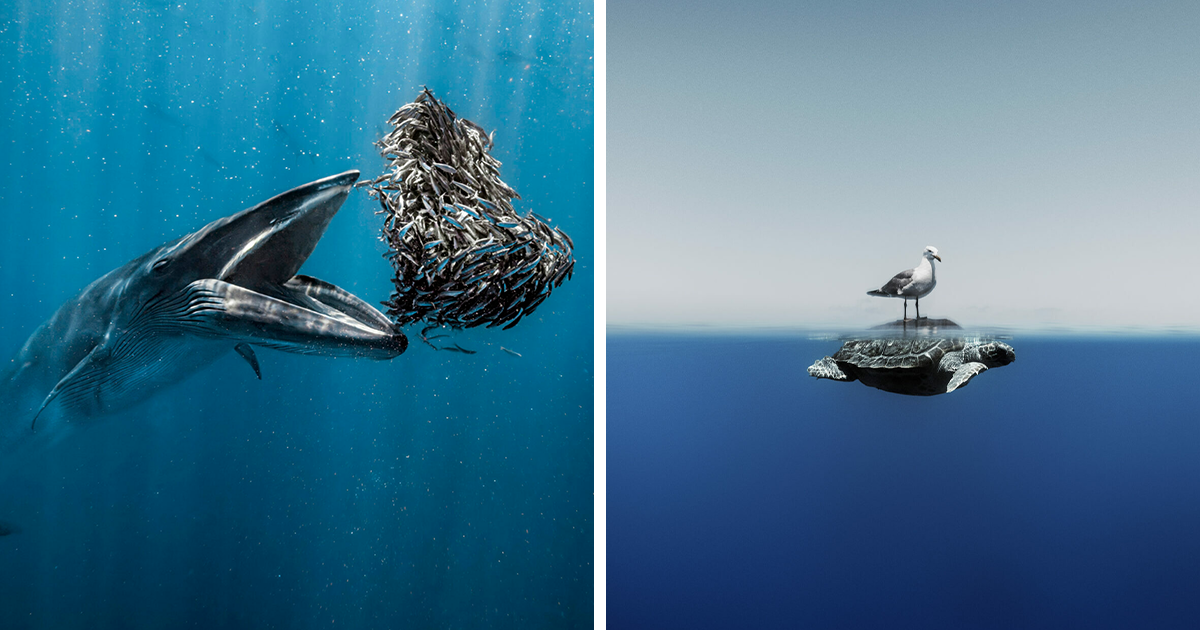
Rafael Fernández Caballero captured the overall winning image in Baja California Sur, Mexico. A Bryde’s whale approaches a tightly packed, almost heart-shaped school of sardines with its mouth open. It is beautiful, dramatic, and slightly unfortunate for the sardines, whose romantic formation receives the least romantic possible ending.
2. A Northern Gannet Becomes a Living Torpedo
Jade Hoksbergen earned second place overall with a northern gannet diving into cold water near Scotland’s Shetland Islands. The bird enters the sea with extraordinary precision, turning an everyday hunt into a high-speed demonstration of natural engineering.
3. A Fishing Boat Draws Across the Vietnamese Coast
Thien Nguyen Ngoc’s third-place aerial photograph shows a fishing boat off Hon Yen, Vietnam. Its trail of smoke visually aligns with green fishing nets beneath the surface, connecting human industry, ocean currents, and local food traditions in one carefully timed composition.
4. A Mahi-Mahi Shows Off Its Lunch
Wildlife category winner Manuel Castellanos Raboso photographed a brilliantly colored mahi-mahi during a feeding frenzy in Baja California Sur. The fish glows yellow and green beneath refracted sunlight while gripping its catch like a diner who has no intention of sharing appetizers.
5. A Marine Iguana Occupies Two Worlds
Another image by Rafael Fernández Caballero presents a Galápagos marine iguana resting at the waterline. The split-level perspective places its head above the surface and its body within the ocean, emphasizing the reptile’s remarkable adaptation to life between land and sea.
6. A Giant Pacific Octopus Visits the Shallows
Andrey Shpatak photographed a giant Pacific octopus moving through shallow Russian waters. Its flowing arms and richly textured body seem almost too elaborate to be real, as though the ocean hired a costume designer and forgot to establish a budget.
7. A Rare Turtle Hatchling Meets Its Reflection
Jake Wilton documented a leucistic green sea turtle hatchling in Papua New Guinea’s Conflict Islands. As the pale turtle surfaces for air, calm water creates a near-perfect reflection, doubling the visual impact of an already unusual conservation success story.
8. A Curious Octopus Peeks From Its Shelter
Kate Jonker’s South African octopus initially blends into the surrounding hydroids. Look closer and two alert eyes emerge. The animal appears to be examining the photographer with the cautious expression of someone wondering why a stranger has arrived carrying two enormous flashes.
9. Mobula Rays Turn the Sea Into a Playground
Laura Leusko’s aerial photograph captures a large group of mobula rays in the Sea of Cortez. Several rays break the surface as the school moves below, creating a scene that combines synchronized swimming with spontaneous acrobatics.
10. Devil Rays Perform an Aquatic Ballet
Fine Art category winner Henley Spiers used a slow exposure to photograph juvenile Munk’s devil rays feeding around a green light near Espiritu Santo Island. Their movements become luminous curves, transforming a plankton buffet into something resembling an underwater dance performance.
11. A Nurse Shark’s Eye Becomes a Landscape
Julien Anton moved close to a resting nurse shark in Tahiti and focused on its eye and patterned skin. Removed from the full animal, the details become abstract, reminding viewers that the ocean’s most impressive designs often arrive without logos or marketing departments.
12. Humpback Whales Rise Through Sunbeams
Renée Capozzola photographed a humpback mother and calf ascending through radiant water off Tahiti. Their enormous bodies appear gentle and almost weightless as shafts of sunlight turn the scene into a marine cathedral.
13. Penguins Face the Scale of Antarctica
Kristiyan Dimitrov Markov placed a small group of Adélie penguins against a colossal iceberg in the Weddell Sea. The photograph is a master class in scale: tiny birds, enormous ice, and a viewer suddenly reconsidering the importance of their overflowing email inbox.
14. A Peacock Mantis Shrimp Looks Almost Extraterrestrial
Ajiex Dharma’s portrait of a peacock mantis shrimp highlights brilliant blues, greens, and oranges against a dark background. Its complex eyes and armored body resemble something designed for a science-fiction movie, except nature released this version long before computer graphics existed.
15. A Whale Shark Swims Through a Galaxy of Fish
Ipah Uid Lynn’s Female Fifty Fathoms Award portfolio includes a whale shark surrounded by swirling fish in the Maldives. Artificial light separates the shark from the darkness, emphasizing both its immense scale and the delicate motion of the smaller animals around it.
16. A Diver Becomes Tiny Beside a Shipwreck
Adventure category winner Tobias Friedrich photographed a diver beside the wreck of the Sea Trader in the Bahamas. The diver provides scale, making the sunken vessel feel less like abandoned machinery and more like an enormous sleeping creature.
17. A Surfer Rides Beneath a Rainbow
Sébastien Bachellereau’s drone photograph shows a surfer racing along a large wave in New South Wales while a rainbow rises behind him. It is the sort of combination that sounds suspiciously overproduced until the ocean proves it can manage special effects without assistance.
18. Freedivers Hang Upside Down Beneath a Boat
Chong Wan Yong photographed skilled freedivers suspended beneath a boat in Sri Lanka. Their inverted bodies appear to ignore gravity, while the split-level composition connects the ordinary vessel above with the strangely graceful world below.
19. Volcanic Water Creates an Underwater Aurora
Daisuke Kurashima captured a diver swimming through colorful water near Japan’s volcanic Iwo Jima. Minerals from hot springs produce red and orange tones, surrounding the silhouetted diver with a flowing display reminiscent of the northern lights.
20. A Freediver Enters a Living Tunnel of Sardines
Benjamín Yávar photographed a freediver moving through a dense sardine school near Bohol in the Philippines. The fish open around the swimmer, creating a circular window toward the surface and turning thousands of nervous individuals into one enormous composition.
21. A Green Sea Turtle Returns to Freedom
Shane Gross won the Conservation Hope category with a turtle being released in the Seychelles. Researchers had accidentally caught it while studying sharks, then quickly measured, tagged, and freed it. The image captures conservation as practical action rather than a vague inspirational slogan.
22. A Whale Shark Swims Beside a Research Vessel
Edwar Herreño photographed an endangered whale shark beneath the Sharkwater research vessel near Costa Rica. The ship was once used by a fishing fleet but now supports scientific work, giving the composition a satisfying narrative of machinery repurposed for protection.
23. Two Polar Bears Rest Together in the Snow
Florian Ledoux’s aerial image shows a male and female polar bear sleeping close together after mating in Svalbard. Their curled bodies form a quiet shape in the snow, revealing tenderness in an environment usually photographed for its harshness.
24. A Stingray Patrols a Healthy Seagrass Meadow
Remuna Beca photographed a southern stingray gliding above flourishing seagrass in the Bahamas. Sunbeams illuminate the habitat, emphasizing that conservation is not only about rescuing individual animals but also about protecting the ecosystems that allow them to thrive.
25. Coral Restoration Reaches Toward the Sun
Megan Hassa looked upward beneath a hanging coral nursery in Bali. Young coral fragments form branching silhouettes against the sunlight, presenting reef restoration as both scientific work and an unexpectedly elegant form of underwater gardening.
26. A Fin Whale Waits at an Icelandic Processing Plant
Frederik Brogaard’s Conservation Impact winner shows a fin whale awaiting butchering in Iceland. The industrial surroundings and gathering seabirds make the animal’s immense body feel especially vulnerable. It is a difficult image, but discomfort is precisely what gives it power.
27. An Entangled Gannet Hangs Below Its Nest
Rebecca Douglas photographed a dead gannet caught in rope beneath a cliff in the Shetland Islands. Plastic and discarded fishing material had become incorporated into nesting areas, turning what should have provided shelter into a fatal trap.
28. A Coconut Octopus Hides Inside a Plastic Bag
Pietro Formis found a coconut octopus sheltering in transparent sandwich packaging in the Philippines. These animals normally use shells and natural debris. The substitute may look clever at first glance, but its transparency leaves the octopus exposed and illustrates how pollution changes animal behavior.
29. A Traditional Fisher Crosses a Golden Beach
Zhang Xiang won the Human Connection Award with an aerial view of a fisherman walking across reflective coastal shallows in Fujian, China. Curving channels, warm light, and the small human figure show how culture and livelihood remain physically shaped by the sea.
30. An Algae Octopus Glows Under Ultraviolet Light
Young Photographer of the Year Jacob Guy revealed an algae octopus fluorescing in North Sulawesi, Indonesia. Usually hidden by excellent camouflage, the animal becomes dramatically visible under ultraviolet light, its yellow eyes emerging from a world of electric color.
What These Ocean Photographs Reveal
The 2024 collection demonstrates how modern ocean photography blends art, fieldcraft, biology, journalism, and occasionally an impressive tolerance for cold water. Successful images depend on more than expensive equipment. Photographers must understand tides, weather, animal behavior, light, diving safety, and the ethical limits of approaching wildlife.
They must also make fast creative decisions. A whale may appear without warning. A seabird may strike the water for less than a second. A shy octopus may retreat before the camera is ready. Drone batteries run low, waves rearrange compositions, and underwater visibility can transform from crystal clear to pea soup with ambitions.
The finalists also show that conservation photography does not need to lecture viewers. A turtle released from a research net communicates hope. A polar bear playing with plastic communicates contamination. A fin whale beside an industrial ramp communicates loss. The photograph presents evidence, while the viewer supplies the emotional response.
A Personal Viewing Experience: How to Spend Time With Ocean Photography
Viewing a gallery like the 2024 Ocean Photographer of the Year finalists is surprisingly different from scrolling through ordinary wildlife pictures. At first, the experience is driven by spectacle. The whale is enormous. The octopus looks alien. The shipwreck seems large enough to contain its own weather system. Your brain responds with a simple and scientifically rigorous observation: “Wow.”
The more rewarding experience begins when you slow down. Instead of immediately moving to the next image, study the relationship between the subject and its environment. Notice how a photographer uses a diver, boat, iceberg, or school of fish to communicate scale. Examine where the light enters the frame. Look for the tiny visual detail that explains why the shutter was pressed at that exact moment.
The northern gannet photograph, for example, becomes more impressive when you imagine the timing involved. The photographer must anticipate where a fast-moving bird will penetrate the surface, control focus in turbulent water, and compose the frame while floating in an environment that is not famous for offering stable seating.
Conservation images require a different kind of attention. The temptation is to look away quickly because the subject is unpleasant. Staying with the picture for several extra seconds can reveal why it works. The dead gannet is not photographed merely for shock. The rope leading toward nests filled with synthetic material explains a wider system of harm. The plastic bag around the coconut octopus is not random trash in the background; it has become part of the animal’s survival strategy.
Another useful exercise is to compare photographs that communicate opposite emotions. Place the thriving seagrass meadow beside the butchered fin whale. Compare the coral nursery with the stranded plastic. One shows what protection can preserve or rebuild. The other shows what unchecked human activity can remove. Together, they prevent the gallery from becoming either hopelessly grim or unrealistically cheerful.
Ocean photography can also improve the way travelers, divers, and coastal visitors behave. Great wildlife images may inspire people to approach animals for their own photographs, but the best lesson is patience rather than proximity. Ethical photographers avoid chasing, touching, feeding, surrounding, or cornering marine life. A calm animal behaving naturally usually creates a stronger picture than a frightened animal attempting to escape someone’s underwater selfie stick.
For aspiring photographers, the collection offers a practical challenge: tell a complete story in one frame. The camera settings matter, but the meaning matters more. A technically flawless image of an indifferent subject may be forgettable. A slightly imperfect photograph of a rare behavior, ecological relationship, or conservation event may remain in the viewer’s mind for years.
Finally, allow the photographs to make the ocean feel personal. Most people will never dive beneath Arctic ice, swim beside a whale shark, or hover over a coral nursery in Bali. Photography closes that distance. It brings inaccessible habitats into homes, classrooms, museums, and conversations. Once viewers recognize individual animals, behaviors, and threats, “the ocean” stops being a distant blue area on a map. It becomes a collection of living places worth understanding and defending.
Conclusion: More Than a Beautiful Blue Gallery
The 2024 Ocean Photographer of the Year finalists capture a planet within our planet. Their images move from microscopic eggs and fluorescent octopuses to giant whales and monumental icebergs, showing how much life can exist beyond the shoreline.
They also demonstrate why compelling ocean photography matters. Beauty attracts attention, storytelling holds it, and conservation gives it direction. Whether a frame produces joy, curiosity, sadness, or outrage, it encourages viewers to look beneath the surfaceand not only in the literal sense.
The ocean may remain mysterious, unpredictable, and occasionally determined to fill expensive camera equipment with saltwater. Thanks to these photographers, however, its hidden stories are a little harder to ignore.
Note: This article is an original editorial interpretation of the 2024 finalist and award galleries. All described photographs remain the intellectual property of their respective photographers and competition organizers.