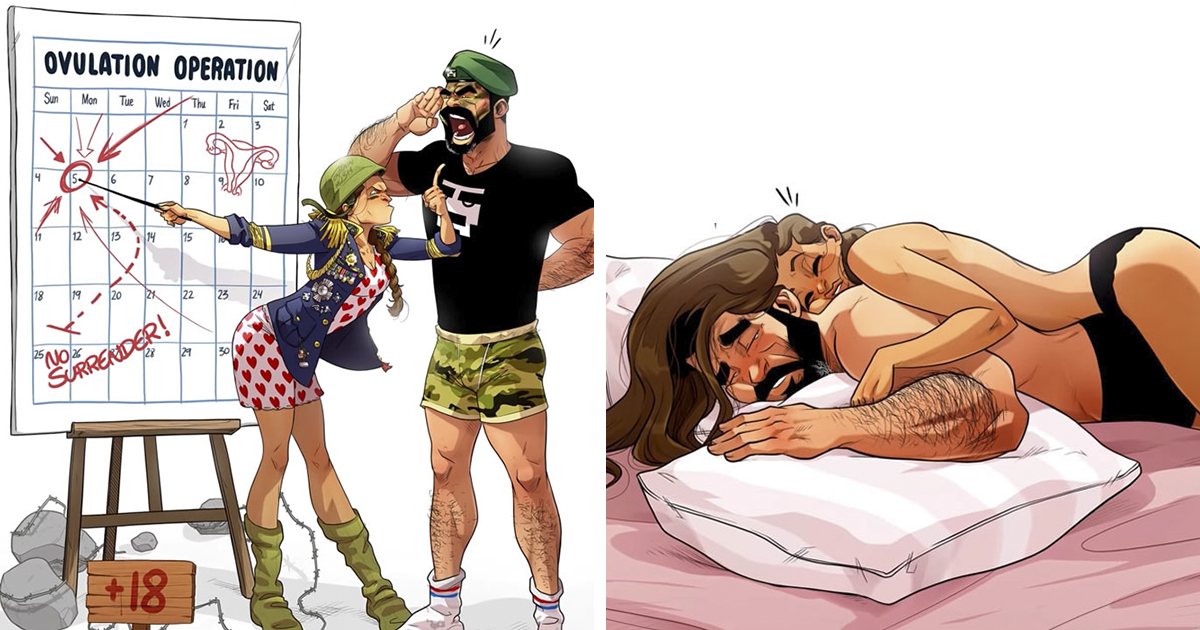
Some love stories are written in candlelight, some in long text messages, and some in one-panel comics where a husband looks like he has just been emotionally body-slammed by a pregnancy test. That last category belongs beautifully to Yehuda Devir and Maya Devir, the married comic artists behind One of Those Days, a wildly popular illustrated series about marriage, domestic chaos, intimacy, awkward timing, and the tiny daily disasters that make relationships feel real.
For years, Yehuda illustrated everyday life with his wife Maya in exaggerated, superhero-style scenes: fighting household pests, surviving morning routines, negotiating couch territory, and turning ordinary couple moments into visual punchlines. Then the series entered a deeper chapter. The couple announced they were having a baby and shared the emotional road that led there through eight comics about trying to conceive, disappointment, hope, pressure, and finally, joy.
The result was not just another cute pregnancy announcement. It was a tender, funny, slightly teary reminder that behind many “We’re expecting!” posts are monthsor even yearsof private waiting. The Devirs turned that waiting into art, and audiences around the world recognized themselves in it.
Who Are Yehuda and Maya Devir?
Yehuda and Maya Devir are Israeli comic artists and the creators of One of Those Days, a webcomic series that began as a personal visual diary of their married life. Yehuda is known for his bold, kinetic illustration style, influenced by American comic books and superhero art. Maya, also a visual artist, plays a key creative role as art director, helping shape concepts, composition, colors, and the emotional rhythm of the series.
Their comics first gained attention because they took common couple experiences and made them feel cinematic. A hot shower becomes a volcanic survival mission. A simple hug becomes an acrobatic event. A bug in the house becomes a boss battle. Their work is funny because it exaggerates everyday life, but it lands because the feelings underneath are familiar.
That mixbig visuals, small moments, honest emotionturned One of Those Days into one of the most recognizable relationship comic series online. The Devirs built a massive audience by showing marriage not as a flawless romantic montage, but as a series of shared situations: silly, frustrating, intimate, messy, and occasionally covered in laundry.
The Pregnancy Announcement That Felt Different
When Yehuda and Maya announced they were having a baby, they did it in the language their fans knew best: comics. But this chapter carried a different emotional weight. Instead of only showing the funny side of marriage, the eight-comic pregnancy journey revealed the couple’s struggle to conceive.
Trying for a baby can be emotionally exhausting, especially when each month begins with hope and ends with another round of disappointment. The Devirs captured that cycle with humor, but they did not hide the sadness. Their comics showed the awkward timing, the clinical pressure, the emotional whiplash, and the way a private dream can quietly take over daily life.
That honesty is why the announcement resonated. Many pregnancy announcements online arrive polished and perfect: tiny shoes, golden lighting, a caption with three heart emojis, and maybe a dog looking confused in the background. The Devirs gave audiences the celebration, but they also showed the tunnel before the light.
Why These 8 Comics Went Viral
The eight comics became widely shared because they balanced three things that are hard to combine: comedy, vulnerability, and visual storytelling. They did not turn fertility struggles into a lecture. They turned them into scenes. That made the experience easier to understand, especially for readers who had never gone through it themselves.
1. They Made Private Anxiety Visible
One of the most powerful things art can do is give shape to feelings people rarely say out loud. The Devirs’ comics showed that trying to conceive is not always a sweet montage. Sometimes it is calendar math. Sometimes it is waiting. Sometimes it is a negative test sitting in a bathroom like a tiny plastic villain.
By illustrating these moments, Yehuda and Maya gave viewers a visual vocabulary for a struggle many couples keep private. The comics made room for people to say, “That’s exactly how it felt,” without needing to explain everything from scratch.
2. They Used Humor Without Mocking the Pain
The humor in the series works because it does not make fun of infertility or pregnancy anxiety. Instead, it makes fun of the absurd situations surrounding them. The pressure to “relax,” the awkwardness of timing intimacy, the emotional drama of waiting for resultsthese are real experiences, and the comics gently exaggerate them without dismissing them.
That is a delicate line. Too much comedy would feel insensitive. Too much seriousness would lose the charm that made One of Those Days famous. The Devirs found the middle: laughing while still holding the heartbreak carefully.
3. They Showed Both Partners
Pregnancy and fertility stories often focus almost entirely on one person. The Devirs’ comics show both Yehuda and Maya as emotionally involved. Maya’s body is central to the journey, but Yehuda’s fear, hope, confusion, and helplessness also appear. That matters because fertility struggles affect couples as a team, even when the physical burden is not equally shared.
The comics remind readers that support does not always look heroic. Sometimes it looks like being present, staying gentle, making room for disappointment, and not trying to fix every feeling with a motivational quote from a gym wall.
The Art Style: Superhero Energy Meets Domestic Reality
One reason Yehuda Devir’s comics are instantly recognizable is the contrast between subject and style. The scenes are domestic, but the energy is epic. A couple’s argument might be staged like a blockbuster showdown. A pregnancy craving may look like a mythological quest. A quiet emotional moment can feel as dramatic as a movie poster.
This superhero-style exaggeration is part of the appeal. It says that everyday life is not small when you are living it. Marriage, pregnancy, fear, dishes, laundry, and love can all feel enormous from the inside. The Devirs simply draw them that way.
In the pregnancy comics, the style becomes especially effective. The couple’s longing feels larger than life because, to them, it is. The art turns emotional pressure into body language, facial expressions, and visual comedy. Readers do not need a medical chart to understand the stakes. They can see them immediately.
The Real-Life Struggle Behind the Smiles
The Devirs have openly shared that getting pregnant was not simple for them. Their comics reflected the repeated emotional pattern many hopeful parents know too well: optimism, effort, waiting, disappointment, and trying again. That cycle can make people feel powerless, even when they are doing everything “right.”
Fertility challenges are more common than many people assume. For couples who want children, difficulty conceiving can bring emotional stress, relationship strain, financial concerns, medical appointments, and a sense of isolation. People often do not talk about it because the subject feels too personal, too painful, or too vulnerable for casual conversation.
That is why these comics mattered. They did not present the Devirs as experts with answers. They presented them as a couple living through uncertainty. In an online world where everyone seems to announce success after success, showing the hard part can feel quietly radical.
Why Audiences Connected With the Story
The pregnancy announcement worked because it was not only about having a baby. It was about surviving the wait for a dream. That theme is universal. Not everyone is trying to become a parent, but almost everyone has wanted something deeply and had to sit with uncertainty.
Readers connected with the Devirs because the comics showed a relationship under pressure without turning it into melodrama. Maya and Yehuda remained recognizably themselves: funny, expressive, affectionate, imperfect, and dramatic in the best cartoonish way. Their love story did not pause during the struggle. It stretched, wobbled, and kept going.
That is also why the series avoided feeling overly sentimental. The comics are emotional, yes, but they are not wrapped in glittery perfection. They have sweat, weird faces, bad timing, and frustration. In other words, they feel like life.
The 8 Comics as a Story Arc
The eight comics can be understood as a small emotional arc, even without seeing them as separate episodes. Together, they move through the major stages of the couple’s journey: the decision to try, the pressure of timing, the awkwardness of routine, the repeated disappointment, the emotional exhaustion, the need for support, the surprise of hope returning, and the final pregnancy reveal.
That structure is part of what makes them memorable. The announcement is not isolated. It arrives after the audience has seen what it cost emotionally. The joy feels earned because the struggle was not skipped.
In storytelling terms, this is why the reveal works so well. A happy ending means more when readers understand the obstacles. The Devirs did not simply say, “We are pregnant.” They said, in their own visual language, “Here is what we went through to get here.”
Pregnancy, Parenthood, and the Evolution of “One of Those Days”
After the pregnancy journey, One of Those Days naturally evolved. The series expanded from married life into pregnancy and parenting. The arrival of a child changed the subjects, the rhythm, and the emotional stakes of the comics. Sleep deprivation, body changes, new responsibilities, and the comedy of baby life entered the frame.
That evolution helped the series stay fresh. The Devirs did not abandon the original concept; they let it grow with them. Marriage changed because life changed. Their audience, many of whom were also growing older, forming relationships, having children, or navigating adult responsibilities, grew with them.
This is one reason the couple’s work has lasted. The comics are not built around one joke. They are built around observation. As long as life keeps being strange, stressful, beautiful, and occasionally covered in baby food, there is material.
What Creators Can Learn From Yehuda and Maya Devir
The success of the pregnancy comics offers useful lessons for artists, bloggers, and digital storytellers. First, specificity beats generic relatability. The Devirs do not draw “a couple experiencing stress.” They draw themselves, with their own faces, personalities, exaggerations, and emotional habits. That specificity makes the work feel real.
Second, vulnerability creates connection when it is handled with intention. Sharing a struggle is not the same as oversharing. The Devirs choose moments that serve the story and protect the emotional truth. They let viewers in, but the comics still feel crafted rather than careless.
Third, visual identity matters. Their art style is instantly recognizable. In a crowded digital space, that matters as much as good captions or clever timing. People remember the look before they remember the algorithm that delivered it.
Finally, the Devirs show that everyday life can be enough. Creators often chase huge concepts, dramatic twists, or shocking topics. But the most shareable stories are often the ones that help people feel seen in ordinary moments. A bathroom mirror, a couch, a pregnancy test, a tired hugthese can carry a whole emotional universe.
The Broader Meaning: Normalizing Difficult Conversations
One quiet strength of the Devirs’ pregnancy comics is that they normalize a difficult conversation without making it feel clinical. Fertility struggles are often surrounded by silence, unsolicited advice, and painfully cheerful comments from people who mean well but should maybe take a brief vacation from speaking.
By sharing their story in comic form, Yehuda and Maya made the subject approachable. The art gave people a way to engage with something serious without feeling overwhelmed. It also offered comfort to couples who may have felt alone in their experience.
That does not mean every couple must share their private journey publicly. Privacy is valid. Silence can be protective. But when public figures or artists choose to speak honestly, they can make the world a little kinder for people going through similar situations.
Experience-Based Reflections: What This Story Teaches About Love, Waiting, and Creating Art From Real Life
Stories like Yehuda and Maya Devir’s pregnancy comics are powerful because they remind us that everyday life is rarely as simple as it looks from the outside. A pregnancy announcement may appear to be one happy moment, but for many couples, that moment sits on top of months of waiting, medical questions, emotional conversations, and quiet disappointment. The public sees the celebration. The couple remembers the calendar, the tests, the hope, and the courage it took to try again.
One experience many readers can relate to is the pressure of being asked, “So, when are you having kids?” It is often said casually, sometimes at family dinners, weddings, holidays, or while someone is just trying to enjoy mashed potatoes in peace. But for couples struggling to conceive, that question can land heavily. The Devirs’ comics help explain why. They show that what looks like a simple life milestone may actually be a private emotional marathon.
Another lesson is that humor can be a survival tool. When life becomes stressful, laughter does not erase the problem, but it can make the room feel breathable again. A couple dealing with fertility disappointment may not feel funny every day. Still, a shared joke, a ridiculous expression, or a comic exaggeration can create a small bridge back to each other. The Devirs use humor like a flashlight: not to deny the darkness, but to help navigate it without bumping into every emotional table leg.
Their work also shows the importance of partnership. During difficult seasons, one person may feel tempted to become the “strong one,” while the other carries the visible pain. But relationships are healthier when both people are allowed to feel. In the comics, Yehuda is not just a narrator standing outside Maya’s experience. He is part of the emotional landscape. He is confused, hopeful, worried, silly, supportive, and sometimes overwhelmed. That honesty makes the relationship feel human.
For artists and writers, the Devirs’ story is a reminder that personal experience can become meaningful content when it is shaped with care. The goal is not to publish pain for attention. The goal is to transform experience into something others can recognize. Good personal storytelling asks, “What did this feel like, and how can I show it truthfully?” The Devirs answer with expressive faces, dramatic poses, and emotional timing that turns private moments into shared understanding.
There is also a useful lesson for audiences. When we see someone’s happy news online, we rarely know the full story. That engagement photo, job announcement, new baby post, or smiling family picture may have a long unseen history. Responding with kindness costs nothing. Avoiding invasive questions costs even less. The Devirs’ comics encourage viewers to celebrate joy while respecting the struggle that may have come before it.
Most of all, this topic reminds us that love is not only proven in grand gestures. Love is often proven in waiting rooms, late-night talks, disappointed mornings, and the decision to keep holding hands when the plan is not working yet. Yehuda and Maya Devir turned that kind of love into comics. Their baby announcement was joyful, but the journey behind it made it unforgettable.
Conclusion
Yehuda and Maya Devir’s baby announcement became more than a viral relationship comic moment because it told the truth behind the celebration. Through eight heartfelt comics, they showed the funny, painful, awkward, and hopeful sides of trying to conceive. Their art transformed a private struggle into a shared human story, proving once again why One of Those Days resonates with millions.
The Devirs’ greatest strength is not simply that they draw marriage well. It is that they understand how ordinary moments become extraordinary when emotion is added. A pregnancy test, a tired embrace, a disappointed month, a long-awaited revealthese are not just scenes. They are chapters in a life built together.
In a digital world full of perfect announcements, Yehuda and Maya offered something better: honesty with a punchline, vulnerability with color, and love with all the messy outlines left in.
Note: This article is written as an original SEO-friendly feature based on publicly available information about Yehuda and Maya Devir, their comic series One of Those Days, and their documented pregnancy journey.