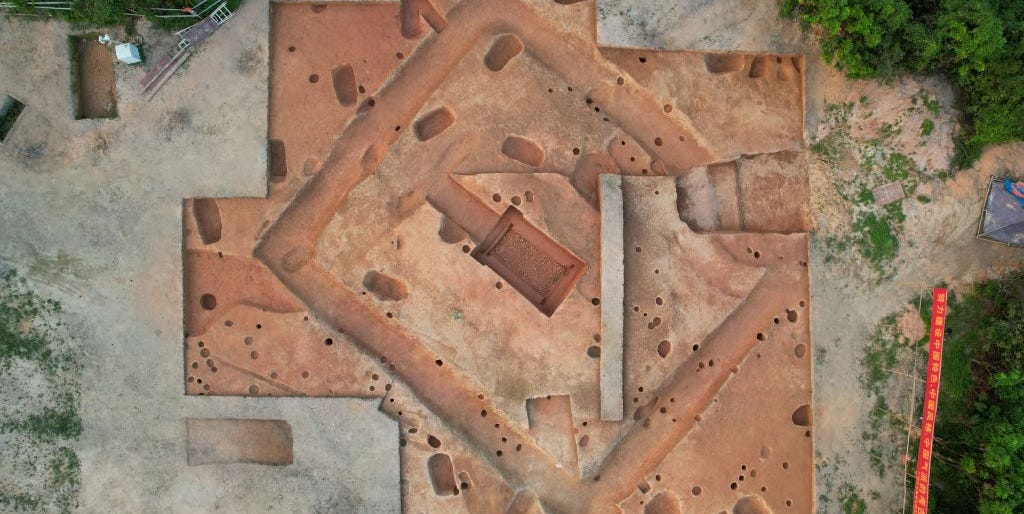
Most zoo visitors expect to meet pandas, peacocks, giraffes, and maybe one deeply judgmental monkey. What they do not expect is a buried archive of human history beneath the paths, animal enclosures, and construction zones. Yet that is exactly what happened at Guangzhou Zoo in southern China, where archaeologists uncovered 148 ancient tombs spanning more than 2,100 years.
The discovery sounds like the opening scene of an adventure movie: workers begin a construction project, archaeologists step in, and suddenly the ground reveals a timeline stretching from the Han Dynasty to the early years of modern China. But this was not a wild accident. Guangzhou Zoo sits in one of Guangzhou’s known ancient burial areas, and since the zoo’s original construction in 1956, archaeologists have found nearly 500 tombs across more than 30 locations on its grounds. In other words, this zoo has been quietly sharing space with history for decades.
The latest excavation, carried out between April and July 2024, covered about 1,300 square meters, roughly 14,000 square feet. Led by the Guangzhou Municipal Institute of Cultural Heritage and Archaeology, the project revealed a dense cemetery system with tombs from multiple dynasties. The result is more than a headline-friendly surprise. It is a rare look at how one urban location carried cultural, social, and funerary meaning across centuries.
A Zoo Built on Layers of History
Guangzhou, historically known to many Westerners as Canton, is one of China’s great southern cities. Located near the Pearl River Delta, it has long served as a commercial gateway, a port city, and a meeting point for inland and maritime trade. That long history matters because ancient cities are not flat pages. They are layered books. Roads, homes, temples, walls, markets, cemeteries, and parks accumulate over time, one chapter beneath another.
Guangzhou Zoo is located in the city’s Yuexiu area, a district already rich in historical associations. To modern visitors, the zoo is a family attraction. To archaeologists, however, the land also functions as a cultural map. The discovery of tombs there is not just about burial chambers; it is about how people used land, organized communities, honored the dead, and marked social identity over more than two millennia.
This is why urban archaeology can be so dramatic. A construction crew may see a project site. An archaeologist sees a question: who lived here, what did they value, and what did they leave behind without knowing we would one day be curious?
What Archaeologists Found Under Guangzhou Zoo
The 148 tombs discovered at the zoo cover a remarkable chronological range. According to the excavation reports, the group includes four tombs from the Han Dynasty, eight from the Jin and Southern Dynasties, 15 from the Tang Dynasty, and 121 from the Ming and Qing Dynasties. Together, the burial site stretches from the Western Han period to the early years following the founding of the People’s Republic of China.
That range is important because each dynasty brought different burial customs, architectural techniques, social structures, and material culture. A Han tomb does not tell the same story as a Qing tomb. A Tang tomb may preserve different clues from a Ming burial. When archaeologists find so many periods represented in one area, they can compare change over time in a way that a single isolated tomb cannot provide.
The team also uncovered 196 pieces or sets of cultural relics. These included pottery, porcelain, bronze objects, jade items, and bead ornaments. Forty-eight gravestones dating from the Republic of China period to the early years of the People’s Republic of China were also found. Some of the objects are considered unusual in recent archaeological discoveries from Guangdong, giving researchers fresh material for studying regional traditions.
The Two Tombs That Stole the Show
Among the 148 tombs, two attracted special attention: a nearly intact Eastern Jin Dynasty tomb and a well-preserved Southern Dynasties tomb.
The Eastern Jin Tomb
The Eastern Jin tomb, dating to the period from 317 to 420, is especially significant because it is considered the largest and best-preserved tomb of its era discovered in Guangzhou so far. Measuring more than 10 meters long, the chamber and walls remain largely intact. That is the archaeological equivalent of finding an old notebook with the pages still readable instead of a soggy grocery receipt from last Tuesday.
The tomb was not completely untouched. Reports note a looter’s hole near the entrance, a reminder that ancient tombs often attracted attention long before modern archaeologists arrived with measuring tools, cameras, and careful documentation. Even so, the structure survived well enough to offer valuable information about construction methods, tomb layout, and funerary customs during the Six Dynasties period.
The Southern Dynasties Couple’s Tomb
The Southern Dynasties tomb, dating from 420 to 589, was identified as a joint burial for a married couple. Though smaller than the Eastern Jin tomb and also showing signs of past looting, it remains structurally well preserved. For archaeologists, that makes it a treasure of context. The design may help researchers better understand family burial practices, social relationships, and how ideas of household, status, and memory were expressed in tomb architecture.
Couple burials are especially interesting because they can reveal how societies imagined relationships beyond life. The tomb is not merely a resting place. It is a carefully planned space shaped by belief, family identity, and cultural expectations.
Why 148 Tombs in One Place Matters
The number alone is striking, but the pattern may be even more important. Archaeologists observed that many of the Ming and Qing tombs shared similarities in scale, orientation, and spacing. This suggests the area was not a random burial ground where people simply chose an open patch of land and hoped for the best. Instead, the evidence points to a planned cemetery system used over a long period.
That matters because burial planning reflects social organization. Cemeteries can reveal how communities understood family lines, status, geography, ritual order, and sacred space. Even the direction a tomb faces can be meaningful, depending on local beliefs, landscape features, and geomantic traditions.
In simple terms, the Guangzhou Zoo discovery is not just “148 old graves.” It is a preserved pattern of human decision-making. It shows how generations returned to the same area, treated it as meaningful, and built burial spaces with consistency.
What the Artifacts Can Tell Us
Artifacts are not valuable only because they are pretty, rare, or old enough to make your grandmother’s antiques look like fresh-out-of-the-box furniture. In archaeology, objects matter because of context. Where an item is found, what it is made of, how it relates to nearby structures, and what other objects appear with it all help researchers reconstruct past lives.
Pottery and porcelain can reveal everyday habits, trade connections, craftsmanship, and ritual use. Bronze items may suggest technology, wealth, or ceremonial meaning. Jade has a long and powerful role in Chinese culture, often associated with status, beauty, moral symbolism, and ideas of preservation. Bead ornaments may point to dress, identity, exchange networks, or personal adornment.
Just as important are the tomb structures themselves. Archaeologists study chamber shape, brickwork, entrance design, sealing methods, orientation, and evidence of disturbance. A looter’s hole, for example, is not just damage. It is also part of the tomb’s later history, showing how the site was encountered and altered after burial.
Urban Archaeology: When the Past Interrupts Construction
The Guangzhou Zoo discovery is a classic example of how modern development and ancient history often collide. Construction projects in old cities can uncover buried roads, foundations, wells, workshops, graves, or entire neighborhoods. When that happens, archaeologists must work carefully and often quickly to document what is there before the site changes forever.
This type of work is sometimes described as rescue archaeology or salvage archaeology. It is not quite as glamorous as movie archaeology. There are fewer dramatic hat moments and fewer collapsing temples. Instead, the work involves grids, notebooks, photographs, soil samples, measurements, artifact bags, conservation plans, and a lot of patience.
But patience is exactly what makes the science powerful. Archaeologists do not simply dig things up. They record layers, positions, relationships, and features. A small pottery fragment in the right context may say more than a shiny object with no known origin. The story is not only in the object; it is in the object’s address.
Why Guangzhou Is a Perfect Place for Discoveries Like This
Guangzhou’s long history helps explain why a zoo could sit above such an important archaeological landscape. The city has been a major center for commerce, politics, migration, and culture for centuries. As one of southern China’s great gateways, it connected inland regions with overseas trade routes and absorbed influences from many directions.
Ancient Guangzhou was not a quiet backwater. It was part of a changing world of imperial administration, regional identity, maritime exchange, and urban growth. The discovery of tombs from so many periods underlines that continuity. People did not just pass through the region. They lived, worked, formed families, died, and were remembered there.
The zoo site is especially fascinating because it shows how modern city life often rests above older landscapes. A family may visit to watch animals and buy snacks, while beneath the walkways lie traces of people who lived during dynasties most visitors only know from textbooks. The contrast is almost poetic: roaring animals above, silent history below.
What This Discovery Teaches Us About Burial Customs
Burial customs are among archaeology’s richest sources of information because they combine belief, architecture, family structure, craftsmanship, and social identity. A tomb may reflect how people understood the afterlife, how they displayed status, and how communities maintained relationships with ancestors.
The Guangzhou Zoo tombs may help researchers refine the study of funerary practices in southern China, especially during the Six Dynasties period. The Eastern Jin and Southern Dynasties tombs are particularly useful because their preservation allows more detailed study of shape, construction, and layout.
At the same time, the many Ming and Qing tombs show a later pattern of organized cemetery use. That continuity helps archaeologists ask broader questions: Did families return to this area because of tradition? Was the site chosen for landscape reasons? Did local burial customs remain stable across generations, or did they adapt gradually?
Each tomb is a data point. Together, they form a long conversation between the living and the dead.
The Human Side of the Discovery
It is easy to talk about dynasties, dates, and excavation units and forget the obvious: these tombs belonged to real people. Some may have been wealthy. Others may have been ordinary residents. Some were buried with objects that reflected care, status, or ritual expectations. Others may have had simpler graves. All of them, however, were part of families and communities.
That is the emotional power of archaeology. It turns “the past” from an abstract phrase into something physical. A bead, a brick, a chamber wall, or a gravestone can shrink the distance between now and then. Suddenly, 2,100 years does not feel like a number. It feels like a chain of human moments.
The discovery also reminds us that cities are shared spaces across time. Modern Guangzhou residents live in a city shaped not only by skyscrapers, highways, and shopping districts, but also by ancient settlements, burial grounds, and cultural memory. The ground remembers more than traffic maps do.
Why This Story Captures Public Imagination
Part of the story’s appeal is the location. “Archaeologists uncover tombs at ancient cemetery” is interesting. “Archaeologists uncover 148 tombs under a zoo” is irresistible. The zoo setting gives the discovery a surprising twist, the kind of detail that makes readers stop scrolling.
But the deeper reason the story works is that it combines mystery with evidence. People love the idea that familiar places can hide extraordinary histories. A zoo feels modern, recreational, and public. Tombs feel ancient, private, and solemn. Put them together, and you get a reminder that history is not always locked away in remote ruins. Sometimes it is under a place selling ice cream near the animal exhibits.
The discovery also offers a hopeful message about archaeology in fast-growing cities. Development does not have to erase the past if cultural heritage teams are involved early and given the opportunity to document what is found. In this case, construction became a doorway into knowledge.
Experience Notes: What This Discovery Feels Like From a Traveler’s and History Lover’s Point of View
There is something thrilling about imagining a normal day at a zoo transformed into a history lesson. You arrive expecting animal habitats, leafy walkways, families taking photos, and children asking extremely serious questions about snack timing. Then you learn that beneath the same ground are tombs from the Han, Tang, Ming, Qing, and other periods. Suddenly the zoo is not just a zoo. It becomes a layered landscape where daily life and deep time overlap.
For travelers, this kind of discovery changes how you look at old cities. In a place like Guangzhou, it is tempting to focus only on the visible highlights: towers, temples, museums, markets, dim sum restaurants, and bright commercial streets. Those are wonderful, of course. Nobody is arguing against dumplings and skyline views. But archaeology teaches a quieter habit of attention. It asks you to wonder what came before the building, before the road, before the park, before the ticket booth.
One useful experience is to visit a city with two maps in mind. The first is the practical map: where to eat, where to walk, where to catch transportation, where to avoid getting lost in a way that makes your phone battery feel personally responsible. The second is the historical map: where the old city stood, where rivers once flowed, where cemeteries, walls, and trade routes shaped the lives of earlier residents. When those maps overlap, a city becomes much richer.
The Guangzhou Zoo tombs also make museum visits more meaningful. If you later walk into an archaeology museum and see pottery, jade, bronze, or funerary objects, they no longer feel like random “old stuff behind glass.” You can imagine the original setting: the chamber, the soil, the careful placement, the family decisions, the beliefs attached to each object. The artifact becomes part of a scene rather than a lonely display item.
For students and casual readers, the discovery is a perfect reminder that archaeology is not just about treasure. The real treasure is information. A plain brick can matter. A repeated tomb orientation can matter. A damaged entrance can matter. Even empty space between graves can tell researchers something about planning and social order. Archaeology rewards people who notice details others overlook.
There is also a respectful lesson here. Tombs are not theme-park props. They are cultural heritage sites connected to human lives, families, and memory. Curiosity is good; sensationalism is not. The best way to appreciate discoveries like this is to balance wonder with care. Yes, the idea of 148 tombs under a zoo is astonishing. But the people buried there deserve to be studied with dignity, not treated like a spooky attraction.
Ultimately, the Guangzhou Zoo discovery encourages a more generous way of seeing the world. Any ordinary place may have an extraordinary past. The sidewalk, the park, the schoolyard, the garden, or the zoo may sit above older stories waiting for the right moment, the right project, and the right team of careful hands to bring them back into public memory.
Conclusion
The discovery of 148 tombs beneath Guangzhou Zoo is more than a surprising archaeological headline. It is a vivid example of how cities preserve memory underground while modern life continues above. Spanning more than 2,100 years, the tombs offer evidence of changing burial customs, cemetery planning, architectural techniques, and regional history in one of China’s most important southern cities.
From the nearly intact Eastern Jin tomb to the Southern Dynasties couple’s burial and the many Ming and Qing graves arranged in a planned pattern, the site gives researchers a rare opportunity to study continuity and change across dynasties. For the rest of us, it offers something just as valuable: a reminder that history is not always far away. Sometimes it is right under the path to the animal exhibits.