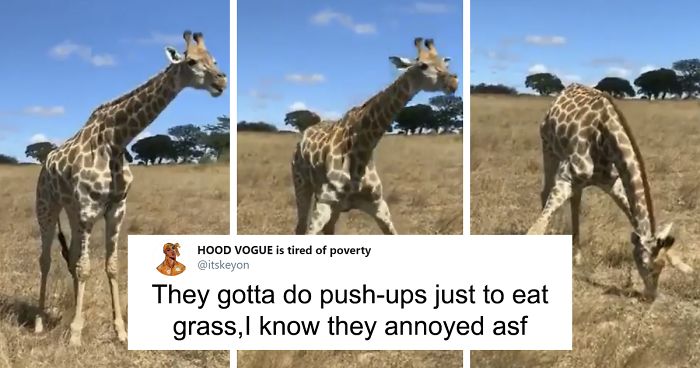
Every now and then, the internet remembers that nature is not only majestic, mysterious, and wildly complexit is also accidentally hilarious. The latest animal moment making people stop mid-scroll features a giraffe trying to eat grass. That sounds simple enough until you remember one very important detail: giraffes are built like living watchtowers.
To reach the ground, a giraffe cannot simply dip its head like a horse or a cow. Instead, it has to spread its long front legs wide apart, lower its neck, balance carefully, and assume a pose that looks like a yoga instructor invented “savanna triangle stretch.” The result is awkward, elegant, and deeply meme-worthy all at once.
But behind the viral video is a real biological puzzle. Why does the world’s tallest land animal have such a hard time reaching the ground? Why do giraffes usually eat leaves instead of grass? And why does this silly-looking snack position actually reveal something serious about giraffe anatomy, survival, and conservation?
Let’s stretch into the sciencefront legs wide, dignity optional.
Why the Viral Giraffe Grass Video Is So Funny
The reason the video works so well is that it flips our expectations. Giraffes are famous for height, grace, and calm confidence. They stroll across the savanna like supermodels with hooves. They can nibble leaves from treetops that most animals can only stare at with envy. They have long eyelashes, patterned coats, and the general energy of an animal that knows it is photogenic from every angle.
Then one tries to eat grass, and suddenly the whole design looks like a furniture assembly project missing one screw.
In the clip, the giraffe spreads its legs far apart to bring its head close enough to the ground. The posture looks exaggerated because the animal’s legs are so longabout six feet in many adults. Its neck is also long, but surprisingly, even that famous neck is not long enough to reach the ground comfortably when the giraffe is standing normally.
That is the funny part: the animal best known for its neck still has a “not enough neck” problem.
Giraffes Are Built for Browsing, Not Grazing
To understand why eating grass looks so awkward, it helps to know what giraffes are actually designed to eat. Giraffes are primarily browsers, not grazers. Browsers feed mostly on leaves, shoots, buds, vines, flowers, and fruits from trees and shrubs. Grazers, such as zebras and wildebeest, spend much more time eating grasses close to the ground.
For giraffes, treetops are the buffet. Their height gives them access to food that many other herbivores cannot reach. Acacia-like trees and other woody plants provide much of their diet, and giraffes use their long, flexible tongues to strip leaves from branches with impressive precision.
Grass, by comparison, is not usually their main course. It is more like the breadbasket at a restaurant: available, sometimes tempting, but not the reason they came.
The Long Tongue Advantage
A giraffe’s tongue can reach roughly 18 to 21 inches, depending on the animal. It is prehensile, meaning it can grasp and manipulate food. The tongue, lips, and mouth work together like a built-in set of salad tongs, helping giraffes pull leaves from thorny branches while avoiding some of the sharpest defenses.
The dark color of the tongue is often described as a form of protection against sun exposure, although scientists are careful about stating that as the only explanation. What is clear is that giraffes spend a lot of time feeding in bright environments, and their tongues are perfectly suited for reaching, wrapping, and plucking.
In other words, giraffes are not poorly designed. They are brilliantly designed for a job that usually happens several feet above the ground.
Why Giraffes Have To Splay Their Legs
The giraffe’s body creates a geometry problem. The legs are extremely long. The neck is extremely long. But the combined length still does not allow the animal to casually lower its mouth to the ground while keeping a normal standing stance.
So giraffes use a workaround. They spread their front legs wide apart, sometimes bend at the knees, and lower their head carefully. This reduces the vertical distance between the mouth and the ground. The same posture is commonly seen when giraffes drink water.
It is a practical solution, but not exactly graceful in the everyday sense. Imagine trying to sip from a drinking fountain while wearing stilts. Now imagine the internet is filming you.
The Drinking Problem Is Even More Important
When giraffes drink from a river, lake, or waterhole, the same awkward posture becomes more than funnyit becomes risky. Lowering the head takes time, and the position can make it harder for the giraffe to react quickly to predators. Large cats and crocodiles are potential threats, especially when the giraffe is bent down and less able to use its height advantage.
That is one reason giraffes often approach water cautiously. They may drink in groups, with some individuals staying alert while others lower their heads. Fortunately, giraffes can get a significant amount of moisture from the leaves they eat, so they do not always need to drink every day when food conditions are favorable.
The viral grass-munching pose may make people laugh, but it also shows how every animal body comes with trade-offs. Height is a superpower in the treetops. At ground level, it becomes a balancing act.
The Hidden Engineering of a Giraffe Body
Giraffes are extreme animals, and extreme bodies require extreme engineering. A giraffe’s heart must pump blood all the way up its long neck to the brain. Its blood pressure is unusually high compared with many mammals. Specialized blood vessels and valves help regulate circulation when the animal raises or lowers its head.
That matters because eating grass or drinking water involves moving the head dramatically downward. Without the right cardiovascular adaptations, that motion could create serious pressure problems. Instead, giraffes manage these changes with biological systems refined by evolution.
The legs are also powerful. A giraffe’s kick can be strong enough to defend against predators, and its long stride allows it to move quickly when needed. Those same legs, however, make low feeding awkward. Evolution is not about making an animal perfect at everything. It is about shaping traits that help the animal survive and reproduce in its environment.
For giraffes, the big win is reaching food high above the competition.
Do Giraffes Actually Eat Grass Often?
Not usually. Giraffes may eat low-growing plants, herbs, and seasonal vegetation when available, but they are not built to spend their day grazing like antelope or cattle. Their normal feeding behavior is focused on trees and shrubs.
That is why videos of giraffes eating grass can feel so surprising. The behavior is real, but it is not the classic picture of giraffe dining. Most of the time, a giraffe would rather browse above shoulder height, where its body plan makes sense and its long tongue becomes a leafy super-tool.
In zoos and wildlife parks, giraffes may also interact with food in ways that look different from wild feeding. They may be offered browse, hay, leafy branches, vegetables, or specially prepared diets. Enrichment feeders are often used to encourage natural foraging behaviors, including reaching, licking, and manipulating food with the tongue.
Why the Internet Loves Awkward Animal Moments
Part of the charm of the viral giraffe video is that it makes an extraordinary animal feel oddly relatable. We may not have six-foot legs, but most of us understand the comedy of trying to do something simple and discovering our body has other plans.
There is also a wholesome surprise factor. The video does not rely on danger or cruelty. It is just a giraffe solving a giraffe problem in the most giraffe way possible. That makes it perfect internet material: quick, visual, harmless, and instantly understandable across languages.
Animal videos often go viral because they compress curiosity into a few seconds. People watch, laugh, and then ask questions. Why does it do that? Is that normal? Are giraffes okay? Suddenly, a funny clip becomes a gateway to learning about anatomy, ecology, and conservation.
That is the best kind of viral content: the kind that starts as “LOL” and ends as “Wait, nature is amazing.”
What This Pose Teaches Us About Evolution
The giraffe’s grass-eating stance is a perfect example of evolutionary compromise. A long neck helps giraffes access food that shorter animals cannot reach. Long legs help them move across open habitats and spot danger from far away. Their height also gives them a feeding advantage in woodlands and savannas.
But the same height creates challenges. Drinking is awkward. Eating from the ground is awkward. Lying down and getting back up require care. Even sleeping comes in shorter patterns than many people expect, because being huge and vulnerable on the ground is not ideal in predator country.
Evolution did not design giraffes to win a floor-snack competition. It shaped them to browse high vegetation, monitor wide landscapes, and survive in habitats where height can be a major advantage.
Giraffes Are More Than One Kind of Animal
For many years, giraffes were commonly discussed as a single species with multiple subspecies. More recent scientific work has supported recognizing four distinct giraffe species: northern giraffe, reticulated giraffe, Masai giraffe, and southern giraffe. This matters because each group faces different population pressures and conservation needs.
Some giraffe populations are relatively more stable, while others are in serious trouble. Habitat loss, poaching, human-wildlife conflict, climate stress, and regional instability can all affect giraffe survival. Conservationists sometimes refer to the giraffe’s decline as a “silent extinction” because these animals are famous and beloved, yet many people do not realize how much pressure they face in the wild.
The viral grass video may be lighthearted, but it offers a useful reminder: these animals are not just internet celebrities. They are living, vulnerable wildlife with complex needs.
How Zoos and Conservation Groups Use Curiosity
Accredited zoos, wildlife organizations, and conservation educators often rely on moments of curiosity to start bigger conversations. A visitor may come to a giraffe exhibit because the animal is tall and beautiful. They may stay because they see the animal use its tongue, bend to drink, or interact with enrichment. Then they learn about habitat protection, anti-poaching work, and responsible conservation funding.
That is why fun animal facts matter. They are not trivia for trivia’s sake. They create emotional connection. When people understand how unusual and specialized giraffes are, they are more likely to care about protecting them.
A giraffe awkwardly eating grass may seem like a small moment, but it can invite millions of viewers to see the animal with fresh attention. In the attention economy, that is no small thing.
Common Questions About Giraffes Eating Grass
Can giraffes eat grass?
Yes, giraffes can eat grass and other low vegetation, but grass is not usually a major part of their diet. They are mainly browsers that feed on leaves, shoots, buds, flowers, vines, and fruit from trees and shrubs.
Why do giraffes spread their legs to eat or drink?
They spread their legs because their long legs and tall bodies make it difficult to reach the ground. By widening their stance, they lower their shoulders and neck enough to bring their mouth closer to grass or water.
Is the splayed-leg position dangerous?
It can be risky in the wild, especially when drinking. A giraffe with its head down has less ability to watch for predators and may need extra time to stand upright again. That is why giraffes often remain cautious around water sources.
Why do giraffes have such long necks if they still cannot reach the ground easily?
The long neck is mainly useful for reaching high vegetation and, in some cases, for male competition. It was not “designed” for ground feeding. The difficulty of reaching the ground is one of the trade-offs of being extremely tall.
Experiences and Reflections: Watching a Giraffe Try To Reach the Ground Changes How You See Them
The first time you see a giraffe lower itself toward the ground, whether in a wildlife documentary, at a zoo, or in a viral video, it can feel almost unreal. We are so used to seeing giraffes framed from the neck up, calmly chewing leaves above the world, that we forget how much physical strategy goes into ordinary movements. A giraffe eating grass is not just eating grass. It is calculating balance, distance, flexibility, and timing with a body that looks like it was designed by someone who really loved vertical lines.
That is what makes the moment so memorable. The giraffe does not look embarrassed. It does not know it has become the star of a social media comedy show. It simply does what works. Legs out, neck down, snack acquired. There is something oddly admirable about that. The animal turns an anatomical inconvenience into a routine movement, and it does so with the calm confidence of a creature that has survived millions of years without needing our approval.
For many viewers, the video also creates a new kind of affection. Giraffes already seem gentle and charming, but seeing one in an awkward pose makes it feel more approachable. The polished postcard version of wildlife gives way to something more honest. Animals are not always majestic in the way humans expect. Sometimes they wobble. Sometimes they stretch. Sometimes they look like they are attempting an advanced Pilates move just to reach lunch.
That experience can be surprisingly powerful for young animal lovers, families, and casual viewers alike. A child who laughs at the video may ask why the giraffe has to stand that way. A parent may look up giraffe facts. A teacher may use the clip to explain adaptation. A wildlife organization may use the attention to talk about conservation. A few seconds of comedy can become a small doorway into science.
It also changes the way people watch animals in person. After seeing the viral clip, visitors at a zoo or safari park may pay closer attention to how giraffes move. They may notice the careful placement of the feet, the slow lowering of the head, the sweeping motion of the neck, or the way the tongue curls around food. Instead of seeing a giraffe as simply “the tall animal,” they begin to see it as a collection of remarkable adaptations.
There is also a useful human lesson tucked inside the humor. The giraffe does not solve its problem by becoming less giraffe-like. It does not need shorter legs or a different body. It uses the body it has. That is a surprisingly good metaphor for problem-solving: sometimes the answer is not elegance; sometimes the answer is a wide stance and commitment.
In a digital world full of intense headlines, a giraffe munching grass can feel like a tiny reset button. It gives people a reason to laugh, learn, and remember that the natural world is stranger and better than anything we could invent. The viral moment is funny because it looks awkward, but it lasts because it reveals something true: even the most graceful creatures have their clumsy angles, and those angles may be the most lovable part.
Conclusion
The viral video of a giraffe splaying its legs wide apart to munch on grass is funny for obvious reasons, but it is also a perfect little science lesson. Giraffes are built for browsing high leaves, not grazing low grass. Their long legs and towering necks give them huge advantages in the treetops, but those same features make ground-level eating and drinking awkward.
So yes, the internet is right to laughkindly. The pose is ridiculous. It is also practical, natural, and wonderfully giraffe. Behind the comedy is a reminder that evolution works through trade-offs, and that even the most iconic animals still have to solve everyday problems one snack at a time.