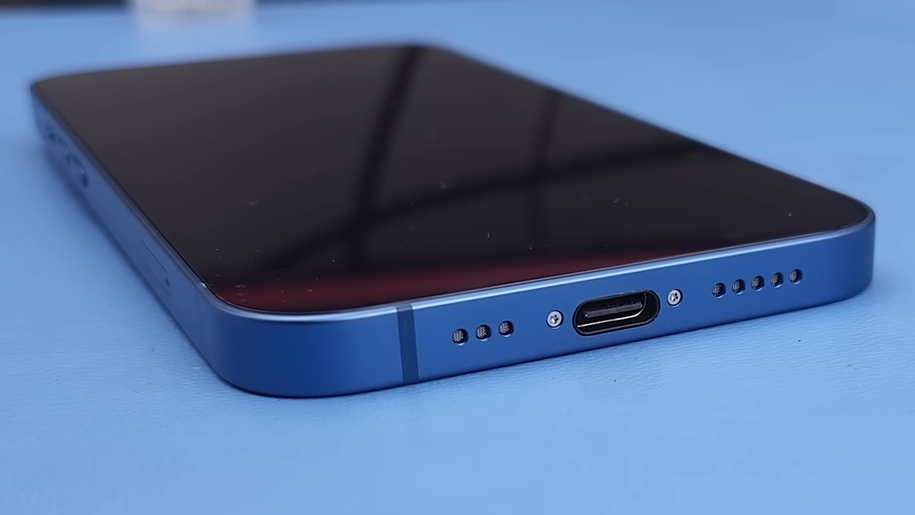
Replacing a connector sounds simple until the connector belongs to an iPhone. Then a project that seems like “remove Lightning, insert USB-C” turns into a tiny engineering adventure involving microscopes, flex cables, precision soldering, custom mechanical work, waterproofing, and enough opportunities for disaster to make a heart surgeon feel relaxed.
That is exactly what made the USB-C iPhone 13 modification created by Restore Technique so fascinating. The project took a standard iPhone 13, which Apple designed around its proprietary Lightning connector, and converted it to use a functional USB-C port. The finished phone was demonstrated with charging, fast charging, reversible cable insertion, and data transfer working through the new connector.
The achievement was especially notable when it appeared in 2022. Apple had already adopted USB-C across several Macs and iPads, yet the iPhone 13 still shipped with Lightning. Apple would not introduce native USB-C on the iPhone until the iPhone 15 generation.
What looks from the outside like a slightly wider hole in the bottom of a phone is therefore a surprisingly useful lesson in electronics engineering, product design, repairability, and the difference between a clever prototype and something that can be manufactured by the million.
Why Put USB-C on an iPhone 13?
The obvious answer is convenience.
USB-C has become the default connector for laptops, tablets, headphones, game systems, cameras, Android phones, accessories, power banks, and an increasingly impressive collection of things people accidentally leave plugged into airport outlets.
The USB Implementers Forum designed USB Type-C around a compact reversible connector capable of supporting scalable power and data capabilities. Unlike older USB plugs, USB-C can be inserted either way, eliminating the traditional ritual of trying a cable, flipping it, discovering that you somehow had it right the first time, and flipping it again.
Lightning is also reversible, of course, and the iPhone 13 was hardly difficult to charge. Apple shipped the model with a USB-C-to-Lightning cable, and the phone supports fast charging with an appropriate USB-C power adapter. Apple states that compatible earlier iPhones can reach roughly 50 percent charge in around 30 minutes under appropriate conditions.
The inconvenience was carrying a different cable for the phone when many other electronics had already migrated to USB-C.
For an enthusiast, there was another reason to attempt the conversion: because it was technically possible.
The USB-C iPhone Idea Did Not Begin With the iPhone 13
The iPhone 13 project followed another famous hardware experiment.
Engineer Ken Pillonel had previously converted an iPhone X to USB-C. Rather than simply attaching a crude external adapter, Pillonel reverse-engineered the necessary electronics and developed a compact internal solution capable of supporting both charging and data transfer. Coverage of the project emphasized that the electronics had to be miniaturized enough to fit within the extremely limited internal volume of the iPhone.
That prototype became unexpectedly valuable as a piece of technology history. The modified iPhone X eventually sold for $86,001 after an online auction attracted enormous attention.
The publicity helped establish an important point: adding USB-C to an older iPhone was possible, but doing it correctly required substantially more work than replacing one socket with another.
How the USB-C iPhone 13 Modification Worked
Starting With Apple’s Existing Lightning Electronics
One of the cleverest aspects of the iPhone 13 conversion was that the builder did not attempt to redesign Apple’s entire charging architecture.
Instead, the project made use of electronics taken from Apple’s USB-C-to-Lightning ecosystem. Hackaday’s coverage describes the use of the C94 board from a Lightning-to-USB-C cable as part of the solution. The goal was essentially to preserve the electronic behavior expected by the iPhone while presenting a USB-C receptacle to the outside world.
This distinction matters. A USB-C connector is merely the visible interface. Behind it are circuits responsible for power negotiation, connection detection, orientation, data paths, and compatibility.
Simply wiring random pins together would be a good way to create a very expensive paperweight.
Working With Extremely Small Flex Cables
Smartphones are built around flexible printed circuits because traditional wires would consume far too much space.
The downside for hobbyists is scale.
The iPhone 13 modification involved adapting approximately 0.5 mm-pitch flex-cable connections to 0.6 mm-pitch pads. At that size, a fraction of a millimeter becomes the electronics equivalent of a canyon.
Tasks like these typically require magnification, fine tweezers, controlled soldering equipment, flux, hot-air rework tools, and a very steady hand. The Restore Technique build listed tools including a microscope, soldering iron, hot-air station, ESD equipment, solder wick, precision blades, tweezers, and measurement equipment.
This is why the project is better described as microsoldering than ordinary soldering.
Finding Physical Space for USB-C
Electronic compatibility was only half the fight.
USB-C and Lightning are physically different connectors. The hole machined into an iPhone chassis for Lightning was not designed to accept a USB-C receptacle.
The enclosure therefore had to be modified.
That introduces a new collection of problems. Remove too much material and the finished port may look sloppy or become mechanically weak. Remove too little and the connector cannot sit correctly. Position it slightly off-center and a cable may bind against the enclosure.
Inside the phone, the port also has to coexist with nearby components. iFixit’s parts information illustrates how integrated the original iPhone 13 Lightning assembly is: the replacement assembly includes the flex cable, logic-board connector, Lightning socket, and two microphones.
In other words, the bottom of an iPhone is not an empty garage waiting for somebody to park a USB-C connector inside.
Charging Was Only One Requirement
A crude USB-C conversion that provides five volts would be interesting, but it would not be especially useful.
The iPhone 13 project aimed considerably higher.
Fast Charging
The modified device demonstrated fast-charging capability rather than being limited to basic low-power charging. This was important because the stock iPhone 13 already supports fast charging through its Lightning connector when paired with a USB-C Power Delivery adapter and appropriate cable. A successful USB-C modification should ideally avoid turning an upgrade into a downgrade.
Reversible Cable Orientation
A USB-C plug is supposed to work in either orientation. The modified phone was designed so users would retain that behavior instead of discovering that their fancy reversible connector had mysteriously become directional.
Maintaining cable reversibility is one of those details that separates a polished hardware hack from a science-fair demonstration.
Data Transfer
Charging was not enough either. The modification preserved wired data connectivity.
That mattered because Lightning on the iPhone 13 serves more purposes than feeding the battery. Apple supports synchronization and data transfer over USB-C-to-Lightning connections, so replacing the port without preserving the relevant data functionality would remove part of the phone’s original capability.
Water Resistance Makes the Mechanical Work Harder
Cutting a larger connector opening in a sealed smartphone creates an obvious problem: water does not respect impressive soldering skills.
The original iPhone housing and connector assembly are engineered as a system. Altering that system means the modifier becomes responsible for restoring a reasonable seal.
The Restore Technique project therefore included a replacement waterproof display seal and sealing work around the USB-C connector. The creator reported testing resistance to water after assembly, although a home modification should never be assumed to retain Apple’s original factory water-resistance rating.
Previous USB-C iPhone experiments encountered the same challenge. Another modified iPhone X used a custom carbon-fiber support component and additional sealing work around the transplanted USB-C port.
This highlights something often overlooked in custom electronics: electrical success is only the beginning. Mechanical strength, strain relief, heat, moisture protection, alignment, and long-term durability matter just as much.
Why Apple Could Do This More Easily Than a Modder
Looking at a hand-built USB-C iPhone sometimes leads to the conclusion that Apple could have replaced Lightning simply by dropping a different connector into the same phone.
That is not quite fair.
A company designing a new phone can rearrange the internal architecture around the connector. Engineers can alter brackets, antennas, flex cables, circuit boards, sealing surfaces, chassis machining, firmware, accessory behavior, and manufacturing equipment before production begins.
A modder faces the opposite problem: the finished phone already exists.
The new connector must adapt to a device that was never designed for it.
That is why a one-off conversion can involve delicate handmade flex cables and internal adapters, while a factory-designed USB-C phone can integrate the interface cleanly from the beginning.
Apple Eventually Moved the iPhone to USB-C
The iPhone 13 modification also captured an interesting moment in technology history.
When the project appeared, USB-C on an iPhone still felt like something enthusiasts had to build themselves. That situation changed with the iPhone 15 family, when Apple replaced Lightning with USB-C on its new phones.
Apple’s current documentation says iPhone 15 and later models use USB-C for charging and data, with compatible models also supporting functions such as external displays, audio accessories, and connections to storage devices.
Regulation helped push the broader industry toward the common connector. European Union common-charger requirements made USB-C the harmonized charging receptacle for categories including wired-chargeable mobile phones, with the requirements applying from December 28, 2024.
That does not make the iPhone 13 hack irrelevant. Quite the opposite. It turns the project into a snapshot of the transition period between Lightning and USB-C.
USB-C Does Not Automatically Mean Faster Data
There is another useful lesson hidden in this project: connector shape and protocol performance are different things.
Seeing USB-C does not automatically tell you how fast a device transfers data.
USB-C describes the connector ecosystem, while different devices can implement different USB data standards behind that connector. Apple’s own USB-C iPhone documentation illustrates the distinction. Certain Pro models support USB 3-class transfer speeds with suitable cables, while the cable supplied with some standard iPhones operates at USB 2 data speeds.
A converted iPhone 13 therefore does not suddenly gain every capability associated with modern USB-C laptops. The new receptacle can expose the functionality engineered into the conversion, but it cannot magically rewrite the phone’s internal hardware architecture.
The port may be new. The phone underneath is still an iPhone 13.
Why This Is Not a Casual Weekend Upgrade
The finished modification looks clean enough that an experienced gadget tinkerer might feel tempted to grab a screwdriver.
That confidence should probably survive at least until the first flex cable appears under a microscope.
Opening an iPhone carries risks to the display, battery, cables, seals, and other components. iFixit’s iPhone 13 repair material shows that even conventional repairs require careful handling of adhesive and tightly packed internal assemblies. Replacing the charging assembly involves significantly more disassembly than plugging in a desktop PC component.
A custom USB-C conversion adds chassis machining and microsoldering on top of that work.
Anyone attempting such a project should view the phone as an engineering platform rather than an irreplaceable daily device. A successful video represents the finished result, not the pile of failed prototypes, sacrificed cables, damaged connectors, and muttered vocabulary that often precedes it.
What the Project Teaches About Modern Electronics
The most interesting lesson may have little to do with Apple versus USB-C.
Modern electronics are extraordinarily integrated.
Consumers see a charging socket as one component because only one component is visible. Inside a smartphone, however, that socket belongs to a network of mechanical and electrical systems.
Changing it can affect:
- power delivery and charging negotiation,
- USB data communication,
- cable-orientation detection,
- microphones and nearby flex assemblies,
- mechanical support,
- water sealing,
- accessory compatibility, and
- the physical structure of the enclosure.
That is what makes projects like the USB-C iPhone 13 valuable even for people who will never perform the modification themselves. They expose layers of engineering normally hidden behind polished aluminum and glass.
A Broader Repairability Experiment
USB-C conversion projects also overlap with the growing interest in keeping electronics useful for longer.
Pillonel, whose earlier USB-C iPhone helped inspire similar experiments, later applied the same philosophy to other Apple products, creating replacement USB-C electronics and repair-oriented designs for devices including AirPods. Ars Technica documented his efforts to make traditionally difficult-to-service hardware more repairable and extend its usefulness.
By 2025, Pillonel had even developed cases that add USB-C connectivity to older Lightning-era iPhones without requiring owners to perform the original invasive internal modification. Those designs illustrate the same fundamental engineering challenge in a more consumer-friendly format: translate between Lightning-era electronics and the USB-C world while retaining charging and data functionality.
The evolution from one-off microsoldering experiment to external accessory is a useful reminder that clever prototypes can eventually inspire more practical solutions.
Conclusion: A Tiny Port With a Huge Amount of Engineering Behind It
Adding USB-C to an iPhone 13 proved that a determined hardware enthusiast could give a Lightning-era iPhone the connector many users wanted years before upgrading their phones.
But the real story was never merely USB-C.
It was the process required to make USB-C behave as though it belonged there.
The project combined reverse engineering, microsoldering, flex-circuit modification, enclosure machining, charging electronics, data connectivity, mechanical reinforcement, and sealing. Every successful cable insertion at the end represented dozens of tiny engineering decisions hidden inside the phone.
Today, buying a newer USB-C iPhone is considerably easier than performing the conversion. Apple has already made USB-C standard on modern iPhone models, and USB-C has become deeply established across the consumer-electronics market.
Yet the modified iPhone 13 remains impressive precisely because the builder did not have the luxury of redesigning the phone. The job was to persuade an existing Lightning device to accept a completely different physical interface without sacrificing the features that made the original port useful.
That is delicate work indeed.
Hands-On Lessons From Projects Like a USB-C iPhone 13 Conversion
Watching a polished hardware-modification video can create a dangerous illusion: the project appears to proceed in a straight line. Screw comes out, component comes off, solder goes on, phone works, triumphant music begins.
Real bench work rarely behaves that politely.
The first practical lesson from projects like the USB-C iPhone 13 conversion is that preparation often matters more than soldering talent. Before touching the phone, an experienced builder needs to understand where every cable runs, which assemblies overlap, where heat can safely be applied, and how the replacement connector will physically sit when the device is reassembled.
That last detail is particularly important. A port can work perfectly on an open test bench yet fail after the phone is screwed together because a flex cable folds incorrectly or the connector sits half a millimeter too high. In normal woodworking, half a millimeter might qualify as excellent craftsmanship. Inside a smartphone, half a millimeter can be a traffic jam.
Another lesson is to test progressively.
A careful modifier does not perform every operation, seal the phone, install all the screws, admire the result, and only then discover that data transfer is dead. Power, orientation, charging behavior, and data connectivity should be checked whenever the project reaches a sensible testing stage.
This approach dramatically reduces troubleshooting possibilities. If the phone worked before one modification and failed immediately afterward, the latest change becomes the obvious suspect. If twenty modifications happened between tests, congratulations: you now have twenty suspects and no alibis.
Magnification also changes the experience completely. Under the naked eye, tiny contacts may look perfectly clean. Under a microscope, a solder bridge suddenly resembles the Golden Gate Bridge. Pads that seemed enormous become delicate metallic islands surrounded by components that absolutely do not want to meet a soldering iron.
Heat management becomes equally important. Modern flex circuits and nearby plastic structures tolerate far less abuse than a full-size circuit board. Successful microsoldering is often about applying exactly enough energy, in exactly the right place, for exactly long enough. More heat is not more professional.
Mechanical finishing deserves the same patience. Enlarging the phone’s port opening is irreversible. Electronics can sometimes be desoldered and tried again; aluminum removed from the chassis does not grow back overnight. Measurements, alignment checks, and gradual material removal are therefore far safer than an enthusiastic attack with a rotary tool.
Reassembly produces its own surprises. Adhesive seals must sit correctly. Flex cables cannot be trapped beneath brackets. Screws should return to their proper locations. Connectors need to be fully seated without excessive force. A modification can function electrically and still fail as a finished device if the mechanical details are rushed.
Perhaps the most valuable experience, however, is understanding why consumer hardware costs so much to engineer. Building one working prototype is difficult. Designing a version that can survive drops, moisture, thousands of cable insertions, temperature changes, manufacturing tolerances, automated assembly, warranty expectations, and millions of users is an entirely different challenge.
The USB-C iPhone 13 mod makes the first challenge beautifully visibleand offers a small glimpse of just how enormous the second one really is.