Changing a watch band sounds like one of those tiny tasks that should take thirty secondsuntil a spring bar launches across the room like it has somewhere more important to be. The good news? You usually do not need a jeweler, a white glove, or a tiny velvet chair for your watch to sit on while you work. With the right method, a clean surface, and a little patience, you can replace a leather strap, silicone band, metal bracelet, NATO strap, or smartwatch band at home.
This guide covers four quick and easy ways to change a watch band without a jeweler. We will walk through tool-free quick-release bands, traditional spring bar straps, drilled-lug watches, and modern smartwatch systems. You will also learn how to measure lug width, avoid scratches, test the fit, and know when a professional really is the safer choice. Because yes, independence is greatbut so is not turning your favorite watch into a tiny expensive rattle.
Before You Start: Check What Kind of Watch Band You Have
Most watch bands attach to the watch case at the lugsthe two little arms on each side of the case. Between those lugs, you will usually find a spring bar, which is a small metal tube with spring-loaded tips. Compress the tips, and the band comes out. Release them into the lug holes, and the band stays in place.
Some newer bands make this even easier with quick-release levers. Many smartwatches use their own button, slider, or cartridge-style system. A few traditional or rugged watches use screws instead of spring bars, and some luxury or integrated bracelets require special handling. The first step is simply flipping the watch over and looking carefully. Your watch is basically telling you what it needs; it just speaks in tiny metal parts.
Basic Supplies That Make the Job Easier
- A soft microfiber cloth or padded mat
- A spring bar tool, ideally with a forked end and pin end
- A small parts tray or bowl
- Painter’s tape to protect polished lugs
- A ruler or caliper for measuring lug width in millimeters
- Good lighting, because watch parts love shadows
Never work over carpet if you can avoid it. A dropped spring bar on carpet becomes a full archaeological expedition. A white towel or tray is much friendlier.
Way 1: Use a Quick-Release Watch Band
The fastest way to change a watch band without a jeweler is to use a quick-release strap. These bands have a tiny lever built into the spring bar. Instead of using a tool to compress the spring bar, you slide the lever with your fingernail and lift the strap away from the watch case.
Best For
Quick-release bands are ideal for everyday watches with standard lugs. They are common on leather, silicone, canvas, nylon, and some metal mesh straps. If you like switching from “office leather” to “weekend silicone” faster than you can decide what to order for lunch, this is your method.
How to Remove a Quick-Release Band
- Place the watch face down on a microfiber cloth.
- Find the small lever on the back side of the band near the lug.
- Slide the lever inward toward the center of the strap.
- While holding the lever, gently angle the strap away from the watch case.
- Repeat on the other side.
How to Install a Quick-Release Band
- Insert the fixed end of the spring bar into one lug hole.
- Slide the quick-release lever inward to shorten the spring bar.
- Position the other end between the lugs.
- Release the lever and listen or feel for a small click.
- Gently tug the band to confirm it is locked in place.
Make sure the buckle side of the strap goes at 12 o’clock and the long tail goes at 6 o’clock. This is the standard orientation for most watches. Will the universe collapse if you install it backward? No. Will it feel weird on your wrist and quietly annoy you all day? Absolutely.
Way 2: Use a Spring Bar Tool for a Traditional Watch Strap
If your watch band does not have a quick-release lever, it probably uses standard spring bars. This is still very doable at home. A spring bar tool is inexpensive, small, and much safer than improvising with a kitchen knife, which is how watches get scratched and people learn new vocabulary.
Best For
This method works well for traditional leather straps, rubber straps, silicone straps, many fabric bands, and some metal bracelets. It is especially useful when the watch has solid lugs without drilled holes on the outside.
How to Remove the Old Band
- Lay the watch face down on a soft cloth.
- If the lugs are polished, place a small strip of painter’s tape on them for protection.
- Insert the forked end of the spring bar tool between the strap and the lug.
- Feel for the shoulder or ridge of the spring bar.
- Push the spring bar inward toward the strap to compress it.
- While compressed, gently pull the strap away from the case.
- Remove the spring bar and place it in a parts tray.
- Repeat on the other side.
The key word is gently. If you are wrestling the watch like it owes you rent, stop and reposition the tool. Spring bars are small, but they are not complicated. Usually, one tip is simply not compressed enough to clear the lug hole.
How to Install the New Band
- Slide a spring bar through the end of the new strap.
- Place one spring bar tip into the lower lug hole.
- Use the forked tool to compress the other tip.
- Guide the strap between the lugs.
- Slowly move the strap until the tip snaps into the lug hole.
- Repeat on the other half of the band.
- Pull gently on both sides to test security.
If the spring bar does not click into place, do not wear the watch yet. A loose spring bar can pop out at exactly the worst moment, such as when you are waving hello, carrying groceries, or dramatically checking the time like a spy in a movie.
Way 3: Change a Band on a Watch with Drilled Lugs
Some watches have tiny holes drilled through the outside of the lugs. These are called drilled lugs, and they make strap changes easier because you can access the spring bar tips directly from the outside. Many field watches, dive watches, and tool watches use this setup.
Best For
This method is great for watches with visible holes on the sides of the lugs. You can use the pointed end of a spring bar tool, a proper pin pusher, or, in a pinch, a very small paper clip. A proper tool is still better, but drilled lugs are forgiving for careful beginners.
How to Remove the Band
- Place the watch face down on a soft surface.
- Locate the small hole on the outside of one lug.
- Insert the pointed end of your spring bar tool into the hole.
- Push inward to compress the spring bar tip.
- While pressing, gently pull that side of the strap away from the case.
- Repeat on the other end of the same spring bar if needed.
- Remove the band and store the spring bar safely.
How to Install the New Band
Installation is similar to the traditional spring bar method. Insert the spring bar through the strap, seat one tip into a lug hole, compress the other tip, and guide it into position. With drilled lugs, you can use the outside hole to nudge the spring bar into alignment if it does not seat immediately.
Drilled lugs are wonderfully practical, but they do not make your watch scratch-proof. Keep the tool straight, use light pressure, and avoid dragging metal across the case. The goal is a strap change, not abstract art on your lugs.
Way 4: Swap a Smartwatch or Proprietary Watch Band
Many modern smartwatches and fitness watches use proprietary band systems. Apple Watch bands slide into a channel after you press a release button. Some Samsung Galaxy Watch models use one-click buttons. Many Garmin models use QuickFit or quick-release systems, depending on the device. These designs are made for easy swapping, which is convenient because your watch may go from workout mode to dinner mode more often than you do.
Best For
This method applies to smartwatches, fitness watches, and modern watches with branded quick-change mechanisms. It is also useful if you use adapters that allow traditional straps to fit a smartwatch case.
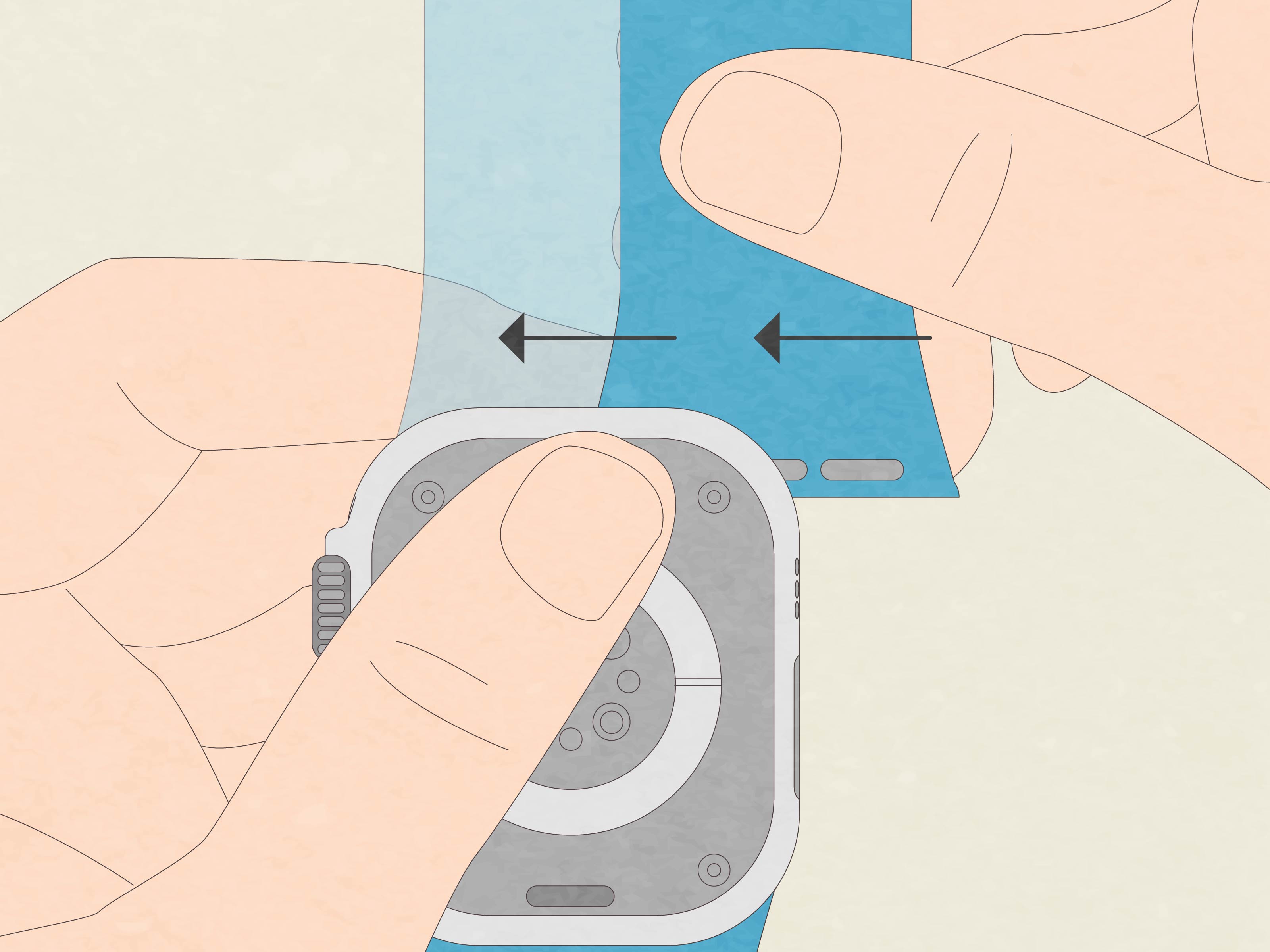
How to Change an Apple Watch Band
- Place the Apple Watch face down on a clean, soft cloth.
- Press and hold the band release button on the back of the watch.
- Slide the band sideways out of the channel.
- Repeat for the other side.
- Slide the new band in until it locks securely.
Do not force the band into the slot. If it does not slide easily, check the orientation. Some Apple Watch bands only fit smoothly in one direction. Forcing it is like arguing with a vending machine: loud, awkward, and rarely productive.
How to Change a One-Click or QuickFit Smartwatch Band
- Turn the watch over so the back is facing up.
- Locate the release button, tab, or lever near the band connection.
- Press or slide the release mechanism while pulling the band away.
- Align the new band with the connector.
- Push it into place until it clicks or feels firmly seated.
- Gently tug to confirm both sides are secure.
Always use a band designed for your exact smartwatch model or lug width. A band that “almost fits” is not a bargain; it is a future floor impact waiting to happen.
How to Measure Watch Band Size Correctly
Before buying a replacement watch band, measure the lug width. This is the distance between the inside edges of the lugs, usually measured in millimeters. Common sizes include 18mm, 20mm, 22mm, and 24mm, but odd sizes exist. A digital caliper is best, but a ruler with millimeter markings works if you are careful.
Do not measure the old strap only. Straps can stretch, taper, or be mislabeled. Measure the watch case itself where the band attaches. If your watch has a 20mm lug width, buy a 20mm band. A strap that is too wide may bunch up or fail to seat properly. A strap that is too narrow may leave gaps and wiggle like it is nervous.
Common Mistakes to Avoid
Using the Wrong Tool
A screwdriver, pocketknife, or random sharp object may work once, but it can easily scratch the case or damage the spring bar. A spring bar tool costs little and saves a lot of regret.
Forgetting to Test the Band
After installation, tug both sides of the band firmly but gently. You should not see the spring bar shift or hear clicking. If anything feels loose, remove the band and reinstall it.
Reusing Worn Spring Bars
Spring bars are inexpensive. If yours are bent, rusty, weak, or suspiciously wobbly, replace them. Fresh spring bars are cheap insurance for a watch you actually like.
Ignoring Water Resistance
Changing a band usually does not affect water resistance unless you open the case, but some dive watches, integrated bracelets, or specialty bars may be part of the watch’s secure wearing system. If you are unsure, check the brand’s instructions.
When You Should Still Visit a Jeweler or Watchmaker
Changing a watch band at home is safe for most everyday watches, but there are exceptions. Visit a professional if your watch has an integrated bracelet, hidden screws, damaged lugs, vintage case parts, gold or delicate precious-metal lugs, or a high-value bracelet with fitted end links. Also get help if a spring bar is jammed, the lug hole looks damaged, or the band refuses to budge after several careful attempts.
There is no shame in calling a professional. A jeweler or watchmaker has the tools and experience to solve tricky cases quickly. The point of DIY is confidence, not turning a five-minute job into a tiny mechanical tragedy.
Extra Experience: What Changing Watch Bands Teaches You After a Few Tries
The first time you change a watch band, it may feel oddly dramatic. You place the watch face down, pick up the spring bar tool, and suddenly the room gets quiet. The tiny spring bar appears harmless, but you know it has the personality of a popcorn kernel. One wrong angle and it may leap into another dimension. After a few tries, though, the process becomes surprisingly satisfying. It is one of the easiest ways to make an old watch feel new again.
One practical lesson is that preparation matters more than force. People often struggle because they start with the watch in one hand, the tool in the other, and no plan for where loose parts will go. A soft cloth, bright light, and small tray instantly make the job easier. The watch stays stable, the case avoids scratches, and the spring bars have fewer opportunities to escape. This simple setup can turn a frustrating job into a calm five-minute routine.
Another lesson is that strap material changes the whole personality of a watch. A black leather band can make a simple field watch look office-ready. A rubber strap can make the same watch feel sporty and practical. A NATO-style nylon strap gives a casual, outdoorsy look and often adds comfort in warm weather. A stainless steel bracelet can make a watch feel heavier, dressier, and more substantial. Changing a watch band is not just repair; it is wardrobe strategy for your wrist.
Quick-release straps are especially addictive. Once you own two or three, you may start matching straps to shoes, jackets, seasons, moods, and imaginary vacations. Brown leather for Monday meetings. Silicone for the gym. Olive nylon for Saturday errands. Blue canvas because the weather is nice and your watch deserves a little vacation. It sounds excessive until you realize that one watch can serve several roles simply by changing the band.
You also learn to respect fit. A strap can be beautiful but wrong for the watch if the lug width is off, the thickness is too bulky, or the spring bars do not seat securely. Many beginners focus only on color and material. Experienced strap-swappers check width, taper, hole spacing, buckle size, wrist comfort, and whether the strap clears the case. The small details are what separate “nice upgrade” from “why does this feel like wearing a garden hose?”
The biggest confidence boost comes from learning the click. When a spring bar seats correctly, you can often feel or hear it snap into place. That tiny click is the sound of success. Still, the final tug test is non-negotiable. Hold the watch over a soft surface and pull gently on both sides of the band. If it stays put, you are ready to wear it. If it slips, reseat it. This habit prevents accidents and gives peace of mind.
Over time, changing watch bands becomes less about saving a trip to the jeweler and more about enjoying your watch. You notice the case shape, the lug design, the way different materials balance the dial, and how comfort changes throughout the day. It is a small DIY skill, but it makes watch ownership more personal. Plus, it gives you a useful party trick, assuming you attend parties where people appreciate spring bars. If not, you still get a better-looking watch, which is a pretty good consolation prize.
Conclusion
Learning how to change a watch band without a jeweler is one of the simplest ways to refresh your watch, save money, and make your timepiece fit your lifestyle. For the fastest swap, choose a quick-release band. For classic watches, use a spring bar tool and work patiently. For drilled lugs, use the outside lug holes to compress the spring bars with better control. For smartwatches, follow the built-in release system and avoid forcing anything that does not align.
The golden rule is simple: protect the watch, control the spring bars, test the fit, and know when to stop. Most band changes are beginner-friendly, but delicate, luxury, vintage, or unusual watches may deserve professional care. Your watch does not need a jeweler for every outfit changebut it does appreciate a steady hand and a soft landing zone.
Note: This article is based on current watch manufacturer guidance, watch repair best practices, and common strap-changing methods used for traditional watches, quick-release bands, and popular smartwatch systems. Always check your specific watch model before applying pressure or using tools.