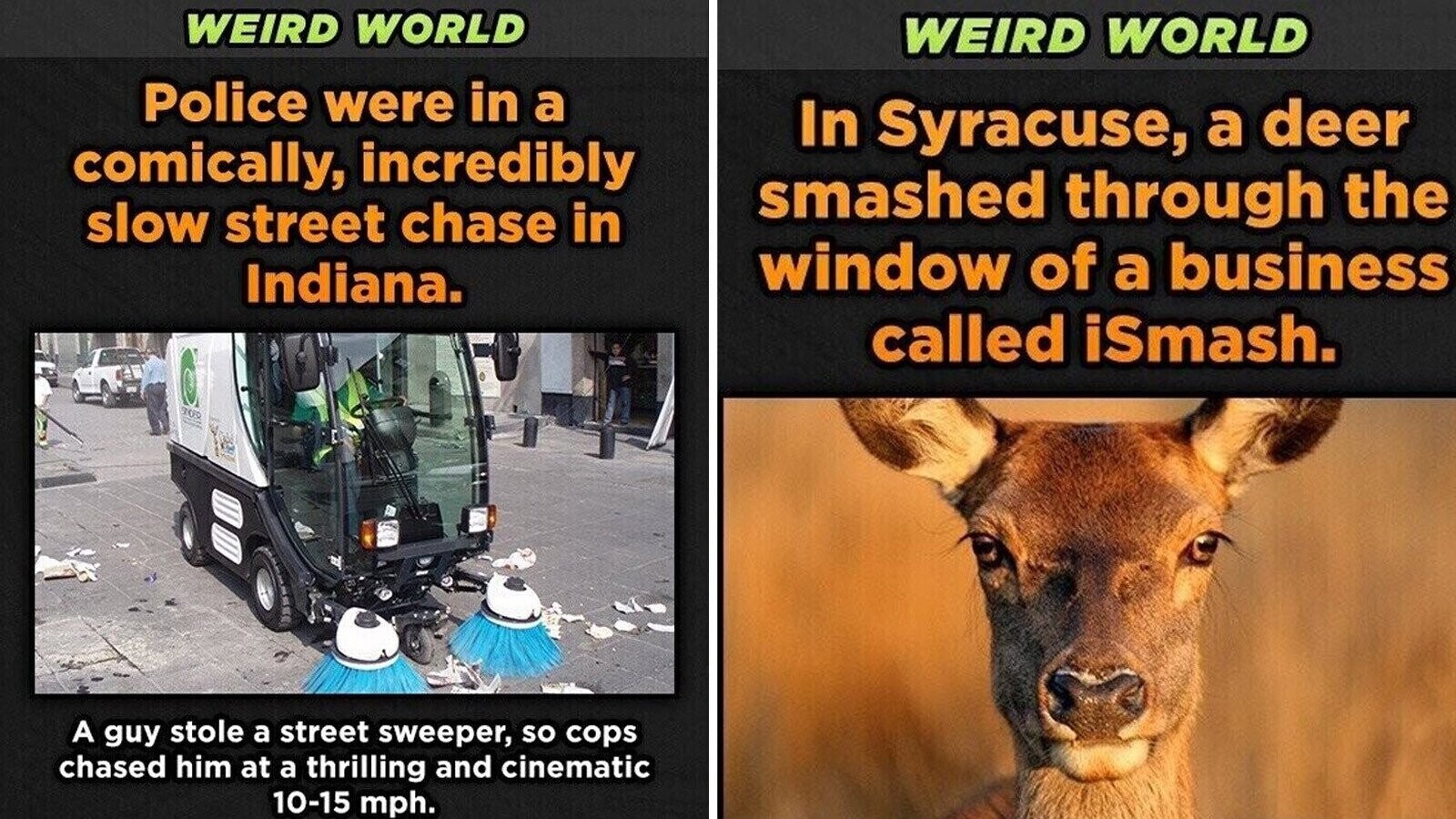
Note: The “Thanos snap” idea here is pure pop-culture exaggeration. Nobody needs to vanish. We are simply requesting a cosmic clean-up button for the weirdest corners of the news cycle.
Every so often, the news stops acting like news and starts behaving like a raccoon with a press badge. One minute you are reading about global trade, and the next minute a cargo ship is parked sideways in a canal like someone failed parallel parking on the final boss level. That is the magic of bizarre news events: they remind us that reality has no editor, no outline, and apparently no adult supervision.
Below are 27 real strange news stories and historical oddities that prove the world is both deeply complicated and suspiciously committed to slapstick. From runaway animals and mysterious monoliths to insects with better PR than most celebrities, these weird headlines are funny, unsettling, memorable, and oddly educational. They also make one thing clear: humanity does not need more drama. We need a giant universal “refresh” button and perhaps a strongly worded memo to nature.
Why Bizarre News Events Go Viral
Bizarre news succeeds because it breaks the pattern. Regular headlines ask us to understand policy, finance, weather, or conflict. Weird news asks us to imagine a moose casually walking into a hospital lobby for a salad. The brain loves surprise, and strange-but-true stories deliver it with a side of “wait, that actually happened?” They are also easy to share. A story about a lost space tomato does not require a political science degree. It requires curiosity, a sense of humor, and the emotional strength to accept that NASA can track orbital mechanics but still misplace produce.
27 Bizarre News Events That Sound Fake but Are Real
1. The Ever Given Turned the Suez Canal Into a Parking Lot
In 2021, the massive container ship Ever Given became wedged across the Suez Canal, disrupting global trade and launching a thousand memes. It was an international logistics crisis, but visually it looked like the world’s largest bath toy got stuck in a drain. For nearly a week, one ship reminded everyone that modern civilization runs on narrow waterways and crossed fingers.
2. The Utah Monolith Appeared Like an Alien Art Project
In 2020, a shiny metal monolith was found in the Utah desert, and people immediately did what people do best: blamed aliens, artists, or extremely bored hikers. Similar structures later appeared elsewhere. The whole thing felt like a low-budget science fiction trailer where the aliens had a great design department but forgot the plot.
3. NASA Lost a Tomato in Space
A tiny tomato grown aboard the International Space Station went missing and later turned up after months of joking suspicion around astronaut Frank Rubio. Space exploration is one of humanity’s proudest achievements, yet this story had the emotional rhythm of losing a grape under the fridge. It was science, mystery, and salad drama in zero gravity.
4. The “Balloon Boy” Hoax Floated Across America
In 2009, a homemade helium balloon shaped like a flying saucer drifted across Colorado while people feared a child was inside. The boy was later found at home, and the story was eventually treated as a hoax. It became a national lesson in media frenzy, family chaos, and why flying-saucer-shaped DIY projects should come with a therapist.
5. A Monkey Took a Selfie and Sparked a Copyright Fight
A macaque named Naruto snapped a famous selfie with a photographer’s camera, leading to years of legal debate over who could own the image. The monkey did not hire a lawyer, as far as we know, but still became the face of a surprisingly serious copyright conversation. Somewhere, a banana probably got billed as a consultation fee.
6. “Murder Hornets” Became America’s Nightmare Bug
Northern giant hornets were detected in Washington state, and the phrase “murder hornet” entered the public imagination with all the calm energy of a horror movie poster. Officials later announced the invasive hornets had been eradicated in the United States. It was rare good news in the category of “large insects we would rather not meet personally.”
7. Oregon Had a Highway Covered in Slime Eels
In 2017, a truck carrying hagfish overturned on Oregon’s Highway 101, covering cars and pavement in slippery slime. Hagfish produce mucus as a defense mechanism, which is scientifically fascinating and emotionally unacceptable when it is on your vehicle. The cleanup looked like a seafood restaurant had a nervous breakdown.
8. Arizona Watched a Live Llama Chase
In 2015, two llamas escaped in Sun City, Arizona, and TV viewers watched as people tried to capture them. It was a slow-speed chase with hooves, dignity, and absolutely no cooperation from the suspects. The internet had a perfect day. The llamas had freedom. The humans had cardio.
9. Chicago Met Chance the Snapper
In 2019, an alligator nicknamed Chance the Snapper was spotted in Chicago’s Humboldt Park Lagoon. For days, the reptile avoided capture and became a local celebrity. Chicago already has wind, traffic, and deep-dish pizza debates; adding an alligator to the civic agenda felt ambitious.
10. WallyGator Was Denied Entry to a Phillies Game
In 2023, an emotional support alligator named WallyGator was denied entry to a Philadelphia Phillies game. Ballpark officials allowed service animals but not all other animals, which is reasonable because “left field gator incident” is not a phrase anyone wants in a sports recap. Still, WallyGator became an instant odd-news icon.
11. A Moose Walked Into an Alaska Hospital Lobby
In Anchorage, a moose wandered into a medical building and started eating plants. It sounds like the beginning of a joke, but it was real. Security guided the animal out, and everyone learned that hospital lobbies should maybe reconsider their salad-bar aesthetic.
12. Bears Raided a Krispy Kreme Delivery Van
At an Alaska military base, two bears climbed into a Krispy Kreme van and helped themselves to pastries. The driver had left the doors open during a delivery stop, and the bears made the kind of decision many humans would also make if nobody were watching. Wildlife management met glazed temptation.
13. A Raccoon Got Trapped in a Vending Machine
At a Florida high school, a raccoon ended up inside a snack vending machine and had to be freed. Officials joked about vending-machine burglary, which feels fair because raccoons already dress like tiny bandits. This was not a crime wave; it was a snack emergency with paws.
14. A Zebra Went on the Lam Near Seattle
In 2024, a zebra escaped from a trailer near North Bend, Washington, and remained loose long enough for officials to close trailheads to keep crowds away. The phrase “zebra on the lam” should not be a public-safety update, yet here we are, galloping through the dictionary.
15. A Kansas Flamingo Became a Long-Term Fugitive
A flamingo that escaped a Kansas zoo in 2005 was spotted years later on the Texas coast. Nicknamed Pink Floyd, the bird became a legend of feathered independence. Some people dream of moving south and starting over; this flamingo actually did it and looked fabulous the entire time.
16. San Francisco’s Sea Lions Took Over Pier 39
San Francisco’s Pier 39 has long been famous for sea lions, but in 2024, more than 1,000 gathered there, drawn by anchovies. That is not a crowd; that is a barking, flopping, seafood-motivated conference. Tourists loved it. The anchovies probably did not.
17. Tumbleweeds Buried Roads and Neighborhoods
In Washington and Utah, tumbleweeds have piled so high that roads, cars, and homes were blocked. Tumbleweeds are supposed to drift dramatically across Western movie scenes, not form hostile landscaping committees. When a plant needs heavy equipment to remove it, the plant has overstepped.
18. Boston Was Hit by a Molasses Flood
In 1919, a storage tank burst in Boston’s North End, sending millions of gallons of molasses through the streets. The event was tragic and destructive, but it remains one of history’s strangest industrial disasters. It also proves that “slow as molasses” does not apply when the molasses is moving through a city.
19. Australia Had an Emu War
In 1932, Australia launched a military-style effort to control emus damaging crops in Western Australia. The birds did not cooperate, and the episode became famous as the Great Emu War. Any time history includes the phrase “the birds won,” civilization should pause and take notes.
20. The 2024 Double Cicada Emergence Sounded Apocalyptic
In 2024, two periodical cicada broods emerged in the United States at the same time, a rare overlap not seen since the early 1800s. The result was a loud, crunchy, red-eyed natural spectacle. Scientists called it fascinating. People with open windows called it “absolutely not.”
21. A Goat Became an Honorary Mayor in Vermont
A goat named Lincoln became the honorary mayor of Fair Haven, Vermont, in 2019. The town did not have an actual mayor, so the title was symbolic, but still: a goat held public office. Depending on your view of politics, this may be bizarre, adorable, or a concerning improvement.
22. A Florida Neighborhood Faced a Lionhead Rabbit Invasion
In Wilton Manors, Florida, dozens of domestic lionhead rabbits multiplied after being released, leaving residents and rescue groups to find humane solutions. They were fluffy, cute, and logistically overwhelming. It was like a children’s storybook got loose and started chewing outdoor wiring.
23. Cleveland Released Around 1.5 Million Balloons
In 1986, Cleveland’s Balloonfest attempted a massive balloon release. What looked festive became an example of how spectacular ideas can create spectacular problems when weather, cleanup, and consequences arrive. It is the kind of event that makes future planners whisper, “Maybe confetti is enough.”
24. Boaty McBoatface Won the Internet
When the public was invited to name a British polar research vessel, the internet chose Boaty McBoatface. Officials ultimately named the ship after Sir David Attenborough, but the silly name survived for a submersible. It remains a perfect case study in why open naming contests need seatbelts.
25. A Rare Blue-Eyed Cicada Became a Tiny Celebrity
During the 2024 cicada emergence, a rare blue-eyed cicada was spotted near Chicago. Most periodical cicadas are known for reddish eyes, so this one became an insect celebrity. It was basically the bug version of walking into a party wearing a custom suit.
26. Chonkers the Sea Lion Drew Crowds
San Francisco later gained another marine celebrity when a giant sea lion nicknamed Chonkers drew crowds at Pier 39. The appeal was simple: a huge animal, an unforgettable name, and the universal joy of watching wildlife behave like it owns waterfront property.
27. Cattle, Cars, and Highways Created Rural Absurdity
Escaped livestock on highways may not sound glamorous, but it regularly becomes strange news because it turns ordinary traffic into a farm-themed obstacle course. A road full of cattle, zebras, or llamas reminds us that transportation planning did not fully account for animals with strong opinions.
What These Weird Headlines Reveal About Us
Bizarre news events are not just random entertainment. They expose the seams in everyday life. A ship blocks global trade, and suddenly everyone understands supply chains. A monolith appears in the desert, and people reveal how much they want mystery. A moose walks into a hospital, and we remember that humans built automatic doors but forgot moose can also use them.
These stories also show how fast the internet turns confusion into culture. The llama chase became memes before the animals were even fully captured. Boaty McBoatface became a permanent symbol of democratic chaos. Chance the Snapper received a better public-relations campaign than many startups. Weird news is the internet’s favorite raw material because it is short, visual, and emotionally low-risk. You can laugh at a raccoon in a vending machine without needing a three-hour debate panel.
Experience Section: What It Feels Like to Live in the Age of Bizarre News
Reading bizarre news today feels like standing in a grocery checkout line where every magazine cover was written by a caffeinated raccoon. You start with one normal headline, then somehow end up learning about a tomato missing in space, a flamingo living its best coastal life, and a sea lion named Chonkers becoming a dockside celebrity. The experience is funny, but it is also strangely comforting. The world can feel heavy, complicated, and overloaded with serious problems. Weird news gives the brain a small window to breathe.
There is a particular joy in the phrase “this cannot be real,” followed by the discovery that yes, it is real, and yes, multiple officials had to comment on it. That is the emotional engine behind odd news stories. They create a shared moment of disbelief. People may disagree about almost everything, but most can unite around one question: “How did a raccoon get into the vending machine?” In that tiny moment, the internet becomes less like a battlefield and more like a group chat full of people pointing at the same ridiculous screenshot.
These stories also make ordinary life feel more cinematic. After reading about the Ever Given, a person stuck behind a slow truck may suddenly imagine themselves in a miniature Suez Canal incident. After seeing the llama chase, any loose neighborhood pet seems like the opening scene of a documentary. After hearing about the moose in the hospital, even automatic doors seem suspiciously generous. Weird news changes how we look at normal spaces. A school, a ballpark, a highway, a pier, or a hospital lobby can become a stage for absurdity at any moment.
There is a lesson here for content creators, too. Bizarre news performs well because it combines truth, surprise, and clean storytelling. The best strange headlines are simple enough to explain in one sentence but odd enough to remember for years. “A ship blocked the Suez Canal.” “A monkey took a selfie.” “A goat became mayor.” Each one is a tiny story engine. You do not need clickbait when reality is already wearing a clown hat and carrying official paperwork.
At the same time, good bizarre-news writing should keep empathy intact. Animals should not be treated like props, and real accidents should not be reduced to jokes when people were harmed. The sweet spot is playful curiosity: laugh at the absurd situation, not at suffering. That is why the best approach is to treat these events like reminders that reality is unpredictable, humans are improvising, and nature has a prank department with excellent timing.
Conclusion
The strangest news events are funny because they make reality feel unscripted. They are also useful because they reveal how fragile, flexible, and deeply weird our systems can be. A canal can stop because of one ship. A city can rally around an alligator. A scientific mission can include a missing tomato. A public naming contest can accidentally create Boaty McBoatface.
So yes, the next time a headline makes you wish Thanos would get busy with that whole “snap” thing, take a breath. The world does not need to vanish. It just needs a better filing system, fewer open delivery vans near bears, stronger vending-machine security, and maybe a small committee to ask, before every major decision: “Could this become a weird news headline tomorrow?”