A great Saturday Night Live monologue has one deceptively simple assignment: convince millions of viewers that the next 90 minutes are worth losing sleep over. Sometimes the host delivers polished stand-up. Sometimes the cast rushes onstage wearing costumes that appear to have been assembled during a minor electrical emergency. And sometimes a nervous movie star begins singing because the writers have correctly determined that rhythm is cheaper than confidence.
Since SNL premiered in 1975, its opening monologues have evolved into miniature comedy events. They can introduce a new performer, revive an old favorite, respond to a national crisis, or transform celebrity gossip into a catchy musical number. The best SNL monologues do more than generate laughs. They establish the host’s personality, capture a cultural moment, and occasionally produce a joke people are still quoting decades later.
The following selections span stand-up sets, musical performances, surprise reunions, political commentary, social-media jokes, and affectionate celebrity cruelty. Rankings are naturally subjective, but these 15 moments stand out for their originality, influence, timing, or pure rewatchability.
Historical background supported by NBC and Time.
The Funniest and Most Memorable SNL Opening Monologues
1. George Carlin Introduces America to a Strange New Saturday Night
George Carlin hosted the first episode of what was then called NBC’s Saturday Night on October 11, 1975. Instead of performing in sketches, Carlin delivered several portions of his stand-up act throughout the broadcast. His opening material included an observational comparison of football and baseball, demonstrating how ordinary language could reveal the personalities of two entire sports.
The performance feels unusual compared with modern SNL monologues. There is no promotional speech, no cast interruption, and no parade of celebrity cameos. It is simply Carlin, a microphone, and the confidence of someone who apparently did not receive the memo that live television was supposed to be terrifying. His direct style gave the experimental new program an immediate comedic identity.
George Carlin details supported by NBC and Time.
2. Steve Martin’s Holiday Wishes Become Increasingly Selfish
Steve Martin’s 1986 holiday monologue begins with the warm glow of seasonal sincerity. He wishes for peace and harmony among the world’s children. Lovely. Heartwarming. Practically suitable for a greeting card.
Then Martin starts adding wishes.
Money enters the picture. So does absolute power. Soon, the children have fallen several places down his priority list, somewhere beneath wealth, pleasure, and revenge against his enemies. The brilliance comes from repetition: each new wish exposes another layer of cheerful selfishness while Martin maintains the calm expression of a man reading announcements at a school assembly.
It remains one of the finest examples of escalation in SNL monologue history. The premise is instantly understandable, every addition makes the character worse, and Martin never rushes the descent from humanitarian to smiling supervillain.
Steve Martin’s holiday performance supported by NBC.
3. Tom Hanks Discovers the Five-Timers Club
When Tom Hanks hosted for the fifth time in December 1990, his monologue introduced viewers to the fictional Five-Timers Club, an absurdly elegant private lounge reserved for frequent SNL hosts. Inside, celebrity veterans relaxed in smoking jackets while treating repeated hosting duties like membership in a secret society for extremely famous theater kids.
The idea permanently expanded SNL mythology. Hosting five times was no longer merely a statistic; it became a ceremonial promotion complete with jackets, drinks, snobbery, and surprise appearances. The format has since returned for hosts including Justin Timberlake, John Mulaney, Scarlett Johansson, and Martin Short.
Hanks’s naturally trustworthy screen presence made the joke even better. Of course he could enter an exclusive club and immediately make viewers feel welcome. He is Tom Hanks. He could probably guide someone through airport security and make it feel like a spa treatment.
Five-Timers Club history supported by People.
4. Norm Macdonald Hosts the Show That Fired Him
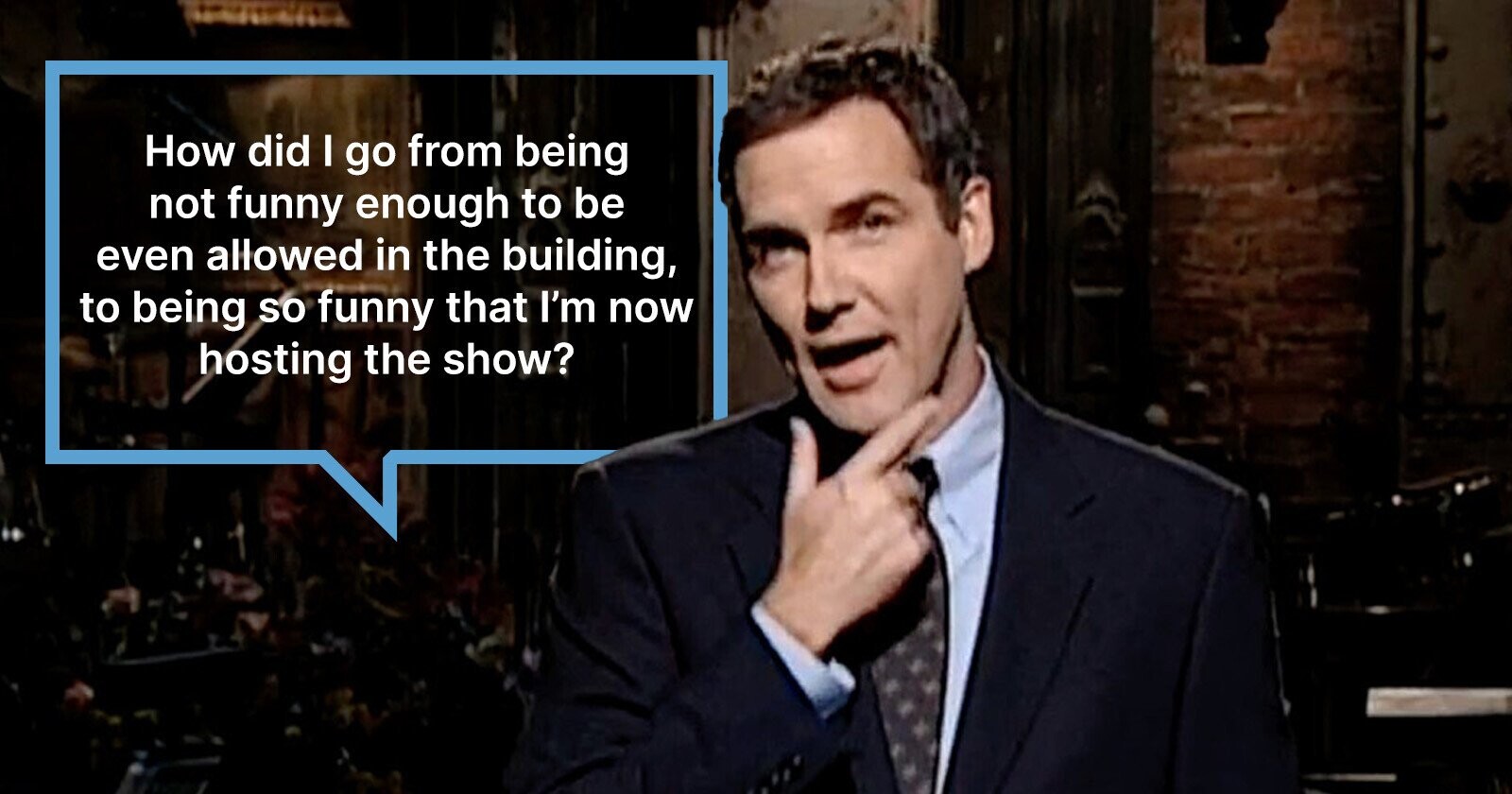
Norm Macdonald returned to host SNL in 1999, roughly a year and a half after losing his job on the program. Most performers would have politely thanked the producers, promoted a movie, and avoided discussing the workplace unpleasantness.
Norm built the entire monologue around it.
He carefully considered why the same organization that had dismissed him now believed he was qualified to host. Had he become dramatically funnier in such a short time? After pretending to examine the evidence, he reached a much more insulting conclusion: perhaps the show itself had simply declined.
The routine is classic Macdonaldslow, fearless, and structured so the audience can see the disaster approaching long before NBC does. He turned professional rejection into a victory lap while standing inside the building that rejected him. That is not merely confidence. That is returning to the restaurant that banned you and being asked to carve the turkey.
Norm Macdonald’s 1999 monologue supported by SNL’s official channel and Newsweek.
5. Taylor Swift Sings Everything Other Hosts Avoid
During her 2009 hosting debut, Taylor Swift performed a self-written “Monologue Song” that cheerfully addressed the subjects celebrity publicists usually hide under a conference table. She referenced her breakup with Joe Jonas, joked about dating Taylor Lautner, and acknowledged Kanye West’s interruption of her MTV Video Music Awards speech.
The melody was sweet, but the lyrics carried tiny knives.
What makes the performance especially effective is its controlled self-awareness. Swift understood that viewers expected her to discuss those stories, so she transformed the obligation into a joke about refusing to discuss them while discussing them in detail. Former SNL head writer Seth Meyers later praised how fully formed her idea was when she presented it.
The monologue also predicted a skill that would define Swift’s career: turning highly publicized personal experiences into catchy material before anyone else can control the narrative.
Taylor Swift’s monologue supported by NBC, Rolling Stone and The Hollywood Reporter.
6. Betty White Reviews Facebook and Finds It Unnecessary
A grassroots Facebook campaign helped bring Betty White to SNL in May 2010. At 88, she became the oldest person to host the show. Naturally, she used her monologue to thank Facebookand then question why anyone would voluntarily spend time on it.
White joked about reconnecting with old friends, looking at vacation photographs, and the supposedly revolutionary nature of online socializing. Her delivery made every innocent sentence sound as though it might suddenly become inappropriate, which it frequently did.
The contrast powered the performance. Viewers saw a beloved television legend with impeccable manners, while White delivered jokes with the timing of a comic who knew exactly how far she could push an audience. The monologue was both a generational comedy routine and proof that internet culture had finally met an opponent it could not intimidate.
Betty White’s hosting campaign and episode supported by Vanity Fair and The Christian Science Monitor.
7. Justin Timberlake Enters the Five-Timers Club
Justin Timberlake’s fifth hosting appearance in 2013 revived the Five-Timers Club with a guest list that looked like someone had accidentally opened a storage closet full of celebrities. Steve Martin, Tom Hanks, Candice Bergen, Alec Baldwin, Chevy Chase, Paul Simon, Martin Short, and Dan Aykroyd appeared during the sequence.
The joke was not only that Timberlake had earned entry. It was that the club had developed a ridiculous internal hierarchy. Some stars enjoyed luxurious privileges, while others were apparently working behind the bar despite their legendary careers.
Timberlake had already established himself as one of SNL’s strongest musician-hosts, but this monologue officially placed him within the show’s recurring universe. It also demonstrated a reliable SNL principle: when one cameo creates excitement, eight cameos create something resembling a celebrity evacuation drill.
Justin Timberlake’s Five-Timers monologue supported by NBC, People and GQ.
8. Ariana Grande Wonders What Her Adult Scandal Will Be
When Ariana Grande hosted in 2016, she acknowledged that she was attempting to move beyond her wholesome Nickelodeon image. Her solution was a musical monologue about needing a serious adult scandal to advance her career.
The number allowed Grande to parody both celebrity reinvention and the entertainment industry’s appetite for public mistakes. Instead of apologizing nervously for earlier controversy, she exaggerated the situation until scandal became another item on a pop star’s professional checklist: record an album, launch a tour, create a fragrance, alarm the nation.
Grande’s vocal ability made the joke sharper because the performance sounded polished enough to become a real single. SNL musical monologues work best when the host can genuinely perform while also making fun of performing, and Grande handled both jobs with suspicious ease.
Ariana Grande’s musical monologue supported by Billboard, The Hollywood Reporter and Variety.
9. Lin-Manuel Miranda Takes His Shot
Lin-Manuel Miranda opened his October 2016 episode by rewriting “My Shot” from Hamilton as a celebration of hosting SNL. The performance carried him through Studio 8H while he referenced the show’s history, his own excitement, and the political atmosphere surrounding that year’s presidential campaign.
The concept was predictable in the best possible way. Inviting Miranda to host without asking him to rap would have been like hiring a magician and requesting a detailed presentation about municipal bonds.
What elevated the monologue was its momentum. Miranda did not merely perform a shortened Broadway number on the main stage. He used the building, the cast, and SNL’s legacy as part of the song. The result captured the thrilling disbelief of a lifelong comedy fan suddenly receiving access to television’s most famous live playground.
Lin-Manuel Miranda’s monologue supported by NBC, Vox and Pitchfork.
10. Dave Chappelle Processes the 2016 Election
Dave Chappelle hosted the first SNL episode after the 2016 presidential election. Rather than offering a standard collection of promotional jokes, he delivered an extended stand-up monologue about Donald Trump’s victory, racial division, public anger, mass shootings, and his experience attending an event at the Obama White House.
The set moved between sharp political humor and unusually reflective storytelling. Chappelle acknowledged the shock many viewers felt without pretending that the country’s divisions had appeared overnight. His closing message balanced skepticism with a request for fairness toward historically marginalized Americans.
It was not the lightest monologue in SNL history, but it demonstrated what live comedy can do during a disorienting moment. The laughter did not erase the tension. It gave the audience enough breathing room to examine it.
Dave Chappelle’s 2016 monologue supported by Vanity Fair, Vogue and the Los Angeles Times.
11. John Mulaney Turns the Monologue into a Stand-Up Showcase
Former SNL writer John Mulaney returned as host in April 2018 and used the opening monologue as a compact stand-up set. He discussed getting older and grumpier, mocked the dramatic urgency of modern pop songs, and performed an impression of Patrick Stewart introducing Salt-N-Pepa during a 1994 SNL episode.
Mulaney’s appearance helped revive the idea that a monologue could simply be excellent stand-up without an elaborate premise. No surprise celebrity was required. No cast member needed to ask an obviously scripted question from the audience. One comedian stood under the lights and delivered carefully constructed stories.
The performance also announced Mulaney as more than a successful former writer. He looked completely comfortable hosting the institution where he had once worked behind the scenes, as though an office intern had returned years later and discovered the conference room was now named after him.
John Mulaney’s 2018 monologue supported by Pitchfork and Vulture.
12. Eddie Murphy Returns with a Comedy Supergroup
Eddie Murphy’s December 2019 episode marked his first time hosting SNL in 35 years. The monologue could have relied entirely on nostalgia, but Murphy quickly demonstrated that he was not there merely to wave at old photographs.
He joked about his career, fatherhood, changing public reputations, and the enormous value of the comedians standing onstage. Then Tracy Morgan, Chris Rock, and Dave Chappelle joined him, creating an extraordinary lineup of Black comedy legends from multiple generations.
The cameos were exciting, but Murphy remained the center of gravity. His relaxed delivery suggested that returning to Studio 8H was both a homecoming and a reminder of how much modern comedy inherited from his early work. The full episode later revived characters including Mister Robinson, Buckwheat, and Gumby, but the monologue had already delivered the evening’s main message: Eddie Murphy was back, and he had brought references.
Eddie Murphy’s return supported by The Hollywood Reporter, Variety and ABC.
13. Tom Hanks Hosts SNL from His Kitchen
In April 2020, SNL produced its first remote “At Home” episode during the COVID-19 shutdown. Tom Hanks, who had recently recovered from the virus, delivered the monologue from his kitchen.
The setting was simple, quiet, and completely removed from Studio 8H. There was no live audience to provide instant reassurance. Hanks joked about his diagnosis, quarantine life, and his increasingly complicated status as “America’s dad.” The familiar host helped viewers enter an unfamiliar version of the show.
Not every joke needed to be spectacular. The significance came from seeing SNL attempt live-adjacent comedy while its performers were isolated in their homes. Hanks’s calm presence made the experiment feel less like a technical malfunction and more like everyone had been invited to the same strange neighborhood meeting.
The first SNL at Home episode supported by Time and Business Insider.
14. Jerrod Carmichael Refuses to Discuss the Oscars Slap
Jerrod Carmichael hosted SNL less than a week after Will Smith slapped Chris Rock during the 2022 Academy Awards. By Saturday night, the incident had been analyzed, debated, reenacted, moralized, and squeezed for content by nearly every person with an internet connection.
Carmichael began his monologue by insisting he would not talk about it. He then spent several minutes talking about how thoroughly he did not want to talk about it.
The structure perfectly captured public exhaustion. Carmichael avoided repeating the same obvious jokes and instead focused on the impossible expectations placed on a comedian hosting a topical show after a major cultural spectacle. He even imagined producer Lorne Michaels assigning him the modest responsibility of healing the nation. Carmichael’s response was essentially: Does the nation know who booked this episode?
Jerrod Carmichael’s monologue supported by Vanity Fair.
15. Steve Martin and Martin Short Deliver Each Other’s Eulogies
During their joint 2022 monologue, Steve Martin and Martin Short decided there was no reason to wait until one of them died before delivering heartfelt eulogies. They read imagined funeral tributes filled with insults, disappointing attendance estimates, professional jealousy, and the particular affection shared by friends who have spent decades improving their insults.
The routine worked because their rivalry was obviously theatrical. Martin played the cool, controlled straight man, while Short responded with wounded theatrical outrage. Sad piano music attempted to create dignity, but dignity had already left the studio and taken a taxi home.
Selena Gomez eventually appeared, adding a perfectly timed third presence to the double act. The monologue showed why Martin and Short remain such effective partners: each man seems genuinely delighted whenever the other discovers a more efficient way to be cruel.
The 2022 joint monologue supported by NBC, Vulture and The Hollywood Reporter.
Why These SNL Monologues Still Work
The strongest Saturday Night Live monologues usually understand the host’s public identity and then twist it. Betty White appeared sweet but delivered mischievous punch lines. Taylor Swift appeared confessional while joking about refusing to confess. Tom Hanks offered stability during an unstable moment. Norm Macdonald returned as a supposedly defeated former employee and behaved like the only person in the building who had won.
Timing matters just as much as writing. A monologue airs near the beginning of a live broadcast, before anyone knows whether the episode will become a classic or a beautifully decorated traffic accident. The host must establish trust quickly. Stand-up comedians can rely on rhythm and tested material, while actors and musicians often benefit from songs, cast interruptions, or cameos that transform nervousness into part of the entertainment.
The best performances also create a reason to revisit them. A topical joke may age, but personality lasts. Viewers return to these monologues because they capture Carlin’s precision, Martin’s absurdity, White’s timing, Macdonald’s nerve, Murphy’s authority, and Mulaney’s storytelling. They are not simply introductions to old episodes. They are complete comedy pieces.
The Experience of Rewatching Classic SNL Monologues
Rewatching old SNL monologues can feel like opening a comedy time capsule that has been stored next to several outdated hairstyles. The stage remains familiar, but nearly everything surrounding it changes: the celebrities, political references, clothing, audience reactions, and assumptions about what television can say. Even the pace of laughter is different. Earlier audiences sometimes allow a joke to breathe, while modern crowds respond instantly to a famous cameo before that person has done anything beyond successfully locating the stage.
The most rewarding viewing experience comes from watching chronologically. George Carlin’s first-episode appearance resembles a nightclub stand-up set placed inside an experimental variety program. By the time Tom Hanks discovers the Five-Timers Club, SNL has developed its own mythology. Later monologues assume viewers understand recurring traditions, backstage personalities, and the possibility that any available celebrity may walk through the curtain carrying a smoking jacket.
Musical monologues provide another noticeable evolution. Taylor Swift, Ariana Grande, and Lin-Manuel Miranda use songs differently, but all three performances solve the same problem: how can a host communicate a recognizable persona within minutes? Swift turns tabloid stories into self-protection. Grande satirizes celebrity scandal as career development. Miranda converts excitement into a high-speed tour of SNL history. The songs are entertaining, but they are also efficient character introductions.
Context can dramatically change the experience. Norm Macdonald’s return is funny without background knowledge, but it becomes far more daring once viewers understand that NBC had fired him. Betty White’s jokes become richer when one remembers that Facebook users campaigned for her hosting appearance. Tom Hanks’s kitchen monologue may look visually plain years later, yet its quietness recalls the uncertainty of April 2020 more effectively than an elaborate set could.
Another pleasure is observing how different comedians control silence. Macdonald leaves uncomfortable spaces that make the audience wonder whether the joke has ended. Chappelle allows serious ideas to settle before moving toward another punch line. Martin Short attacks silence as though it has insulted his family. Steve Martin often does the opposite, standing calmly while absurdity accumulates around him.
These performances are also useful for anyone interested in comedy writing. Each monologue demonstrates a distinct mechanism: repetition, escalation, reversal, self-deprecation, topical commentary, surprise entrances, musical parody, or carefully managed discomfort. Watching only for punch lines misses half the craft. Notice where the premise becomes clear, how quickly the first major laugh arrives, and how the performer exits before the idea grows tired.
Finally, revisiting SNL monologues reminds viewers that live comedy thrives on uncertainty. A joke can receive thunderous laughter, nervous silence, or one alarming cough from somewhere near the band. The performer must continue regardless. That tension is part of the appeal. A polished streaming special can be edited, reordered, and perfected. An SNL host gets one Saturday night, one opening, and several cue cards that suddenly appear to be much farther away than they were during rehearsal.
Conclusion
Saturday Night Live monologues have changed enormously since George Carlin walked onto the stage in 1975, but their essential purpose remains intact. They introduce the host, establish the evening’s comic voice, and create the first opportunity for something wonderfully unpredictable to happen.
The greatest examples succeed because they feel specifically designed for the person delivering them. Nobody else could have turned an SNL firing into Norm Macdonald’s particular kind of revenge. Few performers could have handled the Facebook campaign with Betty White’s sweetly dangerous timing. Steve Martin and Martin Short can make imagined funerals feel like a celebration because insulting each other has become their most reliable expression of friendship.
Not every monologue becomes a classic. Some are pleasant introductions followed by polite applause and the sudden appearance of Kenan Thompson. But when the host, material, and cultural moment align, the opening can become as memorable as any sketch that follows.
Note: This editorial ranking emphasizes comedic craft, cultural impact, originality, historical importance, and long-term replay value. Individual favorites may vary, especially among viewers prepared to defend a particular John Mulaney monologue with courtroom-level evidence.