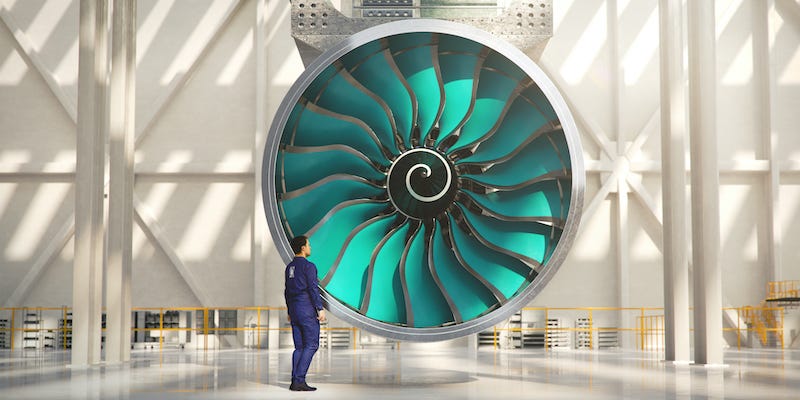
The world’s largest aircraft engine does not merely look as though it could swallow a compact car. It looks as though it might ask whether the compact car comes with fries.
Built by GE Aerospace for the Boeing 777X family, the GE9X is the largest and most powerful certified commercial jet engine ever produced. Its enormous 134-inch front fan, record-setting test thrust, advanced composite materials, and extremely efficient core make it one of the most ambitious propulsion systems in aviation history.
Yet the GE9X is not simply a contest entry in the category of “Who can build the biggest mechanical hurricane?” Its size serves a practical purpose. The engine is designed to move an extraordinary volume of air efficiently, helping a very large twin-engine aircraft carry hundreds of passengers across oceans while using less fuel than the airplanes it is intended to replace.
Meet the GE9X: The World’s Largest Aircraft Engine
When aviation experts describe the GE9X as the world’s largest aircraft engine, they are usually referring to its fan diameter. The engine’s front fan measures 134 inches, or approximately 11 feet 2 inches, across. That is larger than the fans used in its already enormous predecessor, the GE90-115B.
The GE9X was developed exclusively for the Boeing 777X, including the 777-9 passenger aircraft, the shorter-range variants planned for the family, and the 777-8 Freighter. Two GE9X engines will provide the thrust required to lift one of the world’s largest twin-engine airplanes.
| Feature | GE9X specification |
|---|---|
| Engine type | Two-spool, high-bypass turbofan |
| Front fan diameter | 134 inches, or about 3.4 meters |
| Fan blades | 16 carbon-fiber composite blades |
| Approximate bypass ratio | 10:1 |
| Overall pressure ratio | Approximately 60:1 |
| High-pressure compressor ratio | Approximately 27:1 |
| Certified takeoff-thrust class | Approximately 105,000 to 110,000 pounds, depending on model |
| Record test thrust | 134,300 pounds-force |
| Primary aircraft | Boeing 777X family |
How Powerful Is the GE9X?
During engineering testing, the GE9X produced 134,300 pounds of thrust. That performance earned recognition as the highest thrust ever recorded for a commercial aircraft jet engine under test conditions.
One important distinction often gets lost in the excitement: record test thrust is not the same as normal operating thrust. Airlines will not routinely blast every GE9X to 134,300 pounds while departing for a Tuesday morning flight to Frankfurt.
The engine’s certified operating ratings are lower and vary by model and aircraft application. The primary GE9X-105B1A model is associated with a takeoff-thrust rating of roughly 105,000 pounds. Test engines are deliberately pushed beyond ordinary operating requirements so engineers can measure structural margins, validate computer models, and prove that components can survive demanding conditions.
Thrust Versus Efficiency
Raw thrust makes excellent headlines, but efficiency is more important to airlines. An engine that produces spectacular power while consuming fuel like a bonfire fed with credit cards would not be commercially attractive.
The GE9X was therefore engineered to combine high thrust with lower specific fuel consumption. GE says it can provide up to a 10% improvement in specific fuel consumption compared with the GE90-115B. When multiplied across thousands of long-distance flights, even a modest percentage improvement can translate into substantial fuel savings, lower carbon dioxide emissions, and reduced operating costs.
Why Is the GE9X Fan So Large?
The GE9X is a high-bypass turbofan. Air entering the engine is divided into two main streams. A smaller portion travels through the core, where it is compressed, mixed with fuel, burned, and expanded through turbines. A much larger portion flows around the core through the bypass duct.
The ratio between those two streams is known as the bypass ratio. With an approximate bypass ratio of 10:1, the GE9X sends about ten times as much air around its core as it sends through it.
This arrangement improves propulsive efficiency. Instead of accelerating a relatively small quantity of air to an extremely high speed, a large fan accelerates a much greater mass of air by a smaller amount. In simplified terms, gently pushing a huge volume of air is generally more efficient and quieter than violently pushing a smaller volume.
A larger fan captures more air, supporting a higher bypass ratio. However, simply enlarging an old design would create unacceptable penalties in weight, drag, structural load, and manufacturing complexity. The GE9X required new aerodynamics, lighter materials, improved computer modeling, and a carefully optimized engine core.
Technology Inside the Largest Jet Engine
Sixteen Composite Fan Blades
The GE9X uses only 16 front fan blades, compared with 22 on the GE90. Fewer blades can reduce weight and aerodynamic interference, but each blade must handle enormous forces.
The blades are made primarily from carbon-fiber composite material rather than conventional solid metal. Composite construction allows engineers to produce large, carefully shaped blades that are lighter and highly resistant to fatigue. Metal leading edges provide added protection where the blades are most likely to encounter rain, hail, sand, birds, and other airborne troublemakers that refuse to respect the engine’s price tag.
A composite fan case surrounds the rotating assembly. Its job includes containing fragments if a blade is damaged. This is less glamorous than breaking thrust records, but containment performance is one of the most important safety functions in any turbofan.
Ceramic Matrix Composites
Parts of the GE9X operate at temperatures that would make an ordinary kitchen oven reconsider its career choices. To manage these conditions, GE expanded its use of ceramic matrix composites, commonly called CMCs, in the combustor and turbine sections.
CMCs can tolerate extremely high temperatures while weighing less than comparable metal components. They also require less cooling air. That matters because air diverted for cooling is air that cannot contribute as effectively to combustion and thrust. Reducing the cooling requirement helps improve the thermodynamic efficiency of the engine.
A 60:1 Overall Pressure Ratio
The compressor raises the pressure of incoming air before it reaches the combustor. The GE9X has an overall pressure ratio of roughly 60:1, while its 11-stage high-pressure compressor achieves a pressure ratio of about 27:1.
Higher compression can improve thermal efficiency, but it also increases temperature and places greater demands on seals, blades, disks, bearings, and cooling systems. The impressive figure is therefore not just the pressure ratio itself. It is the ability to achieve that pressure while maintaining durability and predictable operation.
Advanced Manufacturing
Additive manufacturing, commonly known as industrial 3D printing, helped GE consolidate complicated assemblies and produce shapes that would be difficult or impossible to manufacture using traditional machining alone. FAA technical materials have indicated that the certified GE9X configuration contains roughly 300 additively manufactured parts.
Engineers can use these processes to reduce part counts, remove unnecessary material, improve internal airflow passages, and create integrated components. Fewer individual pieces may also mean fewer joints, fasteners, and potential failure points.
Digital Engine Control
A dual-channel full-authority digital engine control system manages fuel flow, starting, acceleration, temperatures, rotor speeds, fault detection, and numerous protective functions. Pilots select the required thrust; computers handle thousands of adjustments needed to deliver it safely.
In other words, the flight crew does not manually negotiate with 16 giant fan blades spinning a few feet away. This is probably best for everyone.
From the GE90 to the GE9X
The GE9X did not appear out of an engineering vacuum. Its most important ancestor is the GE90, which entered commercial service in the 1990s and introduced carbon-fiber composite fan blades to commercial jet aviation.
The later GE90-115B became famous for powering long-range Boeing 777 models. Its fan measures 128 inches across, and it produced a previous test-thrust record of 127,900 pounds. The engine demonstrated that an enormous high-bypass turbofan could reliably power a large wide-body aircraft using only two engines.
The GE9X advances that formula with a larger fan, fewer fan blades, a higher bypass ratio, a more efficient compressor, wider use of composite materials, CMC components, and modern manufacturing techniques.
| Engine | Fan diameter | Notable characteristic |
|---|---|---|
| GE9X | 134 inches | Largest commercial-engine fan and record test thrust |
| GE90-115B | 128 inches | GE9X predecessor and longtime wide-body power leader |
| Rolls-Royce Trent XWB-97 | 118 inches | High-thrust engine developed for the Airbus A350-1000 |
Comparisons require context. Fan diameter, certified thrust, maximum test thrust, engine weight, efficiency, and aircraft mission are different measurements. An engine with a lower thrust rating is not automatically less advanced. It may have been optimized for a lighter aircraft or a different combination of range, speed, maintenance cost, and fuel consumption.
Testing a Mechanical Giant
The first full GE9X engine ran on the ground in 2016. In March 2018, a GE9X took to the air beneath the wing of GE Aerospace’s modified Boeing 747-400 flying testbed.
The test aircraft carried the experimental engine in addition to its regular powerplants. Engineers used the flying laboratory to study temperatures, pressures, vibration, fuel consumption, handling effects, and engine behavior at different speeds and altitudes.
The GE9X then powered the Boeing 777-9 on its maiden flight in January 2020. Later that year, the engine received its FAA type certificate following thousands of hours and cycles of testing.
Certification was not the end of the process. GE continued endurance, dust-ingestion, icing, bird-strike, fan-blade containment, high-temperature, vibration, and extended-operations testing. By the mid-2020s, the program had accumulated tens of thousands of test cycles.
Why Dust Testing Matters
Some of the largest prospective 777X fleets are based in regions where sand and dust are daily operating realities. Fine particles can erode compressor surfaces, block cooling passages, contaminate systems, and gradually reduce performance.
GE subjected the engine to extensive dust-ingestion cycles intended to represent years of operation in harsh environments. Engineers then disassembled and inspected the hardware, looking for wear that computer simulations might not fully predict.
The GE9X and the Boeing 777X
The GE9X is inseparable from the Boeing 777X because the engine was designed specifically for that aircraft family. The 777X combines the engine with a new composite wing, folding wingtips, updated flight controls, improved aerodynamics, and a redesigned passenger cabin.
Boeing says the 777-9 is designed to use approximately 20% less fuel and produce 20% fewer emissions than the airplanes it is intended to replace. That improvement comes from the complete aircraft system rather than the engine alone. Wing efficiency, weight, drag, flight controls, seating capacity, and operating profile all contribute.
The engine itself received FAA certification in September 2020, but the 777X aircraft certification program has taken considerably longer. Following multiple delays, the first commercial 777X delivery is currently targeted for 2027. Until the aircraft enters airline service, most GE9X operating experience will continue to come from ground testing, production acceptance runs, and the 777X flight-test fleet.
Engineering Challenges Created by Enormous Engines
Building the world’s largest aircraft engine involves more than drawing a bigger circle around an existing fan.
Weight and Structural Loads
A larger fan, case, nacelle, pylon, and supporting structure can add weight. Engineers must ensure that efficiency gains outweigh those penalties. The wing and engine mount must also withstand thrust, vibration, aerodynamic loads, turbulence, hard landings, and unusual conditions throughout the aircraft’s service life.
Ground Clearance
The engine must fit beneath the wing without getting dangerously close to the runway. Landing-gear height, wing geometry, nacelle shape, and engine placement are closely coordinated. This problem becomes especially challenging as fan diameter increases.
Transportation
Aircraft engines must travel between factories, test facilities, assembly lines, and maintenance centers. A component more than 11 feet across cannot simply be dropped at the nearest parcel counter with a “fragile” sticker.
Special trucks, fixtures, routes, lifting equipment, and handling procedures are required. Transportation constraints influence how the engine is assembled and which modules can be removed for shipment.
Maintenance Accessibility
Airlines need to inspect and repair engines without turning every maintenance event into an archaeological expedition. Designers must provide access to sensors, lines, pumps, filters, gearboxes, and internal inspection points while maintaining aerodynamic performance and structural strength.
Why the World’s Largest Aircraft Engine Matters
The GE9X represents an important transition in long-haul aviation. Earlier generations often relied on three or four engines to carry large passenger loads across oceans. Improvements in reliability, materials, controls, and engine efficiency have allowed twin-engine aircraft to take over many of those missions.
A powerful and efficient engine enables an aircraft to carry more passengers and cargo over long distances while reducing fuel use per seat. Airlines may gain lower operating expenses, while passengers benefit indirectly through expanded nonstop routes and more efficient aircraft.
The engine also serves as a technology bridge. Experience with composite fan systems, CMCs, additive manufacturing, advanced compressors, digital monitoring, and extensive durability testing will influence future propulsion programs.
Future engines may use geared architectures, open-fan designs, alternative fuels, hybrid-electric assistance, or other concepts. They will still benefit from lessons learned while designing and testing a machine as demanding as the GE9X.
Conclusion
The GE9X earns the title of the world’s largest aircraft engine through its 134-inch fan, but physical size is only the beginning of its story. Its record 134,300-pound test thrust demonstrates remarkable power, while its 10:1 bypass ratio, advanced compressor, composite fan blades, ceramic matrix composites, and additively manufactured parts reveal a deeper focus on efficiency and durability.
The most impressive achievement is not that engineers built an enormous engine. Aviation history contains plenty of enormous machines. The achievement is that they created one intended to be quieter, cleaner, and more economical than the engine it replaces.
Once the Boeing 777X enters commercial service, the GE9X will begin its most important test: performing reliably through years of daily airline operations. Until then, it stands as a giant demonstration of how aerospace engineering turns airflow, fire, advanced materials, and a truly unreasonable amount of paperwork into controlled flight.
Extended Experience: What Encountering the GE9X Is Really Like
Photographs do a poor job of communicating the scale of the world’s largest aircraft engine. Without a person, vehicle, or airplane beside it, the GE9X can resemble an ordinary turbofan photographed from very close range. The illusion disappears the moment someone stands next to the fan.
At a public display, aerospace exhibition, factory event, or air show, the first reaction is usually not a sophisticated observation about pressure ratios. It is something closer to, “That belongs under an airplane?” The circular opening dominates the view, while the center spinner and sweeping composite blades create an almost architectural pattern.
The 16 fan blades are especially striking. In diagrams, “16 blades” sounds like a technical specification. In person, each one looks more like a sculpted wing than a conventional blade. Their wide, curved surfaces show how much aerodynamic work is performed before air reaches the engine core.
Walking around the nacelle changes the experience. From the front, the GE9X appears relatively simple: a large opening, a spinner, and a ring of blades. From the side, its true complexity becomes visible. Panels, pipes, wiring, sensors, actuators, accessories, structural mounts, and cooling systems fill the space around the core. What looked like a giant fan becomes a densely packed powerplant containing thousands of carefully coordinated parts.
The experience is different when the engine is running. Visitors cannot safely stand close to a high-power test, of course. The intake can pull in debris, equipment, and anything else that ignores the warning line. Behind the engine, the exhaust produces extreme heat, noise, and high-velocity airflow.
Even from a controlled distance, an engine run is felt as much as heard. At idle, the sound is a deep mechanical rush layered with higher-frequency tones from rotating components. As thrust increases, the noise gains physical weight. The air seems to vibrate, and conversation becomes impractical without hearing protection and communication equipment.
A 777X takeoff offers another perspective. From the terminal, the engines appear large but visually balanced beneath the enormous composite wing. During the takeoff roll, the sound builds smoothly rather than arriving as a single explosive roar. The aircraft accelerates, the wings begin carrying the load, and two engines weighing only a fraction of the airplane’s total mass generate enough force to lift the entire machine.
For engineers, the experience is less theatrical and more analytical. A test run produces streams of data on pressure, temperature, vibration, fuel flow, clearances, exhaust conditions, and rotor behavior. A successful test may look uneventful to an observer, but uneventful is often the goal. In commercial aviation, predictable performance is far more valuable than drama.
Maintenance specialists see yet another version of the GE9X. To them, the engine is a collection of modules that must be inspected, serviced, removed, transported, repaired, and returned to operation. Its size creates challenges, but modular construction, digital diagnostics, and borescope access can help technicians identify problems without completely disassembling the engine.
The most memorable part of encountering the GE9X is the contrast between scale and precision. The engine is large enough to dominate an exhibition hall, yet critical internal clearances may be measured in tiny fractions of an inch. It can produce more than 100,000 pounds of operational thrust, yet computers continuously make minute fuel and airflow adjustments to keep it within safe limits.
That contrast explains why the GE9X fascinates both aviation professionals and casual visitors. It is simultaneously a giant machine and an instrument of extraordinary precisiona controlled storm designed to work on schedule, cross oceans, and politely avoid spilling anyone’s coffee.