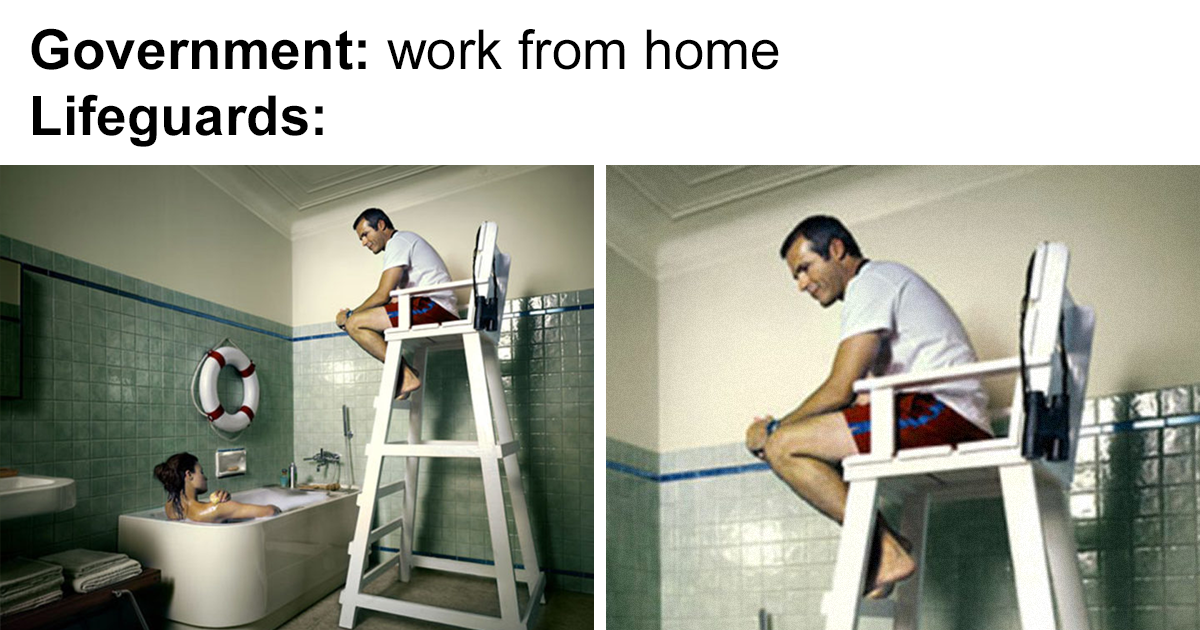
Working from home sounds magical when you do not have the option. No commute. No parking lot small talk. No mystery leftovers in the break room fridge. No manager appearing behind you like a corporate ghost to ask, “Got a minute?” For many people, the phrase “remote work” sounds less like an employment arrangement and more like a vacation package with Wi-Fi.
But here is the truth: not every job can be done from a couch, kitchen table, or carefully angled Zoom background. Nurses, teachers, delivery drivers, retail associates, restaurant workers, warehouse teams, construction crews, mechanics, first responders, factory workers, and countless others still have to show up in person. Their work involves equipment, people, products, buildings, customers, patients, students, or machinery that cannot be politely emailed into existence.
That is why working from home jokes hit differently for people who cannot work from home. They are not just jokes about sweatpants and video calls. They are little pressure valves for everyone who has ever heard a remote worker complain, “My dog interrupted my meeting,” while they were standing under fluorescent lights, holding a scanner, a wrench, a tray, a clipboard, or their last nerve.
This article is for the people who cannot “circle back from the couch.” It is for the workers whose commute is not optional, whose lunch break is a rumor, and whose workplace cannot be replaced by a laptop stand and a lavender candle. Grab a coffee, hide from your supervisor for exactly 90 legal seconds, and enjoy these work from home jokes written for the people who are very much not at home.
Why Working From Home Jokes Are So Relatable
Remote work has changed the way Americans talk about jobs. Some employees now build their day around video meetings, Slack messages, shared documents, and the sacred ritual of pretending the camera “just stopped working.” Meanwhile, millions of others still need to be physically present to keep the country running. That contrast creates a perfect setup for humor.
Jokes work because they point at something everyone already feels but does not always say out loud. People who cannot work from home are not necessarily angry at remote workers. Plenty of them would happily trade a crowded commute for a home office. The funny part is the difference between the two worlds.
One person says, “My biggest challenge is separating work life from home life.” Another person says, “My biggest challenge is separating this customer from the display model.” Both are real problems. One just comes with better slippers.
The Great Pajama Divide
The biggest symbol of working from home is not the laptop. It is the pants. Remote employees became famous for wearing business shirts on top and pajama bottoms underneath, creating the most successful half-formal fashion movement in modern office history.
For workers who cannot work from home, uniforms, steel-toe boots, scrubs, aprons, name tags, hard hats, and safety vests remain part of the job. Nobody at a construction site says, “I am camera-ready from the waist up.” Nobody in a restaurant kitchen says, “Today I am wearing executive sweatpants.” If you show up to a warehouse in fuzzy slippers, the only thing being remotely worked is your ankle.
Joke: My friend works from home and says he has “meeting pants.” I work on-site, so I have “please do not spill industrial cleaner on me” pants.
Joke: Remote workers call it casual Friday. In-person workers call it “the shirt with only one mysterious stain.”
Joke: My coworker said working from home improved his wardrobe. Great. My work shoes look like they survived three natural disasters and a forklift argument.
Classic Work From Home Jokes For People Who Show Up Anyway
The best working from home jokes for people who cannot work from home are not bitter. They are observational, a little sarcastic, and just honest enough to make the break room laugh. They point out the absurdity of workplace inequality without turning the whole mood into a human resources seminar.
Jokes About Commuting
The commute is one of the biggest dividing lines between remote and on-site work. Remote workers complain about walking from the bedroom to the desk. In-person workers consider that a warm-up stretch.
Joke: My remote friend says his commute is “brutal” because the cat was sleeping in the hallway. I spent 42 minutes behind a truck carrying gravel. We are not the same.
Joke: Working from home people save money on gas. I save money by emotionally detaching at red lights.
Joke: My commute has traffic, rain, road work, and existential dread. His commute has a Roomba.
Joke: Remote workers say, “I was late because my internet was down.” I say, “I was late because every car in the county formed a committee.”
Jokes About Zoom Meetings
Video meetings are the unofficial theater of remote work. People mute themselves, unmute themselves, freeze at unfortunate facial expressions, and say “Can you see my screen?” like it is a national anthem. For people who cannot work from home, this world can feel both hilarious and confusing.
Joke: Remote workers say, “Sorry, I was on mute.” I wish I had that option with customers.
Joke: Working from home means turning your camera off. Working in person means your face is always live, even when your soul is buffering.
Joke: My friend has Zoom fatigue. I have “a customer explained my job to me” fatigue.
Joke: Remote employees worry about bad lighting on video calls. I work under fluorescent lights that make everyone look like an unpaid extra in a hospital drama.
Jokes About Snacks
Remote work has made snack access a workplace benefit. The home kitchen is always nearby, which means the line between lunch, second lunch, emergency cheese, and “I am just checking the fridge for morale” gets blurry.
People who work on-site usually face a different food situation: vending machines, rushed breaks, cafeteria mysteries, or the sandwich they packed at 6 a.m. and no longer trust by noon.
Joke: My remote friend says he keeps snacking because the kitchen is too close. My lunch is in a break room fridge guarded by three suspicious yogurts from February.
Joke: Working from home means making fresh coffee. Working on-site means drinking whatever survived in the pot since 9:12 a.m.
Joke: Remote workers meal prep in their own kitchen. I meal prep by asking, “Is this vending machine burrito legally food?”
Why People Who Can’t Work From Home Deserve Their Own Jokes
Many remote-work jokes are written from the perspective of people who already have the privilege of working remotely. They joke about pets interrupting calls, kids walking into meetings, laundry during lunch, and the struggle of not leaving the house. Those jokes are funny, but they do not cover the full workplace experience.
People who cannot work from home deal with a completely different set of daily realities. They may have to commute in bad weather, stand for long hours, interact with the public, wear protective gear, follow strict schedules, or perform physical tasks that cannot be delayed until after a Wi-Fi reboot.
That is why these jokes matter. They give on-site workers a chance to laugh at the gap between “remote work problems” and “I had to unclog the printer while someone asked if we accept expired coupons” problems.
Joke: Remote workers have ergonomic chairs. I have a stool that sounds like it knows too much.
Joke: My friend says he needs a better home office setup. I need a workplace chair that was not assembled during the Bronze Age.
Joke: Some people work from home and light candles for focus. At my job, if we smell smoke, we evacuate.
The Hidden Truth Behind Work From Home Humor
Under the jokes, there is a real workplace story. Remote work has become more common, but it remains unevenly distributed. Jobs that involve information, analysis, writing, design, software, finance, administration, or management are often easier to do remotely. Jobs that involve direct service, physical labor, equipment, transportation, care, repair, production, or public interaction usually require being on-site.
This creates what many workers feel every day: a flexibility gap. Some employees can adjust their schedule, avoid commuting, and work from a quieter environment. Others must be present at a specific time and place, even when the weather is terrible, traffic is angry, and the coffee machine is making noises that suggest it needs counseling.
Humor does not erase that gap, but it helps people talk about it. A joke can say, “This is unfair,” without sounding like a complaint memo. It can turn frustration into connection. It can make a long shift feel slightly less long. It can also remind remote workers that “I had too many meetings today” is not the only kind of workplace exhaustion.
Remote Work Problems vs. On-Site Work Problems
Remote work problem: the neighbor starts mowing during your presentation.
On-site work problem: a customer starts explaining company policy to you using confidence, volume, and no facts.
Remote work problem: your Wi-Fi drops.
On-site work problem: the system crashes, the line gets longer, and everyone looks at you like you personally offended the server.
Remote work problem: your dog barks during a meeting.
On-site work problem: a stranger says, “I know you are closing, but this will only take a second,” and then reveals a 17-step issue.
Remote work problem: you forgot to blur your background.
On-site work problem: your background is the workplace, and everyone can see it forever.
Original Working From Home Jokes For Break Rooms, Group Chats, And Bad Days
Here are more original working from home jokes designed for people who cannot work from home. Use them in a group chat, on a break room board, in a caption, or silently in your head while making eye contact with the clock.
1. Working from home sounds great, but my job requires me to be physically present so the chaos has someone to report to.
2. My friend says he misses office culture. I told him he can come to my workplace and listen to a printer scream for six minutes.
3. Remote workers get background music. I get the motivational soundtrack of beeping machines and someone asking where the restroom is.
4. I tried working from home once, but apparently the forklift would not fit through the front door.
5. My friend’s boss checks in over Slack. Mine appears from behind a shelf like a retail magician.
6. Remote workers say, “I need better work-life balance.” I say, “I need a chair with all four legs emotionally committed.”
7. I cannot work from home because my customers refuse to come over and complain in my kitchen.
8. People working from home talk about protecting their peace. I work in public, so my peace clocks out before I do.
9. My remote friend says he feels isolated. I have spoken to 57 people today and would like to try isolation as a wellness experiment.
10. Working from home means taking a meeting from the couch. Working on-site means pretending the floor is not personally attacking your feet.
How To Use Work From Home Jokes Without Being Mean
There is a difference between funny and resentful. Good workplace humor should feel like a shared laugh, not a tiny office war. The best jokes point at situations, not at people. They make fun of the contrast between work styles without attacking the humans doing the work.
For example, “Remote workers have no real problems” is not a great joke. Remote work can be stressful, lonely, and boundary-destroying. A stronger joke is, “My remote friend’s biggest workplace hazard is accidentally joining a meeting with the potato filter. Mine is whatever is leaking in aisle seven.” That joke keeps the humor in the comparison.
Positive workplace humor works because it makes people feel seen. It says, “Yes, your day is ridiculous, and yes, we are allowed to laugh about it.” That kind of humor can reduce tension, improve morale, and create a sense of team connection. It is not about pretending work is easy. It is about surviving the hard parts without becoming a human storm cloud.
Experiences Related To Working From Home Jokes For People Who Can’t Work From Home
Anyone who has worked a job that cannot be done remotely knows the strange feeling of hearing remote-work conversations from the outside. You listen to someone describe their home office upgrade, their standing desk, their carefully curated desk plant, and their problem with too many delivery packages arriving during meetings. Meanwhile, you are calculating whether you can finish your shift without your feet filing a formal complaint.
One common experience is the morning commute reality check. A remote worker may start the day by opening a laptop. An on-site worker starts the day by negotiating with traffic, weather, parking, public transportation, or a car that makes a mysterious noise only when money is low. By the time the workday begins, one person has brewed coffee in a mug that says “Focus,” while the other has already survived a small transportation documentary.
Another shared experience is the break room comparison. Remote workers can eat lunch in their own kitchen, reheat food properly, or make something fresh. On-site workers often face the break room microwave, a machine that somehow turns soup volcanic on the edges and frozen in the middle. There is also the emotional suspense of shared refrigerators. Every container has a story. Some stories should not be opened.
People who cannot work from home also understand the performance aspect of public-facing jobs. A remote employee can mute themselves, turn off the camera, or take a minute to reset. On-site workers often have to remain professional in real time. If a customer is rude, a patient is anxious, a student is disruptive, or a machine stops working, there is no “camera off” button. Your facial expression becomes a workplace skill.
This is why work from home jokes are so satisfying for non-remote workers. They allow people to name the absurdity without sounding bitter. A cashier can joke that they would love to work remotely, but the customers keep refusing to scan themselves from home. A nurse can joke that telehealth is wonderful, but somebody still has to be in the room with the blood pressure cuff. A mechanic can joke that the car declined the Zoom invite. These jokes are funny because they are built on truth.
The best experience-based humor also creates solidarity. In-person workers often bond over things remote employees may never understand: the sacred importance of comfortable shoes, the politics of the thermostat, the one coworker who takes the good pen, the printer that jams only when a line forms, and the customer who says, “I have a quick question,” before beginning a story with three generations of background information.
At the same time, these jokes can make the workplace conversation more balanced. Remote work has real advantages, but it also has real problems. On-site work has real challenges, but it also offers social contact, routine, hands-on teamwork, and the satisfaction of physically seeing work get done. Humor gives both sides a way to recognize the trade-offs. It lets people admit, “Yes, I envy your commute, but no, I do not envy your endless video meetings.”
For people who cannot work from home, the joke is not simply “remote workers have it easy.” The deeper joke is that modern work has become wildly uneven. Some workers are choosing camera angles while others are choosing whether to sit down for the first time in four hours. Some are worried about Slack notifications. Others are worried about shift coverage. Laughing at that contrast does not solve every workplace issue, but it does make the day feel a little more human.
Conclusion: Laughing At The Work-From-Home Gap
Working from home jokes for people who can’t work from home are funny because they come from a very real place. Remote work may be a normal part of modern employment, but it is not available to everyone. Many workers still have to commute, wear uniforms, interact face-to-face, handle equipment, serve customers, care for people, and solve problems that cannot be fixed by restarting a router.
The humor is not about hating remote workers. It is about laughing at the gap between two very different workdays. One person battles Zoom fatigue. Another battles the lunch rush. One person worries about their webcam angle. Another wonders why the copy machine smells warm. Both are working. Both are tired. Only one gets to do laundry during a meeting.
So the next time someone says, “Working from home is so hard,” feel free to smile kindly, nod professionally, and remember your best joke. Because if you cannot work from home, laughter might be the closest thing you have to a remote benefit.