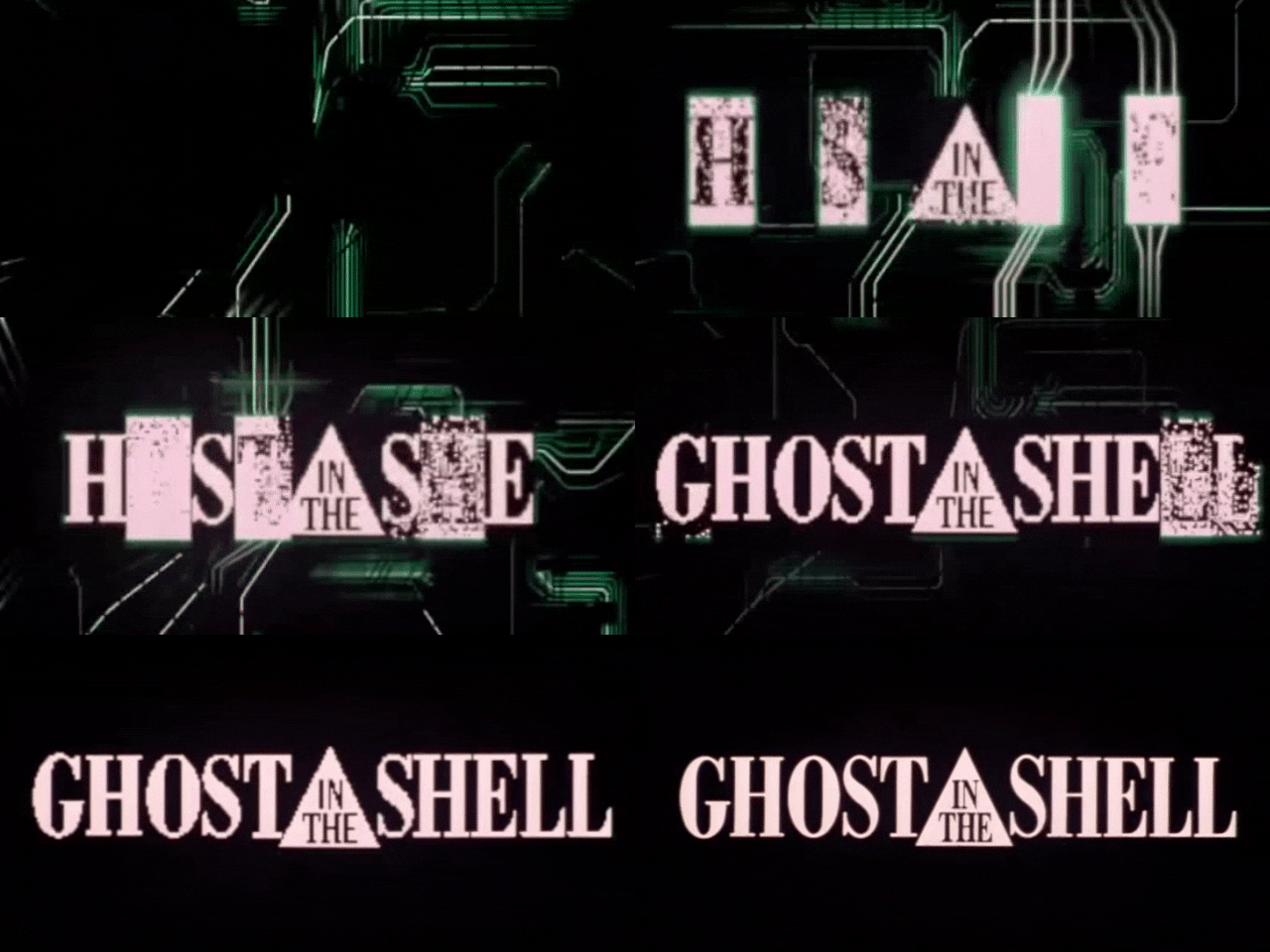
Some science fiction ages like milk in a hot car. Yesterday’s “future” becomes today’s chunky plastic keyboard, and suddenly the supposedly advanced robot looks like it was built from a toaster and a fax machine. Ghost in the Shell, however, has pulled off a much stranger trick: it keeps getting more relevant. The 1995 anime film directed by Mamoru Oshii, based on Masamune Shirow’s manga, still feels like it is staring directly at us through the glow of our phones, laptops, smart watches, surveillance cameras, algorithmic feeds, and increasingly chatty artificial intelligence tools.
At its core, Ghost in the Shell asks one deceptively simple question: what makes a person a person? Is it the body? The brain? Memory? Data? Desire? A soul? Or, as the franchise phrases it, the “ghost” inside the “shell”? That question sounded philosophical in the 1990s. Today, it sounds like a push notification from the future.
This is why Ghost in the Shell still matters. It is not merely a stylish cyberpunk anime with rain-slick streets, invisible camouflage, and a cyborg heroine who can punch through machinery like someone returning a defective printer. It is a lasting work about identity, technology, power, and the uneasy feeling that the line between human and machine is not a wall. It is a sliding glass door.
The World of Ghost in the Shell Was Built for Our Present
Ghost in the Shell began as a manga by Masamune Shirow, a dense and imaginative work packed with cybernetics, political intrigue, artificial intelligence, and futuristic policing. The 1995 animated film refined that material into a slower, moodier, more meditative experience. Instead of treating technology as simple decoration, the film treats it as atmosphere. It is in the bodies, streets, governments, weapons, memories, and dreams of its world.
The story follows Major Motoko Kusanagi, a full-body cyborg and field commander in Public Security Section 9, an elite government unit that investigates cybercrime, terrorism, political corruption, and threats that move between physical and digital reality. The Major’s body is artificial, her abilities are extraordinary, and her sense of self is complicated. She has a human “ghost,” or at least she believes she does. But when minds can be hacked and memories can be edited, belief itself becomes suspicious.
That premise now feels almost painfully modern. We may not be swapping cyberbrains at the mall, but we already outsource memory to search engines, identity to social platforms, direction to GPS, conversation to messaging apps, and reputation to databases we rarely control. We do not have cybernetic bodies like the Major, but we do have digital extensions of ourselves scattered across clouds, feeds, profiles, and devices. In other words, we may still be mostly organic, but our shells have Wi-Fi.
It Predicted the Anxiety of Digital Identity
One reason Ghost in the Shell remains powerful is that it understood digital identity before most people had one. In the film, identity is not fixed. It can be copied, corrupted, manipulated, and questioned. The Puppet Master, a mysterious intelligence born from networks and government experiments, challenges the assumption that personhood must begin in a biological body. If an artificial intelligence can think, desire, evolve, and seek survival, does it have a soul? Does it have rights? Does it have a “ghost”?
Today, those questions are no longer safely locked inside science fiction. Artificial intelligence systems create images, write text, mimic voices, generate synthetic faces, and imitate human conversation. Deepfakes make visual evidence less trustworthy. Data brokers build shadowy portraits of people from clicks and purchases. Social media profiles can outlive their owners. Bots can impersonate humans. People can form emotional attachments to digital companions. The internet has become a vast hall of mirrors, and some mirrors are learning to talk back.
Ghost in the Shell matters because it does not treat this confusion as a gimmick. It treats it as existential weather. The Major’s doubts are not melodrama; they are the emotional cost of living in a world where the self is increasingly technical. She is not simply asking, “Am I human?” She is asking, “What evidence would prove it?” That is a much scarier question, and also a much better one.
The Major Is Still One of Science Fiction’s Great Characters
Major Motoko Kusanagi is often remembered for her physical power, but her real strength is interior. She is a soldier, investigator, weapon, employee, thinker, and restless consciousness trapped inside a body that is both hers and not hers. Her artificial shell gives her freedom, but it also makes her dependent on systems that maintain, own, upgrade, and deploy that body. She is powerful enough to fight tanks, yet vulnerable to the institutions that define her existence.
This contradiction gives the character unusual depth. Many action heroes are built around confidence. The Major is built around uncertainty. She moves through the city with professional control, but her private moments are full of silence, drift, and unease. When she dives into the ocean, she is not performing an action scene. She is searching for a feeling that cannot be easily measured. In a franchise full of guns, drones, hackers, and armored vehicles, one of its most memorable images is a woman floating in water, wondering what she is.
That is why the Major still resonates with audiences who are thinking about gender, embodiment, disability, labor, surveillance, and selfhood. Her body is designed, manufactured, maintained, and observed. Yet her consciousness refuses to be reduced to hardware. She is neither a simple machine nor a simple human. She is a living argument against easy categories.
Its Cyberpunk Vision Still Looks Stunning
Visually, Ghost in the Shell remains astonishing because it does not confuse detail with noise. The film’s cityscapes are crowded but not random. Skyscrapers, canals, markets, cables, alleys, advertisements, and government spaces form a world that feels lived-in rather than merely designed. The result is a future that seems both alien and familiar, like a dream assembled from Hong Kong streets, Japanese bureaucracy, military hardware, and late-night anxiety.
The animation’s patience is part of its power. Modern sci-fi often races, flips, explodes, and explains itself until the viewer feels like they have been attacked by a very expensive screensaver. Ghost in the Shell knows when to be still. It gives viewers time to absorb wet pavement, passing boats, crowded streets, blank faces, and humming machines. Its famous city montage does not rush the plot forward; it expands the film’s soul. That confidence is rare.
The movie also helped define what many viewers now recognize as cyberpunk anime: neon density, corporate and state power, cybernetic bodies, invisible networks, philosophical crime stories, and urban beauty mixed with decay. Yet its style is not just cool wallpaper. The visuals express the theme. The city looks like a body. The body behaves like infrastructure. The network feels like a second atmosphere. Everything is connected, which means everything is vulnerable.
Ghost in the Shell Changed the Language of Science Fiction
The influence of Ghost in the Shell can be felt across film, television, games, comics, and digital culture. Its DNA appears in the way later science fiction imagines plugged-in consciousness, tactical hackers, synthetic bodies, virtual spaces, and government units chasing crimes that do not stay politely inside one jurisdiction. It helped show Western audiences that animation could carry adult themes with seriousness, elegance, and intellectual ambition.
Its connection to The Matrix is often discussed for good reason. Both works explore artificial reality, identity, bodies as systems, and the possibility that what we call “self” may be manipulated by technology. But Ghost in the Shell is less interested in escaping the machine than in asking what happens when the machine becomes part of you. It does not offer a clean red-pill awakening. It offers something stranger: transformation.
That idea remains fresh because modern technology rarely lets us simply opt out. We do not stand outside the network, heroically unplugged, hair blowing in the wind. We live inside it. We work through it, love through it, shop through it, argue through it, and occasionally lose entire afternoons to it because one video of a raccoon washing grapes led to another. Ghost in the Shell understands that technology is not just a tool we use. It is an environment that changes what “we” means.
Its Politics Feel More Relevant Than Ever
While many viewers remember the philosophy, Ghost in the Shell is also deeply political. Public Security Section 9 operates in a world where governments, corporations, intelligence agencies, and criminal networks fight for control of information. The battlefield is not just a city street; it is the public record, the human mind, the media narrative, and the hidden architecture of power.
This is another reason the franchise has aged so well. Cybersecurity, surveillance, data privacy, biometric tracking, information warfare, and state-backed hacking are not futuristic fantasies. They are headlines. In the Ghost in the Shell universe, a hacked brain can turn an innocent person into a puppet. In our world, manipulated feeds, scams, synthetic media, and disinformation can distort what people believe to be true. The tools differ, but the nightmare rhymes.
The franchise also understands that technology is never neutral once power gets involved. A cybernetic body can liberate someone from physical limitation, but it can also create dependency. A network can connect people, but it can also monitor them. Artificial intelligence can solve problems, but it can also become a weapon. Ghost in the Shell does not wag its finger and shout, “Technology bad!” It does something more useful: it asks who benefits, who pays, who controls the upgrade, and who gets deleted when the system needs a scapegoat.
Stand Alone Complex Expanded the Franchise’s Best Ideas
The television series Ghost in the Shell: Stand Alone Complex gave the franchise room to breathe. Where the 1995 film is poetic and concentrated, Stand Alone Complex is procedural, political, and expansive. It follows Section 9 through investigations involving cybercrime, terrorism, corruption, refugees, corporate wrongdoing, and viral social behavior.
The phrase “stand alone complex” itself remains one of the franchise’s sharpest concepts. It describes a pattern in which individuals act independently while appearing to participate in a larger coordinated movement. That idea feels startlingly suited to the internet age. Online mobs, meme movements, copycat behavior, decentralized activism, conspiracy cultures, and viral outrage can all look coordinated even when they arise from imitation, shared incentives, and network effects.
In plain English: the internet can make strangers dance to the same invisible music. Sometimes that music is harmless. Sometimes it is funny. Sometimes it sells sneakers. Sometimes it burns down trust. Stand Alone Complex recognized that digital culture could create collective behavior without a traditional leader. That insight alone makes the series worth revisiting.
The 2017 Live-Action Film Proved the Original’s Strength
The 2017 live-action Ghost in the Shell adaptation introduced the property to a broader mainstream audience, but it also sparked intense debate over casting, cultural translation, and Hollywood’s handling of Japanese source material. The controversy surrounding Scarlett Johansson’s casting as the Major became part of a larger conversation about representation and whitewashing in American film.
However viewers feel about that adaptation, its mixed reception highlighted something important: the original works are difficult to reduce to surface aesthetics. You can recreate the thermoptic camouflage, the geisha robots, the city lights, and the dramatic rooftop poses, but Ghost in the Shell is not just “cyborg police in a cool jacket.” Its power comes from mood, ambiguity, politics, and metaphysical tension. Remove those, and the shell remains, but the ghost gets suspiciously quiet.
In that sense, the live-action film accidentally proved why the 1995 anime still matters. The original is not beloved only because it looks cool, although it absolutely does. It is beloved because its images are attached to ideas that keep expanding in the viewer’s mind long after the credits end.
Why New Generations Keep Returning to It
Each generation finds a different doorway into Ghost in the Shell. Older fans may remember it as a landmark anime film that pushed the boundaries of adult animation. Cyberpunk fans may admire its world-building and visual design. Philosophy-minded viewers may focus on consciousness and identity. Tech workers may notice its questions about networks, security, and artificial intelligence. Younger audiences may see in the Major a figure wrestling with body autonomy, digital selfhood, and institutional control.
The franchise also keeps returning in new forms, including new animated projects, because its central questions refuse to expire. What is a human being in a technological society? What happens when memory becomes editable? What rights should an artificial mind have? Who owns a body built by a corporation or government? Can individuality survive inside systems designed to categorize, predict, and control?
These are not dusty questions from a 1990s VHS shelf. They are alive in debates about AI ethics, online identity, facial recognition, cyberwarfare, medical implants, digital labor, virtual reality, and the ownership of personal data. The future did not copy Ghost in the Shell exactly. Thankfully, most of us are not being chased by spider tanks during lunch. But the emotional shape of its futurethe unease, the wonder, the dependency, the blurred identityfeels increasingly familiar.
What Ghost in the Shell Teaches Us About Being Human
The most moving thing about Ghost in the Shell is that it does not define humanity in simple biological terms. The Major’s body is artificial, but her longing is real. The Puppet Master is nonhuman, but its desire to live, reproduce, and evolve is treated seriously. The film does not ask viewers to choose between flesh and machine. It asks whether consciousness might be more fluid, relational, and mysterious than we prefer to admit.
That is a profound idea in an era obsessed with measurement. We count steps, clicks, followers, calories, watch time, productivity, engagement, and sleep cycles. We convert behavior into data and data into predictions. Yet Ghost in the Shell reminds us that a person is not only a pattern. A person is also uncertainty, memory, hunger, contradiction, and change. The ghost cannot be fully captured by the shell.
This is why the franchise endures not merely as cyberpunk entertainment, but as a philosophical mirror. It reflects our fear that technology may swallow us, but also our hope that transformation does not have to mean disappearance. The Major’s journey suggests that identity may not be a fixed object we protect in a glass case. It may be a process, a migration, a signal crossing from one form into another.
Personal Viewing Experiences: Why the Film Still Hits Hard
Watching Ghost in the Shell today is a very different experience from watching it as a piece of “classic anime homework.” Many famous films arrive with so much reputation that you brace yourself for a museum visit. You expect to admire the brushstrokes, nod respectfully, and then quietly check how much runtime is left. But Ghost in the Shell does not feel like homework. It feels like a cold hand on the back of your neckin the best possible way.
The first thing that tends to stand out is the silence. Not total silence, of course, but the film’s willingness to slow down and let the viewer sit with images. The city montage is especially striking. Nothing “big” happens in the conventional sense, yet everything happens emotionally. Boats pass. People move through markets. Reflections shimmer on water. Buildings loom. The music feels ancient and futuristic at the same time, as if a ritual has been plugged into a motherboard. It is the kind of sequence that makes you forget to snack, which is serious business.
Then there is the Major herself. On a first viewing, she may seem distant. On a second viewing, that distance becomes the point. She is not cold because the film forgot to give her feelings. She is cold because she is trying to understand whether her feelings belong to her, whether her memories can be trusted, and whether her body is a home or a company vehicle with better abs. That tension grows more powerful the more time we spend online. Many people now know what it feels like to maintain a version of themselves that is public, searchable, editable, and strangely separate from private experience.
The action scenes also age better than expected because they are not overstuffed. The opening assassination, the shallow-water fight, and the tank confrontation all have weight. Bodies hit hard. Machinery feels heavy. Violence is not edited into confetti. Even the invisibility technology has a strange elegance; it is spectacular, yes, but also thematically perfect. In Ghost in the Shell, the most dangerous forces are often the ones you cannot see: networks, agencies, programs, memories, orders, motives.
Rewatching the film after years of living with smartphones and AI tools can feel almost rude. It keeps poking at modern habits. When the movie asks whether memory defines identity, it is hard not to think about photo libraries that remember birthdays better than we do. When it shows hacked perception, it is hard not to think about deepfakes and manipulated media. When it questions who owns the Major’s body, it is hard not to think about workers whose livelihoods depend on platforms they do not control. The film has not changed, but the room around it has.
The best experience of Ghost in the Shell may be watching it with someone who expects only action. At first, they may wonder why the movie keeps pausing to stare at water, wires, and the Major’s thousand-yard existential crisis. Then, somewhere near the Puppet Master’s revelations, the trap closes. The viewer realizes the film is not asking them to solve a case. It is asking them to reconsider the boundaries of life, self, and evolution. That is a bold move for an animated movie with a spider tank. Frankly, more philosophy should come with spider tanks.
Ultimately, the experience of Ghost in the Shell is less about receiving answers than becoming comfortable with better questions. It leaves viewers with awe and discomfort in equal measure. That balance is rare. Many sci-fi stories either worship technology or fear it. Ghost in the Shell does both and neither. It understands that technology can be beautiful, intimate, liberating, invasive, seductive, and terrifying all at once. In other words, it understands us.
Conclusion: The Ghost Is Still in the Machine
Ghost in the Shell still matters because it saw the digital future not as a collection of gadgets, but as a crisis of identity. Its world of cybernetic bodies, artificial intelligence, surveillance, and networked consciousness remains compelling because our own world keeps moving in that direction. The franchise’s greatest achievement is not predicting specific technology. It predicted the feeling of living with technology so deeply embedded in daily life that the boundary between person and system becomes difficult to draw.
That is why the 1995 film, the original manga, Stand Alone Complex, and later adaptations continue to invite debate. They are stylish, yes. They are influential, absolutely. But more importantly, they are still useful. They help us think about AI, privacy, memory, body autonomy, political power, and what remains human when almost everything can be digitized.
The shell keeps changing. The ghost keeps asking questions. And as long as our lives become more connected, more augmented, and more mediated by invisible systems, Ghost in the Shell will remain one of science fiction’s sharpest mirrors.