Some LEGO sets look like toys. Some look like architectural models. And then there is the LEGO Ideas Vincent van Gogh – The Starry Night set, which looks like a famous painting escaped its frame, wandered into a brick factory, and came back with texture, depth, and a tiny artist holding a paintbrush. Inspired by Vincent van Gogh’s legendary 1889 masterpiece, this build turns one of the most recognizable night skies in art history into a three-dimensional display piece for adults, collectors, art lovers, and anyone who has ever stared at a pile of blue bricks and thought, “Sure, I can build emotional turbulence.”
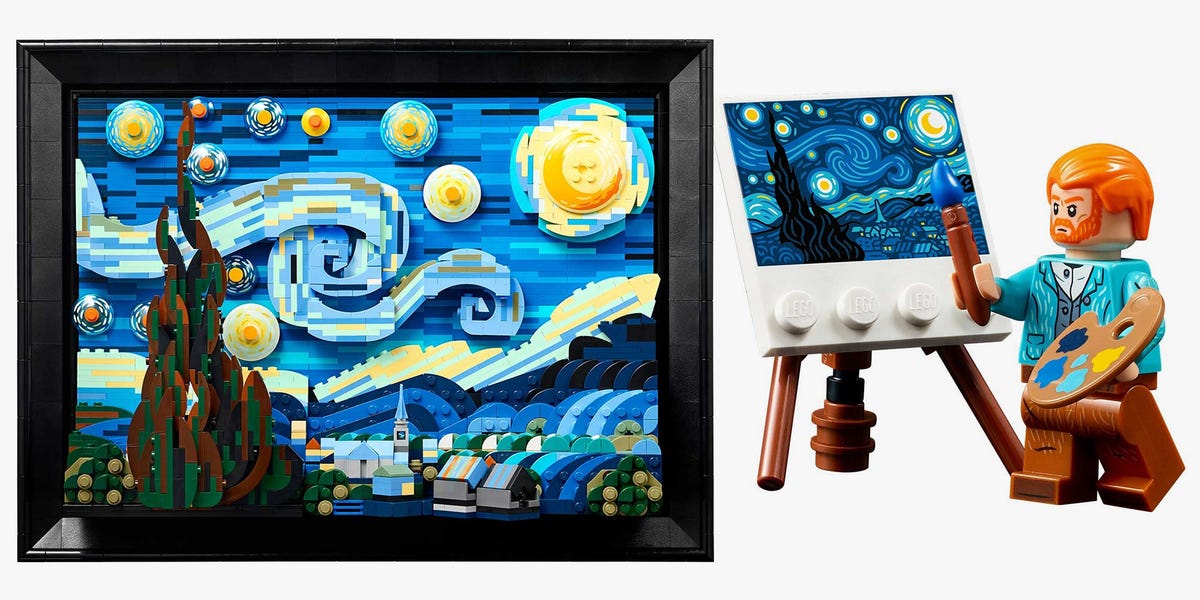
Officially known as LEGO Ideas set 21333, Vincent van Gogh – The Starry Night contains 2,316 pieces and was created in collaboration with The Museum of Modern Art in New York, where the original painting is part of the collection. It is not simply a flat mosaic. Instead, it uses layered bricks, plates, curves, color blocking, and a clever sense of motion to recreate Van Gogh’s famous swirling sky, glowing moon, rolling hills, quiet village, and dramatic cypress tree.
The result is a buildable artwork that feels both familiar and fresh. It respects the original painting while giving it a playful LEGO twist. The set is designed for ages 18 and up, making it part of LEGO’s growing world of adult display sets. In other words, this is not the kind of build you finish, toss into a toy bin, and rediscover later with a missing moon. This is the kind of set you hang on a wall, place on a shelf, and casually point to when guests arrive so they know you are a cultured person who also owns a brick separator.
What Makes the LEGO Starry Night Set Special?
The biggest appeal of the LEGO Starry Night set is its unusual format. Many LEGO art sets use a flat, mosaic-style approach, but this model leans into depth. The moon, stars, clouds, village, hills, and cypress tree all push outward in layers, giving the scene a sculptural quality. Van Gogh’s brushstrokes were famous for movement and texture, and LEGO wisely translates that energy into physical form rather than merely copying the image like a poster made of studs.
The sky is the star of the show, as it should be. In the original painting, the night does not sit still. It rolls, bends, glows, and practically hums. In the LEGO version, different shades of blue, white, yellow, and tan pieces create a similar sense of motion. The stacked elements help imitate Van Gogh’s thick, expressive brushwork, while the curved shapes make the famous spirals feel alive.
A 3D Painting You Can Build
One of the smartest design choices is the way the set turns a two-dimensional canvas into a layered display. The background is built like a framed artwork, while the foreground elements extend outward. The cypress tree rises along the left side, the village rests below the mountains, and the sky seems to move above everything. It is not just a LEGO version of The Starry Night; it is a LEGO interpretation of how the painting feels.
The model can be displayed freestanding or hung on a wall using the included hook. That flexibility makes it useful as home decor, especially for people who want something more distinctive than another framed print. It has the charm of handmade art, the structure of a collector’s model, and the conversation-starting power of a guest asking, “Wait, is that Van Gogh made of LEGO?”
The Vincent van Gogh Minifigure Adds Personality
The set also includes a Vincent van Gogh minifigure, complete with a paintbrush, palette, easel, and a tiny printed version of The Starry Night. This detail gives the model a playful narrative: Van Gogh appears to be painting the very scene displayed behind him. It is a charming little time loop, except instead of science fiction, it involves post-impressionism and excellent hair.
The minifigure can be attached to the main model with an adjustable display arm, allowing builders to place him in front of the artwork. It is a small feature, but it makes the whole set feel more alive. Without Van Gogh, the model would still be beautiful. With him, it becomes a miniature studio moment, as if the artist paused mid-brushstroke and accidentally wandered into the LEGO aisle.
The Real Painting Behind the Bricks
Vincent van Gogh painted The Starry Night in June 1889 during his stay at the Saint-Paul-de-Mausole asylum in Saint-Rémy, France. The painting was inspired partly by the view from his window, but it was not a simple landscape study. Van Gogh altered reality, added imagination, and turned the night sky into something emotionally charged. The village below, for example, was not exactly what he saw from the window; it was shaped by memory and artistic invention.
That mix of observation and imagination is one reason the painting remains so powerful. The moon glows like a lantern. Venus shines near the center-left of the sky. The cypress tree reaches upward like a dark flame. The village rests quietly below, almost asleep, while the sky above behaves like it has had three espressos and a poetic crisis.
The painting is now one of the most famous works in the collection of The Museum of Modern Art in New York. It is widely recognized not only as a masterpiece of post-impressionism but also as a symbol of emotional expression in art. Van Gogh did not paint the night as a photographic record. He painted it as experience, memory, movement, and mood. That is exactly why it works so well as a LEGO model: it already feels dimensional.
How a Fan Idea Became an Official LEGO Set
The LEGO Starry Night set began as a fan submission by Truman Cheng, a Hong Kong-based LEGO builder and PhD student. His concept gained support through the LEGO Ideas platform, where fan-designed projects can become official products after reaching enough community votes and passing review. Cheng’s idea reportedly earned more than 10,000 votes, which pushed it into LEGO’s official development process.
What made the idea stand out was its method. Cheng noticed that stacked LEGO plates could resemble Van Gogh’s famous brushwork. That simple observation became the foundation for a full model. Instead of treating LEGO bricks as pixels, the design treated them almost like brushstrokes. This is the magic trick of the set: the bricks do not hide the fact that they are bricks. They use that identity to echo the original painting’s texture.
LEGO designers then refined the concept into the final product, keeping the spirit of the fan build while making it stable, buildable, and display-ready. The collaboration with MoMA gave the set an extra layer of credibility. It is not just a novelty item wearing a famous name. It is a carefully developed tribute to one of the most studied, reproduced, and beloved paintings in modern art.
Design Details That Capture Van Gogh’s Brushstrokes
Recreating The Starry Night in LEGO form is not as simple as picking a lot of blue bricks and hoping for the best. The original painting depends on rhythm, contrast, and expressive movement. The LEGO set answers those challenges through layering, color shifts, and smart part usage.
The Swirling Sky
The sky uses multiple shades of blue and white to create movement. The famous spiral near the center is built with curved and angled elements that suggest motion without becoming messy. The stars are bright and rounded, standing out from the darker background. The crescent moon on the right is bold and luminous, just like in the painting.
The best part is that the model does not try to smooth everything out. LEGO pieces have edges, ridges, and shadows. Those qualities help recreate the thick, tactile feeling of Van Gogh’s paint. The set understands that texture is not a problem to solve; it is the entire point.
The Village and Mountains
Below the sky, the quiet village gives the composition balance. The little rooftops, church steeple, and dark hills create a calm foundation under the restless heavens. This contrast is essential to the painting and the LEGO version preserves it well. The village does not compete with the sky; it supports it, like the responsible friend in a group chat full of dramatic poets.
The Cypress Tree
The cypress tree on the left is one of the painting’s most recognizable features. In the LEGO model, it rises vertically and adds strong visual drama. Its dark, flame-like shape separates the foreground from the sky and helps guide the eye upward. It also gives the set its strongest sense of depth, making the artwork feel less like a picture and more like a scene.
Why This LEGO Set Appeals to Adults
The LEGO Ideas Vincent van Gogh – The Starry Night set fits neatly into the adult LEGO trend. Over the past several years, LEGO has increasingly released sets aimed at grown-up builders: architecture models, botanical designs, classic cars, pop culture displays, and fine-art-inspired builds. These sets are not about fast play. They are about relaxation, focus, nostalgia, creativity, and having something impressive to display afterward.
The Starry Night set is especially appealing because it crosses multiple interests. Art lovers appreciate the Van Gogh connection. LEGO fans enjoy the unusual building techniques. Interior design fans get a bold wall piece. Gift shoppers get an option that feels more thoughtful than a candle and less risky than buying someone abstract wall art that looks like a confused salad.
It also works as a mindfulness build. The process requires attention, but it is not intimidating in the way some massive technical sets can be. Builders move section by section, watching the image emerge gradually. That slow transformation is part of the satisfaction. At first, you have bags of parts. Then you have color fields. Then the sky starts swirling. Then suddenly you are holding a brick-built version of one of the most famous paintings ever made, and your coffee table has become a tiny museum workshop.
Is the LEGO Starry Night Set Worth It?
For many collectors, the answer is yes. The set offers strong display value, a famous subject, a meaningful design story, and a building experience that feels different from standard LEGO models. With 2,316 pieces, it provides a substantial project without becoming overwhelming. Its dimensions make it large enough to stand out but not so huge that it requires rearranging your entire living room like you are preparing for a visiting art critic.
It is also a smart gift choice. A LEGO Starry Night set can appeal to people who may not normally buy LEGO for themselves. Because it is connected to fine art, it feels more mature and decorative. Because it is LEGO, it still feels fun, approachable, and hands-on. That combination is rare. Plenty of gifts are beautiful. Plenty are fun. Few let the recipient build a moon, a cypress tree, and a tiny post-impressionist painter in the same afternoon.
The only real challenge is deciding where to display it. On a wall, it reads like a framed art object with unexpected texture. On a shelf, it feels more sculptural. Near books, plants, or other art-inspired LEGO sets, it becomes part of a tasteful creative corner. Near a pile of laundry, it becomes a silent reminder that Van Gogh achieved greatness and you still have not folded the towels.
How This Set Connects Art, Play, and Creativity
The brilliance of this LEGO set is not just that it copies The Starry Night. It invites people to participate in the act of translation. Van Gogh translated emotion into paint. LEGO translates paint into bricks. The builder translates loose pieces into a finished object. Each step changes the medium while keeping the spirit of the original alive.
That matters because famous art can sometimes feel distant. Museums are wonderful, but they can also make masterpieces seem untouchable. A buildable artwork changes that relationship. It turns looking into doing. Instead of standing quietly in front of a painting, you spend hours assembling its structure, color, rhythm, and composition. By the end, you know the artwork differently because you have physically rebuilt its logic.
This is where the LEGO Starry Night set succeeds most. It does not replace the original painting, and it does not need to. It creates another way to experience it. The set becomes a bridge between art history and hands-on creativity, between a museum wall and a living room shelf, between adult taste and the simple joy of snapping two bricks together.
Experience: Building a Starry Night, One Brick at a Time
Building a set like LEGO Vincent van Gogh – The Starry Night feels different from building a spaceship, castle, or city street. With a typical model, you often know what role each section plays: this is the roof, this is the engine, this is the door that will absolutely fall off if you press it too confidently. With The Starry Night, the process is more painterly. You are not just constructing objects; you are building movement.
The experience begins with curiosity. The pieces do not immediately announce themselves as a masterpiece. They look like ordinary plates, slopes, tiles, and curved elements in shades of blue, yellow, white, green, tan, and black. But as the layers begin to form, the structure starts to make sense. The first satisfying moment comes when the sky stops looking like a blue puzzle and starts looking like weather with feelings.
There is something surprisingly calming about placing repeated pieces to create the swirls. The pattern asks for focus, but not panic. It is the kind of task that lets your brain settle into a rhythm. You check the instructions, find the piece, press it into place, and slowly the night becomes more alive. It is easy to understand why LEGO describes many adult sets as creative relaxation. This one has the bonus of making you feel as if your stress is being absorbed into a famous post-impressionist vortex.
The village section offers a nice change of pace. After the dramatic sky, the small houses and church feel grounded and precise. The contrast mirrors the painting itself: calm below, motion above. As you build the rooftops and hills, you begin to appreciate how much composition matters. The sky may grab attention, but the village gives it scale. Without the quiet land below, the heavens would not feel nearly as wild.
The cypress tree is another memorable part of the build. Its dark shape adds instant drama, and placing it against the brighter sky feels like adding the final bold stroke to a canvas. It is one of those LEGO moments where you attach a section and the whole model suddenly gains personality. Before the cypress, the set is beautiful. After the cypress, it becomes unmistakably Starry Night.
The Van Gogh minifigure is the delightful final wink. Setting him near the easel changes the mood from “famous artwork display” to “tiny artist at work.” It adds humor and humanity without cheapening the tribute. He looks serious, focused, and ready to paint the universe, assuming nobody steals his 1×1 round plate.
When the model is finished, the best part is not only how it looks but how it rewards close viewing. From across the room, it reads as The Starry Night. Up close, it becomes a landscape of clever LEGO decisions. You notice the layers, the angles, the way shadows create depth, and the way simple plastic pieces imitate painted energy. That dual identity is the set’s greatest strength. It is art and toy, tribute and redesign, display piece and building memory.
For anyone who loves creative projects, this build delivers a rare experience: it makes you feel connected to a masterpiece without requiring a museum ticket, an art degree, or the ability to pronounce “post-impressionism” before coffee. You simply sit down, open the bags, follow the steps, and watch a famous sky rise from the table. By the end, you do not just own a LEGO Starry Night. You have spent time inside it.
Conclusion
The LEGO Ideas Vincent van Gogh – The Starry Night set is one of the most successful examples of how LEGO can turn fine art into an interactive experience. It captures the spirit of Van Gogh’s painting through color, texture, depth, and movement while adding the playful charm that makes LEGO builds so satisfying. With 2,316 pieces, a Van Gogh minifigure, a 3D display format, and a collaboration tied to MoMA, the set stands out as both a collector’s item and a meaningful creative project.
For art fans, it offers a new way to engage with a masterpiece. For LEGO fans, it provides an inventive build unlike most traditional models. For gift buyers, it is thoughtful, beautiful, and just nerdy enough to be interesting. Most importantly, it proves that great art does not have to stay behind glass. Sometimes, it can arrive in numbered bags, click together piece by piece, and end up glowing on your wall like a brick-built night sky.