Note: This article is based on real trends in adult LEGO fandom, LEGO’s adult-focused marketing, AFOL communities, toy-industry “kidult” buying behavior, and the viral family-drama premise behind the title. No source links are included per request.
When Grandma Declares War on the Brick Kingdom
Some family arguments begin with politics. Others begin with thermostat settings, casserole recipes, or whether “just one more plate” can fit in the dishwasher. And then there are the rare, spectacular disputes that begin with LEGO bricks.
The title “This Grandma Really, Really Doesn’t Think Legos Are For Adults” sounds funny at first, like the opening line to a sitcom episode where everyone learns a lesson and nobody steps barefoot on a 1×2 brick. But underneath the comedy is a surprisingly modern debate: are LEGO sets still “toys for kids,” or have they become a legitimate adult hobby?
For millions of grown-ups, the answer is obvious. Adults build LEGO sets to relax, decorate their homes, reconnect with childhood, bond with their children, collect favorite franchises, and occasionally spend three evenings trying to find one missing gray hinge piece that was somehow under the cat. LEGO for adults is not a weird side quest anymore. It is a mainstream hobby with its own vocabulary, online communities, conventions, display rooms, high-end sets, and proudly self-identified fans known as AFOLs, or Adult Fans of LEGO.
But for some older relatives, the idea still sounds outrageous. A grown man building a Millennium Falcon? A mother displaying a LEGO flower bouquet on the dining table? A retired engineer sorting tiny bricks by color on a Sunday afternoon? To the skeptical grandma, this may look less like a hobby and more like society forgetting how taxes work.
So let’s unpack the great plastic-brick conflict: why LEGO for adults is booming, why some people still judge it, and why Grandma may need to step away from the display shelf before things get expensive.
LEGO Is No Longer Just a Toy Aisle Thing
For decades, LEGO lived in the cultural box labeled “children’s toys.” The bricks were associated with playrooms, birthday parties, scattered floor hazards, and children proudly presenting a spaceship that looked suspiciously like a chair with wings. That reputation never disappeared, and it should not. LEGO is still deeply tied to childhood creativity.
But the modern LEGO world is much larger. Walk through a LEGO store today and you will find sets designed with adults clearly in mind: architectural landmarks, botanical arrangements, sports cars, movie icons, classic video game systems, art sets, modular buildings, and massive Star Wars models that look less like toys and more like mortgage-adjacent decisions.
The company itself has leaned into adult builders with product lines and messaging that acknowledge grown-up interests. Adult LEGO sets often emphasize display value, detailed design, nostalgia, collecting, mindfulness, and premium building experiences. In other words, LEGO is not merely asking adults to play. It is inviting them to build, focus, relax, and proudly place the finished model on a bookshelf next to the serious books they may or may not have read.
Why Adults Love LEGO: It’s Not Just Nostalgia
Nostalgia is definitely part of the appeal. Many adult LEGO fans grew up with the bricks and return to them later in life when they have more money, more patience, and less parental supervision over how many sets are “too many.” Childhood memories matter. A set can feel like a tiny time machine back to rainy afternoons, carpet forts, and the simple joy of making something from nothing.
But adult LEGO fandom is not only about remembering childhood. It is also about escaping adult life for a while. Bills, inboxes, meetings, car repairs, grocery prices, and group chats all compete for mental space. LEGO building offers something rare: a task with clear instructions, visible progress, and a satisfying ending. Step one leads to step two. Bags are numbered. Pieces click. The chaos of the day becomes a tiny organized city, spaceship, orchid, or typewriter.
LEGO as Mindfulness With Better Sound Effects
Many adults describe LEGO building as calming. It requires attention, but not panic. It uses the hands, eyes, and imagination. The clicking sound is oddly satisfying. Sorting pieces can become meditative. Following instructions can feel soothing because the rules are clear, unlike most conference calls.
This is why adult LEGO building is often compared to puzzles, coloring books, model kits, knitting, or gardening. It gives the brain a focused activity that is creative without being overwhelming. The builder does not have to become a professional artist. They just have to find the right piece, attach it correctly, and try not to accuse the instruction booklet of betrayal.
LEGO as Home Decor
Modern LEGO sets are also designed to be displayed. A LEGO bonsai tree, wildflower bouquet, skyline, jazz club, or vintage camera can serve as conversation-starting decor. Some adults prefer LEGO flowers because they do not wilt, require no watering, and never make the kitchen smell like swamp water after two weeks.
For collectors, display is part of the joy. The finished build becomes a trophy of patience. It says, “I completed this,” and also, “Please do not dust this shelf aggressively.”
The AFOL Community: Adults Who Build Without Apology
The adult LEGO community is not a tiny secret club meeting behind the cereal aisle. AFOLs gather online, attend conventions, share custom builds, trade techniques, review sets, restore old collections, and design original models known as MOCs, short for “My Own Creation.” Some build miniature cities. Some build fantasy castles. Some recreate movie scenes, historical landmarks, machines, flowers, animals, or entire rooms that make visitors whisper, “How long did this take?”
LEGO Ideas has also helped legitimize fan creativity. Through this platform, fans can submit designs, gather support, and potentially see their concepts become official LEGO sets. That changes the relationship between company and consumer. Adults are not merely buying boxes; they are contributing to the culture of the brand.
In many ways, AFOL culture resembles other passionate hobbies. Model train enthusiasts build landscapes. Gardeners obsess over soil. Quilters discuss fabric. Gamers upgrade setups. LEGO fans sort bricks into tiny drawers with the focus of museum archivists protecting national treasure. Every hobby looks a little strange from the outside. The difference is that LEGO has the misfortune of being brightly colored, which makes judgmental relatives think they have discovered evidence of immaturity.
Why Some People Still Think LEGO Is “Not for Adults”
Grandma’s reaction, while exaggerated in the viral family-drama version of this topic, reflects a real generational divide. Some people were raised with a strict timeline for maturity: toys in childhood, work in adulthood, practical hobbies in retirement. Under that worldview, adults may collect tools, china, stamps, golf clubs, or ceramic geesebut plastic bricks? Absolutely not. Fetch the pearls, because they must be clutched.
The judgment usually comes from a narrow definition of adulthood. Adults are expected to be productive, serious, and financially responsible. A LEGO collection can look frivolous if someone sees only the object and not the experience behind it. To a skeptical observer, a LEGO Star Wars ship is “a toy.” To the builder, it may represent hours of focus, bonding with a child, a tribute to a beloved story, or a hard-earned reward after a long week.
Another issue is cost. Adult LEGO sets can be expensive. Some large display sets cost hundreds of dollars, and rare retired sets can climb even higher on resale markets. A grandparent who grew up with a more practical spending mindset may see the price tag and immediately begin calculating how many sensible bath towels could have been purchased instead.
That concern is not always wrong. Like any hobby, LEGO collecting benefits from boundaries. A fun hobby becomes a problem if it causes debt, household conflict, or turns the guest room into a brick warehouse without warning. But the same could be said of golf, gaming, crafting, fishing, sneakers, home decor, or buying “just one more” kitchen gadget that slices vegetables into shapes nobody requested.
The Millennium Falcon Problem: Why Destroying a Build Feels Personal
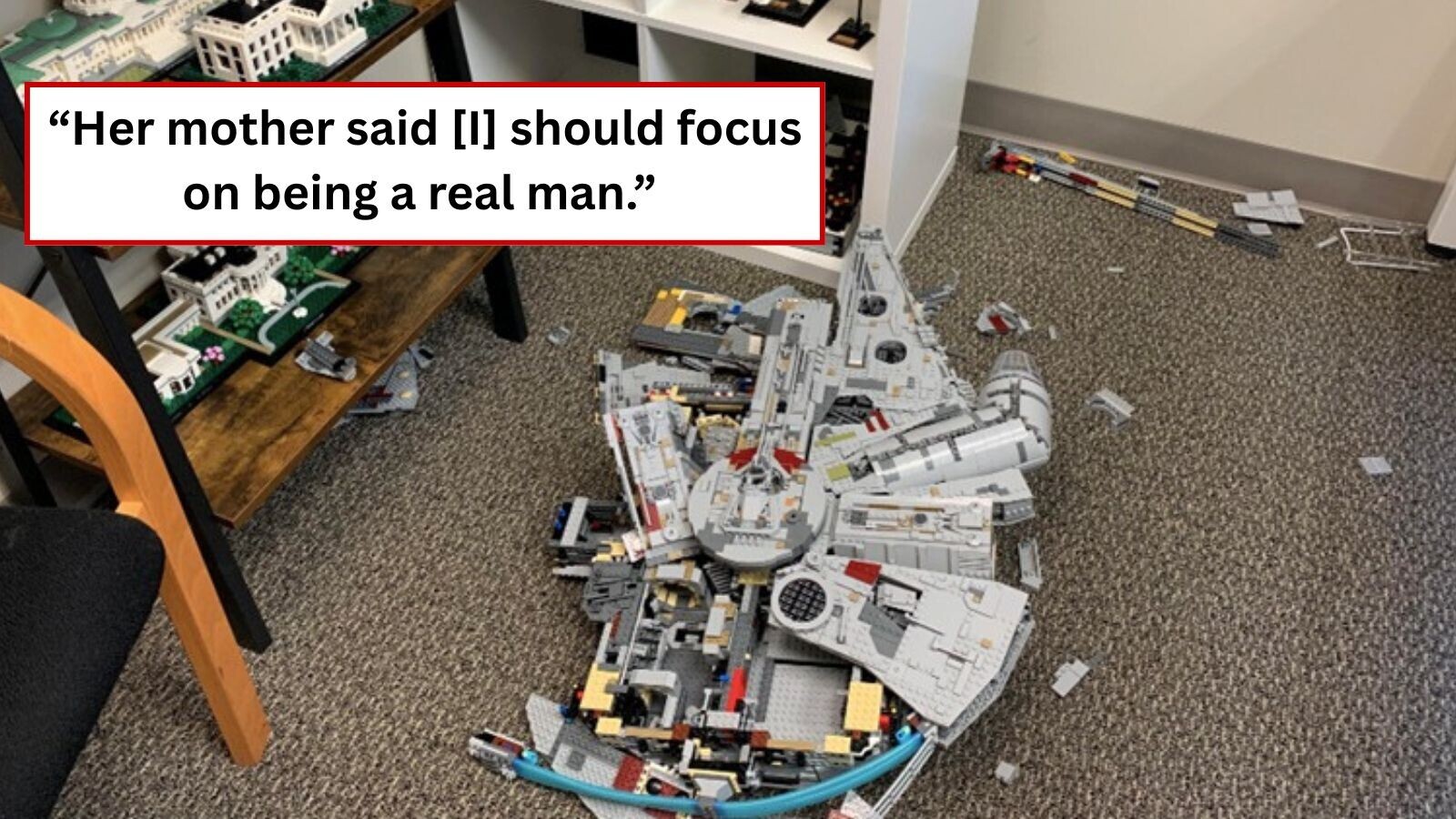
In the viral-style story behind the title, the emotional center is not merely that a grandmother disapproved of an adult’s LEGO hobby. It is that a built setespecially one connected to a parent-child projectwas treated as worthless. That is where the situation moves from silly disagreement to real hurt.
A completed LEGO model is more than plastic. It represents time, attention, and often memory. When a father and son build a Millennium Falcon together, they are not just assembling gray pieces. They are creating a shared experience: choosing the set, opening the bags, laughing at mistakes, searching for missing parts, celebrating finished sections, and maybe arguing over who gets to attach the coolest piece. The finished model becomes a physical reminder of that time together.
Breaking it on purpose is not the same as accidentally bumping a shelf. It sends a message: “What you care about does not matter.” That is why reactions to this kind of family drama are so strong. The issue is not whether Grandma likes LEGO. She does not have to. The issue is respect.
Adults do not need every relative to understand every hobby. But they do need basic boundaries. You do not smash someone’s guitar because you dislike music. You do not rip apart someone’s quilt because blankets are “for sleeping, not art.” And you do not destroy a LEGO build because you believe joy expires at age eighteen.
LEGO and Parenting: The Best Excuse Adults Ever Had
One of the funniest truths about adult LEGO fans is that children often provide socially acceptable cover. A parent buys a set “for the kids,” then somehow becomes the project manager, quality-control inspector, and chief sticker applier. The child wanders away after bag two, while Dad is still there at midnight muttering, “No, no, the left engine assembly is different.”
But this is not a bad thing. Shared building can be wonderful for families. It encourages patience, teamwork, problem-solving, spatial thinking, and communication. Children learn that mistakes can be fixed. Adults learn that children are better at finding tiny pieces in the carpet than anyone with a retirement account.
LEGO can also bridge generations. A grandparent who dislikes adult LEGO collecting might soften when invited to build a simple set with a grandchild. The act of building can turn judgment into curiosity. Sometimes the person who says, “This is ridiculous,” is the same person who, twenty minutes later, is carefully attaching a window and asking whether the little yellow person is supposed to have two faces.
The “Kidult” Trend: Adults Are Buying Toys for Themselves
LEGO’s adult audience is part of a broader retail trend often called the “kidult” market. Adults and teens increasingly buy toys, collectibles, puzzles, plush items, trading cards, and building sets for themselves. This shift is driven by nostalgia, fandom, stress relief, social media, home display culture, and the simple fact that adulthood is hard and sometimes a tiny plastic dragon helps.
Entertainment franchises also fuel the trend. Star Wars, Harry Potter, Marvel, Disney, Nintendo, Formula 1, and other pop-culture partnerships give adults a reason to buy sets connected to stories they already love. A LEGO set is not just a toy; it is a collectible, a display object, and a hands-on fan experience.
That is why the phrase “LEGO for adults” no longer sounds odd to many consumers. It sounds like a product category. Adults buy LEGO flowers instead of real flowers, LEGO cars instead of actual cars they cannot afford, and LEGO landmarks instead of plane tickets. Honestly, compared with international travel, a tiny brick Eiffel Tower is a bargain and has fewer airport delays.
How to Handle a LEGO-Hating Relative Without Starting Brick World War III
If you have a grandma, mother-in-law, uncle, neighbor, or mysterious family critic who insists LEGO is only for children, the goal is not to win a courtroom argument. The goal is to set boundaries without turning Thanksgiving into a minifigure crime scene.
1. Explain the Meaning, Not Just the Object
Instead of saying, “It’s my LEGO, leave it alone,” explain why it matters. Maybe it helps you relax. Maybe you built it with your child. Maybe it connects to a favorite movie. Maybe it is part of a collection. People are more likely to respect a hobby when they understand the story behind it.
2. Set a Clear Boundary
Kindness is good. Vagueness is not. A simple boundary works best: “You don’t have to like my LEGO collection, but you may not touch, move, or take apart my builds.” That sentence is calm, direct, and much cheaper than replacing a collector’s set.
3. Offer a Low-Stakes Build
Sometimes critics are just unfamiliar with the hobby. Offer a small seasonal set, flower, bird, or simple house build. Do not start with a 7,000-piece spaceship unless you want Grandma to call a family meeting.
4. Accept That Not Everyone Will Get It
Some relatives will never understand. That is fine. Adults are allowed to enjoy harmless hobbies without receiving unanimous committee approval from the family council. As long as the bills are paid, the walkways are clear, and nobody is eating LEGO pieces, the hobby is probably safe.
What This Debate Says About Adulthood
The bigger question is not whether adults should build LEGO. The bigger question is why adults are so often expected to abandon play altogether. Somewhere along the way, many people absorb the idea that maturity means giving up visible joy. Hobbies must be practical, impressive, profitable, or at least beige.
But adulthood is not proven by boredom. Adults need play, creativity, rest, and personal rituals. A person can pay taxes, care for family, meet deadlines, and still spend Saturday evening building a LEGO castle. These things are not opposites. In fact, playful hobbies may help adults stay balanced enough to handle responsibilities better.
LEGO building is structured creativity. It gives adults permission to make something with their hands in a world where much of life happens on screens. It can be social or solitary. It can be silly or serious. It can be a collector’s passion, a family activity, a design challenge, or a quiet form of stress relief.
And yes, it can also be expensive, space-consuming, and slightly ridiculous. But so are many beloved adult hobbies. Have you seen what people spend on fishing rods, espresso machines, golf clubs, handbags, fantasy football, or decorative pillows that nobody is allowed to use?
Related Experiences: When Adult LEGO Meets Family Opinion
Nearly every adult LEGO fan has a version of “the look.” It is the expression someone gives when they walk into a room, see a grown person hunched happily over numbered bags of bricks, and silently wonder whether society took a wrong turn. The look is not always cruel. Sometimes it is confusion. Sometimes it is concern. Sometimes it is the face of a person trying to decide whether a LEGO orchid needs sunlight.
One common experience is the “gift misunderstanding.” An adult mentions liking LEGO, and a relative buys them a small children’s police car set, assuming all LEGO is basically the same. The fan smiles politely, because kindness matters, while secretly dreaming of modular buildings, botanical sets, architecture models, or a collector’s spaceship with enough pieces to qualify as a second job. This moment reveals the gap between casual awareness and actual hobby knowledge.
Another familiar scenario is the “display debate.” Adult fans often place completed sets on shelves, desks, mantels, or inside glass cabinets. Some family members admire the display. Others ask when it will be “put away,” as though the Eiffel Tower, once built, should return to a shoebox under the bed. For collectors, display is part of the hobby. The build is not clutter; it is the finished artwork. Of course, presentation matters. A well-arranged LEGO display can look intentional and stylish. A dining table permanently covered in loose pieces may inspire less enthusiasm from household members who enjoy eating dinner without excavating a blue plate from beneath a dragon wing.
Parents who build with children often experience the sweetest version of adult LEGO life. A child may begin the set, lose focus, return, ask questions, invent a story, and proudly claim credit for the finished model. The adult may do most of the technical work, but the memory belongs to both of them. Years later, the set may matter less than the afternoon spent together. That is why criticism from relatives can sting. They are not just judging plastic bricks; they may be dismissing a family ritual.
There is also the “conversion moment.” A skeptical relative sits down “just to help for five minutes” and slowly becomes invested. They start searching for pieces. They ask what page comes next. They complain that the dark gray and black pieces look too similar. Then, without warning, they experience the tiny thrill of snapping the final section into place. This is how LEGO wins. Not through arguments, but through the click.
Many adults also describe LEGO as a healthier evening habit than endless scrolling. After work, instead of sinking into a phone for two hours, they build a section of a set. The progress is visible. The hands are busy. The mind settles. A finished model gives a sense of completion that digital life often lacks. Even if the build is small, it says: something real happened here.
So when Grandma insists LEGO is not for adults, the best response may not be a lecture. It may be an invitation. Hand her a small bag of pieces. Show her the instructions. Let her attach a window, a flower, or a tiny coffee cup. She may still think the whole thing is silly. But she might also smile despite herself. And if she does, protect the Millennium Falcon anyway. Forgiveness is noble, but retired LEGO sets are not cheap.
Conclusion: LEGO for Adults Is Here to Stay
The debate over whether adults should build LEGO says more about our cultural discomfort with play than it does about plastic bricks. LEGO has grown into a hobby that serves children, teens, parents, collectors, artists, designers, and stressed-out adults who just want one peaceful hour where the instructions make sense.
Grandma may never fully understand why an adult wants to build a Star Wars ship, a flower bouquet, a skyline, or a tiny jazz club. That is okay. Not every hobby needs universal approval. But respect is non-negotiable. A LEGO build can represent creativity, patience, family bonding, nostalgia, relaxation, and personal expression. It deserves the same basic courtesy as any handmade project.
So, are LEGO sets for adults? Absolutely. They are for adults who want to create, collect, unwind, decorate, connect, and occasionally experience the spiritual test of applying a sticker perfectly straight. And if anyone still disagrees, they are welcome to their opinionas long as they keep their hands away from the Millennium Falcon.