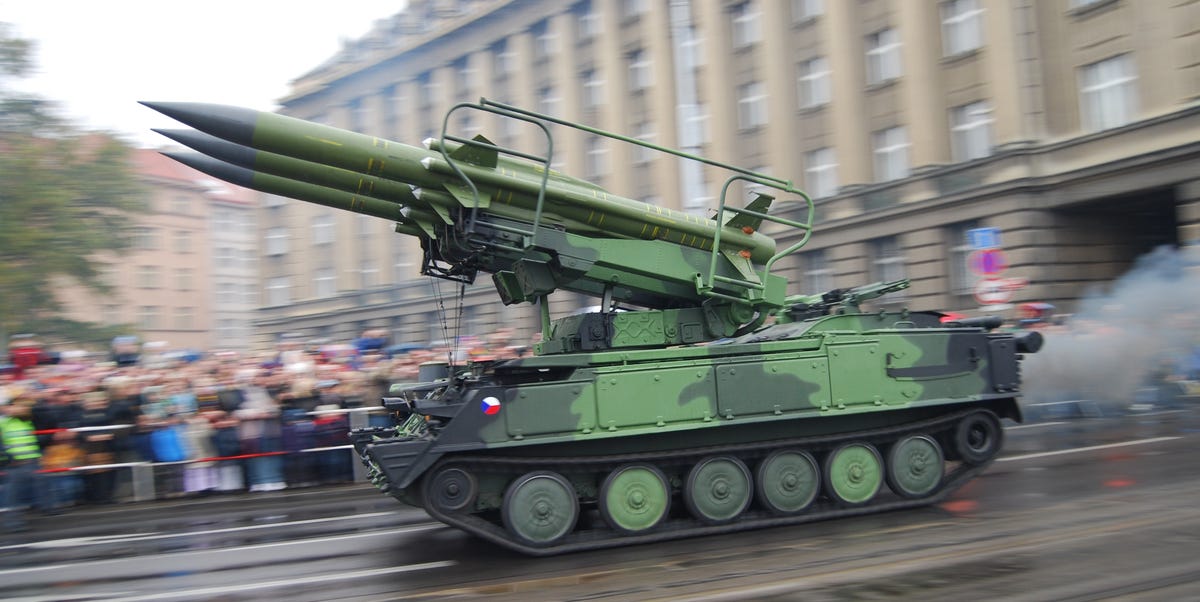
The nickname sounds like something a heavy-metal band would print on a tour shirt, but the “Three Fingers of Death” are not here to play guitar solos. They are 2K12M2 Kub-M2 air-defense systems, known to NATO as the SA-6 “Gainful,” and their three ready-to-fire missiles sitting ame. In Ukraine, however, the drama is not branding. It is survival.
Russia’s war has turned Ukrainian skies into a relentless test of endurance: missiles, drones, glide bombs, helicopters, and aircraft all competing for the same terrifying job of breaking cities, infrastructure, and frontline units. Against that pressure, every additional air-defense layer matters. The arrival of Czech-upgraded Kub-M2 systems gives Ukraine another tool in a battlefield where the difference between “old” and “useful” can be measured in seconds.
What Are the “Three Fingers of Death”?
The 2K12 Kub is a Soviet-designed mobile surface-to-air missile system developed during the Cold War to protect ground forces from aircraft flying at low and medium altitudes. The launcher carries three long 3M9 missiles, which look like three raised fingers when elevated. That visual alone explains the nickname. The “death” part comes from the system’s reputation: when it first appeared in combat, it made pilots take it very seriously, very quickly.
The Kub was never designed to sit politely in one place and wait to be destroyed. It was built on tracked vehicles so it could move with armored formations, hide, relocate, and create uncertainty for enemy aircraft. A typical Kub battery pairs launchers with radar and command vehicles. In simplified terms, the radar finds and tracks a target, the missile is launched, and guidance keeps the missile moving toward the aircraft, helicopter, drone, or cruise missile. It is not magic. It is engineering, radar, speed, and a healthy amount of Cold War paranoia packed into metal.
Why Ukraine Needed Another Air-Defense Layer
Ukraine’s air-defense problem is not one problem. It is a whole buffet of bad options. Russian forces use one-way attack drones to exhaust defenses, cruise missiles to strike infrastructure, ballistic missiles to arrive fast and hard, helicopters to threaten troops near the front, and aircraft launching glide bombs from outside the reach of many short-range systems. That means Ukraine cannot rely on one miracle weapon. It needs a layered shield.
Layered air defense is exactly what it sounds like: different systems covering different distances, altitudes, and target types. Long-range systems may protect major cities and critical infrastructure. Short-range guns and missiles may chase drones. Mobile medium-range systems can fill the awkward space between them, especially near the battlefield. That middle layer is where the Kub can still matter.
The arrival of the Kub-M2 systems from the Czech Republic did not suddenly make Ukraine’s skies safe. No single system could do that. But it gave Ukraine more launchers, more radar coverage, and more flexibility. In a war of attrition, flexibility is not a luxury. It is the military equivalent of finding a phone charger at 3 percent battery.
Why an Old Soviet System Still Matters
At first glance, sending a system that entered service in the 1960s into a modern drone-and-missile war sounds like bringing a typewriter to a cybersecurity conference. But military usefulness is not measured only by age. It is measured by whether a system can still do a job, whether crews can operate it, whether ammunition exists, whether it can be repaired, and whether it fits into the wider defense network.
The Kub checks several important boxes. Ukraine has experience with Soviet-designed air-defense equipment, which reduces the training burden compared with completely unfamiliar systems. The Kub is mobile, which makes it useful around changing frontlines. Its missiles can reach farther than many shoulder-fired or very short-range systems. And the Czech Kub-M2 version brought upgrades that improved reliability, communications, crew workload, and integration with more modern command systems.
That does not make the Kub young. It just makes it stubborn. And in Ukraine, stubborn hardware has often performed better than glossy brochures predicted.
The Czech Upgrade: Old Bones, New Nerves
The Czech Republic did not simply pull museum pieces out of a dusty warehouse and say, “Good luck, Kyiv.” The Kub-M2 systems in Czech service had been modernized. Those upgrades reportedly included improvements to electronics, cabling, power supply, communications, displays, diagnostics, and NATO-compatible features. In practical terms, that means crews get better information, maintenance becomes less painful, and the system is easier to plug into a broader air-defense picture.
This matters because a radar-guided missile system is only as useful as the network around it. In modern war, the best air-defense units do not operate like lonely hunters wandering the forest. They work as part of a larger web of sensors, command posts, radars, mobile teams, and other interceptors. The more smoothly a system can share information, the more useful it becomes.
The Czech upgrade also hints at a broader trend: Ukraine and its partners have repeatedly adapted older platforms for new battlefield needs. Soviet-era launchers, Western missiles, improvised mobile firing teams, commercial drones, and modern software have all collided in Ukraine’s war laboratory. Sometimes the result looks elegant. Sometimes it looks like a garage project with a defense budget. Either way, if it works, it matters.
What the Kub Can Threaten
The Kub was designed mainly to counter aircraft, helicopters, and low-to-medium-altitude aerial threats. In Ukraine, that makes it relevant against several categories of Russian activity. Helicopters operating near the front, aircraft attempting to release weapons too close to Ukrainian positions, certain drones, and some cruise-missile profiles may all fall into the kind of target set that mobile medium-range air defense was built to complicate.
The key word is “complicate.” Air defense is not only about shooting things down. It is also about changing enemy behavior. A Russian pilot who knows a mobile Kub battery may be nearby has to think harder about altitude, route, exposure time, and launch distance. A helicopter crew may avoid certain zones. Aircraft may be forced farther back, reducing accuracy or limiting attack options. Even when no missile is fired, the threat can shape the battlefield.
That is one of the Kub’s underrated values. It creates a danger bubble. The bubble is not perfect, not permanent, and not invincible. But it forces the enemy to plan around it, and planning around threats costs time, fuel, range, and confidence.
What the Kub Cannot Do
There is a reason Ukraine continues asking for more modern air-defense systems. The Kub has limitations, and pretending otherwise would be like calling a flip phone “basically an iPhone with character.” A classic Kub battery can engage only a limited number of targets at once. Its missiles and radar technology belong to an older generation. It may struggle against sophisticated electronic warfare, saturation attacks, and very fast ballistic missiles. It also depends on missile stocks, and Soviet-caliber air-defense ammunition is not something allies can manufacture overnight.
Russia’s strike tactics are built around pressure. Large drone waves can force defenders to reveal positions or spend interceptors. Cruise missiles can come from different directions. Ballistic missiles compress decision time. Electronic warfare can interfere with sensors and communications. Against that kind of attack mix, the Kub is helpful but not sufficient.
So the right way to understand the “Three Fingers of Death” is not as a superhero entrance. It is a reinforcement. It fills gaps, adds depth, and gives commanders more choices. In a long war, more choices can be as valuable as more firepower.
Why Mobility Is the Real Superpower
One of the Kub’s most important features is mobility. Fixed air-defense systems can be powerful, but once the enemy identifies them, they become targets. Mobile systems can move, hide, fire, relocate, and reappear somewhere else. That “shoot-and-scoot” logic has defined air-defense survival for decades.
In Ukraine, mobility is especially valuable because drones are everywhere. Surveillance drones look for radar emissions, tracks, heat signatures, vehicles, and patterns. Long-range strike drones and missiles can attack discovered positions. A system that can move with ground forces and avoid predictable routines has a better chance of surviving.
The Kub’s tracked chassis was designed for rough terrain and battlefield movement. That gives it an advantage over systems that require more preparation or are less suited to muddy, damaged, or contested environments. Ukraine’s battlefield is not a showroom floor. It is fields, tree lines, broken roads, temporary positions, and constant movement. A tracked launcher fits that unpleasant reality.
The Historical Reputation of the SA-6 Gainful
The Kub earned its fearsome reputation during the 1973 Yom Kippur War, when Egyptian and Syrian forces used Soviet-supplied air defenses to challenge Israeli aircraft. The SA-6 shocked pilots because it combined mobility, radar guidance, and better low-altitude performance than many older systems. Suddenly, flying low was not the easy answer it had once seemed to be.
That history matters because the Kub changed how air forces thought about suppression of enemy air defenses. It helped prove that mobile missile systems could deny airspace, protect advancing ground forces, and punish predictable attack patterns. Decades later, the same basic idea still applies in Ukraine: do not give the enemy a clean sky.
Of course, every famous weapon eventually becomes less mysterious. Countermeasures improve. Pilots adapt. Electronic warfare evolves. Intelligence systems get sharper. The Kub is no longer the terrifying surprise it was in 1973. But it remains a reminder that mobile air defense can make even a powerful air force cautious.
Ukraine’s Air Defense Is a Patchwork by Necessity
Ukraine’s air-defense network is one of the most unusual in the world because it has been assembled under fire. It includes Soviet-era systems, Western high-end platforms, short-range mobile teams, anti-aircraft guns, electronic warfare, interceptor drones, and improvised solutions that would make a procurement officer spill coffee on a spreadsheet.
That patchwork is not ideal, but it is realistic. Ukraine cannot wait for a perfectly standardized force. It has to use what arrives, integrate what works, and keep adapting as Russia changes tactics. The Kub-M2 fits into that reality. It is not the newest piece on the board, but it can still occupy a square that Ukraine needs defended.
The bigger lesson is that air defense in Ukraine is no longer just about high-end missiles. It is about inventory depth, repair capacity, software integration, trained crews, radar coverage, mobility, and cost-effectiveness. A cheap drone shot down by a million-dollar missile is sometimes necessary, but it is not a sustainable business model. Every system that helps distribute the burden matters.
Could Western Missiles Be Integrated?
One of the most interesting questions around the Kub is whether older launchers can be adapted to fire Western missiles. Ukraine and its partners have already explored creative integrations across different platforms, and past modernization concepts for Kub-type systems have included the possibility of using non-Soviet missiles. In theory, this could help solve the ammunition problem. In practice, integration is never as simple as bolting one thing onto another and calling it innovation.
Missiles require compatible launch rails, electronics, guidance logic, command systems, power interfaces, safety procedures, testing, crew training, and supply chains. That is a lot of engineering before breakfast. Still, the idea is attractive because Ukraine’s Soviet missile stocks are finite. If older launchers can be paired with more available Western interceptors, they may stay useful far longer.
Even if that path is difficult, the broader principle is already clear: Ukraine’s defense depends on adaptation. The country’s military has repeatedly shown that old and new technologies can be fused when necessity gets a vote. And in war, necessity votes every day.
What This Means for Russia
For Russia, the arrival of additional Kub systems means more uncertainty. Every extra Ukrainian air-defense asset forces Russian planners to account for another possible engagement zone. That can affect flight paths, attack timing, drone routing, helicopter tactics, and the use of aircraft near the front.
The psychological effect should not be exaggerated, but it should not be ignored either. Pilots and mission planners respect systems that can move. A known fixed threat can be studied and attacked. A mobile threat that may or may not be waiting in a tree line is harder to dismiss. Air defense works best when it creates doubt, and doubt is expensive.
Russia will try to locate and destroy these systems, as it does with all Ukrainian air defenses. That means the Kub’s survival will depend on discipline, movement, concealment, emissions control, decoys, and integration with other defenses. The “Three Fingers” can be dangerous, but they are not immortal. In modern war, anything that radiates, moves, or leaves tracks can become a target.
Why the Nickname Caught Public Attention
Let’s be honest: “2K12M2 Kub-M2 mobile surface-to-air missile system” is not exactly a headline that jumps off the page and buys you a coffee. “Three Fingers of Death,” on the other hand, sounds like a movie title your uncle would absolutely watch on cable. The nickname works because it is visual, memorable, and just dramatic enough to survive the internet.
But behind the nickname is a serious point: the war in Ukraine has made obscure military systems part of public conversation. Weapons once known mainly to specialists now appear in headlines, social media posts, and dinner-table arguments. HIMARS, Patriot, Storm Shadow, Shahed, Lancet, FPV drones, and now the Kub have all entered a strange new vocabulary of war.
That public attention can be useful when it helps people understand why air defense aid matters. It can also be misleading if nicknames make systems sound more decisive than they are. The Kub is important, but it is not a magic wand. It is one more piece in a very large, very dangerous puzzle.
Experience-Based Lessons from the “Three Fingers” Story
The biggest experience connected to the arrival of the “Three Fingers of Death” is not just military; it is human. For civilians in Ukrainian cities, air defense is not an abstract topic. It is the difference between sleeping through the night and waking to sirens, explosions, and shattered windows. Every intercepted drone or missile is not merely a statistic. It is a school still standing, a power station still operating, a family still alive, a morning that begins with coffee instead of smoke.
For soldiers near the front, the experience is different but equally intense. Air defense creates breathing room. When helicopters are pushed back, when aircraft are forced to launch from farther away, when drones are intercepted before they can spot artillery positions, ground troops get a chance to move, dig, resupply, and survive. The Kub’s role may be technical, but its effect is deeply practical. It helps turn open sky from an enemy highway into contested ground.
For military planners, the lesson is humility. Modern war has not erased old systems. It has punished lazy thinking. A weapon from the 1960s can still matter if it is maintained, upgraded, networked, and used intelligently. At the same time, even the most famous system becomes vulnerable if it is predictable. The Kub teaches both lessons at once: old tools can still cut, but only if the user respects their limits.
For Ukraine’s partners, the experience is a reminder that “air defense” is not a single shopping list item. It is a constant supply problem. Launchers are important, but missiles are just as important. Radars matter, but so do spare parts. Training matters, but so does maintenance. A donated system that cannot be repaired or resupplied becomes a very expensive lawn ornament. The most useful aid packages think beyond the headline and include the boring things that keep equipment alive.
For readers watching from far away, the “Three Fingers of Death” story offers a clear way to understand the war’s technological character. Ukraine is defending itself with a mix of old Soviet platforms, modern Western systems, domestic innovation, and battlefield improvisation. It is not neat. It is not symmetrical. It is not the clean, futuristic war imagined in defense brochures. It is a hard, adaptive contest where yesterday’s hardware and tomorrow’s software often meet in the same muddy field.
That is why the Kub’s arrival matters. Not because it guarantees air superiority. Not because it ends Russia’s missile campaign. Not because a dramatic nickname can stop a drone swarm. It matters because Ukraine’s defense is cumulative. One more system means one more defended sector, one more aircraft forced away, one more drone possibly intercepted, one more commander with options. In a war this long, options are oxygen.
Conclusion
The “Three Fingers of Death” have arrived in Ukraine not as a miracle weapon, but as a meaningful reinforcement in one of the most demanding air-defense battles of the modern era. The Czech-upgraded 2K12M2 Kub-M2 brings mobility, medium-range coverage, familiar Soviet-era architecture, and modernized electronics to a country fighting daily against missiles, drones, aircraft, and helicopters.
Its strengths are real: mobility, battlefield relevance, and the ability to complicate Russian air operations. Its weaknesses are also real: age, limited engagement capacity, missile-stock challenges, and vulnerability to modern detection and strike systems. The smart analysis sits between hype and dismissal. The Kub is not a relic, and it is not a revolution. It is a useful, dangerous, imperfect tool in a war where imperfect tools can still save lives.
So yes, the “Three Fingers of Death” make a great headline. But their real importance is quieter and more serious. They add another layer to Ukraine’s shield. And in a sky crowded with threats, every layer counts.
Note: This article is written as public-interest analysis based on publicly reported information about the 2K12 Kub / SA-6 Gainful system, Czech military aid to Ukraine, and the broader air-defense challenges of the Russia-Ukraine war. It does not provide operational instructions.