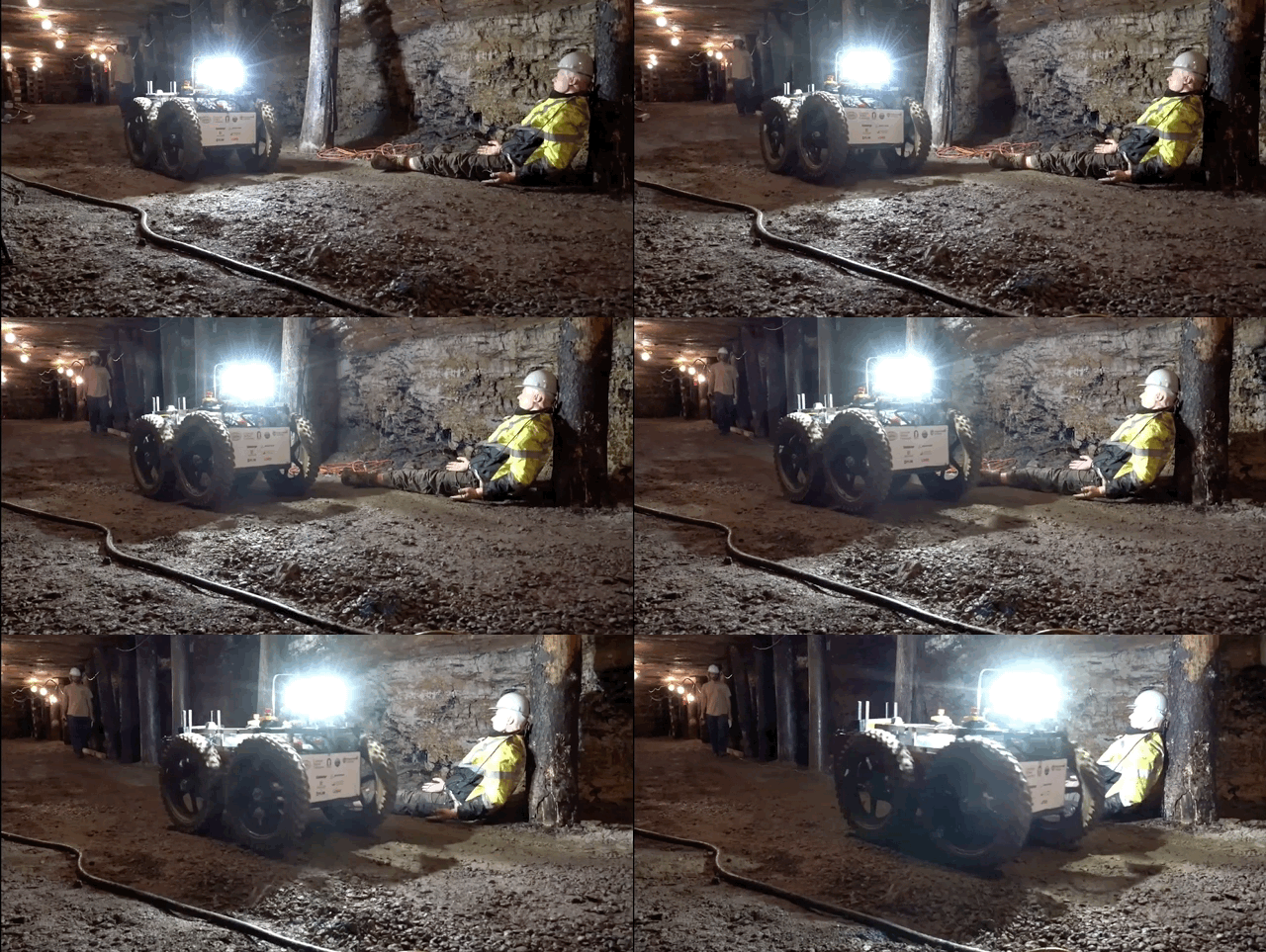
The DARPA Subterranean Challenge 2019 sounded, at first, like the setup for a science-fiction movie: send robots into dark mines, ask them to find hidden objects, keep humans safely outside, and hope the machines do not panic in the mud. Luckily, robots do not panic. They simply lose Wi-Fi, stare into dust, argue silently with their sensors, and keep rolling, walking, flying, or occasionally floating forward.
In reality, the 2019 event was one of the most important robotics competitions of the decade. Officially called the DARPA Subterranean Challenge, or SubT Challenge, it was created to push autonomous systems beyond clean lab floors and into the kind of underground environments where first responders, soldiers, rescue crews, and mine-safety teams often face serious danger. The first scored event, the Tunnel Circuit, took place from August 15 to August 22, 2019, in the Pittsburgh area at mining research facilities operated by the National Institute for Occupational Safety and Health.
The mission was simple to describe and extremely hard to execute: build robotic systems that could rapidly map, navigate, and search complex underground spaces without relying on GPS. Teams had to locate “artifacts,” such as survivor mannequins, cell phones, backpacks, fire extinguishers, and drills, then report their positions accurately. In plain English, the robots had to go into a mine, figure out where they were, find important stuff, and tell humans about it before the clock ran out. Easy, right? Only if your toaster also does cave rescue on weekends.
What Was the DARPA Subterranean Challenge?
The DARPA Subterranean Challenge was designed by the Defense Advanced Research Projects Agency to accelerate technology for underground operations. The competition focused on three major types of underground environments: human-made tunnel systems, urban underground infrastructure, and natural caves. These are places where satellite navigation fails, radio signals fade, visibility collapses, and every innocent-looking puddle may be hiding a robot-eating rut.
DARPA split the challenge into two main tracks. The Systems Competition involved real physical robots operating in real underground courses. The Virtual Competition focused on software teams controlling simulated robots in digital underground environments. This dual format mattered because underground autonomy requires both rugged hardware and smart algorithms. A robot can have tank tracks, fancy LiDAR, and the confidence of a superhero, but without reliable software it may still spend 20 minutes trying to understand a wall.
The 2019 Tunnel Circuit was the first major test. It gave researchers a brutally honest report card on what worked underground and what only worked in PowerPoint. Teams brought fleets of ground robots, unmanned aerial vehicles, quadrupeds, tracked machines, wheeled platforms, and even an autonomous blimp called Duckiefloat. That mix made the event feel less like a single robot race and more like a subterranean technology zoo, minus the gift shop.
Why the 2019 Tunnel Circuit Mattered
The DARPA Subterranean Challenge 2019 mattered because it attacked a real operational gap. Underground environments are dangerous for humans because they are dark, unstable, confusing, and often communication-poor. Mines may include rails, mud, steep slopes, standing water, narrow passages, loose rock, and sharp turns. Urban underground spaces can include subway tunnels, basements, utility corridors, and disaster-damaged infrastructure. Caves add irregular geometry, slippery surfaces, and natural obstacles that seem personally offended by wheel-based transportation.
For first responders, time matters. After a mine accident, earthquake, tunnel collapse, or hazardous-material incident, sending people into an unknown underground area can be risky. Autonomous robots could scout ahead, create maps, detect signs of survivors, locate hazards, and provide situational awareness. In military contexts, similar systems could help teams understand subterranean infrastructure without exposing personnel to unnecessary danger.
The 2019 event also forced teams to solve problems at the system level. It was not enough to have one great sensor or one clever navigation algorithm. Robots had to combine mobility, perception, mapping, communications, object detection, mission planning, and human supervision. The winning approach was not “build the fanciest robot.” It was “build a resilient team of machines that can keep working when the mine starts behaving like a villain.”
How the 2019 Tunnel Circuit Worked
In the Systems Competition, 11 teams from eight countries competed in the Pittsburgh-area Tunnel Circuit. They completed four total runs: two 60-minute runs on each of two courses, known as Experimental and Safety Research. Each course contained 20 artifacts. A correct artifact report had to identify the object and localize it within five meters. The final score combined each team’s best performance from the two courses.
This scoring system rewarded more than raw speed. Teams had to explore efficiently, detect objects reliably, build useful maps, maintain localization, and report accurate coordinates. Finding a backpack was not enough if the robot had no idea where the backpack was. In underground robotics, “somewhere over there in the spooky tunnel” is not a coordinate system.
The Tunnel Circuit tested several hard technical problems at once:
- GPS-denied navigation: Robots could not rely on satellite positioning underground.
- Limited communication: Radio signals degraded through rock, corners, depth, and distance.
- Rough terrain: Mines included mud, rails, slopes, clutter, drops, and uneven surfaces.
- Low visibility: Dust, darkness, and lighting changes made visual perception difficult.
- Multi-robot coordination: Teams had to manage fleets without turning the command station into a robot traffic jam.
- Accurate artifact detection: Robots needed to identify objects and report their locations precisely.
2019 Tunnel Circuit Results
The top overall score in the Systems Competition went to Team Explorer, a DARPA-funded team led by Carnegie Mellon University and Oregon State University collaborators. Explorer scored 25 points, far ahead of the field. Team CoSTAR placed second with 11 points, while CTU-CRAS finished third overall with 10 points and won the $200,000 Tunnel Circuit prize as the highest-scoring self-funded team.
| Rank | Team | Score | Track Status |
|---|---|---|---|
| 1 | Explorer | 25 | DARPA-funded |
| 2 | CoSTAR | 11 | DARPA-funded |
| 3 | CTU-CRAS | 10 | Self-funded prize winner |
| 4 | MARBLE | 9 | DARPA-funded |
| 5 | CSIRO Data61 | 7 | DARPA-funded |
| 6 | CERBERUS | 5 | DARPA-funded |
Those scores reveal how difficult the challenge really was. Each course contained 20 artifacts, yet even the strongest team found only a portion of the possible total. That should not be read as failure. It was the point. DARPA challenges are famous for exposing the gap between what technology can do in controlled settings and what it can do when reality kicks open the door wearing muddy boots.
The Robots: Rolling, Walking, Flying, and Floating
The 2019 Tunnel Circuit featured a remarkable variety of machines. Some teams used tracked ground robots because tracks handle rough terrain better than standard wheels. Others deployed quadruped robots because legs can step over obstacles that would trap a wheeled platform. Aerial drones offered speed and access to spaces that ground robots could not easily reach, though flying underground creates its own comedy of problems: dust, tight walls, poor lighting, and the ever-present threat of bumping into geology.
Team Explorer’s strong performance came from a coordinated multi-robot approach. The team used legged robots and drones to search long tunnel networks and report artifact locations. CoSTAR developed autonomy tools for perception, mapping, risk-aware planning, and resilient navigation. CTU-CRAS used a heterogeneous robotic system that combined different platforms for exploration, detection, and mapping. CSIRO Data61 emphasized multi-agent mapping and shared sensing across ground and aerial robots. CERBERUS explored the value of legged and flying robots working together in difficult terrain.
The lesson was clear: no single robot form was perfect. Wheels can be efficient but struggle with obstacles. Tracks are tough but may be slower. Legs are agile but mechanically complex. Drones are fast but have limited endurance and can be vulnerable in cluttered spaces. A smart team used each machine where it made sense. Underground robotics became less about one heroic robot and more about a balanced squad.
Core Technologies Behind the Challenge
Autonomous Navigation Without GPS
One of the biggest technical demands was navigation in a GPS-denied environment. Most people use GPS so casually that getting lost now feels like a software bug in real life. Underground, GPS is gone. Robots had to estimate their position using onboard sensors such as LiDAR, cameras, inertial measurement units, wheel odometry, and sometimes thermal or depth sensors.
Many teams relied on SLAM, or simultaneous localization and mapping. SLAM allows a robot to build a map while estimating its own position within that map. In a mine, this is tricky because tunnels may look repetitive, featureless, dusty, or geometrically confusing. A robot may travel a long distance and then discover that one dark corridor looks suspiciously like another dark corridor. That is when good sensor fusion becomes essential.
Artifact Detection
The robots were not merely mapping empty tunnels. They had to find artifacts that represented objects of interest in rescue or operational settings. These included simulated survivors, phones, backpacks, fire extinguishers, and drills. Detection required computer vision, thermal sensing, acoustic clues, radio signals, or other specialized approaches depending on the artifact type.
Accurate detection was only half the job. Teams also had to report the artifact location within a five-meter radius. That meant perception and mapping had to agree. A robot might visually recognize a backpack, but if its localization drifted badly, the reported coordinate could miss the scoring window. In the SubT Challenge, being nearly right was often the same as being wrong, which is also how most people feel when assembling furniture without instructions.
Communication Networks
Communication is a quiet villain in underground robotics. Rock, concrete, distance, turns, and elevation changes all weaken signals. Some teams experimented with breadcrumb-style communication nodes, mesh networks, or robot-to-robot data relays. Others leaned more heavily on autonomy, allowing robots to continue exploring even when they could not maintain constant contact with the human operator.
This tradeoff became one of the challenge’s most important lessons. A robot that needs continuous hand-holding is not very useful in a mine. But a robot with too much independence and poor situational awareness can wander into trouble. The best systems balanced autonomy, intermittent communication, and human oversight.
Virtual Competition and Simulation
The 2019 SubT Challenge also included a Virtual Tunnel Circuit. In this track, software teams selected simulated robot platforms and sensors using a budget-like system of “SubT Credits.” They then developed algorithms to explore digital tunnel environments and locate artifacts during 60-minute runs. Coordinated Robotics topped the Virtual Tunnel Circuit with 50 points, followed by BARCS and SODIUM-24 Robotics.
Simulation played an important role because it allowed teams to test autonomy at scale without breaking hardware every afternoon. Real robots are expensive, and mines are not exactly casual office spaces. Virtual environments gave researchers a way to experiment with robot coordination, mapping, path planning, and artifact detection before facing real dust, real mud, and real battery anxiety.
Still, simulation was not a magic shortcut. The physical Tunnel Circuit showed that real-world deployment introduces messy details that are difficult to model perfectly. Sensor noise, mechanical failures, unexpected terrain, poor lighting, and communication dropouts can turn a beautiful algorithm into a very confused machine. That gap between simulation and field performance became one of the central learning points of the entire challenge.
Why Team Explorer Won the 2019 Event
Team Explorer’s 25-point performance stood out because the team combined mobility, autonomy, mapping, and multi-robot coordination effectively. Its approach demonstrated the advantage of sending different robots into different parts of the course while maintaining enough mapping accuracy to report artifacts successfully.
Explorer’s result also showed the value of field-ready engineering. In robotics competitions, the winning team is not always the one with the most futuristic-looking machine. Often, it is the team that can recover from failures, keep sensors calibrated, manage power, avoid communication collapse, and make practical decisions under time pressure. The Tunnel Circuit rewarded durability and execution as much as invention.
CoSTAR’s second-place finish also deserves attention. The team’s later work on Networked Belief-aware Perceptual Autonomy, known as NeBula, helped demonstrate how robots can reason under uncertainty in difficult environments. CTU-CRAS proved that a strong self-funded team could compete with major DARPA-funded groups, a reminder that smart design and focused execution can punch above their budget class.
Real-World Impact of the DARPA Subterranean Challenge 2019
The technologies tested in 2019 have applications beyond the competition. Search and rescue teams could use autonomous robots to inspect collapsed structures, mines, subway systems, tunnels, and disaster zones. Industrial operators could use similar systems for mine safety, infrastructure inspection, and hazardous-site monitoring. Scientific teams could adapt the same ideas for cave mapping, planetary analog research, and remote exploration.
Subterranean robotics is especially relevant because underground environments are often too risky for immediate human entry. Robots can go first, gather information, and reduce uncertainty. They do not replace human judgment; they extend it. A rescue commander with a current underground map, likely survivor locations, and hazard markers is in a far stronger position than one relying on guesswork and a flashlight.
The 2019 challenge also influenced the broader robotics community by creating public datasets, field reports, and lessons learned. Researchers studied multi-robot SLAM, traversability prediction, resilient communication, aerial autonomy, legged locomotion, and perception in degraded conditions. In that sense, the Tunnel Circuit was not just a contest. It was a stress test that produced knowledge for years of robotics research.
Challenges and Lessons From the 2019 Tunnel Circuit
The most obvious lesson was that underground autonomy is hard. The less obvious lesson was that it is hard in many overlapping ways. A robot might have excellent mapping but poor mobility. Another might move beautifully but fail to detect artifacts. A third might find objects but lose communication before reporting them. The competition forced teams to design complete systems rather than isolated technical tricks.
Another lesson was the importance of redundancy. Teams needed backup sensors, multiple robot types, robust communication strategies, and recovery behaviors. Underground environments are unforgiving. A robot can get stuck, lose lighting, misread terrain, or experience sensor degradation. When that happens, the system needs a Plan B, and ideally a Plan C that does not involve a graduate student sprinting into a mine with a rescue cart.
The event also highlighted the value of autonomy that is understandable to human operators. In high-pressure missions, people need to know what the robots are doing, where they are going, and how confident their reports are. A black-box robot that silently makes decisions underground may be technically impressive, but field teams need actionable information, not mystery with wheels.
Experience Notes: What the DARPA Subterranean Challenge 2019 Teaches Engineers, Teams, and Observers
Studying the DARPA Subterranean Challenge 2019 feels like getting a masterclass in the difference between robotics as a laboratory discipline and robotics as a field sport. In the lab, the floor is flat, the lighting behaves, the network connects, and the robot’s biggest enemy may be a chair leg. In the Tunnel Circuit, everything became more dramatic. Terrain changed without warning. Radio links weakened. Dust confused perception. Narrow passages punished bulky machines. Mud made mobility a negotiation rather than a guarantee.
One practical experience from the event is that preparation must include failure, not just success. Teams could not simply ask, “What should the robot do when everything works?” They had to ask, “What happens when the robot loses contact, when the map drifts, when a drone cannot fly safely, when a tracked robot gets stuck, or when two robots need the same narrow passage?” That mindset is valuable for any engineering project. The real world rarely reads the design document before causing trouble.
The 2019 challenge also showed how important team communication is outside the tunnel. Robotics competitions are not won only by robots. They are won by software developers, mechanical engineers, electrical engineers, operators, safety staff, logistics coordinators, and researchers who can make fast decisions without turning every problem into a three-hour meeting. In a timed run, clarity matters. A team must know which robot to deploy, when to recall it, when to trust autonomy, and when to stop chasing an artifact that is costing too much time.
Another experience worth noting is the emotional rhythm of field robotics. There is excitement when a robot disappears into a tunnel and begins building a map. There is tension when communications drop. There is relief when an artifact report lands successfully. And there is a special kind of silence when expensive hardware stops moving in a place where nobody wants to walk casually. This emotional pressure matters because future rescue robotics will operate in even more urgent situations. Tools must be reliable not only for machines, but also for humans making decisions under stress.
For students and young engineers, the 2019 SubT Challenge offers a powerful lesson: elegant algorithms need rugged partners. A brilliant planner is not useful if the battery fails, the chassis cannot climb, or the sensor mount shakes itself loose. At the same time, a strong robot body needs intelligent autonomy. The best systems come from integration. Mechanical design, perception, mapping, networking, and user interface must support one another like members of a very nerdy rescue band.
The Tunnel Circuit also suggests a broader lesson about innovation. DARPA did not create a neat classroom problem. It created a messy goal with real constraints and invited teams to discover solutions through competition. That format encouraged experimentation, comparison, and rapid learning. Some ideas worked. Some ideas became cautionary tales with wheels. Both outcomes were useful. The experience proved that progress in robotics often comes from letting machines meet the world before they are completely ready, then listening carefully when the world says, “Nice try, now fix this.”
Conclusion
The DARPA Subterranean Challenge 2019 was more than a robotics contest in a mine. It was a serious step toward autonomous systems that can help humans understand dangerous underground environments. The Tunnel Circuit revealed how difficult it is to build robots that can map, navigate, detect, localize, communicate, and survive without GPS or easy human access. It also showed that multi-robot teams, resilient autonomy, sensor fusion, and field-tested engineering are essential for the future of underground robotics.
Team Explorer’s victory, CoSTAR’s strong autonomy research, CTU-CRAS’s self-funded success, and the contributions of teams such as MARBLE, CSIRO Data61, CERBERUS, NCTU, Robotika, CRETISE, PLUTO, and Coordinated Robotics helped turn the 2019 event into a landmark moment. The robots did not solve every problem. That was never the point. They exposed the hard problems clearly enough for researchers to attack them.
In the end, the 2019 Tunnel Circuit gave the robotics world something valuable: evidence. Evidence that autonomous robots can explore underground spaces. Evidence that the work is still difficult. Evidence that future rescue, defense, industrial, and exploration missions may benefit from the lessons learned in those dark Pittsburgh tunnels. And yes, evidence that if you send enough robots underground, at least one of them will make you proud, and at least one will make you reach for the troubleshooting manual.