Every few months, the internet gathers around the digital campfire to ask the same ancient question: “Did The Simpsons predict the future again?” Usually, the answer is more complicated than the meme. The show has been on television long enough to predict everything from smartwatches to political circus acts simply by satirizing human behavior with surgical precision. But the Florida controversy over Michelangelo’s David feels different. This was not a vague joke that later became reality. It was almost a storyboard brought to life by adults with email accounts, school-board authority, and apparently no functioning relationship with Renaissance art.
In 2023, Tallahassee Classical School in Florida became national news after principal Hope Carrasquilla resigned following complaints about a sixth-grade Renaissance art lesson that included images of Michelangelo’s David. One parent reportedly described the image as pornographic; other complaints centered on the lack of advance notice before students saw a nude statue. To be precise, Florida as a state did not officially declare David pornography. But the cultural mood that made the controversy possible was very Florida-in-the-headlines: parental-rights politics, curriculum anxiety, and the growing habit of treating education like a suspicious package left unattended at an airport.
And then came the punchline: The Simpsons had already done it.
The Simpsons Episode That Turned Into a News Report
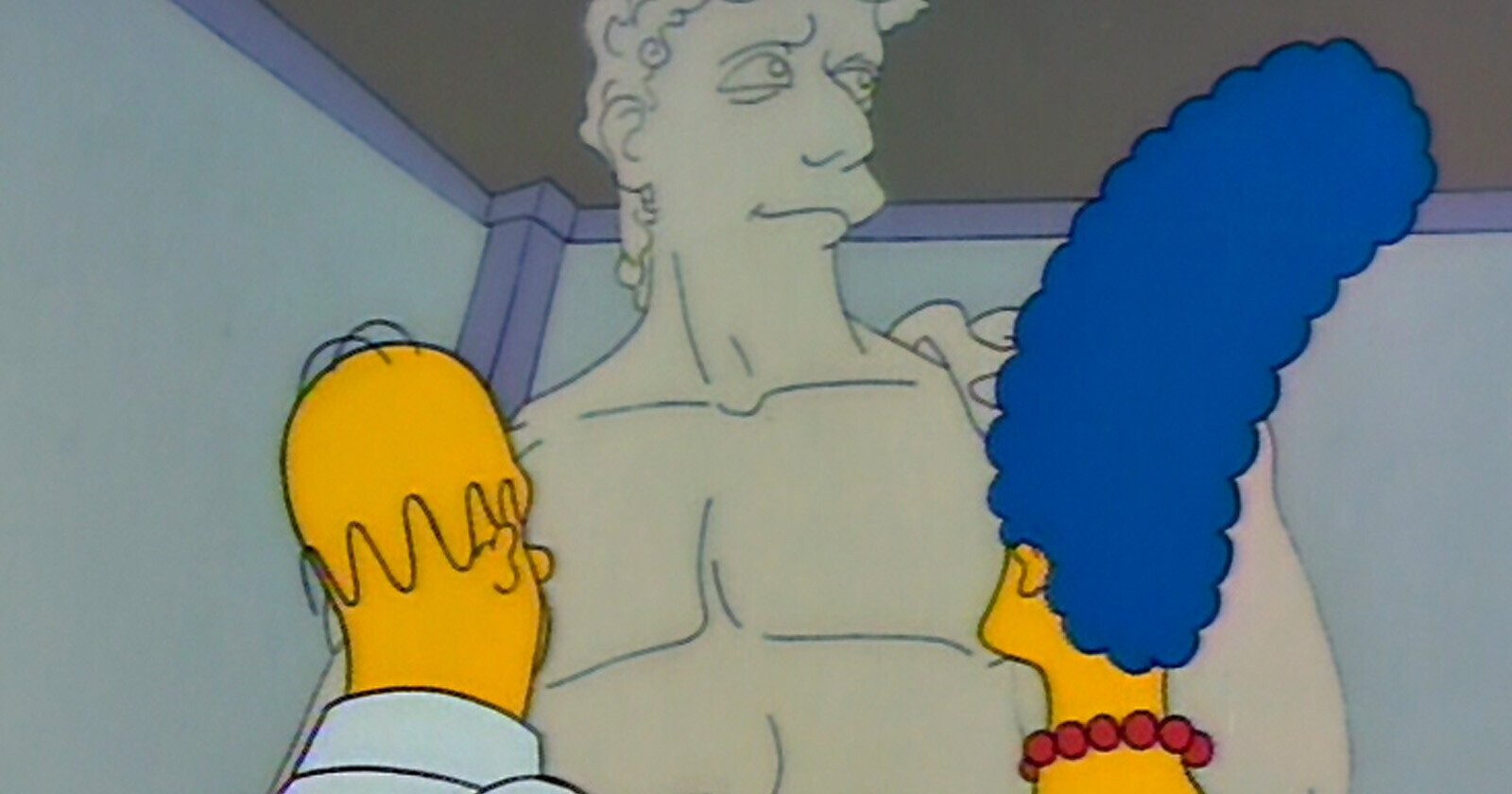
The relevant episode is “Itchy & Scratchy & Marge,” the ninth episode of Season 2, first aired in 1990. In it, Marge Simpson becomes concerned that violent cartoons are influencing children. She launches a protest movement against Itchy & Scratchy, wins public support, and briefly gets the cartoon sanitized into something so gentle that Springfield’s kids abandon television and go outside. A miracle, basically.
Then the movement turns its attention to Michelangelo’s David, which is coming to Springfield as part of a traveling exhibition. Marge’s allies want the statue censored because of its nudity. Marge refuses, because she sees David as art, not obscenity. The episode’s joke is not simply “people are prudish.” It is sharper than that. It shows how censorship movements can begin with a concern that sounds reasonable, gather moral momentum, and then become ridiculous when their logic is applied consistently.
That is why the Florida story felt so eerily familiar. A sixth-grade lesson about the Renaissance included one of the most famous sculptures in world history. Some parents objected. A principal lost her job. The internet found the old Simpsons clip and collectively yelled, “Springfield did it first!”
What Actually Happened in Florida?
The controversy centered on Tallahassee Classical School, a charter school in Leon County. The school used a classical curriculum and taught Renaissance art to sixth graders. The lesson reportedly included Michelangelo’s David, Michelangelo’s Creation of Adam, and Botticelli’s Birth of Venus. These are not obscure underground images smuggled into art class by a substitute teacher with a suspicious flash drive. They are foundational works of Western art.
The problem, according to school leadership, was not only the sculpture’s nudity but the failure to notify parents in advance that students would see nude art. That distinction matters. It is fair for schools to communicate clearly with parents, especially in communities where curriculum expectations are tightly managed. But when an image of David can trigger the word “pornography,” the conversation has already left the museum and wandered into the swamp wearing flip-flops.
Michelangelo’s David is not a pinup. It is a 17-foot marble statue created between 1501 and 1504, depicting the biblical hero David before his battle with Goliath. It is a masterpiece of Renaissance sculpture, admired for its anatomical detail, psychological tension, and symbolic power. The nudity is not a marketing strategy. It belongs to an artistic tradition that connects biblical narrative, classical form, civic identity, and the Renaissance fascination with the human body.
Why Calling David “Pornography” Misses the Point
To call David pornography is to confuse nudity with sexual exploitation. That is not a small mistake. It is the kind of mistake that flattens culture into categories so blunt they could be used to tenderize steak. Art history requires context. Pornography is designed primarily for sexual arousal. Michelangelo’s David is designed to express heroic courage, spiritual confidence, human vulnerability, and civic pride. The statue’s body is idealized, yes, but its purpose is not erotic spectacle.
The figure is tense, alert, and psychologically alive. David is not shown after victory, posing with Goliath’s head like a Renaissance action hero. He is shown before the fight, focused and watchful. That choice matters. Michelangelo sculpted not just a body but a moment of decision. The oversized hands, the concentrated gaze, the contrapposto stance, and the marble surface all work together to create a vision of human potential under pressure.
If students cannot encounter that in art class, what exactly is art class for? Finger painting safe emotional weather systems? A 45-minute lecture on “Shapes That Have Never Offended Anyone”? At some point, education must involve meeting the world as it is: complicated, beautiful, strange, imperfect, and occasionally unclothed because Renaissance sculptors did not consult modern school-board panic meters.
The Bigger Problem: Context Collapse in Education
The Florida David controversy is part of a larger American problem: context collapse. A single image, sentence, or page is pulled from its setting and judged as if it exists alone. A nude statue becomes “pornography.” A difficult novel becomes “inappropriate.” A historical lesson becomes “indoctrination.” The surrounding explanationthe teacher’s guidance, the artistic tradition, the age of the students, the purpose of the lessongets shoved aside.
This is dangerous because learning depends on context. Students do not become thoughtful citizens by avoiding every uncomfortable image or idea. They become thoughtful citizens by learning how to interpret. That does not mean every work belongs in every classroom at every age. It means decisions should be made with educational judgment, not instant outrage.
The irony is especially thick at a school built around “classical” education. Classical education often claims to honor the great works of Western civilization. Well, surprise: Western civilization contains a lot of marble anatomy. Ancient Greece, Rome, the Renaissance, biblical art, cathedral art, mythological painting, and humanist sculpture are not exactly famous for dressing everyone in cargo shorts. If a school wants the prestige of the classical tradition but panics at the sight of a classical nude, it may be ordering the Renaissance sampler platter and sending back the main course.
Why The Simpsons Keeps “Predicting” Us
The Simpsons did not predict the Florida controversy by magic. It predicted it by understanding people. The show’s best early satire worked because it identified patterns: moral panic, hypocrisy, media frenzy, political opportunism, and the way ordinary people can become absurd when they join a righteous crowd. These patterns repeat because human beings repeat them.
In “Itchy & Scratchy & Marge,” the joke is not that all censorship concerns are foolish. Marge begins with a genuine worry about violence in children’s entertainment. The episode gives her argument some weight. But it also shows how movements can lose proportion. Once the crowd learns the thrill of condemning things, it needs new targets. Eventually, even David looks like a public menace.
That is the real prediction. Not “Florida will one day argue about Michelangelo.” The prediction was: people will keep mistaking control for wisdom. They will keep confusing protection with avoidance. They will keep trying to solve cultural anxiety by covering, banning, removing, or firing. Springfield is not a place on a map. Springfield is the part of society that sees a masterpiece and reaches for a complaint form.
Florida, Book Bans, and the Fear of the Classroom
The David story landed during a period of intense debate over school materials in Florida and across the United States. In recent years, Florida has been at the center of national fights over book challenges, classroom libraries, parental rights, race, gender, sexuality, and what counts as appropriate educational content. Supporters of stricter rules argue that parents deserve transparency and control over what children see in school. Critics argue that vague laws and political pressure have created a chilling effect, making teachers and librarians afraid to teach anything that might provoke a complaint.
Both parent involvement and professional educational judgment matter. Parents should know what schools teach. Teachers should not be treated as cultural criminals for introducing students to major works of art. The problem begins when the loudest objection becomes the standard for everyone. A single complaint should start a conversation, not detonate a career.
Education cannot function if every lesson must be pre-defended against the most literal, suspicious, or context-free interpretation possible. Imagine teaching biology under those conditions. Or literature. Or history. Or health. Or mythology. Actually, imagine teaching mythology in a classroom where David is considered too spicy. Zeus would require a legal department.
What Students Lose When Adults Panic
When adults turn art into scandal, students lose more than a lesson. They lose trust in the classroom as a place where ideas can be explored honestly. They learn that discomfort is dangerous, that images are threats, and that cultural literacy is optional if someone objects loudly enough. They also learn a strange double message: classical art is important, but not important enough to defend when it becomes inconvenient.
Students are usually smarter than these controversies assume. A sixth grader can understand that a marble statue in an art history lesson is different from explicit sexual material. They may giggle. They may ask awkward questions. That is not a disaster. That is teaching. A good teacher can turn that moment into a discussion about anatomy, symbolism, religion, Renaissance humanism, and why different cultures treat nudity differently.
Shielding students from every uncomfortable encounter does not make them mature. It makes them brittle. The goal of education is not to preserve innocence by pretending the world is made of laminated worksheets. The goal is to help young people build the interpretive muscles they need to live in a world full of images, arguments, histories, and contradictions.
The Real Obscenity Is Anti-Intellectual Fear
The most obscene thing in this story is not the statue. It is the anti-intellectual reflex that treats knowledge as contamination. Michelangelo’s David has survived weather, politics, religious anxieties, wars, tourism, and centuries of people staring at it while pretending to be very serious about sculpture. It will survive Florida. But schools are more fragile than marble. A culture that makes educators afraid to teach great art is chiseling away at something harder to restore.
There is a difference between age-appropriate teaching and fear-based censorship. Age-appropriate teaching asks: How do we explain this responsibly? Fear-based censorship asks: How do we make this disappear before someone complains? One builds understanding. The other builds silence.
And silence is a poor curriculum. It has no texture, no debate, no beauty, no courage. It cannot explain why a young sculptor in his twenties transformed a rejected block of marble into one of humanity’s most admired works. It cannot tell students why Florence saw David as a symbol of liberty. It cannot help them understand how art can be religious, political, anatomical, philosophical, and beautiful all at once.
A 500-Word Experience Reflection: What This Controversy Feels Like in Real Life
Anyone who remembers sitting in an art, literature, or history class knows that education is often a long series of surprises. You open a textbook expecting dates and definitions, and suddenly you are staring at a painting, a poem, a war, a moral dilemma, or a sculpture that asks more from you than “Will this be on the test?” That is the point. Good education interrupts the small room of your assumptions and lets in a much bigger world.
The Florida David controversy feels familiar because many people have experienced that awkward classroom moment when a subject becomes unexpectedly human. Maybe it was a health class diagram that made everyone stare at the ceiling. Maybe it was a Shakespeare scene full of jokes the teacher had to explain while wishing for early retirement. Maybe it was a museum field trip where students discovered that ancient people, Renaissance artists, and modern advertisers all had very different ideas about the body. These moments can be uncomfortable, but they are also memorable. They teach students that culture is not always tidy.
The best teachers do not avoid those moments. They frame them. They say, “Yes, this is a nude figure, and here is why it matters.” They explain that artists have used the human body to explore strength, weakness, divinity, mortality, beauty, and identity. They help students move from reaction to interpretation. That movement is education in miniature: first you notice, then you wonder, then you think.
Parents also have real experiences that deserve respect. Many parents worry about what their children encounter online and in school. That worry is not automatically foolish. The modern media environment is overwhelming, and children are exposed to adult content in ways previous generations could barely imagine. But that is exactly why context matters. A guided lesson on Michelangelo is not the same as a child stumbling through the internet alone. One is education. The other is algorithmic chaos wearing a trench coat.
In real life, the healthiest response would have been boring, which is often a sign of civilization working properly. The school could have apologized for missing its notification protocol. Parents could have expressed concerns. Teachers could have explained the lesson. Students could have learned why the Renaissance mattered. Everyone could have gone home slightly wiser and eaten dinner.
Instead, the story became a national symbol because it captured a deeper exhaustion. Americans are tired of every classroom becoming a battlefield, every book becoming evidence, every teacher becoming a suspect, and every work of art becoming a culture-war grenade. The laughter around the Simpsons comparison was funny, but it was also weary laughter. It was the laugh people make when reality becomes so absurd that satire starts taking notes from the news.
If there is a practical lesson here, it is this: children can handle more complexity than adults often give them credit for, especially when adults guide them calmly. What they cannot handle is a society that teaches them fear before interpretation. Michelangelo’s David is not dangerous because it is nude. It becomes dangerous only to a culture that has forgotten how to look, think, and explain.
Conclusion
The controversy over Michelangelo’s David at a Florida charter school was ridiculous, but it was not random. It grew from a larger climate of suspicion around classrooms, books, images, and teachers. The Simpsons seemed to predict it because the show understood the machinery of moral panic long before social media gave that machinery a turbo engine.
Michelangelo did not carve pornography. He carved a biblical hero, a civic symbol, and a Renaissance masterpiece that still asks viewers to think about courage, beauty, vulnerability, and human potential. If that is too dangerous for students to see in an art history lesson, the problem is not the statue. The problem is our shrinking confidence in education itself.
Springfield laughed at this in 1990. Florida acted it out in 2023. The rest of us should probably take notes before the next masterpiece is accused of indecent exposure.