For 139 years, the F.J. King rested somewhere beneath Lake Michigan like a rumor with a rudder. Fishermen claimed they had snagged pieces of it. A lighthouse keeper once reported seeing masts poking from the water. Shipwreck hunters searched, argued over old accounts, scanned promising spots, and came back with nothing but cold spray and bruised confidence.
Then, in 2025, a team of citizen scientists, maritime historians, and underwater archaeology enthusiasts finally found the infamous “ghost ship” near Baileys Harbor, Wisconsin. The most cinematic part? After decades of failed searches, the wreck appeared on sonar roughly two hours into the expedition. If Lake Michigan had a sense of humor, it was clearly saving the punchline.
The discovery of the F.J. King is more than a spooky shipwreck story. It is a case study in historical research, modern sonar technology, citizen science, and the stubborn value of reading old newspapers carefully. It also gives researchers a rare look at a 19th-century Great Lakes cargo schooner that helped move the raw materials of America’s industrial age.
The F.J. King: A Working Ship, Not a Haunted Prop
The F.J. King was a 144-foot wooden schooner built in Toledo, Ohio, in 1867. Designed for Great Lakes commerce, it hauled cargo such as grain, lumber, and iron ore across the inland seas that powered Midwestern industry. These vessels were the long-haul trucks of their day, except with sails, wooden hulls, and crews who could not simply pull into a rest stop when the weather turned rude.
The ship began life as a canal schooner, a type of vessel built to navigate the Welland Canal and connect the upper Great Lakes with Lake Ontario. That made it useful in a shipping world where flexibility mattered. The F.J. King could carry bulk cargo through narrow waterways and still handle open-lake travel, which was not exactly a gentle Sunday paddle.
By the mid-1880s, the schooner had been converted into a three-masted vessel and improved for different kinds of cargo. Its final voyage came on September 15, 1886, while carrying roughly 600 tons of iron ore from Escanaba, Michigan, toward Chicago. The route was ordinary. The storm was not.
The Night the “Ghost Ship” Vanished
During a gale off Wisconsin’s Door Peninsula, the F.J. King began taking on water. Waves battered the wooden hull, seams opened, and the pumps could not keep pace. Captain William Griffin and his crew fought to save the schooner, but Lake Michigan was in one of its less negotiable moods.
Eventually, Griffin ordered the crew into the yawl boat. The men escaped and were later picked up by another schooner, La Petite. No lives were lost, which is the bright spot in an otherwise terrifying night. But the crew watched their vessel sink bow-first into the darkness. According to accounts of the disaster, the stern deckhouse blew apart as the ship went down, sending debris and papers into the air.
That dramatic final scene helped turn the F.J. King into maritime legend. The ship was gone, but not forgotten. Its cargo, structure, and story sank into the cold freshwater, waiting for a century and then some.
Why the F.J. King Became a “Ghost Ship”
The nickname “ghost ship” did not come from reports of spectral sailors polishing the deck at midnight. It came from the wreck’s maddening elusiveness. Searchers had looked for the F.J. King since the 1970s, and the vessel became one of Lake Michigan’s most sought-after missing wrecks.
Part of the mystery came from conflicting location reports. Captain Griffin’s account placed the sinking farther offshore, while Cana Island lighthouse keeper William Sanderson reportedly saw masts breaking the surface closer to shore. Commercial fishermen also claimed to have pulled wreckage from the area in their nets. These clues sounded promising, but they did not agree neatly. For shipwreck hunters, that is like receiving three treasure maps and discovering all of them were drawn during a thunderstorm.
For decades, searchers focused on the wrong places. The F.J. King was not hiding in a supernatural sense. It was hiding in a historical paperwork problem: which witness should modern researchers trust?
The Breakthrough: Old Clues Meet New Technology
The successful search was led by maritime historian Brendon Baillod and the Wisconsin Underwater Archeology Association. Baillod studied historical records, including old newspaper accounts, and gave special weight to the lighthouse keeper’s observation. That decision changed everything.
Instead of repeating earlier searches based mainly on the captain’s reported location, the team created a search grid around the area suggested by the lighthouse keeper’s account. The expedition used sidescan sonar, a technology that sends sound waves across the lakebed and creates images of objects below. Think of it as giving researchers the ability to “see” underwater without asking Lake Michigan to please become transparent for a few minutes.
Two hours into the search, the sonar revealed a long object with the unmistakable outline of a ship. The team measured it at around 140 feet, closely matching the F.J. King’s known dimensions. Remote operated vehicles were then sent down to capture images and confirm the find. For the first time since 1886, human eyes saw the lost schooner again.
What Researchers Found on the Lakebed
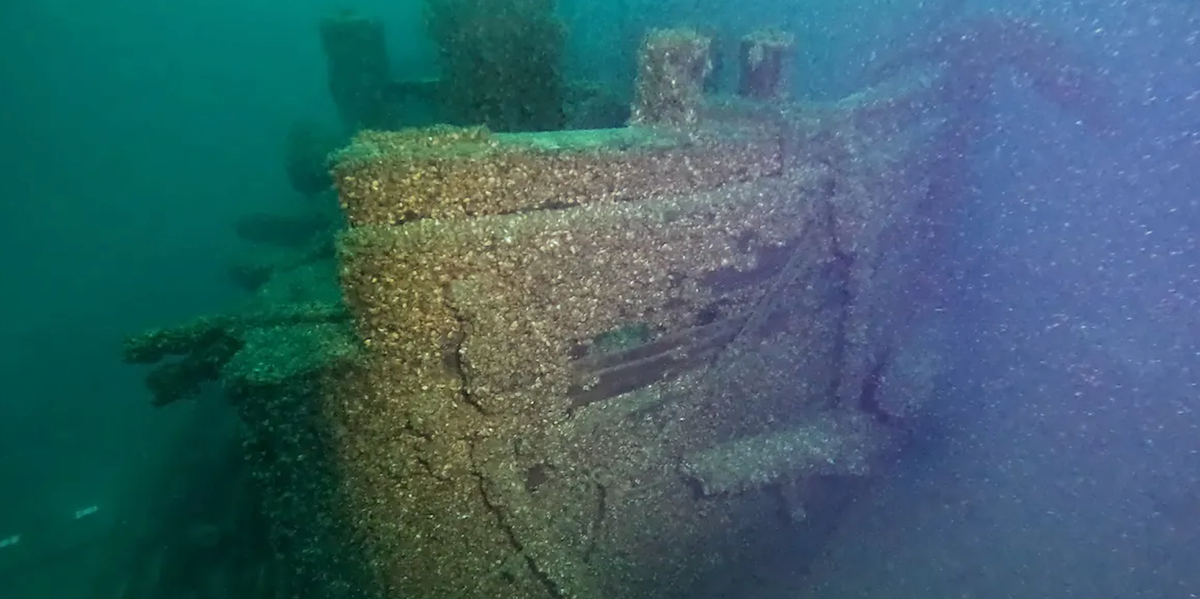
The F.J. King was found in Lake Michigan near Baileys Harbor, resting in deep freshwater. What surprised researchers most was its condition. A ship loaded with heavy iron ore might be expected to break apart violently when it hit the bottom. Instead, the hull remained remarkably intact and upright.
The wreck still shows features that can help archaeologists understand 19th-century Great Lakes shipbuilding. Its wooden hull, hatches, cargo-related structures, and surviving machinery provide a physical record of how working schooners were built and modified. That matters because these vessels were not luxury yachts or naval showpieces. They were practical tools of commerce, designed to move heavy cargo efficiently across some of the most unpredictable waters in North America.
Researchers have also worked to document the site through archaeological surveys and 3D photogrammetry. This process uses many overlapping images to create a detailed digital model of the wreck. The model allows experts, students, and the public to study the ship without disturbing it. In archaeological terms, that is the difference between reading a rare book with clean hands and using it as a coaster.
Why Citizen Science Made This Discovery Special
One of the most exciting parts of the F.J. King discovery is that it involved citizen scientists. The Wisconsin Underwater Archeology Association brought together volunteers and community historians, giving non-professionals a direct role in the search. Participants learned how sonar and remote operated vehicles are used in underwater archaeology, and they were present when the “long shot” became a confirmed discovery.
This matters because archaeology is often imagined as something done only by professors in khaki or divers with very expensive gear and mysterious acronyms. In reality, community involvement can be powerful, especially when local history is at stake. Citizen science brings more eyes, more curiosity, and more public investment into preservation.
The F.J. King was not found by luck alone. It was found through disciplined research, smart interpretation of old evidence, and the practical use of technology. Still, there is something wonderfully human about the moment the sonar image appeared. After 139 years of mystery, the ship did not announce itself with thunder. It simply appeared on a screen, as if saying, “Yes, yes, I’ve been here the whole time.”
The Great Lakes Are an Underwater Museum
The discovery also highlights the enormous shipwreck heritage of the Great Lakes. Thousands of vessels are believed to rest beneath these waters, from wooden schooners and steamers to modern freighters. Lake Michigan alone has hundreds of known and unknown wrecks, many preserved by cold freshwater conditions that slow decay.
These wrecks are not just curiosities for divers. They are time capsules. They reveal how goods moved before highways and diesel engines dominated transportation. They show how communities grew around ports, shipyards, lighthouses, and trade routes. They also remind us that the Great Lakes were not calm blue decorations on a map. They were working waterways, and they could be deadly.
Finding the F.J. King helps fill in one missing page from that story. The ship carried iron ore, the raw material of factories, railroads, tools, machines, and buildings. Its final cargo connects the wreck to the industrial growth of the late 19th-century United States. Beneath the water is not just a broken ship; it is a chapter of American labor, trade, engineering, and risk.
Preservation: The Race Against Time
Discovering a shipwreck is thrilling, but it also creates responsibility. Historic wrecks are protected cultural resources, not underwater souvenir shops. Removing artifacts, damaging structures, or publicizing sensitive locations too early can put a site at risk.
The F.J. King is expected to be nominated for historic recognition, and officials have emphasized that the site is protected by law. That protection is important because shipwrecks can be damaged by careless divers, looters, anchors, fishing gear, and invasive species.
Quagga mussels are a particular concern in the Great Lakes. These invasive mussels attach to submerged surfaces, including historic wrecks, and can obscure details while accelerating deterioration. For archaeologists, the race is not only to find shipwrecks but to document them before nature, pollution, invasive species, or human interference erases valuable evidence.
Why This “Ghost Ship” Story Captured Public Attention
The F.J. King story has all the ingredients people love: a lost ship, a stormy night, conflicting clues, old newspapers, modern technology, and a discovery that happened much faster than anyone expected. It feels like a mystery novel, except the detective work involved sonar instead of a magnifying glass and a suspicious butler.
But the deeper appeal is emotional. People are drawn to shipwrecks because they sit at the intersection of adventure and loss. Even when no one dies, as in the case of the F.J. King, a wreck represents a sudden interruption. A ship had a route, a purpose, a crew, a destination. Then weather changed the story.
Finding the ship gives that interrupted story an ending. It does not undo the disaster, but it restores identity. The wreck is no longer just “somewhere out there.” It has a confirmed place, a documented condition, and a renewed connection to the communities around Lake Michigan.
Experience Section: What the F.J. King Teaches Modern Explorers, Travelers, and History Lovers
The discovery of the F.J. King offers a surprisingly useful experience lesson for anyone interested in exploration, research, travel, or even personal curiosity. The first lesson is simple: old information is not useless just because it is old. In this case, a 19th-century account from a lighthouse keeper helped point modern searchers toward the right area. That is a powerful reminder for students, writers, researchers, and history fans. Sometimes the key to solving a modern mystery is not a new gadget, but a forgotten paragraph in an old newspaper.
The second lesson is that technology works best when guided by good questions. Sidescan sonar did not magically decide where the F.J. King was located. Researchers had to choose where to search. They had to compare accounts, evaluate witnesses, and think critically about what Captain Griffin could or could not have known on a dark, stormy night. The sonar was the tool, but historical judgment was the compass.
For travelers visiting Wisconsin’s Door Peninsula, the story adds a new layer of meaning to the shoreline. Baileys Harbor and Cana Island are already beautiful places, with lake views, maritime charm, and enough fresh air to make your phone feel guilty. Knowing that the F.J. King rested offshore for more than a century turns the landscape into a living museum. The water is not empty scenery; it is an archive.
The discovery also encourages responsible curiosity. It is natural to want to see, touch, or collect pieces of the past. But shipwrecks should be treated like historic buildings, not yard sales with barnacles. The best experience is not taking something from a wreck, but learning its story and helping preserve it for others. Digital models, museum exhibits, public talks, and responsible diving programs can bring these sites to life without damaging them.
For writers and content creators, the F.J. King is a perfect example of how to tell history in a way that feels alive. Start with the human mystery: a ship vanishes, witnesses disagree, searchers fail, and a legend grows. Then add the facts: dimensions, cargo, route, storm, technology, and preservation. Finally, connect the story to a larger theme, such as Great Lakes commerce or citizen science. That structure turns a shipwreck report into a story readers actually want to finish.
For everyday readers, the emotional lesson may be the most memorable. The F.J. King reminds us that not every lost thing is gone forever. Some things wait quietly until patience, research, teamwork, and a bit of good timing bring them back into the light. Or in this case, into the glow of a sonar screen.
Conclusion
The discovery of the F.J. King after 139 years is more than a headline about an infamous “ghost ship.” It is a triumph of careful research, citizen science, and modern underwater archaeology. The schooner’s story connects the industrial past of the Great Lakes with today’s preservation challenges, reminding us that history is not always buried in libraries or displayed behind glass. Sometimes it rests upright in cold freshwater, covered in mussels, waiting for someone to read the clues correctly.
From its 1886 sinking during a fierce Lake Michigan gale to its rediscovery in 2025, the F.J. King has moved from mystery to documented maritime treasure. Its intact hull, cargo history, and legendary disappearance make it one of the most fascinating Great Lakes shipwreck discoveries in recent years. The “ghost ship” has finally been found, and thankfully, it still has plenty to teach.
Note: This article is written for web publication in original wording and is based on verified public information about the F.J. King discovery, Great Lakes shipwreck preservation, underwater archaeology methods, and related historical context.