Drawer slides are the sort of hardware nobody admires until they stop working. Then, suddenly, opening the silverware drawer feels like dragging a refrigerator across gravel. A good set of slides makes a cabinet feel solid, quiet, and expensive. A poor set squeaks, sticks, sags, or launches the drawer toward your toes like a tiny wooden battering ram.
Bob Vila’s roundup of the best drawer slides highlights five options for different budgets and cabinet styles: LONTAN soft-close side-mount slides, the Accuride 1029 center-mount slide, PROMARK full-extension side-mount slides, Blum Tandem concealed runners, and Liberty European-style bottom-mount slides.
Each pick solves a different problem. Some prioritize affordability, while others deliver premium soft-close action, greater load capacity, or invisible installation. This guide examines those Bob Vila drawer-slide picks, explains where each one performs best, and helps you avoid ordering hardware that is beautifully engineered for a drawer you do not own.
Bob Vila’s Best Drawer Slides at a Glance
- Best overall: LONTAN 20-Inch Soft-Close Drawer Slides
- Best value: Accuride 1029 Center-Mount Slide
- Best side mount: PROMARK Full-Extension Drawer Slides
- Best undermount: Blum Tandem Drawer Slides
- Best European style: Liberty Bottom-Mount Drawer Slides
These products cover most ordinary cabinet projects, from restoring an old dresser to building a full kitchen. However, the best drawer slide is not automatically the one with the longest feature list. It is the one that fits the drawer box, supports the expected weight, provides the desired extension, and matches the installer’s skill level.
Best Overall: LONTAN Soft-Close Side-Mount Drawer Slides
Why They Stand Out
LONTAN’s side-mount slides earned Bob Vila’s best-overall position by combining popular features with a relatively accessible price. They use cold-rolled steel, ball-bearing movement, full-extension travel, and hydraulic soft-close dampers. The commonly featured set includes multiple pairs, making it practical for a kitchen, closet system, or multi-drawer workshop cabinet.
The 100-pound load rating is sufficient for most household drawers when the slides are installed correctly. That includes cookware, pantry supplies, bathroom products, office equipment, and the mysterious collection of charging cables every household apparently inherits.
Because these are side-mount slides, the metal rails remain visible when the drawer is open. That may not matter inside painted utility cabinets, but it can interrupt the clean appearance of high-end hardwood drawers.
Potential Drawbacks
Soft-close side-mount slides require accurate spacing. Even a small difference between the front and rear clearance can produce friction, uneven closing, or a damper that refuses to engage. Some packages may not include rear mounting brackets, which can be important when installing slides in face-frame cabinets.
Packaging and included hardware can also vary by seller or SKU. Before ordering, confirm the slide length, number of pairs, screw package, bracket requirements, and actual load rating for the exact listing.
Best for: Homeowners upgrading several standard kitchen, bathroom, or storage drawers at once.
Best Value: Accuride 1029 Center-Mount Slide
A Simple Solution for Light Drawers
The Accuride 1029 is a single center-mount slide designed for relatively small, lightweight drawers. Bob Vila lists it as the best budget option because it provides dependable ball-bearing movement without requiring a pair of side rails.
Center-mount hardware is particularly useful when restoring older furniture. Many vintage dressers, desks, and nightstands were constructed with one rail beneath each drawer rather than modern paired slides. Replacing the original configuration with another center slide may require less modification than rebuilding the drawer box for side-mount hardware.
The slide is rated for approximately 35 pounds and provides three-quarter extension. That is perfectly reasonable for socks, documents, craft supplies, or bedside items. It is not a sensible choice for cast-iron cookware, power tools, or your emergency collection of canned beans.
What to Know Before Buying
Three-quarter extension means the back portion of the drawer remains inside the cabinet. This can make deep drawers harder to organize because smaller objects inevitably migrate to the rear, where they begin a quiet second life beyond human reach.
A center slide also provides less resistance to side-to-side movement than a well-installed pair of side-mount or undermount runners. The drawer box should be square and structurally sound to prevent wobbling.
Best for: Furniture restoration and narrow drawers containing lightweight items.
Best Side Mount: PROMARK Full-Extension Drawer Slides
Strong, Familiar, and Practical
PROMARK’s full-extension slides offer the straightforward strength many DIYers expect from traditional ball-bearing hardware. Bob Vila highlights their cold-rolled-steel construction, corrosion-resistant coating, smooth movement, multiple available lengths, and 100-pound load capacity.
Full extension is a major advantage in kitchens, offices, and workshops. The drawer travels far enough to expose the contents at the back, making it easier to retrieve a spatula, file folder, or oddly specific wrench without unloading everything in front of it.
Side-mount slides are also familiar to most installers. The drawer member separates from the cabinet member using a release lever, allowing the drawer to be removed without dismantling the hardware. This makes cleaning, adjustment, and future repairs easier.
Installation Considerations
Most standard side-mount slides need roughly 1/2 inch of clearance on each side of the drawer, although the exact requirement must be verified in the manufacturer’s specification sheet. The drawer and cabinet rails must remain level, parallel, and square to the cabinet opening.
Bob Vila notes that screws may not be included with these slides. That is not merely an inconvenience. Using screws with heads that protrude too far can interfere with the moving rail. Select the recommended fastener type and length rather than grabbing whatever is rolling around in the bottom of the toolbox.
Best for: Kitchen cabinets, shop storage, office drawers, and other medium-duty projects where visible hardware is acceptable.
Best Undermount: Blum Tandem Drawer Slides
The Premium Choice for Refined Cabinetry
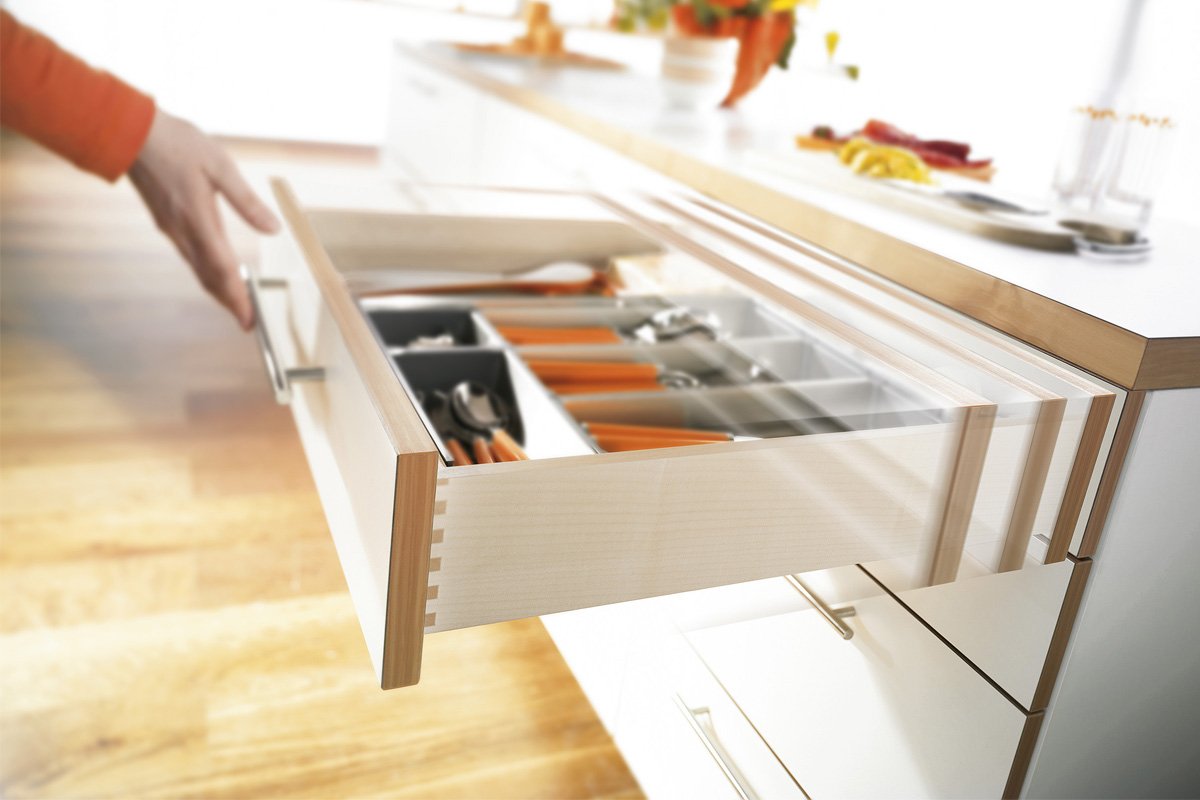
Blum Tandem runners are concealed beneath the drawer, leaving the sides free of visible metal hardware. This produces the polished appearance commonly associated with custom kitchens and premium furniture.
The Tandem system combines full extension, integrated BLUMOTION soft close, and a load rating of up to 100 pounds in common configurations. Blum also engineers these runners for long-term use and offers adjustment features that help installers refine drawer-front alignment after assembly.
That adjustability is more important than it sounds. A drawer can operate perfectly while its front sits slightly crooked. In a bank of six drawers, a small error becomes a zigzagging line that will attract the homeowner’s eye every morning until the end of time. Adjustable locking devices make it easier to correct those reveals.
Why Installation Is More Demanding
Undermount slides require a compatible drawer box. The drawer sides, bottom position, rear notches, mounting holes, and overall width must follow the selected runner’s specifications. They are not always a direct replacement for old side-mount slides.
Face-frame cabinets may also require rear brackets or blocking. A drilling jig can significantly improve accuracy, especially when installing multiple drawers. The extra preparation is rewarded with smooth movement, hidden hardware, and a decidedly upscale feel.
Best for: Custom kitchens, bathroom vanities, hardwood drawers, and projects where appearance matters as much as function.
Best European Style: Liberty Bottom-Mount Drawer Slides
An Affordable Choice for Everyday Furniture
Liberty’s European-style bottom-mount slides use stamped steel with an epoxy finish and a rolling mechanism. They are inexpensive, easy to understand, and commonly used in basic cabinets, dressers, closets, and ready-to-assemble furniture.
The slides wrap around the lower edge of the drawer and usually include a self-closing action near the end of their travel. Unlike true soft-close hardware, self-closing slides do not necessarily slow a drawer gently. They guide or pull it into the closed position, but a determined drawer slammer can still make an entrance.
Bob Vila’s featured Liberty slides provide three-quarter extension and a load capacity around 50 pounds. That is enough for clothing, linens, toiletries, and ordinary household storage, but less suitable for heavily loaded kitchen or workshop drawers.
Where European Slides Make Sense
These slides are forgiving, affordable, and relatively easy to replace. They can be a smart choice when renovating rental properties, updating utility cabinetry, or repairing furniture that already uses the same mounting format.
The white epoxy finish also blends well with white cabinet interiors. It is not invisible, but it is less visually industrial than a large zinc-plated ball-bearing rail.
Best for: Dressers, closets, light-duty cabinets, rentals, and budget-conscious repairs.
How to Choose the Best Drawer Slides
Choose the Correct Mounting Style
Side-mount slides attach to the drawer and cabinet sides. They are strong, widely available, and relatively easy to service, but remain visible when open.
Undermount slides sit beneath the drawer and are largely concealed. They create a premium appearance and often include soft-close technology, but require more precise drawer construction.
Center-mount slides use one rail beneath the middle of the drawer. They work well for light furniture drawers and restorations but offer limited load capacity.
European or bottom-mount slides support the lower edge of the drawer with epoxy-coated rails and nylon rollers. They are economical and simple, though usually less smooth and less powerful than ball-bearing systems.
Understand the Load Rating
A drawer slide’s stated load rating generally includes both the drawer box and everything stored inside it. A 100-pound rating does not mean you can place 100 pounds of cookware into a 20-pound drawer. Together, the drawer and contents must remain within the specified limit.
Load ratings also depend on correct installation, slide length, drawer width, mounting orientation, and weight distribution. A very wide drawer creates more leverage and may rack from side to side even when its total contents remain under the advertised limit.
For ordinary kitchen and bathroom use, a properly installed 75- to 100-pound slide is usually adequate. Deep pot drawers, appliance pullouts, filing systems, pantry units, and tool cabinets may require heavier hardware. Premium systems such as heavy-duty Blum Movento configurations and industrial Knape & Vogt or Accuride slides are available for significantly larger loads.
Select the Right Extension
Three-quarter-extension slides leave part of the drawer inside the cabinet. They cost less and work well for shallow or lightly used drawers.
Full-extension slides expose nearly the entire drawer box, improving access and visibility. This is the most useful configuration for kitchens, offices, and workshops.
Over-travel slides extend beyond the cabinet face. They are valuable when a countertop overhang or other obstruction would otherwise block access to the back of the drawer.
Measure Before Ordering
Slide length is usually selected according to the drawer depth and available cabinet depth. Measure the existing drawer box rather than assuming that a nominal 24-inch cabinet contains a 24-inch drawer.
Next, measure the side clearance, opening width, drawer width, drawer-bottom position, and distance available behind the drawer. For replacement work, identify the existing mounting style before removing everything. The old hardware may look unfashionable, but it contains useful clues.
Always follow the technical sheet for the exact slide model. Two undermount systems that appear almost identical may require different notches, hole locations, drawer-side thicknesses, or locking devices.
Common Drawer-Slide Installation Mistakes
The most common error is mounting the two cabinet rails at slightly different heights. A level helps, but a spacer, story stick, or installation jig usually produces more repeatable results.
Another problem is failing to keep the rails parallel. If the opening is wider at the rear than at the front, the drawer may move freely at first and bind as it closes. Measure the spacing at several points rather than trusting the cabinet to be perfectly square.
Do not tighten every screw immediately. Begin with screws in the elongated adjustment holes, test the movement, make corrections, and then secure the slides through the round holes. This approach turns a possible woodworking tragedy into a manageable series of small adjustments.
Finally, test the drawer under a realistic load. An empty drawer may glide beautifully while a drawer full of plates sags, rubs, or overwhelms the soft-close mechanism.
Real-World Experience: What a Drawer-Slide Upgrade Is Actually Like
A drawer-slide replacement often begins with excessive optimism. The old drawer is removed, the new hardware looks roughly the same length, and the project appears destined to take 20 minutes. Then someone discovers that the cabinet opening is not square, the drawer is 1/8 inch too wide, and the package contains 38 screws but not the two brackets actually needed.
The biggest practical lesson is that preparation matters more than drilling speed. Empty the cabinet completely, label each drawer, and measure every opening. Cabinets that look identical may not be identical, particularly in older homes where components were built or modified by hand.
Side-mount slides are usually the easiest upgrade for a confident DIYer. Once the correct clearance is established, a commercial drawer-slide jig or a pair of accurately cut spacers can keep the rails level. The first drawer may require repeated adjustments, but the remaining drawers move faster once a reliable setup has been created.
Soft-close hardware can initially feel stiffer than ordinary slides. This is not always a defect. The drawer must overcome the resistance of the closing mechanism when it opens, and a lightweight drawer may require a firmer pull. Problems arise when the drawer needs to be yanked, closes unevenly, or stops before the damper engages. Those symptoms often point to alignment or clearance errors rather than a failed mechanism.
Undermount slides create the most satisfying finished result but demand greater precision. Building a new drawer box around the runner specifications is easier than forcing an existing box to cooperate. Rear notches must be accurate, the drawer bottom needs the correct recess, and the locking devices must align with the runners. A template turns these operations into repeatable steps; improvisation turns them into an afternoon-long character-building exercise.
Load testing also produces surprises. A wide drawer full of pots may technically remain below a 100-pound rating but still feel less stable than a narrow drawer carrying the same weight. Wider drawers place more stress on the box, joints, mounting screws, and cabinet structure. For oversized storage, stronger slides and a rigid drawer box are both necessary.
During a multi-drawer renovation, it is wise to complete one drawer before modifying the rest. Install it, load it, open it repeatedly, and confirm that the face aligns correctly. This prototype reveals whether the measurements, brackets, screw lengths, and mounting method are correct. Copying a successful installation is easy. Copying an unnoticed mistake nine times is also easy, but considerably less festive.
The final improvement is often more noticeable than expected. Full-extension slides eliminate the dark, unreachable zone at the back of a drawer. Soft close reduces noise and prevents lightweight objects from shifting during a hard slam. Concealed runners make even a simple plywood drawer feel more refined.
Good drawer slides do not merely repair furniture. They change the daily experience of using it. A drawer that opens smoothly with one hand, remains stable under load, and closes quietly feels like a small luxuryespecially after years of wrestling with a rail that required a hip bump and a motivational speech.
Final Verdict
The LONTAN soft-close slides are a practical overall choice for upgrading several standard drawers without paying premium undermount prices. PROMARK is appealing when strength, full extension, and conventional side-mount installation are priorities. The Accuride 1029 and Liberty European slides serve lighter, budget-oriented applications.
For high-end cabinetry, Blum Tandem is the standout. Its concealed installation, smooth full-extension travel, soft-close action, and adjustability justify the additional planning and cost. It is especially well suited to kitchens and bathrooms where the drawer boxes are being built or modified specifically for the hardware.
Regardless of brand, begin with measurements rather than marketing. Match the slide to the cabinet construction, total loaded weight, desired extension, and expected frequency of use. The best drawer slides are the ones you barely notice after installationand that is the highest compliment a piece of cabinet hardware can receive.
Note: Product specifications, package quantities, hardware inclusions, availability, and load ratings may vary by model or seller. Confirm the manufacturer’s current technical sheet before cutting or modifying a drawer box.