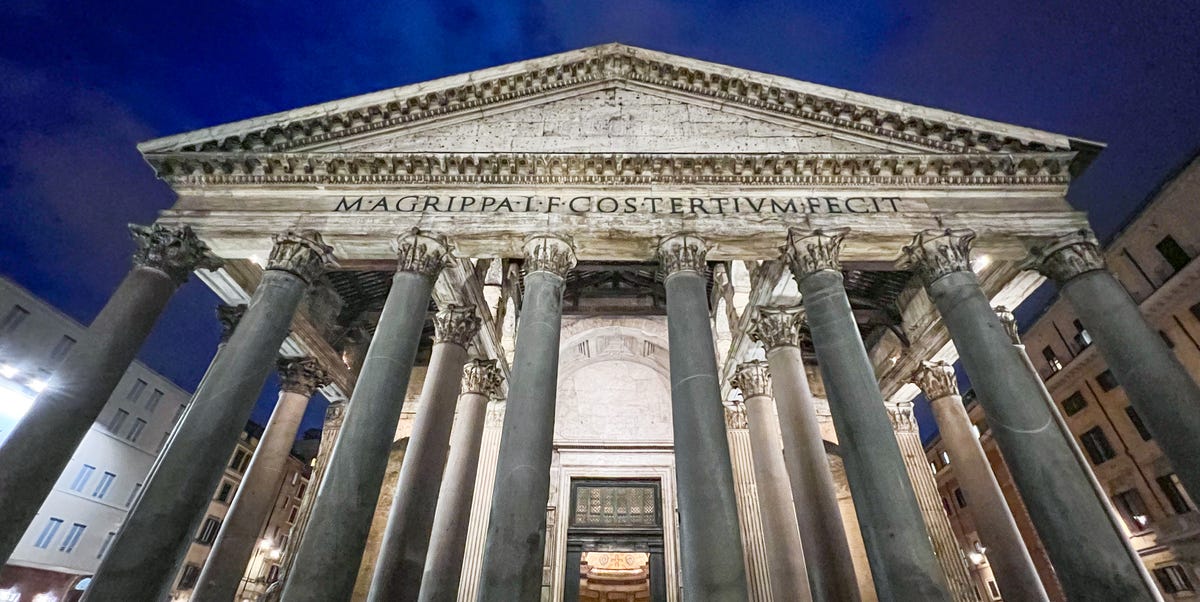
The ancient Romans gave the world roads, aqueducts, amphitheaters, suspiciously dramatic emperors, and concrete that apparently missed the memo about aging. While many modern buildings start developing cracks before the office coffee machine does, Roman concrete has survived earthquakes, seawater, weather, war, tourists, pigeons, and roughly two thousand years of history saying, “Surely this thing should have collapsed by now.”
For decades, scientists wondered why Roman concrete was so durable. Was it a lost ingredient? Ancient construction magic? A secret recipe guarded by toga-wearing engineers with excellent sandals? The real answer is even more interesting: Roman concrete was not simply strong. In some cases, it could repair itself.
Recent research has shown that the secret behind Roman concrete durability lies in a mix of volcanic ash, lime, seawater chemistry, and a clever process known as hot mixing. Tiny white mineral chunks once dismissed as sloppy workmanship may actually be the key to the material’s self-healing power. In other words, what looked like a mistake may have been ancient Rome’s version of advanced materials engineering.
Why Roman Concrete Became a Scientific Mystery
Modern concrete is everywhere. It supports highways, bridges, skyscrapers, sidewalks, dams, parking garages, and the emotionally complicated slab behind every suburban basketball hoop. But modern concrete is not immortal. It can crack, corrode, weaken, and fail, especially when exposed to saltwater, freeze-thaw cycles, heavy traffic, or steel reinforcement corrosion.
Roman concrete, however, has behaved differently in many historic structures. The Pantheon in Rome still has the world’s largest unreinforced concrete dome from antiquity. Ancient harbor structures remain visible in the Mediterranean. Roman aqueducts, walls, baths, and piers have endured for centuries, and in some marine environments, their concrete appears to have grown stronger over time.
That baffled researchers because Roman concrete often looks rougher than modern concrete. It was not made with Portland cement, the dominant binder in today’s construction. It did not rely on steel rebar. It was mixed with local materials, including volcanic ash and rock. Yet it survived conditions that can chew through modern materials like a raccoon through a camping cooler.
The Basic Roman Concrete Recipe
Roman concrete was not one single universal formula. Builders adapted recipes depending on location, purpose, and available materials. Still, many durable Roman mixes included three important ingredients: lime, volcanic ash, and aggregate such as chunks of volcanic rock, brick, or stone.
Volcanic Ash: The Ancient Super Ingredient
One of the most famous materials in Roman construction was pozzolana, a volcanic ash associated with the region around Pozzuoli near Naples. When volcanic ash reacts with lime and water, it can form cement-like compounds through what is called a pozzolanic reaction. This reaction helps create a binding matrix that hardens and gains durability.
The Romans did not need a chemistry textbook to understand the benefit. They observed that certain ash-rich materials produced stronger, more water-resistant mortars. Like many great technologies, it probably began with practical experimentation: mix this gray powder with that white lime, add water, pack in stones, and suddenly you have infrastructure worthy of an empire.
Lime: More Than a Simple Binder
Lime was another crucial ingredient. Traditional explanations assumed Romans used slaked lime, which is made by reacting quicklime with water before mixing it into mortar. That would have been a reasonable process, and ancient texts seemed to suggest it. But newer research indicates that at least some Roman builders used quicklime directly in dry mixtures before adding water.
That detail matters because quicklime reacts strongly with water, producing heat. This “hot mixing” process changes the chemistry and texture of the mortar. It can create small, reactive lime-rich fragments known as lime clasts. For years, those white chunks were treated as signs of poor mixing. Scientists now believe they may have been intentionalor at least very useful.
Hot Mixing: The Ancient Technique Scientists Now Take Seriously
Hot mixing is exactly what it sounds like: the ingredients heat up during preparation. When quicklime is blended with volcanic ash and other dry materials, then water is added, the reaction releases heat inside the mixture. That heat can speed setting, alter mineral formation, and leave behind reactive lime fragments.
The most exciting part is what happens later. When cracks form in the concrete and water seeps in, those lime clasts can dissolve and release calcium. The calcium-rich solution can then recrystallize, often as calcium carbonate, filling cracks and sealing the damage. It is not magic, although Roman engineers probably would not have objected to the branding.
Think of it like a built-in repair kit. Modern concrete often treats cracks as the beginning of decline. Roman concrete, in some cases, treated cracks as an opportunity to activate chemistry. Water was not always the enemy; sometimes it was the delivery driver bringing repair materials to the scene of the crime.
The Lime Clast Discovery: From “Bad Mixing” to Brilliant Feature
The white chunks found in ancient Roman mortar were long interpreted as evidence that workers had not mixed the material thoroughly. That assumption made sense at first glance. In modern construction, inconsistent mixing can create weak spots. But researchers studying Roman samples noticed that the lime clasts had distinctive structures and chemical behavior.
Instead of being random defects, these lime-rich particles appeared to provide a reactive calcium source. Laboratory tests showed that cracks passing through lime clasts could seal when exposed to water. The clasts created pathways for self-healing reactions, allowing mineral deposits to form inside cracks.
This finding changes the story of Roman concrete. The Romans were not simply lucky. Their material system had multiple durability mechanisms: a strong pozzolanic binder, mineral growth over time, and crack-sealing lime chemistry. That is not bad for a civilization without electron microscopes, industrial kilns, or YouTube tutorials titled “How to Make Concrete That Outlives Your Empire.”
Seawater Made Some Roman Concrete Stronger
Marine Roman concrete is especially fascinating because seawater usually causes trouble for modern structures. Saltwater can corrode steel reinforcement and damage concrete. Yet ancient Roman harbor concrete often performed well in seawater for centuries.
Research into Roman marine concrete found that seawater did not merely attack the material. It interacted with volcanic ash and lime to encourage the growth of rare minerals such as aluminous tobermorite and phillipsite. These minerals helped reinforce the concrete’s internal structure over time.
That means Roman seawater concrete was dynamic. It did not simply harden once and sit there like a stone loaf. It continued to evolve chemically. Seawater moved through tiny spaces, dissolved parts of volcanic materials, and helped new mineral crystals grow. The result was a concrete that could become more resilient in the very environment that destroys many modern materials.
Why the Pantheon Still Matters
The Pantheon is often mentioned in discussions of Roman concrete because it is a masterpiece of material design. Completed under Emperor Hadrian in the second century, its massive dome remains an engineering icon. The Romans varied the density of materials in the structure, using heavier aggregates lower down and lighter materials higher in the dome.
That practical intelligence matters. Roman concrete durability was not only about chemistry; it was also about design. Builders understood load, weight, geometry, and local materials. They did not pour the same mix everywhere and hope Jupiter handled quality control.
The Pantheon shows how material science and architecture worked together. The concrete was strong, but the structure was also intelligently shaped. The dome’s thickness changes, its aggregate composition changes, and its famous oculus reduces weight while creating one of the most dramatic shafts of sunlight in architectural history. Not bad for a building that predates Wi-Fi by a comfortable margin.
What Pompeii Revealed About Roman Construction
Recent work at Pompeii has added a valuable piece to the puzzle. Archaeologists and scientists examined a construction site preserved by the eruption of Mount Vesuvius in 79 CE. Because the site was frozen mid-project, it offered rare evidence of how Roman builders actually prepared materials.
Samples from unfinished walls, raw material piles, and construction areas supported the idea that quicklime was mixed with dry pozzolanic materials before water was added. That is important because it gives real-world archaeological support to the hot-mixing theory. Instead of relying only on finished concrete samples, researchers could study a construction process interrupted almost two thousand years ago.
Pompeii turned into history’s most tragic jobsite pause button. The evidence left behind suggests Roman builders used methods more sophisticated than previously assumed. They were managing materials, timing, heat, and ratios with practical skill. Their concrete was not accidental genius; it was craft backed by experience.
Roman Concrete vs. Modern Concrete
Modern concrete has major advantages. It can reach high early strength, be standardized across huge projects, and support steel-reinforced construction at enormous scale. Without it, modern cities would look very different, and parking garages would become even more emotionally distressing than they already are.
But modern concrete also has weaknesses. Portland cement production requires high heat and releases carbon dioxide, both from fuel use and the chemical conversion of limestone into clinker. Cement manufacturing is a major source of industrial greenhouse gas emissions, which is one reason researchers are searching for lower-carbon alternatives.
Roman concrete is not a simple replacement for modern concrete. It often gained strength more slowly. Its ingredients were regional. Its performance depended on specific chemical conditions. You cannot simply tell a modern highway department, “Use volcano dust and vibes,” and expect a safe bridge.
Still, Roman concrete offers principles that modern engineers can learn from. Those principles include using reactive mineral systems, designing materials that improve over time, reducing reliance on energy-intensive clinker, and creating concrete with self-healing behavior.
What Modern Engineers Can Learn
The lesson is not that ancient technology is automatically better. Nobody wants Roman plumbing standards making a full comeback. The lesson is that durability should be designed into materials from the beginning. Roman concrete demonstrates how chemistry, local geology, and construction technique can work together.
1. Build Materials That React Beneficially
Modern construction often tries to isolate materials from the environment. Roman marine concrete shows another possibility: design materials that use environmental exposure to strengthen or repair themselves. In coastal infrastructure, that idea is especially attractive.
2. Treat Cracks as a Design Challenge
Cracking is common in concrete. Instead of pretending cracks will never happen, researchers can design systems that respond when they do. Lime clast-inspired self-healing concrete could reduce maintenance, extend service life, and lower the need for frequent replacement.
3. Reduce Carbon Where Possible
Longer-lasting concrete can reduce environmental impact because structures do not need to be repaired or rebuilt as often. If Roman-inspired methods help lower cement content, use alternative binders, or improve durability, they could support the broader push toward low-carbon construction.
Why This Discovery Feels So Modern
The funny thing about Roman concrete is that it feels futuristic. Self-healing materials sound like something from a clean-tech startup pitch deck. Yet the underlying idea was used in ancient construction, long before anyone said “innovation ecosystem” with a straight face.
This is why the discovery matters beyond archaeology. It reminds us that progress is not always a straight line. Sometimes the future is hidden in the past, waiting for modern tools to explain why old solutions worked so well.
Scientists used advanced imaging, chemical analysis, mineral studies, and laboratory testing to decode a material that Roman builders understood through practice. The Romans may not have known the molecular details, but they knew what worked. Their concrete was a collaboration between observation, geology, heat, water, and time.
Experiences and Practical Lessons Related to Roman Concrete
Anyone who has walked through ancient Roman ruins knows the strange feeling of standing beside something that should not still be standing. You see broken columns, worn stones, and walls with plants growing out of them, and yet the structure remains stubbornly present. It is like history folded its arms and refused to move.
That experience changes how we think about durability. In modern life, we are used to replacement. Phones get replaced, furniture gets replaced, appliances get replaced, and sometimes buildings seem designed with the life expectancy of a trendy restaurant. Roman concrete challenges that mindset. It asks a bigger question: what if infrastructure were designed not merely to survive inspection, but to serve generations?
There is also a lesson for homeowners, builders, and designers. Materials matter, but process matters just as much. A recipe is not only a list of ingredients. It is timing, temperature, mixing order, moisture, curing, and context. Anyone who has baked bread understands this immediately. Flour, water, yeast, and salt can become a glorious loaf or a countertop brick depending on how they are handled. Roman concrete worked because the Romans understood the behavior of their materials in practice.
The same idea applies to modern projects. A patio, foundation, seawall, or bridge is only as good as its design conditions. Drainage, reinforcement, curing time, aggregate choice, climate, and exposure all influence performance. Roman builders did not have modern building codes, but they paid attention to local resources and environmental conditions. That habit is still valuable.
Roman concrete also offers a humbling experience for modern technology. We often assume newer means better. Usually, newer does mean faster, more scalable, or more standardized. But durability is a different game. A material that lasts two thousand years has earned the right to interrupt the meeting.
The most useful takeaway is not nostalgia. We do not need to rebuild the modern world exactly like ancient Rome. We need to borrow the best principle: design with time in mind. A bridge that lasts longer saves money. A seawall that repairs microcracks reduces risk. A concrete mix with a smaller carbon footprint helps the environment. A building that ages gracefully becomes part of a city’s memory rather than another demolition permit.
Roman concrete teaches patience in an impatient industry. It reminds engineers, architects, and everyday readers that great materials are not always the hardest on day one. Sometimes the best materials are the ones that keep adapting, reacting, and quietly improving while everyone else is busy admiring the marble.
Conclusion: The Roman Secret Was Chemistry, Craft, and Time
Scientists have figured out that Roman concrete lasted for centuries because it combined smart ingredients with smart methods. Volcanic ash triggered durable pozzolanic reactions. Seawater helped grow reinforcing minerals in marine concrete. Hot mixing with quicklime created lime clasts that could help seal cracks. Together, these features made Roman concrete more than a static building material. It was a living chemical system, at least in the slow, stony way concrete can be “living” without making things weird.
The discovery does not mean modern builders should copy Rome exactly. Instead, it gives today’s engineers a blueprint for longer-lasting, lower-maintenance, and potentially lower-carbon concrete. The Romans built for empire. We can build for resilience.