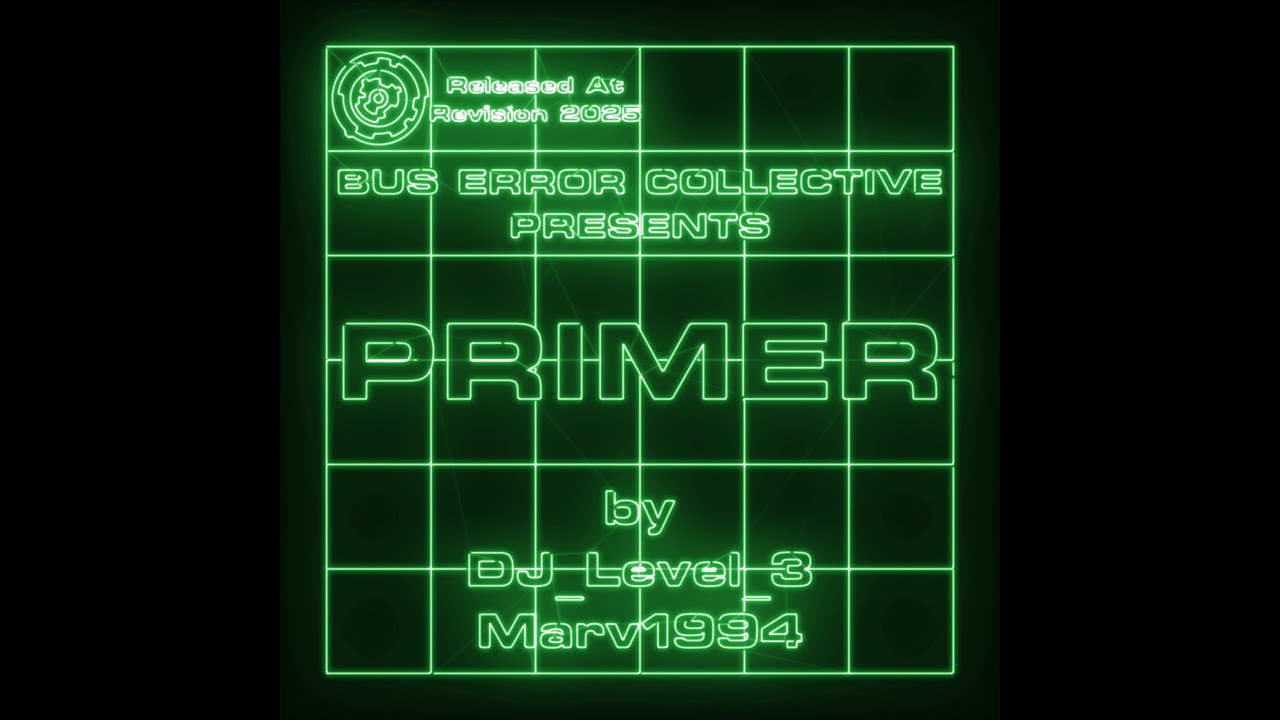
Every so often, a tech demo comes along that makes even seasoned electronics nerds lean forward and mutter, “Wait… that’s the audio?” At Revision 2025, that moment arrived in glowing green phosphor. The project was Primer, an oscilloscope music demo by DJ_Level_3 and Marv1994 of BUS ERROR Collective. It won first place in the Wild competition and also earned the Crowd Favorite award, which is basically the demoscene equivalent of winning the trophy and getting carried out of the venue on a wave of caffeinated applause.
The title “Amazing Oscilloscope Demo Scores The Win At Revision 2025” sounds dramatic, but honestly, the demo earns it. Instead of using a modern GPU, a giant LED wall, or a suspiciously overpowered gaming laptop, Primer turns sound itself into moving vector art. The result is part electronic music performance, part retro-futurist magic trick, and part reminder that old test equipment still has excellent stage presence.
What Happened at Revision 2025?
Revision is one of the world’s most important demoscene events, held annually in Saarbrücken, Germany. The 2025 edition ran from April 18 to April 21 at the E Werk venue, bringing together coders, musicians, pixel artists, hardware hackers, and people who can still explain Amiga memory layouts without blinking. The party features competitions across graphics, music, old-school platforms, modern PC demos, tiny executable intros, live coding, and the beautifully unpredictable Wild category.
That Wild category is where Primer landed. It is the perfect home for projects that refuse to behave like normal demos. The competition welcomed everything from custom hardware and odd platforms to experiments that make the audience ask, “Is that even allowed?” In this case, the answer was yesand the voters responded with enthusiasm.
Primer placed first in the Revision 2025 Wild competition with 1,570 points. The next entry, Kaleidoscopico by lft, came in second with 1,090 points. That margin matters because Revision audiences are not easily impressed. These are people who have watched computers draw impossible tunnels, ray-marched worlds, raster bars, plasma effects, and 4K intros for decades. Getting their attention with an oscilloscope is not a small achievement. It is the nerd equivalent of winning a drag race in a lovingly restored lawn mower.
Meet “Primer,” the Oscilloscope Music Demo That Stole the Show
Primer is both a demonstration and a lesson. True to its name, it introduces viewers to oscilloscope music by starting with simpler waveforms and then escalating into complex shapes, logos, motion, patterns, and rhythmic transformations. The demo does not merely play music while showing visuals. The audio signal is the visual signal.
That distinction is crucial. In ordinary music videos, the soundtrack and visuals are separate ingredients. In oscilloscope music, they are fused. The left and right audio channels become coordinates. One channel controls horizontal movement, and the other controls vertical movement. Feed those two signals into an oscilloscope in XY mode, and the display becomes a vector screen. The beam draws what the sound tells it to draw.
In other words, Primer is not cheating. It is not a rendered video pretending to be analog. It is sound steering a beam across a screen with enough precision to form recognizable images, animations, and design language. The green trace becomes a dancing line with musical obligations. If it sounds good but draws badly, the illusion fails. If it draws beautifully but sounds like a robot falling down stairs, the music fails. Primer succeeds because it balances both.
How Oscilloscope Music Works Without Summoning a Wizard
An oscilloscope normally displays voltage over time. Engineers use it to inspect electrical signals, diagnose circuits, compare waveforms, and catch misbehaving electronics in the act. But many oscilloscopes also support XY mode, where one input controls the X-axis and another controls the Y-axis. Instead of showing voltage against time, the screen shows one voltage against another.
That small shift changes everything. In XY mode, the oscilloscope behaves like a vector display. A single bright point moves around the screen. Move it fast enough and precisely enough, and persistence of vision turns that moving dot into lines, shapes, curves, and animation. This is the same broad visual family as old vector arcade games, laser graphics, and classic scientific Lissajous figuresexcept here the coordinates arrive as audio.
For oscilloscope music, a stereo audio file can carry position data. The left channel may drive horizontal deflection, while the right channel drives vertical deflection. The waveform is not just heard; it is drawn. Circles, spirals, text, faces, geometric shapes, and abstract motion can all be encoded into sound. The hard part is making the sound musical at the same time. Anyone can make an oscilloscope scribble. Making it scribble beautifully while dropping a good electronic track is where the art begins.
Why “Primer” Felt So Fresh
Oscilloscope art is not brand-new. Artists such as Jerobeam Fenderson helped popularize oscilloscope music by creating audiovisual pieces where the audio signal draws recognizable vector imagery on analog scopes. Tools and experiments around this art form have existed for years, including software that converts drawings, models, and animations into waveforms suitable for vector displays.
What made Primer feel special was its demoscene fluency. It did not present oscilloscope music as a laboratory curiosity. It presented it as a proper demo: paced, stylish, technically confident, and audience-aware. The visuals build. The music evolves. The screen does not merely show a clever trick and then run out of steam. It keeps delivering new motion, new shapes, and new “how did they do that?” moments.
That matters in the demoscene because demos are judged not only by whether they work, but by whether they have flow. A great demo has structure. It understands timing, surprise, mood, and reveal. Primer begins as an explanation and turns into a performance. It teaches the viewer what is happening, then uses that understanding to make the later scenes hit harder. That is good storytelling, even when the storyteller is a cathode-ray tube with a very busy electron beam.
The Demoscene Loves Constraints, and This Demo Is Pure Constraint Candy
The demoscene has always celebrated creative limitation. Old-school demos pushed the Commodore 64, Amiga, Atari ST, ZX Spectrum, and early PCs beyond what their designers expected. Modern intros compress entire audiovisual worlds into 64 kilobytes or even 4 kilobytes. The point is not only to make something beautiful. The point is to make something beautiful under ridiculous conditions.
Primer fits that philosophy perfectly. An oscilloscope is not a normal display. It does not have pixels, shaders, frame buffers, textures, or a cozy graphics API waiting politely for commands. It has voltages. It has deflection. It has physics. It has a glowing trace that becomes brighter when the beam moves slowly and dimmer when it races across the screen. Every shape has to be considered as motion, sound, and electrical behavior at once.
That limitation creates a fascinating design problem. On a pixel display, drawing a square is easy. On an oscilloscope, drawing a square means commanding the beam to travel around four edges at the right speed, without creating unwanted artifacts, while keeping the corresponding sound usable. Want multiple objects? Now the beam must visit them in sequence quickly enough that the eye perceives them together. Want smooth animation? Congratulations, you are now negotiating with time, voltage, human perception, and your audio interface.
Why the Wild Competition Was the Right Stage
The Wild category at demoparties is a glorious playground. It allows productions that do not fit neatly into standard demo categories. That could mean custom hardware, unusual consoles, handmade devices, performance pieces, strange controllers, or ideas that begin with “what if” and end with someone soldering something at 3 a.m.
By entering Primer in Wild, BUS ERROR Collective placed it exactly where audiences would understand its spirit. This was not a PC demo trying to compete against GPU-heavy real-time graphics. It was not a music entry with a video tacked on. It was a hardware-aware audiovisual work using an oscilloscope as the display and sound as the drawing engine. That is Wild in the best possible sense: experimental, technically risky, and fun to explain to your non-technical friends until their eyes glaze over like a donut.
The Role of Tools: Craft Behind the Glow
Reports around the demo mention tools such as Osci-Render and Ableton Live 11, which makes sense for this kind of production. A modern oscilloscope music workflow often blends digital audio production, vector design, synthesis, signal routing, and careful previewing. The artist is not just composing notes; they are composing coordinates.
Software can help render text, objects, and shapes as audio-compatible motion paths. A digital audio workstation can arrange layers, timing, rhythm, transitions, and sound design. But tools do not automatically make a great demo. They simply make the impossible slightly less rude. The creative challenge remains: how do you turn shapes into sound, sound into motion, and motion into a performance that feels alive?
Primer answers that question with confidence. The visuals are clean enough to read, but not sterile. The music is punchy enough to stand on its own, but not disconnected from the graphics. The piece has the aesthetic of a retro computer fever dream: familiar in its green glow, modern in its execution, and mischievous in its refusal to stay inside one category.
Why Analog Displays Still Feel Magical
Part of the appeal is emotional. Modern screens are crisp, bright, and convenient, but they can feel invisible. We look through them. An analog oscilloscope, especially one with a green CRT trace, feels like an object with a personality. The glow blooms. The line breathes. Brightness changes with speed. Curves have a physical softness that pixels do not quite imitate.
That physicality is why oscilloscope demos are so satisfying. The viewer senses that the image is not merely being displayed; it is being performed. A beam is actually moving. Voltages are actually changing. The machine is drawing in real time, and the music is the command language. It feels closer to watching a plotter, a laser show, or a tiny electronic ghost writing on glass.
This tactile quality also explains why oscilloscope music resonates with hardware hackers. It collapses the wall between signal and art. The same principles used to measure circuits become tools for animation. A device designed for troubleshooting becomes a stage. Somewhere, an old lab manual quietly sheds a proud tear.
What “Primer” Says About the Future of Retro-Tech Art
The success of Primer at Revision 2025 shows that retro technology is not just nostalgia. It can still produce new forms of expression when artists treat limitations as instruments rather than obstacles. The oscilloscope was not used because it was easy. It was used because its difficulty creates a unique visual and musical language.
That is an important lesson for makers, musicians, and digital artists. The most interesting tools are not always the newest. Sometimes the best creative spark comes from taking an old device seriously enough to ask what else it can do. A test instrument can become a display. A stereo waveform can become choreography. A demoparty crowd can become unexpectedly emotional about green lines.
In a world filled with generative visuals and high-resolution screens, Primer stands out because it feels earned. It is technical, but not cold. It is retro, but not dusty. It is musical, but not merely decorative. It is a reminder that the demoscene remains one of digital culture’s best laboratories for joyful overengineering.
Experience Notes: Watching an Oscilloscope Demo Like “Primer” Changes How You Hear Sound
The most memorable experience related to a demo like Primer is the moment your brain stops separating audio from image. At first, you may watch the oscilloscope as if it were a screen playing a synchronized animation. Then the trick clicks: the sound is not accompanying the drawing. The sound is the drawing. Suddenly, every bass wobble, chirp, sweep, and glitch becomes suspicious. You start wondering what shape it makes. Music becomes architecture with a beat.
For anyone who has used an oscilloscope in a classroom, repair bench, or electronics lab, this can feel delightfully wrong. Most people meet a scope while trying to solve practical problems: checking a signal, finding noise, measuring frequency, or confirming that a circuit has not decided to become modern art without permission. The display is supposed to be analytical. You look at it to understand what electricity is doing. Then an oscilloscope music demo arrives and says, “What if electricity is doing a music video?”
That shift is powerful because it makes technical concepts feel immediate. XY mode is no longer an abstract feature in a manual. It becomes a drawing method. Phase relationships are no longer just Lissajous patterns from a textbook. They become moving choreography. Amplitude is not merely voltage height; it becomes screen position. Frequency is not only pitch; it affects motion, density, and the way a line occupies space.
Trying to explain it to someone else is half the fun. You start with, “The left speaker channel controls left and right, and the right channel controls up and down.” They nod. Then you say, “So the music draws the picture.” They pause. Then you add, “But the picture has to sound good too.” That is usually when the eyebrows rise. It is one of those rare tech-art ideas that is simple enough to summarize in one sentence and difficult enough to keep experts busy for years.
The experience also changes how you think about old equipment. A dusty analog oscilloscope at a surplus shop no longer looks like obsolete bench gear. It looks like a potential display for alien calligraphy. Audio interfaces become coordinate generators. Synth patches become motion paths. Even simple waveforms gain personality: sine waves become circles and ellipses, sawtooths become sharp edges, and noise becomes a mischievous swarm of light.
There is also a lesson in restraint. Because an oscilloscope has limitations, the artist must choose carefully. Too many shapes can become a blur. Too much detail can turn into noisy spaghetti. Too much musical complexity can ruin visual clarity. The best oscilloscope demos feel intentional because they respect the machine. They do not force it to imitate a modern monitor. They let it be what it is: a fast, glowing, voltage-driven pen.
That is why Primer works so well as both an introduction and a showcase. It gives newcomers an entry point without flattening the complexity. It gives experts enough craft to admire. And it gives everyone else the pure pleasure of watching sound become light. In the end, the win at Revision 2025 was not just about novelty. It was about execution, taste, and the very demoscene idea that technical limits are not creative walls. They are playground equipment.
Conclusion
Amazing Oscilloscope Demo Scores The Win At Revision 2025 is more than a catchy headline. It captures a real moment when a clever, beautiful, hardware-aware production reminded the demoscene why strange ideas matter. Primer by DJ_Level_3 and Marv1994 of BUS ERROR Collective won because it combined technical skill, musicality, visual design, and crowd-friendly surprise. It turned an oscilloscope into a stage and a soundtrack into a drawing tool.
The demo’s success also points to something larger: creative technology does not move in a straight line from old to new. Sometimes the future arrives by plugging stereo audio into a vintage instrument and letting green phosphor do the dancing. Revision 2025 gave that idea a spotlight, and Primer used it brilliantly.