Moon missions used to sound like the kind of thing only governments could afford: giant rockets, giant budgets, giant headaches. Then NASA made a move that felt a little like calling an Uber for lunar science. In 2019, the agency picked three private companies to deliver payloads to the Moon under its Commercial Lunar Payload Services program, better known as CLPS. The companies were Astrobotic, Intuitive Machines, and Orbit Beyond. On paper, it was a contract announcement. In reality, it was a major shift in how America planned to explore the Moon.
That decision mattered for more than one reason. It showed NASA was serious about buying delivery services instead of building every spacecraft itself. It signaled confidence in small and midsize aerospace companies. And it turned the Moon from a distant government-only destination into something closer to a shared commercial frontier. That does not mean lunar delivery suddenly became easy. It means NASA decided the fastest way to learn was to let industry take real shots on goal, accept risk, and build a market while doing science.
If that sounds bold, it was. If it sounds risky, also yes. This is the Moon, not a pizza route. Miss the address and your package does not get returned to sender.
Why NASA Made This Move
NASA created CLPS to get science and technology to the lunar surface faster, more often, and at a lower cost than traditional government-led development. Instead of designing every lander in-house, the agency would purchase end-to-end delivery services from commercial providers. That means the companies handle integration, launch, delivery, and landing, while NASA focuses on the payloads and the science goals.
This service model was not just about saving money. It was about speed, repetition, and learning. Lunar exploration works better when missions are frequent enough to build momentum. One launch every so often might create headlines, but a steady cadence creates capability. NASA wanted lunar data, landing experience, dust measurements, radiation readings, navigation practice, and engineering lessons. In other words, it wanted the Moon to become a place you can reach regularly, not just occasionally.
That was especially important because CLPS was tied to the broader Artemis effort. At the time, NASA was pushing hard to return astronauts to the Moon, and robotic missions were supposed to scout terrain, test technologies, and gather environmental data before humans arrived. The agency was not just asking, “Can we land?” It was asking, “Can we keep landing, learn from every attempt, and build something sustainable?”
The Three Companies NASA Picked
Astrobotic
Astrobotic, based in Pittsburgh, received a contract worth $79.5 million. The company proposed sending as many as 14 payloads to Lacus Mortis, a large crater region on the Moon’s near side. Astrobotic quickly became one of the best-known CLPS names because its pitch matched NASA’s broader vision almost perfectly: commercial delivery with serious science on board.
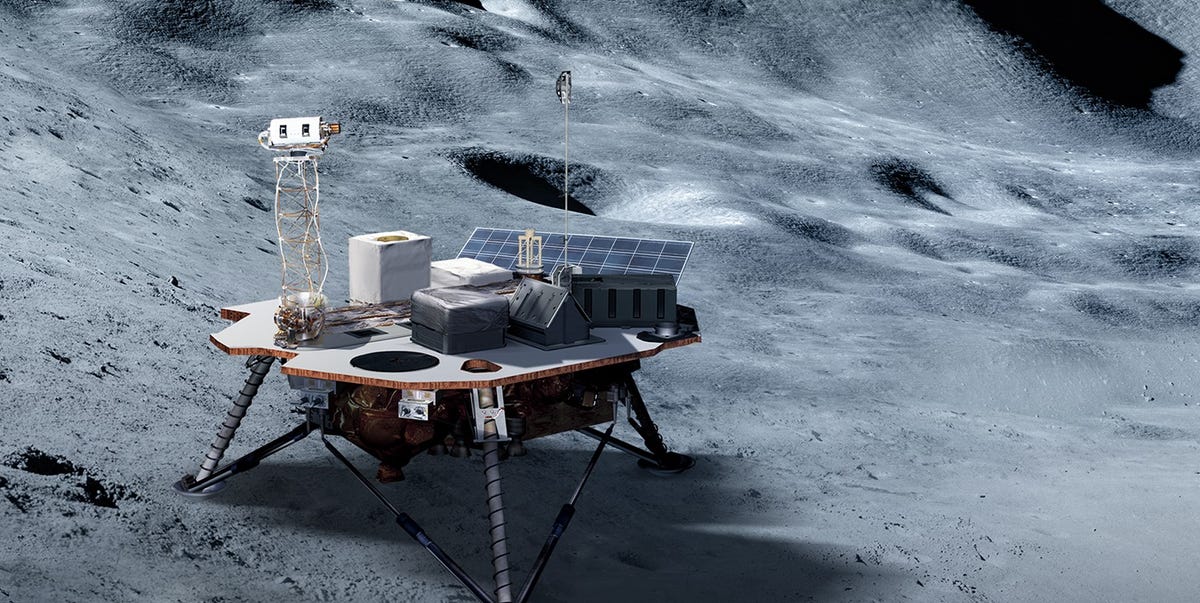
Astrobotic’s lander concept, Peregrine, was designed not just as a one-off vehicle, but as part of a future lunar transportation business. That mattered. NASA was not merely buying a ride for one mission. It was encouraging companies to build repeatable systems and real business plans around lunar access. In theory, NASA could become one customer among many.
Intuitive Machines
Houston-based Intuitive Machines received $77 million and proposed carrying as many as five payloads to Oceanus Procellarum, one of the Moon’s most scientifically interesting volcanic plains. If Astrobotic represented steady engineering ambition, Intuitive Machines brought a sleek confidence to the table. Its Nova-C lander became one of the first true symbols of the CLPS era: privately built, NASA-supported, and aimed squarely at proving commercial lunar operations could work.
Intuitive Machines was especially important because it helped make CLPS feel less like a policy memo and more like an actual flight program. The company later became central to proving that NASA’s gamble on commercial lunar transport was not just a hopeful PowerPoint with dramatic Moon photos in the background.
Orbit Beyond
Orbit Beyond, from Edison, New Jersey, received the largest of the three early awards at $97 million. The company proposed carrying up to four payloads to Mare Imbrium, a basaltic lava plain inside one of the Moon’s great impact basins. On announcement day, Orbit Beyond looked like a fast-moving player with an aggressive schedule and a willingness to jump into the lunar race with confidence.
But the Moon has a way of separating ambition from execution. Not long after NASA’s selection, Orbit Beyond asked to be released from its task order because of internal corporate challenges. That development did not kill CLPS, but it did reveal the fragile side of the commercial model. Startups can move quickly, but they can also wobble quickly. The lesson was simple: commercial space can be innovative, but innovation does not come with a guarantee sticker.
What NASA Actually Wanted These Missions to Carry
The phrase “science payloads” can sound dry, like something stored in a beige filing cabinet. In practice, these payloads were a big deal. NASA wanted instruments that could study the lunar surface, measure radiation, improve navigation, examine how landing activity kicks up dust, and help answer geologic questions about the Moon’s history.
The agency later said the earliest NASA-provided lunar payloads included a mix of science, technology, and exploration objectives, and NASA selected 13 instruments in 2019 that were ready or nearly ready to fly. That is the sweet spot for a program like CLPS. You do not want science that exists only in theory. You want instruments that can actually get strapped to a lander, survive launch, operate on the surface, and send useful information home.
Some of the later CLPS payload work makes the value of this approach even clearer. NASA and JPL have tied lunar deliveries to tasks such as measuring dust plumes during landing, studying subsurface temperatures, exploring magnetic anomalies, and gathering seismic data from the Moon’s far side. That last one is especially exciting because new seismic measurements can help scientists understand the Moon’s interior structure in ways that echo the scientific legacy of Apollo, but with newer tools and a very different business model.
Why This Was a Big Deal for Artemis
Artemis is often described through its biggest visuals: astronauts, giant rockets, deep-space hardware, and dramatic views of the lunar south pole. But the quieter truth is that sustainable exploration depends on logistics. Before humans can work on the Moon regularly, somebody has to deliver instruments, test landing systems, study terrain, understand dust behavior, and validate communications and navigation methods.
That is where CLPS comes in. These commercial deliveries are the scouts, the supply runners, and the engineering interns who somehow do all the hard work before the flashy part starts. NASA’s idea was to let robotic landers gather knowledge ahead of human crews. That makes the 2019 selection more than a procurement story. It was an architecture story. NASA was building a pipeline in which science, technology demonstrations, and commercial transportation would feed directly into future human exploration.
It also reflected a deeper strategic shift. NASA was no longer acting like the only builder in the room. It was becoming a customer, a coordinator, and a long-term market maker. That is a very modern space strategy, and one the agency had already tested in low-Earth orbit with cargo and crew transportation.
The Results Were Messy, Which Is Exactly Why They Mattered
The legacy of the 2019 announcement becomes much more interesting when you look at what happened next. Astrobotic’s Peregrine launched in January 2024 carrying NASA CLPS payloads, but it did not land on the Moon. Intuitive Machines’ Nova-C launched in February 2024 and reached the lunar surface, giving the United States its first Moon landing since the Apollo era, though the vehicle had landing complications. Then Firefly Aerospace, another CLPS provider that joined the program later, successfully landed Blue Ghost on the Moon in 2025 with NASA experiments on board.
That sequence tells you almost everything you need to know about commercial lunar development. It is not clean. It is not linear. It does not look like an old-school government program built around one giant moment of perfection. Instead, it looks like iteration. One mission misses. Another lands but not flawlessly. A later one sticks the landing with more confidence. The result is not elegance. The result is progress.
In fact, that messy pattern may be the strongest argument for NASA’s original choice. By spreading risk across providers and missions, the agency gave itself more chances to succeed. A single failure no longer meant the whole lunar plan went dark for years. That is not a bug in the system. That is the system working.
What the Three-Company Selection Really Changed
When NASA picked Astrobotic, Intuitive Machines, and Orbit Beyond, it sent a message to the entire aerospace industry: the Moon was open for business, and the government was willing to buy rides instead of owning every vehicle. That helped pull new companies, investors, suppliers, and international partners into the conversation.
It also changed the tone of lunar exploration. Apollo was heroic and singular. CLPS is entrepreneurial and plural. Apollo was a national sprint. CLPS is a supply chain with moon dust on it. One model put flags and footprints on the surface. The other is trying to create routine access, payload by payload, mission by mission, contract by contract.
That does not make CLPS less exciting. In some ways, it makes it more important. Routine capability changes history more than one glorious moment does. A future lunar economy, if it happens, will not be built on a single iconic image. It will be built on repeated deliveries, reliable systems, and boringly competent logistics. Space fans may dream in cinematic montages, but actual infrastructure is built by people who know where every bolt goes.
The Risks NASA Accepted
Of course, this strategy came with real risks. Commercial providers can miss deadlines, run into technical trouble, or collapse under internal strain. Landing on the Moon is brutally difficult, especially for companies trying to do it under fixed-price contracts with ambitious schedules. There is little margin for error, and the Moon is not famous for offering second chances.
But NASA accepted that risk because the alternative was also risky: moving too slowly, spending too much, and failing to create a broader industrial base. By accepting early failures and uneven performance, NASA bought something more valuable than a single clean outcome. It bought learning velocity.
That may be the most important phrase in the whole story. Learning velocity is what turns experiments into systems. It is what lets engineers refine landing software, dust mitigation tools, thermal controls, communications systems, and payload integration methods across multiple attempts. If NASA wants to support both science and human exploration on the Moon, it needs exactly that kind of momentum.
Extended Experiences: What This Moon Story Feels Like in Real Life
There is also a human side to this story that often gets buried under contract values and mission acronyms. If you have followed modern lunar missions closely, you know they do not feel like polished museum exhibits. They feel like live theater with engineering degrees. One moment you are watching a gorgeous animation of a lander descending toward the lunar surface. The next moment somebody in mission control is speaking in the calmest possible voice while everyone at home silently negotiates with the universe.
That emotional whiplash is part of what makes NASA’s three-company decision so memorable. It did not just create a procurement pipeline. It created a new kind of public experience around lunar exploration. Suddenly, the Moon was not only the destination of a giant government machine. It was also the proving ground for private teams, startup culture, fixed-price contracts, and all the nervous energy that comes with trying to do something historic on a budget that still sounds massive to regular humans but tiny by old NASA standards.
Following these missions feels a bit like watching a high-stakes relay race where every baton is made of software, metal, fuel, math, and hope. You learn the names of landers. You learn the geography of places like Lacus Mortis and Mare Imbrium. You start caring deeply about navigation sensors, thermal systems, and engine plumes, which is not a sentence most people expect to say about themselves.
And then there is the strange charm of lunar science itself. The payloads are not flashy in the usual sense. They are cameras, drills, sensors, reflectors, instruments for dust, heat, magnetism, and seismic data. But that is exactly why they feel real. These are not props for a sci-fi trailer. They are tools. They are the first wave of practical questions we ask when we plan to go somewhere and stay longer than a photo op.
There is something inspiring about that shift. It makes the Moon feel less like mythology and more like a workplace that humanity is slowly learning how to visit again. Not in a boring way, either. In a thrilling, slightly chaotic, deeply ambitious way. The kind where every successful landing feels earned, every failure becomes a lesson, and every new contract quietly says, “We are still trying.”
That may be the lasting emotional impact of NASA picking those three companies. It reminded people that exploration is no longer just about national prestige or astronaut posters on classroom walls. It is also about systems, partnerships, iteration, and resilience. It is about trusting new players to take meaningful swings at very old dreams.
So yes, the headline was about three companies delivering science payloads to the Moon. But the experience surrounding that headline is bigger than it first appears. It is the experience of watching a familiar world become new again. It is the experience of seeing lunar exploration shift from rare spectacle to repeated attempt. And it is the experience of realizing that the road back to the Moon may not be smooth, but it is finally crowded with vehicles pointed in the right direction.
Conclusion
NASA’s decision to pick Astrobotic, Intuitive Machines, and Orbit Beyond was one of those announcements that looked modest at first and historic in hindsight. It redefined how the agency approaches lunar access, pushed commercial providers into a serious role, and laid groundwork for the robotic missions that now support Artemis and broader lunar science. Not every company made it. Not every mission landed perfectly. But that was never the full point.
The point was to begin building a repeatable pathway to the Moon. On that front, the three-company selection did exactly what it was supposed to do: it turned lunar delivery into an operating idea instead of a distant ambition. And in space exploration, that kind of shift is how eras begin.