A butterfly is usually associated with transformation, freedom, and new beginnings. In one family, however, a butterfly tattoo somehow transformed into a full-scale constitutional crisis involving tank tops, graduate school, and the ancient parental doctrine known as “my house, my rules.”
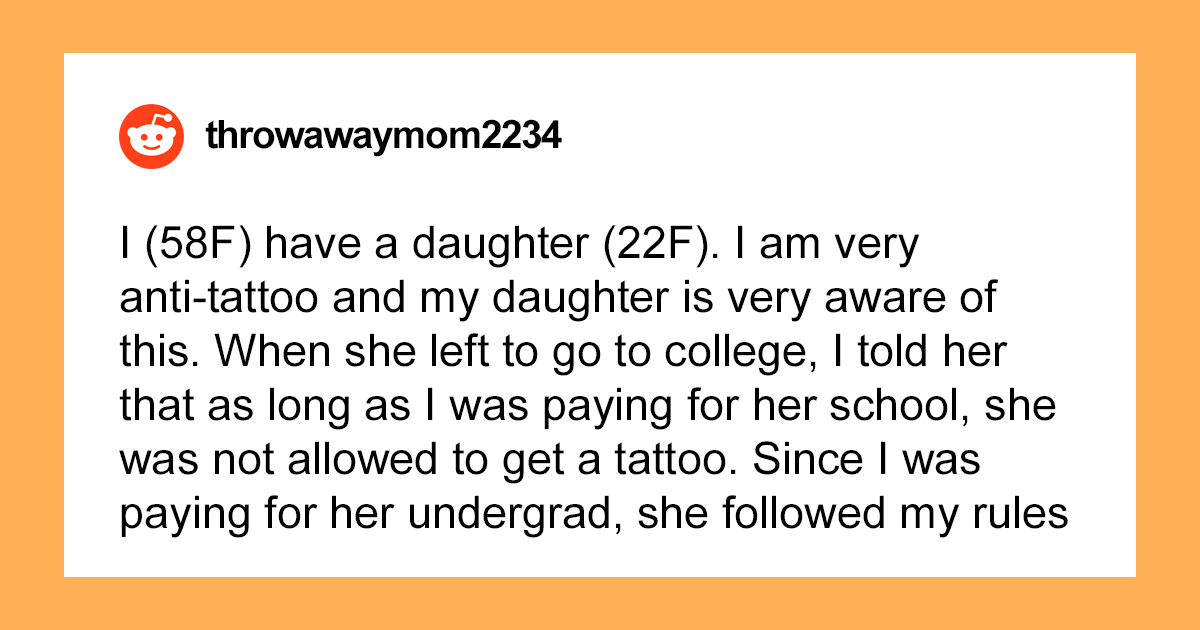
The dispute began when a mother learned that her adult daughter had gotten a tattoo on her shoulder. The daughter had respected her mother’s wishes while the mother was paying for college. Once she began financing her own graduate education, she decided to get inked. Later, when an unpaid internship required her to move back home, her mother issued an ultimatum: cover the tattoo inside the house or find somewhere else to live.
Online readers delivered a reality check. Their central argument was not that parents must suddenly adore tattoos, buy matching butterfly designs, or turn the living room into a tattoo studio. It was that disliking an adult child’s decision does not automatically give a parent ownership over that child’s body.
Story details synthesized from the original anonymous post and subsequent reporting.
What Happened Between the Mom and Her Daughter?
According to the anonymous account, the mother was 58 and her daughter was 22. The mother described herself as strongly opposed to tattoos and said her daughter had always known how she felt.
The Daughter Followed the Original Rule
While paying for her daughter’s undergraduate education, the mother established a condition: no tattoos while she was covering tuition. Whether that condition was reasonable is debatable, but the daughter followed it. She completed her undergraduate studies without getting tattooed.
Before beginning graduate school, which she was paying for herself, the daughter got a butterfly tattoo on her shoulder. It was approximately the size of her mother’s fist. The mother did not discover it immediately; the daughter mentioned it months later.
This timeline mattered to readers. The daughter had not secretly broken the financial arrangement. She waited until she was supporting her own education and making decisions independently. In other words, she followed the stated rule, graduated from its jurisdiction, and then exercised her adult freedom.
The Rule Changed When Housing Became Necessary
The conflict intensified when the daughter needed to return home while completing an unpaid internship required for her master’s degree. Because the internship provided no income, she had limited housing options.
The mother told her she could live at home only if she wore clothing that concealed the tattoo. The daughter objected because the weather was hot and she preferred tank tops. The mother responded that it was her house, so her rules applied.
What caused the strongest backlash was the mother’s admission that she knew her daughter had nowhere else to go. To many readers, that transformed the condition from an ordinary household expectation into financial leverage. The debate was no longer about sleeves. It was about using dependency to force compliance with a personal aesthetic preference.
The post states that the daughter was 22, paid for graduate school, needed housing during an unpaid internship, and was told to cover the tattoo.
Why the Internet Gave the Mom a Blunt Reality Check
Her Daughter Was an Adult
The most obvious issue was adulthood. At 22, the daughter could choose her education, career, clothing, relationships, medical care, and appearance. A parent could offer advice, express concern, or admit personal discomfort, but the final decision belonged to the daughter.
Healthy parent-adult child relationships often require a transition from authority to influence. Parents do not stop caring, but their role changes. Guidance works best when it respects the adult child’s capacity to make choices, including choices the parent would never make personally.
That shift can feel surprisingly difficult. One day, a parent is approving field-trip forms. The next, the former field-trip participant is making permanent decisions without submitting a three-page proposal. Emotionally, some parents need time to catch up with the legal and practical reality that their child has grown up.
Research on parent-adult child relationships emphasizes the young adult’s need to establish autonomy and the value of adjusting parental roles.
The Daughter Had Honored the Previous Agreement
The daughter’s compliance during undergraduate school weakened the mother’s position. She had followed the condition attached to financial support. After becoming responsible for graduate school expenses, she made a different choice.
Changing the practical consequences after the fact can make an adult child feel as though the real rule was never “no tattoos while I pay tuition.” The real rule may have been “no tattoos while I have any leverage.” That is a far more controlling message.
The Tattoo Was Not Disrupting the Household
Reasonable house rules usually concern behavior that affects other residents: cleaning shared spaces, paying agreed expenses, limiting noise at night, respecting privacy, caring for pets, or not using the refrigerator shelf labeled “Grandma’s puddingseriously, do not touch.”
A healed shoulder tattoo does not create noise, leave dishes in the sink, increase the utility bill, or invite strangers over at 2 a.m. It simply exists on someone’s skin. Requiring it to be hidden therefore regulates the daughter’s body rather than her contribution to the household.
The Ultimatum Overshadowed the Daughter’s Achievements
Readers also pointed out that the daughter was completing a master’s degree and an unpaid internship. Those facts suggested discipline, ambition, and a willingness to invest in her future. Yet the mother’s attention remained fixed on a butterfly.
Imagine receiving a framed graduate diploma and responding, “Wonderful, but could you rotate your shoulder away from me?” That is the emotional imbalance commenters noticed. The daughter’s accomplishments were substantial; the tattoo was cosmetic. The mother treated them in reverse order.
Does “My House, My Rules” Settle the Argument?
The phrase sounds decisive because it contains both property and authority in five convenient words. However, it does not make every demand reasonable.
A homeowner can establish conditions for living in a shared space. Guests and adult family members should respect rules that protect safety, comfort, property, and fairness. No smoking indoors, no unauthorized parties, and no practicing the drums at sunrise are all defensible expectations.
But ownership of a house is not ownership of the people inside it. A rule can be legally possible and still be emotionally manipulative, unnecessarily humiliating, or damaging to a relationship.
The better question is not merely, “Can I impose this condition?” It is, “What legitimate household problem does this condition solve?” In this case, covering the tattoo did not protect the home. It protected the mother from having to tolerate a visual reminder that her daughter had different preferences.
Why Some Parents React So Strongly to Tattoos
Criticizing the ultimatum does not require pretending the mother’s feelings came from nowhere. Tattoos can activate deep fears involving permanence, social judgment, safety, religion, money, and parental identity.
Generational Attitudes Are Different
Tattoos have become mainstream in the United States. Pew Research Center reported in 2023 that about one-third of American adults had at least one tattoo. Adults under 50 were especially likely to be tattooed, and most Americans believed society had become more accepting of body art.
For many older adults, tattoos may still evoke rebellion, criminal stereotypes, or limited professional opportunities. Younger adults may see the same design as art, memorialization, identity, or a personal milestone. Both generations are looking at the same butterfly but reading entirely different subtitles.
Pew Research Center found that 32% of U.S. adults had tattoos and that society was widely viewed as becoming more accepting of them.
A Child’s Choice Can Feel Like a Rejection
Parents sometimes interpret an adult child’s opposing decision as a rejection of family values. A mother may think, “I explained why tattoos were wrong, and she got one anyway, so she must not respect me.”
But disagreement is not automatically disrespect. An adult child can understand a parent’s beliefs, appreciate the parent’s sacrifices, and still reach a different conclusion. Successful parenting is not demonstrated by producing a human photocopy. It is demonstrated by raising someone capable of thinking, deciding, and accepting consequences.
Parents May Fear Tattoo Regret
Concern about permanence is legitimate. Pew’s survey found that roughly one-quarter of tattooed adults reported regretting at least one tattoo. People change, relationships end, trends fade, and a design that looked profound at 19 may look like a mysterious grocery-store logo at 39.
Still, the possibility of regret does not transfer decision-making authority to someone else. Adults are allowed to make permanent choices, including imperfect ones. Parents can encourage careful thought without turning concern into coercion.
Pew reported that 24% of tattooed Americans regretted at least one tattoo, while 76% did not.
There Are Responsible Reasons to Discuss Tattoo Safety
Although the mother’s ultimatum centered on appearance, parents are not wrong to raise practical tattoo concerns. A productive conversation, however, focuses on informed decisions rather than disgust.
Choose a Reputable, Regulated Studio
The FDA warns that tattooing can involve infections, allergic reactions, scarring, granulomas, and complications from contaminated ink or improperly sterilized equipment. Even sealed ink may occasionally contain microorganisms.
A responsible client should check local licensing requirements, evaluate the studio’s cleanliness, confirm that needles are single-use, watch the artist open sterile equipment, and follow aftercare instructions closely.
Think About Placement and Professional Context
Visible tattoos may still be treated differently across industries, employers, and regions. However, research from the University of Miami has found that tattoos are not necessarily associated with lower employment or earnings after other individual and occupational factors are considered.
A calm discussion about placement, workplace policies, and future flexibility is reasonable. Predicting that one butterfly will destroy an entire career is less reasonable and may require the parent to step away from the disaster-movie soundtrack playing in their head.
Understand That Removal Is Not an Eraser
Laser removal can require multiple sessions, cost significant money, cause discomfort, and leave discoloration or scarring. Anyone considering a tattoo should therefore treat it as permanent, even though removal technology exists.
Tattoo risks and precautions are described by the FDA, American Academy of Pediatrics, Harvard Health, Mayo Clinic, and Cleveland Clinic. Labor-market research found no significant tattoo penalty after controlling for relevant factors.
How the Mother Could Repair the Relationship
Drop the Cover-Up Requirement
The simplest repair would be to remove the rule. The mother would not have to compliment the tattoo or change her personal beliefs. She would merely have to accept that her daughter’s shoulder is not part of the household property inventory.
Offer a Direct Apology
A useful apology would avoid excuses:
“I let my feelings about tattoos become more important than respecting you as an adult. You followed our original agreement, and it was unfair for me to use your housing situation to pressure you. You do not have to cover your tattoo at home.”
That statement acknowledges the behavior, identifies the harm, and explains what will change. It is more effective than, “I’m sorry you became upset when I reasonably attempted to govern your shoulder.”
Separate Support From Approval
Parents often assume that supporting an adult child means approving every decision. It does not. A parent can say, “Tattoos are not for me, but I love you, respect you, and want to help you complete your internship.”
This distinction is crucial. Love should not become a performance bonus awarded only when an adult child mirrors a parent’s preferences.
Establish Real Household Expectations
If the daughter moves in, the family can discuss practical responsibilities: chores, food expenses, schedules, guests, parking, quiet hours, and the likely disappearance rate of leftovers. Clear agreements reduce resentment without crossing into control over personal identity.
The Bigger Lesson: Parents Must Choose Influence Over Control
An ultimatum may produce temporary compliance. The daughter might wear sleeves, avoid confrontation, and finish her internship. But compliance is not the same as closeness. Once she becomes financially independent, she may remember that support was made conditional on hiding part of herself.
Parents retain influence when adult children feel safe discussing choices. They lose influence when every disagreement becomes a loyalty test. A young adult who expects curiosity may call before making a difficult decision. A young adult who expects condemnation may call afterwardor not at all.
The mother was entitled to dislike the tattoo. She was even entitled to privately wonder why the butterfly needed to be approximately fist-sized. What she was not entitled to do, at least without relational consequences, was exploit her daughter’s unpaid internship and limited housing options to control how the daughter displayed her own body.
The reality check was therefore simple: the daughter respected the original agreement, financed her own graduate education, and made an adult decision. The mother’s challenge was no longer to prevent the tattoo. That butterfly had already left the cocoon. Her challenge was to decide whether a personal dislike was worth damaging the relationship.
Experiences From Similar Parent-and-Adult-Child Conflicts
The following examples are composite scenarios designed to illustrate common family experiences. They are not additional claims about the anonymous mother and daughter in the original post.
The Parent Who Needed Time, Not Control
Consider a mother whose 23-year-old son comes home with a forearm tattoo honoring a deceased friend. Her first reaction is panic. She worries about employers, relatives, and whether he will regret seeing the design every day. She wants to demand that he remove it, but removal is neither immediate nor guaranteed.
Instead, she asks what the tattoo means. Once she understands the connection to grief, she still dislikes the design but stops treating it as random rebellion. Their conversation changes from “How could you do this?” to “How are you coping?” The ink remains, but the argument loses its fuel because the parent chooses understanding over command.
The Daughter Who Stopped Sharing
In another family, a college graduate gets a small tattoo that can be hidden under ordinary clothing. Her father reacts by insulting her judgment and repeatedly bringing it up at dinner. She learns that any personal disclosure may become evidence in a future family prosecution.
Over time, she shares less. She does not mention a new relationship, a difficult work decision, or plans to move. Her father believes the tattoo made her secretive. In reality, his response taught her that honesty carried an emotional fee.
The lesson is uncomfortable but valuable: parents often worry that independence will create distance, then respond to independence in ways that create exactly that distance.
The Family That Negotiated Actual House Rules
A 24-year-old moves home while preparing for a licensing exam. She has several visible tattoos, while her parents strongly prefer traditional appearances. Rather than demanding that she cover them, the family discusses issues that genuinely affect shared living.
She agrees to contribute to groceries, clean the kitchen twice a week, text when she will be home late, and avoid loud calls after 10 p.m. Her parents agree not to criticize her appearance or use financial help as leverage in unrelated disagreements.
No one changes their opinion about tattoos. What changes is the focus. The family regulates behavior, not identity. Because expectations are concrete and reciprocal, the arrangement feels adult rather than punitive.
The Parent Who Apologized Before It Was Too Late
Another parent initially refuses to attend a daughter’s graduation unless she covers a large upper-arm tattoo. After several tense days, the parent realizes the condition will not erase the tattoo; it will simply attach a painful memory to graduation.
The parent apologizes and attends without further demands. Family photographs include the tattoo. The sky remains in place. The diploma is awarded. No ancestor rises from the grave to file a complaint.
Years later, the daughter remembers that her parent struggled but ultimately chose the relationship. That choice becomes more meaningful than whether the parent ever learned to appreciate body art.
What These Experiences Have in Common
In successful outcomes, parents do not necessarily become tattoo enthusiasts. They become more precise about what belongs to them and what belongs to their adult children.
The parent owns personal beliefs, emotional reactions, and household boundaries. The adult child owns their body, appearance, and long-term decisions. Conflict becomes manageable when both sides stop trying to occupy the same territory.
Parents may still offer thoughtful warnings about health, cost, placement, employment policies, or future regret. Adult children should listen respectfully, particularly when they are requesting practical or financial assistance. Yet assistance should not become a remote control for another adult’s body.
That is the central experience behind many tattoo disputes: the visible argument is about ink, but the deeper transition is from parenting a child to relating with an adult. Families that navigate that transition with respect may disagree loudly and still remain close. Families that substitute control for connection may win the sleeve battle and lose something much harder to restore.
Conclusion
The mother’s discomfort was real, but the ultimatum was disproportionate. Her daughter had respected the original tuition-related rule, waited until she was paying for graduate school, and chosen a nonoffensive tattoo on her own body. Using free housing during an unpaid internship to force her to hide it turned personal disapproval into coercion.
Parents do not have to celebrate every adult child’s decision. They do, however, need to recognize when guidance has crossed into control. A healthy response would address tattoo safety, finances, placement, or career considerations while preserving respect and connection.
Ultimately, this was not a battle between a mother and a butterfly. It was a test of whether the mother could accept that raising an independent adult means occasionally watching that adult make choices she would never choose herself.