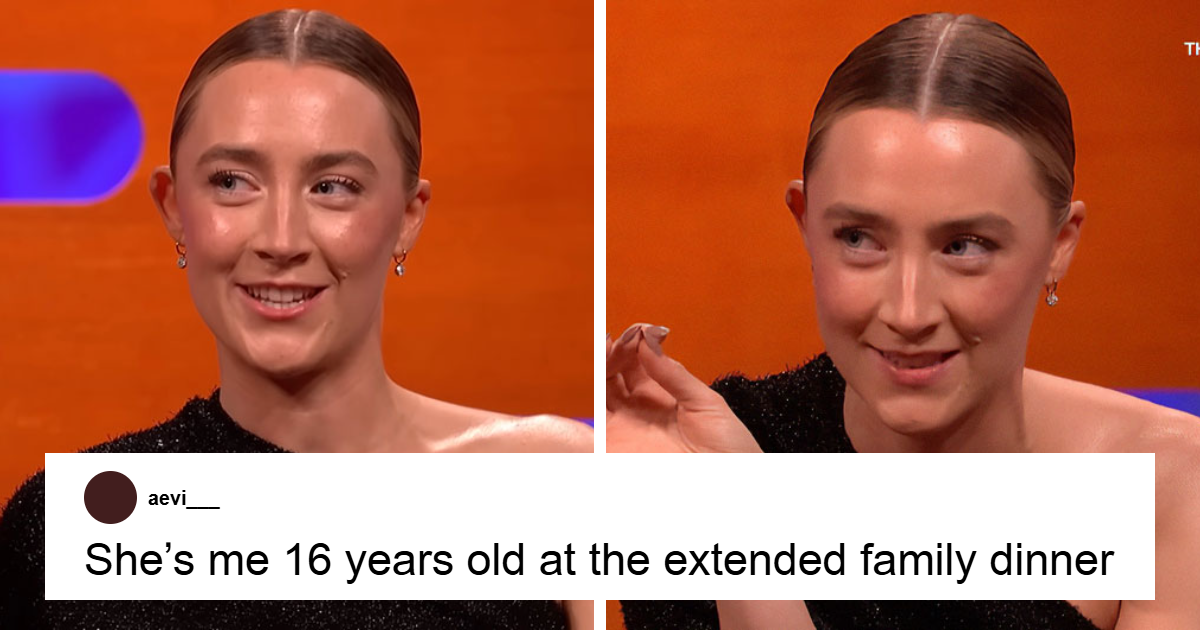
Saoirse Ronan needed only a few seconds to transform a breezy celebrity interview into a worldwide conversation about women’s safety. There was no prepared speech, dramatic soundtrack, or suspiciously well-timed PowerPoint presentation. She simply said what countless women already knew—and what the men sitting beside her had momentarily failed to consider.
The viral Saoirse Ronan remark occurred during a playful discussion about self-defense on The Graham Norton Show. When the male guests laughed at the idea of reaching for a phone during an attack, Ronan calmly pointed out that girls and women routinely think about how everyday objects might help them escape danger. The laughter stopped, the audience applauded, and the internet performed one of its rare useful functions: amplifying an uncomfortable truth.
What Happened on The Graham Norton Show?
The exchange aired on October 25, 2024, when Ronan appeared alongside actors Paul Mescal, Eddie Redmayne, and Denzel Washington. Redmayne was discussing the physical preparation he had completed for The Day of the Jackal, including a self-defense technique involving striking an attacker with the base of a cellphone.
Mescal jokingly questioned whether anyone under attack would actually remember to reach for a phone. Host Graham Norton joined the bit by pretending to ask an imaginary assailant to wait while he searched his pocket. Redmayne acknowledged that Mescal had made a fair comedic point, and the conversation appeared ready to continue toward the next amusing celebrity anecdote.
Then Ronan stepped in.
“That’s what girls have to think about all the time.”
After the brief silence that followed, she turned toward the studio audience and asked, “Am I right, ladies?” The audience responded with loud applause. The men’s expressions shifted almost instantly, as though the entire couch had received an unexpected but necessary software update.
Why Saoirse Ronan’s Honest Remark Went Viral
She Exposed Two Completely Different Experiences of the Same World
The men were discussing an emergency as a hypothetical event. Ronan was describing the preparation many women practice before any emergency happens.
For someone who rarely worries about personal safety, using a phone as a weapon can sound like an improbable movie trick. For someone accustomed to evaluating risks, it can be one item on a long mental checklist. Is the parking lot well-lit? Is someone walking too closely behind me? Should I remove my headphones? Does a friend know where I am? Can I reach my phone quickly?
That difference explains why the moment resonated. Ronan did not introduce an obscure academic theory. She identified a familiar divide in everyday experience using one short sentence. Numerous viewers praised her for articulating something women are often expected to manage quietly.
Her Delivery Was Direct Without Becoming Hostile
Ronan did not accuse the other guests of deliberately dismissing violence against women. She did not turn the interview into a courtroom drama or challenge Denzel Washington to explain the patriarchy before the commercial break. She simply placed another reality beside the joke.
That restraint made the comment difficult to dismiss. There was no exaggerated language for critics to attack and no lengthy argument to derail. The sentence was calm, recognizable, and complete.
Online descriptions frequently said Ronan had “silenced” or “shut down” the male guests. Those phrases capture the sudden change in mood, but they can also make the interaction sound more combative than it was. The men had been joking about whether a self-defense technique was practical. Ronan widened the frame and revealed why the subject was not merely theoretical for many women.
The Silence Became Part of the Message
The pause after Ronan’s remark became nearly as memorable as the words themselves. Viewers watched several successful, thoughtful men recognize that they had not approached the subject from the same position.
That does not make the male guests villains. In fact, the moment arguably became more powerful because they were not generally perceived as aggressively macho public figures. The exchange demonstrated that blind spots do not require malicious intentions. Decent people can overlook an experience they have never needed to examine.
Paul Mescal later praised Ronan’s observation, saying she had “hit the nail on the head.” He also emphasized that conversations about violence against women should continue rather than appear only when a celebrity clip goes viral.
Saoirse Ronan Asked Viewers to Consider the Full Context
After the clip spread internationally, Ronan said she was surprised by the scale of the reaction. She also encouraged people to watch the complete conversation rather than assume the men had intentionally mocked women’s safety.
Her clarification matters. Viral media has a habit of converting ordinary human exchanges into miniature morality plays featuring one flawless hero, three cartoon villains, and several million volunteer prosecutors. Ronan’s own interpretation was more measured.
She explained that the original conversation had not been specifically about violence against women and that the male guests were not consciously overlooking it. Her comment emerged naturally because their laughter illustrated how differently men and women can experience the possibility of an attack. She described the viral response as “wild” but welcomed the conversation it had opened.
This distinction improves the message rather than weakening it. The incident was not proof that the men on the couch were terrible people. It was evidence that even considerate men may require reminders about burdens they rarely carry themselves.
The Broader Reality Behind Women’s Safety Concerns
The widespread response was not based solely on celebrity enthusiasm. Research consistently shows a sizable gender gap in feelings of personal safety. A Gallup survey published in 2023 found that 53% of American women were afraid to walk alone at night near their homes, compared with 26% of men. Fear does not perfectly measure the likelihood of victimization, but it clearly demonstrates how differently people experience the same streets and neighborhoods.
Recent data from the Centers for Disease Control and Prevention also provides sobering context. Its 2023–2024 intimate partner violence brief reported that more than one in three women in the United States had experienced contact sexual violence, physical violence, or stalking by an intimate partner during their lifetimes. The same report acknowledged that men also experience intimate partner violence, while documenting meaningful differences in prevalence and impact.
A separate CDC brief reported that nearly half of U.S. women had experienced some form of contact sexual violence during their lifetimes. It also found substantial levels of sexual harassment in public places, workplaces, and technology-mediated environments. These figures help explain why women may think about escape routes, phones, transportation, clothing, drinks, parking spaces, and who is standing behind them. Such vigilance is not a quirky hobby. It is often a learned response to personal experience, shared warnings, and visible patterns of harm.
Why “Just Be Careful” Is Not an Adequate Solution
Discussions about women’s safety frequently produce a familiar parade of instructions: do not walk alone, do not wear headphones, watch your drink, text when you arrive, carry an alarm, avoid dark streets, and apparently develop the situational awareness of an intelligence operative.
Practical preparation can be useful, but exclusively telling potential victims to protect themselves transfers responsibility in the wrong direction. Women can take every recommended precaution and still encounter harassment or violence. No collection of safety tips can replace prevention, accountability, respectful relationships, effective community responses, and social norms that reject abusive behavior.
The CDC identifies bystander approaches, education, protective environments, and changing harmful social norms as parts of evidence-informed sexual violence prevention. The National Sexual Violence Resource Center similarly promotes safe bystander intervention, while the U.S. Department of Justice supports programs that engage men and boys as allies in preventing dating violence, domestic violence, stalking, and sexual assault.
In other words, women should not be the only people doing homework on safety.
What Men Can Learn From the Viral Saoirse Ronan Moment
Listen Before Trying to Correct the Experience
When a woman describes changing her route, holding her keys, sharing her location, or pretending to make a phone call, the useful response is not an immediate statistical debate about whether the street was actually dangerous. The first task is understanding why she believed those precautions were necessary.
Notice the Invisible Planning
A male friend may think everyone simply left a restaurant and traveled home. A woman in the group may have photographed a license plate, checked the driver’s identity, texted her arrival time, avoided an empty train car, and waited until everyone entered their homes. The outing was the same; the mental workload was not.
Make Safety a Shared Responsibility
Men can walk friends to transportation without treating them as helpless, intervene safely when someone is being harassed, challenge degrading jokes, respect boundaries immediately, and check whether everyone has a secure way home. These actions are not medals of exceptional heroism. They are ordinary signs of social awareness.
Avoid Making the Conversation About Personal Innocence
When women discuss gender-based violence, some men respond by announcing that they personally have never attacked anyone. That may be excellent news, but it is also a remarkably low entrance requirement for the conversation. The more useful question is whether they recognize warning signs, challenge harmful behavior, and help create safer environments.
Everyday Experiences That Explain Why the Clip Hit So Hard
The following situations are not dramatic action scenes. They are ordinary experiences commonly described by women when explaining the background calculation behind Ronan’s remark.
The Walk From the Building to the Car
A workday ends late, and two colleagues leave the office together. The man walks toward his car thinking about dinner, traffic, and whether he remembered to charge his laptop. The woman notices that most of the parking lot is empty. She checks who exited behind them, moves her phone from her purse to her hand, identifies the nearest occupied building, and waits to unlock her car until she is close enough to enter immediately.
Nothing happens. To an observer, both employees simply walked to their cars. Yet one completed a routine commute while the other conducted a brief security assessment. The absence of an incident does not mean the assessment was imaginary; it means the precaution remained invisible.
The First Date Check-In System
Before meeting someone from a dating app, a woman sends her friend a screenshot of the person’s profile, the restaurant address, and an estimated return time. They agree on a code word. She arranges her own transportation and watches her drink when she leaves the table.
The date may be perfectly pleasant. Her companion may be kind, funny, and only mildly guilty of describing cryptocurrency for too long. Nevertheless, she prepared for the possibility that the person presented online might not match the person sitting across from her. That planning is often treated as normal among women because enough friends have experienced unwanted pressure, stalking, intimidation, or assault.
The Headphones That Are Not Really Playing Music
A woman walking through a city keeps earbuds in her ears to discourage strangers from approaching, but turns the audio off so she can hear footsteps and traffic. She changes sidewalks when someone appears to be following the same turns. She checks her reflection in a store window without obviously looking backward.
From the outside, she looks like someone enjoying a podcast. Internally, she is balancing two competing goals: appearing unavailable while remaining alert. This is precisely the kind of calculation that can sound overly elaborate to someone who has never felt compelled to make it.
The Friendly Stranger Who Will Not Accept a Polite No
At a bar, a stranger offers to buy a woman a drink. She declines politely. He asks again. She declines more firmly. He demands to know why she is being unfriendly, and now she must decide whether direct rejection will make him leave or make him angry.
Women are often advised to be clearer about their boundaries while simultaneously being taught to avoid provoking potentially aggressive men. That contradiction creates a stressful form of social negotiation: reject the attention, manage the other person’s feelings, monitor his reaction, and locate an exit—all while trying not to appear alarmed.
The Group Chat Message That Means Everyone Is Safe
After dinner, several friends travel home separately. One posts, “Made it.” Another shares her live location until she reaches her building. Someone waits awake for the final message before putting down her phone.
These rituals can be warm and supportive, but their existence also reveals the expectation beneath them. The group is not merely exchanging goodnight messages. Its members are quietly confirming that no one disappeared between the restaurant and the front door.
Ronan’s comment condensed all these experiences into one line. The phone was never just a phone. It represented the constant preparation that becomes so routine many women barely mention it until someone else laughs at the idea of needing it.
A Small Interruption With a Lasting Message
Saoirse Ronan’s viral comment succeeded because it did not feel like a performance. She heard a joke, recognized the missing perspective, and supplied it. The male guests paused, the women in the audience responded, and millions of viewers recognized the situation immediately.
The value of the moment is not that Ronan defeated several famous men in a televised debate. There was no debate. Its value lies in the reminder that people can occupy the same room, travel through the same city, and discuss the same emergency while carrying profoundly different assumptions about safety.
Men do not need to experience every fear personally before taking it seriously. They can listen, notice invisible precautions, share responsibility, and help shift the conversation from how women should avoid violence to how communities can prevent it.
Sometimes awareness begins with research, education, and long discussions. Sometimes it begins when one woman interrupts a joke with a sentence everyone else should have considered.