Note: This article is written as original web content inspired by documented abandoned-house photography, historic preservation research, antique clockmaking history, and the strange charm of old collections. It does not encourage trespassing or unsafe exploration; historic places deserve respect, permission, and protection.
Some abandoned houses whisper. Others creak, sigh, and drop a little plaster on your shoulder like they are trying to make a point. But this abandoned 19th-century cottage did something rarer: it seemed to tick.
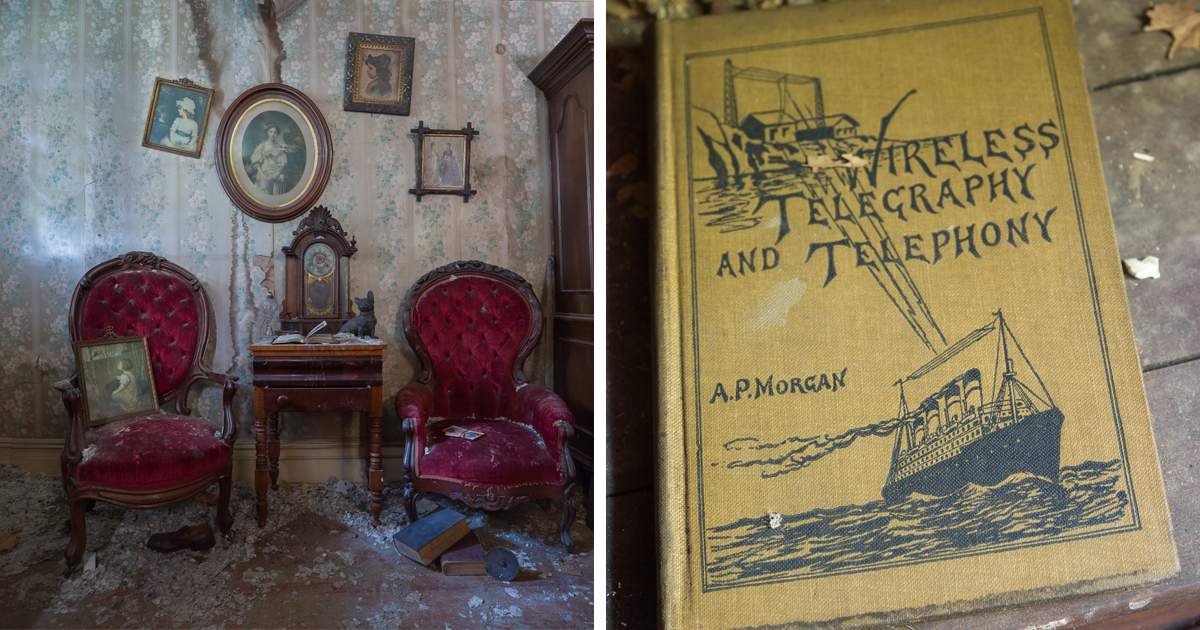
Not literally, of course. Most of the clocks inside had stopped long ago. Their hands were frozen at different hours, as if every room had retired from timekeeping on its own dramatic schedule. Yet the cottage still felt strangely alive. A red velvet dining room, antique books, picture clocks, old gadgets, apothecary bottles, a miniature piano, military hats, dusty portraits, and a clockmaker’s workshop all sat inside like clues left behind by a person who never expected the final chapter to be written by dust.
This was not just an abandoned cottage. It was a time capsule. More specifically, it was the former home of an enigmatic clockmaker and collector of curios in New Jerseya place where craftsmanship, obsession, memory, and mystery had gathered under one sagging roof. For lovers of abandoned places, antique interiors, 19th-century cottages, and “what on earth is that object?” moments, this house is the kind of discovery that makes your imagination immediately put on a tweed coat and start investigating.
The 19th-Century Cottage That Time Forgot
There is something especially haunting about a small old house left untouched. Grand mansions impress us with marble staircases and chandeliers the size of weather systems. But cottages speak more softly. They show us daily life: where someone ate breakfast, repaired tools, stacked books, hung coats, wound clocks, and probably complained about the weather with great sincerity.
This abandoned 19th-century cottage had the intimacy of a personal museum. The rooms were not empty shells; they were crowded with objects. Some were beautiful. Some were odd. Some looked useful, while others seemed to exist simply because the owner once saw them and thought, “Yes, my life requires this mysterious little thing immediately.” That is the spirit of a true collector.
The cottage’s atmosphere felt “frozen in time,” a phrase often overused in abandoned house stories, but here it fits almost too perfectly. A clockmaker’s home filled with stopped clocks is not subtle symbolism. It is practically a Victorian ghost story tapping you on the shoulder with a brass winding key.
Who Was the Clockmaker?
The former owner remains partly mysterious, which is probably why the house feels so compelling. A clockmaker is not merely someone who sells timepieces. Historically, clockmaking required mechanical knowledge, patience, precision, and a willingness to spend many hours handling tiny parts that would make the average person say several words not suitable for a family publication.
In 18th- and 19th-century America, clocks became more than luxury objects. They marked the rise of industry, punctuality, transportation schedules, domestic order, and middle-class aspiration. Early American clockmakers and manufacturers helped move timekeeping from rare handcrafted objects into more accessible household possessions. Wooden movements, shelf clocks, tall case clocks, mantel clocks, regulator clocks, and decorative picture clocks all reflected changing technology and taste.
So when a clockmaker’s cottage still contains clocks, tools, cabinets, and curious inventions, the setting becomes more than spooky decoration. It becomes a portrait of a mind. The person who lived there likely understood gears, springs, dials, weights, pendulums, and the beautiful stubbornness of mechanical things. And based on the objects left behind, he did not stop at clocks. He collected history in fragments.
A Collector of Curios: When a Home Becomes a Cabinet of Wonders
The phrase “collector of curios” sounds charmingly old-fashioned, but it points to a long tradition. Cabinets of curiosities, sometimes called wonder rooms, were collections of unusual natural objects, scientific instruments, artworks, antiques, specimens, relics, and conversation pieces. Before modern museums became formal institutions, collectors arranged objects to reflect knowledge, wealth, taste, exploration, and sometimes a healthy dose of eccentricity.
This abandoned cottage seemed to follow that same spirit on a domestic scale. It was not organized like a museum with labels and soft lighting. It was messier, more personal, and far more emotional. Antique books sat near vintage gadgets. Portraits watched over rooms that were slowly surrendering to decay. Apothecary items hinted at old medical practices. Decorative prints and lithographs added drama. A miniature piano brought in a note of whimsy. The entire house felt like a puzzle assembled by someone who loved objects not because they matched, but because they mattered.
And that is the difference between clutter and a collection. Clutter says, “I should deal with this later.” A collection says, “Every object here has a story, even if I am the only one who knows it.” In this cottage, the stories remainedbut the storyteller had vanished.
Inside the Abandoned Cottage: 27 Details That Make the Photos Unforgettable
The original photo set is powerful because it does not rely on jump scares or cheap horror. Instead, it invites slow looking. Each image feels like a page from a diary written in wallpaper, wood, brass, velvet, and dust.
1. The Red Velvet Dining Room
The dining room is one of the most theatrical spaces in the cottage. Red velvet, antique furniture, and dim natural light create the feeling of a room waiting for guests who are several decades late. It is elegant, but not polished. The beauty is bruised, which makes it more interesting.
2. The Antique Piano
An old piano in an abandoned home always feels emotional. It suggests music, gatherings, lessons, or private moments when someone played badly but confidently. In this cottage, the piano becomes another stopped instrumentsilent, but still expressive.
3. The House Portrait
A portrait of the house inside the house adds a strange loop to the story. It shows that the cottage was once cherished enough to be recorded as an image. That detail matters. Someone saw this place not as a ruin, but as a home worth remembering.
4. The Bedrooms
The bedrooms feel more personal than the public rooms. Beds, furniture, prints, and scattered belongings create the uncomfortable sensation that the resident stepped out and never returned. Abandoned bedrooms are rarely just rooms; they are pauses.
5. The Mourning and “Innocence” Prints
Old chromolithographs and sentimental images were common in many homes, and they often carried moral, religious, or emotional themes. In an abandoned cottage, they become even more symbolic. Innocence, mourning, memory, and decay all seem to sit in the same frame.
6. The Picture Clocks
Picture clocks combine art and timekeeping, making them perfect objects for a clockmaker-collector. They are decorative, mechanical, and slightly magical. A landscape or scene becomes more than an image when time is built into it.
7. The Clockmaker’s Workshop
The workshop is the heart of the cottage. Tools and parts suggest patience, repair, and specialized knowledge. It is easy to imagine the clockmaker leaning over a workbench, adjusting a mechanism, listening for the correct rhythm, and muttering at a stubborn gear like it had personally offended him.
8. Apothecary Paraphernalia
Old bottles, medical tools, and apothecary items add another layer of curiosity. They remind us that 19th- and early 20th-century homes often contained objects related to self-care, folk remedies, early medicine, and household chemistry. Some now look elegant; others look like they might come with a warning label and a lawsuit.
9. Antique Books and Ephemera
Books, papers, and printed scraps are among the most fragile survivors in an abandoned house. Moisture, insects, sunlight, and time can erase them quickly. When they remain, they offer clues about education, hobbies, beliefs, finances, and private routines.
10. The Grandfather Clock
No object better represents the house than the grandfather clock. Tall, formal, and deeply associated with family life, it stands like a guardian of the old rooms. Even stopped, it commands attention.
11. The Attic
The attic is where homes store their unfinished sentences. Boxes, trunks, forgotten furniture, and odd keepsakes often collect there. In this cottage, the attic adds to the sense that the house was not abandoned all at once. It was layered over time.
Why Abandoned Historic Homes Fascinate Us
Abandoned historic homes attract attention because they combine beauty, mystery, and loss. They allow us to stand at the edge of someone else’s life and wonder what happened. Why was everything left behind? Who made the final decision to close the door? Did the owner have family? Were the objects too difficult to move, too personal to sell, or simply forgotten in a legal and emotional tangle?
There is also a deeper reason. Old houses remind us that ordinary lives become history faster than anyone expects. A dining room becomes an artifact. A workbench becomes evidence. A collection becomes biography. Even dust becomes part of the story.
In the case of this clockmaker’s cottage, the theme is especially strong because clocks are designed to measure passing time. Seeing them stopped inside a deteriorating house turns the whole place into a visual metaphor. Time did not stop, of course. It kept moving outside. Trees grew. Paint peeled. Rooflines sagged. But inside, the objects held their positions like actors waiting for a final cue.
The Beauty and Risk of Urban Exploration
Urban exploration photography can be valuable when it documents places that may soon disappear. Photographs of abandoned homes, factories, schools, hospitals, churches, and theaters often become unofficial preservation records. They capture architecture, interiors, craftsmanship, and everyday objects before demolition, vandalism, weather, or redevelopment changes them forever.
But there is an important ethical line. Abandoned does not mean ownerless. Old does not mean open. Interesting does not mean safe. Historic buildings can contain weak floors, unstable roofs, mold, lead paint, asbestos, broken glass, exposed nails, animal activity, and other hazards. Responsible documentation requires permission, caution, and respect for property and privacy.
The best abandoned-place photography does not treat decay as a playground. It treats it as evidence. It asks viewers to notice what has been neglected and what might still be saved. That is why this clockmaker’s cottage matters beyond its eerie charm. It shows how quickly a richly personal home can become vulnerable when maintenance stops.
Could a Cottage Like This Be Saved?
Historic preservation is rarely simple. A small 19th-century cottage may look romantic in photographs, but saving it can involve structural assessments, moisture control, roof repairs, foundation work, environmental testing, historical research, permits, insurance, skilled labor, and money. Lots of money. The kind of money that makes your wallet hide behind the sofa.
Still, preservation is not only about grand landmarks. Modest homes can hold enormous cultural value. They show how craftspeople lived. They preserve local building traditions. They contain evidence of domestic life, work, taste, and community history. A clockmaker’s cottage, especially one filled with tools and collections, could be interpreted as a rare blend of home, workshop, and personal museum.
Adaptive reuse is one possible path for old structures. Instead of demolishing a building, owners and communities may stabilize it and give it a new function while retaining historic character. A cottage like this could theoretically become a small museum, artist residency, preservation studio, antique clock workshop, or educational siteif ownership, condition, zoning, funding, and safety issues aligned.
Even when a building cannot be saved, documentation still matters. Measured drawings, photographs, written histories, object inventories, and oral histories can preserve information that would otherwise vanish. In that sense, every careful photo of this cottage is more than atmospheric content. It is a record.
The Objects Left Behind Tell a Bigger Story
What makes this abandoned 19th-century cottage so compelling is not just that it belonged to a clockmaker. It is that the home shows the overlap between craft and curiosity. The owner appears to have lived among mechanisms, images, books, medical relics, decorative objects, and historical odds and ends. The result is a house that feels like a mind turned inside out.
Collectors often get teased for keeping too much. And yes, some collections do reach the point where the phrase “carefully curated” starts wearing a fake mustache and pretending not to be clutter. But collections can also preserve memory. They reveal what fascinated a person. They show what someone rescued from flea markets, attics, auctions, relatives, or disappearing trades.
In this cottage, the curios are not random props. They create a portrait of a person drawn to the mechanical, the historical, the decorative, and the strange. A clockmaker would naturally understand that objects outlive their users. A well-made clock can keep working for generations if maintained. But a home, like a clock, needs care. Once neglected, both begin to fail.
Why the Photos Feel So Cinematic
The photo set has a cinematic quality because it contains contrast. Beauty and decay. Precision and disorder. Public rooms and private corners. Mechanical objects and organic deterioration. A clockmaker’s tools surrounded by a house that can no longer keep itself together.
The lighting also matters. Abandoned interiors often rely on natural light slipping through windows, cracks, curtains, and broken frames. That kind of light is unpredictable. It can make a dusty dining room look like a painting or turn a hallway into something that seems to be holding its breath.
Then there is color. Red velvet, dark wood, yellowed paper, tarnished metal, faded wallpaper, and gray dust create a palette that feels aged rather than designed. Modern interiors often try hard to look “vintage.” This cottage did not try. It simply became vintage by surviving long enough to be overtaken by time.
What This Cottage Teaches Us About Time
A clockmaker’s abandoned cottage is almost too perfect as a lesson about time, but the lesson is not simply “everything fades.” That is true, but also a little gloomy, and frankly, time has enough public relations problems.
The better lesson is that objects carry care. A clock requires winding, cleaning, adjustment, and repair. A house requires painting, roofing, heating, ventilation, and human presence. A collection requires organization, memory, and meaning. When care disappears, deterioration begins. But when someone notices, documents, preserves, or tells the story, a different kind of care returns.
That is why abandoned places fascinate us. They are not only about loss. They are invitations to pay attention. They ask us to see value before it collapses, rusts, molds, or gets hauled away in a dumpster labeled “miscellaneous,” which is possibly the saddest word in the English language.
Experience Notes: Walking Through a Story Like This
Imagining a visit to this abandoned clockmaker’s cottage is different from imagining a visit to a typical old house museum. In a museum, everything has been cleaned, labeled, stabilized, and politely arranged. You move through the space knowing that someone has already interpreted it for you. In a forgotten cottage, interpretation happens in real time. Your eyes become the labels. Your questions become the tour guide.
The first experience would likely be silence. Not total silence, because old buildings are never completely quiet. They click, tap, groan, and shift. Wind presses against loose windows. A branch scratches siding. A floorboard answers your weight with a complaint from the previous century. In a clockmaker’s home, that silence would feel even more noticeable because the objects were made to produce rhythm. A house full of clocks without ticking is like a library where every book has decided to keep its secrets.
The second experience would be visual overload. A collector’s home does not reveal itself in one glance. You notice a clock first, then a portrait, then a book title, then a tool, then a bottle, then a tiny decorative object hiding on a shelf like it is trying to win a game of historical hide-and-seek. Every surface competes for attention. The challenge is not finding something interesting; it is deciding where to look without missing the small clue that explains everything.
The third experience would be emotional contradiction. Part of you would feel amazed that so much survived. Another part would feel sad that it was left vulnerable. That is the strange pull of abandoned historic places. They are beautiful partly because they are fragile, but their fragility is also the problem. Peeling paint may look poetic in a photograph, but in real life it can signal moisture, toxins, neglect, and structural decline. The romance of decay should never make us forget the reality of damage.
The fourth experience would be curiosity about the owner. A clockmaker and collector of curios sounds like a character from a novel, but this was a real person with real routines. He may have repaired clocks for neighbors, searched for antiques, saved odd objects from being discarded, and arranged his rooms according to a logic that made perfect sense to him. The cottage invites speculation, but it also asks for humility. We can admire the mystery without pretending we know every answer.
The final experience would be leaving. That may be the hardest part of any historic place that feels endangered. When you step away from a house like this, you do not just leave a building. You leave questions behind. Will anyone save it? Will the objects be cataloged? Will the workshop survive? Will the clocks ever tick again? Or will the cottage continue to fade until the story exists only in photographs?
That lingering uncertainty is why the 27 pictures matter. They let viewers return, study, wonder, and care. In the end, the abandoned clockmaker’s cottage is not simply a spooky old house full of antiques. It is a reminder that every home is a container of time, and every object has a chance to become a message. Some messages are written in ink. Some are carved in wood. Some are hidden in gears. And some, apparently, wait inside a quiet New Jersey cottage until someone opens the door and listens.
Conclusion: A Cottage Full of Clocks, Curios, and Questions
The abandoned 19th-century cottage of an enigmatic clockmaker and collector of curios is memorable because it feels both specific and universal. It belonged to one person, in one place, with one unusual collection. Yet it speaks to something everyone understands: the desire to hold onto meaningful things before time carries them away.
Its stopped clocks, antique books, velvet rooms, old tools, portraits, gadgets, and workshop remnants create more than a haunting photo series. They create a layered story about craftsmanship, memory, preservation, and the fragile afterlife of homes. The cottage may be abandoned, but it is not empty. It is full of evidence that someone once cared deeply about objects, mechanisms, beauty, and the mysteries tucked into ordinary rooms.
And maybe that is why this story stays with us. A clock can stop. A house can decay. A collection can scatter. But once a place is documented and remembered, time does not get the final word quite so easily.