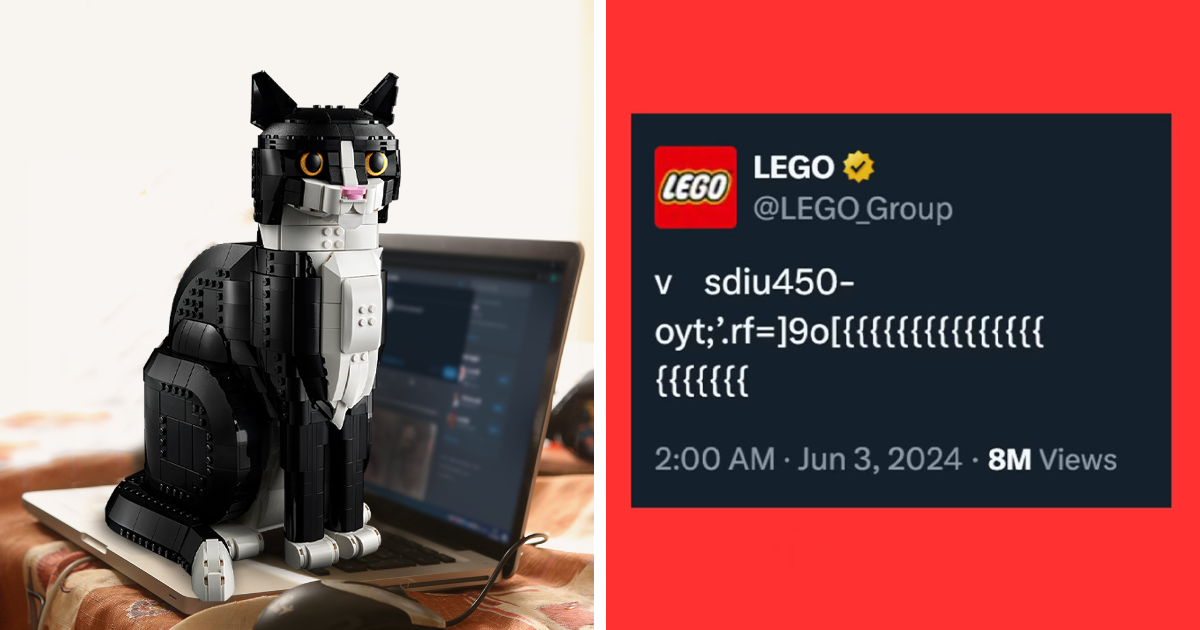
A mysterious burst of keyboard gibberish from LEGO looked like a hack, a mistake, or perhaps an intern having a very unusual Monday. The truth was much fluffier: a brick-built Tuxedo Cat had apparently marched across a laptop, turning one relatable pet-owner moment into an enormously successful viral marketing campaign.
The LEGO Tweet That Made the Internet Check Its Keyboard
When a major brand posts a polished product announcement, social media users generally know what to expect: an attractive photograph, a cheerful slogan, several hashtags, and perhaps a sentence containing the word “excited” more times than strictly necessary.
LEGO chose a different approach.
In early June 2024, the company’s official account on X published a baffling string of characters beginning with something like “v sdiu450-.” There was no explanation, no product name, and no corporate voice calmly assuring everyone that an exciting new building experience was now available.
The post looked exactly like the sort of message produced when a cat walks across a keyboard while its human is trying to work. Naturally, the internet began investigating. Had LEGO been hacked? Was the message a secret code? Had someone accidentally posted the password to a brick-shaped spacecraft?
A few hours later, LEGO revealed the culprit: its new LEGO Ideas Tuxedo Cat sitting proudly on a laptop keyboard. The keyboard was not actually a new LEGO product. It was simply the scene of the alleged feline crime, and the cat showed no remorse whatsoever.
That simple reveal transformed random-looking nonsense into a complete miniature story. The opening post created confusion. The follow-up supplied the punchline. The product itself became the character responsible for the chaos.
Why the LEGO Tuxedo Cat Campaign Went Viral
The campaign worked because it did not immediately feel like a campaign. People encountered what appeared to be a mistake rather than an advertisement, so their first instinct was to react, speculate, and share.
It Created an Irresistible Curiosity Gap
Most promotional posts answer every possible question before anyone has time to become interested. LEGO did the opposite. It offered almost no information, leaving social media users to complete the story themselves.
Was the account compromised? Did a social media manager fall asleep on the keyboard? Was the scrambled text a clue for an upcoming set? Every theory gave people another reason to reply or repost.
The official campaign case study described the opening message as deliberately engineered digital chaos. Instead of correcting the apparent error immediately, LEGO allowed speculation to grow before revealing the cat. The company effectively turned the audience into temporary detectives, although the final suspect was made of 1,710 plastic pieces and could not be questioned without falling apart.
It Used a Familiar Cat-Owner Experience
People who live with cats recognized the situation instantly. Cats sit on laptops, block screens during meetings, attack moving cursors, and stretch across keyboards at the exact moment their humans need to finish something important.
The joke required no complicated explanation because the behavior was already part of everyday pet culture. Even people without cats had seen enough videos and memes to understand the premise.
That relatability mattered. Marketing research and industry guidance frequently identify funny, emotional, and recognizable content as particularly effective for generating social engagement. LEGO did not simply tell consumers that its model looked realistic. It demonstrated the resemblance by giving the brick-built animal a familiar feline habit.
The Product Was the Punchline
The reveal did more than place a product beside a joke. The product completed the joke.
The black-and-white model was positioned as the creature that had typed the nonsense. Its paws appeared to rest near the keys, while its calm expression suggested that any resulting corporate emergency was somebody else’s problem.
This is an important distinction. A brand can attach a product photograph to a popular meme, but that does not automatically make the product relevant. LEGO’s Tuxedo Cat was essential to the narrative. Remove the cat, and there is no payoff. Remove the keyboard, and the cat is merely sitting near some office equipment like a very serious middle manager.
The Numbers Behind LEGO’s Cat-on-Keyboard Moment
Contemporary coverage reported that the initial post had already collected roughly 13 million views shortly after publication. LEGO’s later campaign submission to The One Club for Creativity reported a final total of approximately 14 million views, 293,000 likes, and more than 34,000 reposts.
According to that case study, the campaign achieved its reach organically, without paid amplification. The launch later received a Gold Pencil at the 2025 One Show in the Social Post and Single Platform Series category.
Those figures are impressive, but the more interesting achievement was behavioral. Users did not merely view the posts. They offered theories, created jokes, shared pictures of their own cats, and praised the concept as an unusually smart piece of social media marketing.
In other words, LEGO did not have to manufacture dozens of separate campaign assets. The audience generated additional entertainment around the original idea.
Meet the LEGO Ideas Tuxedo Cat
The star of the campaign was LEGO Ideas set 21349, a large black-and-white cat model designed for adults. The completed cat stands more than 12.5 inches tall and contains 1,710 pieces.
Builders can choose between blue and yellow eyes, construct the mouth in an open or closed position, rotate the head, and adjust the ears, paws, and tail. These customizable details allow the finished model to look alert, relaxed, curious, or mildly offended that dinner is six minutes late.
A Fan Idea That Earned Its Place on the Shelf
The model belongs to the LEGO Ideas line, where fan-created concepts can gather community support and potentially be developed into official sets. The Tuxedo Cat reached the required 10,000 supporter milestone before being selected for production.
That origin made the social media launch especially appropriate. A product born through fan participation was promoted with a campaign that also depended heavily on audience participation. In both cases, the public helped turn a clever concept into something much larger.
Designed as Décor, Not Just a Toy
The set was marketed as a display model and home-decor piece for adult builders. Its realistic proportions allow it to blend surprisingly well into a roomat least until somebody notices the studs, angular whisker area, and complete absence of breathing.
Its scale also made the keyboard image convincing. A tiny LEGO kitten beside a laptop might have been cute, but the almost life-size Tuxedo Cat could plausibly appear to occupy the workspace like a real pet.
The poseable features strengthened that illusion. A slight adjustment to the head or ears could make the cat seem curious about the screen, responsible for the typing, or entirely prepared to knock the laptop onto the floor.
Why Cats and the Internet Remain an Unbeatable Combination
LEGO’s campaign did not invent the internet’s affection for cats. It simply built upon decades of digital feline history.
Keyboard Cat became one of the defining animal memes of early online video culture. Grumpy Cat turned one unforgettable expression into a worldwide entertainment and merchandise phenomenon. LOLcats, reaction images, cat GIFs, and videos of pets sitting in boxes have repeatedly crossed platforms and generations.
Wired has documented how cat culture grew from early chatrooms and playful online communities into a recognizable part of mainstream internet life. Other U.S. publications have treated Keyboard Cat and Grumpy Cat as landmarks in the development of viral media.
Cats are particularly effective meme subjects because their behavior often appears independent of human expectations. A dog may enthusiastically cooperate with the camera. A cat frequently looks as though it has discovered the camera operator’s tax records and is disappointed by what it found.
That combination of cuteness, unpredictability, and apparent emotional detachment gives viewers room to invent stories. A neutral feline expression can represent annoyance, confidence, confusion, judgment, or the discovery that somebody has purchased the incorrect brand of treats.
The LEGO Tuxedo Cat inherited all of that cultural shorthand. It did not need to move, meow, or actually press a key. Its presence on the laptop was enough.
A Small Social Post With a Carefully Built Strategy
The finished campaign looked effortless, but effortless-looking marketing often requires careful planning. LEGO’s internal agency had to choose a recognizable keyboard pattern, time the reveal, frame the product convincingly, and resist the temptation to explain the joke too quickly.
The First Post Had to Look Accidental
Too little gibberish might have looked like a typo. Too much could have appeared staged. The sequence needed to resemble chaotic paw-generated typing while remaining unusual enough to attract attention.
The company also had to accept a temporary loss of control. For several hours, people could interpret the post however they wished. That uncertainty created the campaign’s energy, but it also required confidence that the reveal would make sense.
The Follow-Up Had to Arrive at the Right Time
Reveal the cat immediately, and the audience has no opportunity to speculate. Wait too long, and the confusion may turn into irritation or disappear from people’s feeds.
LEGO allowed the mystery to gather momentum before providing a clean visual payoff. The rhythm resembled a two-panel comic: setup first, punchline second.
The Brand Voice Still Felt Like LEGO
Humor works best when it fits the brand using it. LEGO has long associated itself with play, imagination, visual storytelling, and clever transformations. A fake cat-related keyboard accident felt mischievous without becoming mean, controversial, or disconnected from the product.
Industry analysis of humorous brand accounts repeatedly emphasizes the importance of authenticity and a consistent voice. A serious institution copying the same stunt without a natural connection to cats, keyboards, or play might appear desperate. LEGO could perform the joke because the product itself justified it.
What Other Brands Can Learn From LEGO’s Viral Tweet
Start With a Human Truth
The campaign was based on a tiny observation: cats walk across keyboards. Strong social content often begins with something ordinary that people immediately recognize.
A relatable truth gives the audience an easy entrance into the joke. People do not need product expertise or detailed background knowledge. They simply need to think, “Yes, my cat would absolutely do that.”
Make the Product Necessary
The Tuxedo Cat was not pasted onto an unrelated trend. It was responsible for the entire event. Brands seeking similar results should ask whether their product naturally completes the story or merely appears beside it.
Leave Space for Participation
LEGO did not tell users exactly how to react. The unexplained message invited theories, while the reveal encouraged pet owners to share their own experiences and photographs.
Social media becomes more powerful when audiences can add something rather than simply receive a finished advertisement.
Do Not Confuse Simplicity With Carelessness
A short post can involve substantial strategic thinking. The lesson is not that every company should publish random letters and wait for millions of views. That would quickly turn brand feeds into the digital equivalent of a toddler pressing buttons in an elevator.
The real lesson is to remove anything that does not strengthen the idea. LEGO needed a mysterious post, a pause, and a photograph. Adding a lengthy explanation, promotional slogan, discount code, animated logo, and twelve hashtags would have weakened the effect.
The Shared Experience Behind the Joke: Cats, Keyboards, and LEGO Builders
The campaign resonated because it reflected several familiar experiences at once. Cat owners recognized the invasion of the workspace. Remote workers recognized the danger of leaving a laptop unattended. LEGO fans recognized the satisfaction of seeing a finished model placed in a creative real-world scene.
The Cat Owner’s Experience
Anyone who has attempted to type near a curious cat knows that the keyboard is rarely treated as private property. It is warm, centrally located, covered in interesting moving fingers, and receives far too much of the human’s attention.
A cat may step on the keys, activate an unknown shortcut, send an unfinished message, or replace a carefully written paragraph with 47 copies of the letter “p.” The animal then sits down as though improving workplace efficiency was always the plan.
That is why LEGO’s scrambled tweet felt believable. The campaign compressed a common domestic comedy into a few seconds of confusion. People could mentally insert their own pets into the scene, complete with familiar expressions of innocence.
The Remote Worker’s Experience
The joke also captured a reality of working from home. Pets appear in video calls, interrupt presentations, block monitors, and walk behind people during serious conversations about quarterly targets.
These interruptions can be inconvenient, but they also make digital communication feel more human. A cat crossing the screen can transform a stiff meeting into a shared laugh. LEGO recreated that same emotional shift on a public platform: confusion became amusement, and an official corporate account briefly felt like someone’s chaotic home office.
The Builder’s Experience
Constructing a 1,710-piece model is a very different experience from scrolling past a photograph. Builders gradually assemble the internal structure, body, paws, face, ears, and tail until a pile of angular pieces begins to resemble an animal with a recognizable personality.
Choosing the eye color and mouth position gives owners a small sense of customization. Some may pose the finished cat beside books. Others may place it near a real pet and attempt a photograph before the living cat decides that the model requires immediate inspection.
The completed build can also become a conversation piece. From across a room, its silhouette is realistic enough to cause a moment of uncertainty. Visitors may briefly wonder why a remarkably still cat has been staring at the same wall for three hours.
The Marketer’s Experience
For social media professionals, the campaign offers another familiar experience: watching a tiny idea outperform a complicated content calendar.
Teams can spend weeks developing polished assets, only to see audiences become more excited by one spontaneous-looking joke. That does not mean planning is useless. LEGO’s campaign demonstrates the opposite. Careful strategy made the post look casual.
The challenge is finding an idea simple enough to understand instantly but distinctive enough to reward attention. In this case, LEGO found the answer by combining a product feature, an ordinary pet habit, and the internet’s enduring willingness to stop everything for a cat.
Perhaps the most enjoyable part of the experience was the absence of aggressive selling. Users were allowed to discover the Tuxedo Cat through a joke rather than a command to purchase it. The campaign earned attention before requesting interest, which made the product reveal feel like entertainment instead of an interruption.
Conclusion: The Cat Typed, and the Internet Listened
LEGO’s viral Tuxedo Cat tweets succeeded because they combined mystery, timing, product relevance, and a universally recognizable piece of cat behavior. What appeared to be a keyboard accident was actually a tightly designed social media story.
The campaign generated millions of views without relying on a complicated message or an expensive spectacle. It trusted the audience to notice something strange, participate in the mystery, and enjoy the eventual reveal.
Most importantly, the joke belonged to the product. The LEGO Tuxedo Cat did not merely appear after the viral moment; it explained the viral moment.
That is an unusually high level of achievement for a model that cannot move, cannot purr, and almost certainly refuses to apologize for whatever it typed.