The internet has invented plenty of questionable challenges, from balancing household objects on your face to performing dances that require the knee strength of a professional gymnast. The “Art Vs. Artist” challenge, however, is one of the rare online trends that is creative, revealing, and unlikely to result in an emergency-room visit.
The concept is beautifully simple. An artist places a photograph of themselves in the center of a collage, then surrounds it with examples of their work. Viewers can compare the creator with the creations and decide whether the two appear to belong together. Sometimes the connection is immediate. A pink-haired illustrator creates pink-haired fantasy warriors. A quiet-looking painter produces misty forests. A ceramic artist poses beside a shelf of strange little monsters that appear to share the artist’s mischievous expression.
Other comparisons are delightfully unexpected. The person in the center may resemble a friendly accountant, while the surrounding panels contain dragons, haunted castles, and creatures apparently banned from several dimensions. That contrast is part of the fun. Here are 45 of the best creative approaches to the Art Vs. Artist challengeand what makes each one memorable.
What Is the Art Vs. Artist Challenge?
The Art Vs. Artist challenge began circulating on social media in 2016 and experienced a major revival in 2018. The most recognizable version uses a three-by-three grid: eight pieces of artwork surround a central portrait of the artist. Variations may feature fewer images, a side-by-side comparison, animation, video, studio footage, or a photograph of the creator holding a finished piece.
Its appeal goes beyond answering the playful question, “Does the art look like the artist?” The collage functions as a miniature portfolio, personal introduction, visual résumé, and conversation starter. In a single image, viewers can identify an artist’s favorite colors, recurring subjects, technical strengths, and overall creative personality.
A Digital Version of the Self-Portrait
Artists have used self-portraits to explore identity for centuries. The Art Vs. Artist challenge updates that tradition for the scrolling age. Instead of creating one painted self-image, participants present themselves through both a photograph and a carefully selected body of work. The result says, “Here is my face, but here is also how I see.”
45 Standout Art Vs. Artist Challenge Responses
-
1. The Artist Who Dresses Like the Color Palette
Some creators appear to have stepped directly out of their own illustrations. Their clothing, hair, glasses, and studio background repeat the same colors found throughout the surrounding artwork.
-
2. The Quiet Creator With Explosive Fantasy Art
A calm, softly smiling portrait becomes wonderfully misleading when it is surrounded by roaring dragons, burning skies, armored warriors, and enough lightning to power a small city.
-
3. The Painter Surrounded by Dreamy Landscapes
Misty mountains, glowing windows, distant forests, and moonlit roads create a cinematic frame around the artist. The collage feels less like a portfolio and more like an invitation into another world.
-
4. The Creator Who Includes a Studio Cat
A cat instantly improves almost any internet post. When the animal appears beside paintings, brushes, or sketches, it becomes part assistant, part supervisor, and part suspected destroyer of wet canvases.
-
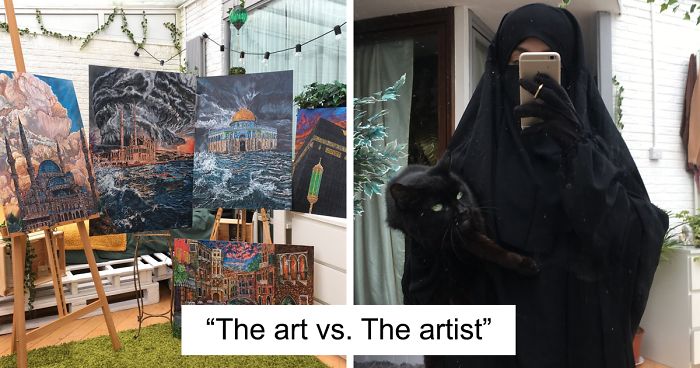
5. The Hijab-Wearing Artist With Architectural Paintings
One especially memorable approach pairs a modest central portrait with luminous paintings of buildings, landscapes, and spiritual spaces. The combination demonstrates how faith and artistic purpose can shape a coherent visual identity.
-
6. The Hyperrealistic Portrait Specialist
These grids make viewers zoom in, squint, and wonder whether the surrounding images are drawings or photographs. Pencil artists who capture pores, eyelashes, and reflections make graphite behave suspiciously like a camera.
-
7. The Artist Who Looks Like an Original Character
Colorful hair, dramatic eyeliner, unusual jewelry, or theatrical clothing can make the creator resemble a character from the surrounding fantasy universe. Life and illustration seem to share one wardrobe department.
-
8. The Miniature Artist With Giant Patience
Tiny food, miniature rooms, dollhouse furniture, and sculptures smaller than a coin reveal a level of precision that makes ordinary hands feel like oversized construction equipment.
-
9. The Ceramicist and the Strange Little Creatures
Rows of handmade clay monsters, frogs, ghosts, and grinning cups surround their maker. The artist often wears the same amused expression as the creatures, suggesting possible family resemblance.
-
10. The Watercolor Artist Who Seems Equally Gentle
Soft florals, delicate animals, pale skies, and transparent washes pair naturally with a relaxed portrait. Nothing in the collage appears capable of raising its voice.
-
11. The Horror Illustrator With a Friendly Smile
The center panel says, “Nice to meet you.” The other eight panels say, “Do not enter the basement.” This dramatic contrast is one of the challenge’s most entertaining possibilities.
-
12. The Embroidery Artist Holding the Hoop
Including tools in the portrait connects the maker directly with the process. Threads, fabric, needles, and half-finished designs show that the polished images began with patient handwork.
-
13. The Fashion Illustrator Wearing Their Own Design
A creator who poses in clothing inspired by their sketches turns the collage into a satisfying creative loop: imagined, drawn, constructed, and finally worn.
-
14. The Pet-Portrait Artist With a Furry Client
Dogs, cats, rabbits, and birds appear both in the artwork and beside the artist. The live model rarely looks impressed, probably because payment arrived in exposure instead of snacks.
-
15. The Comic Artist Who Draws a Cartoon Self
Replacing the central photograph with a caricature makes the entire grid feel like a comic panel. Exaggerated expressions also capture personality better than a carefully posed selfie sometimes can.
-
16. The Black-and-White Artist in a Monochrome Portrait
When every panel follows the same grayscale treatment, the result feels elegant and deliberate. The artist becomes another visual element rather than a separate introduction.
-
17. The Neon Digital Illustrator
Electric pinks, acidic greens, glowing city streets, and futuristic characters surround a portrait illuminated by matching lights. The collage appears ready to release a synthwave album.
-
18. The Nature Artist Photographed Outdoors
Botanical drawings and wildlife studies gain extra context when the artist stands in a forest, garden, desert, or fieldthe real-world source material behind the work.
-
19. The Sculptor Covered in Clay
A spotless professional headshot has its place, but muddy hands, dusty clothing, and a half-finished sculpture communicate something more valuable: this person genuinely makes things.
-
20. The Artist Who Recreates the Grid Physically
Instead of using editing software, some participants arrange canvases, prints, or sculptures around themselves in a studio. The photograph becomes an artwork of its own.
-
21. The Food Artist Who Makes Everything Adorable
Smiling cookies, tiny fruit characters, decorated cakes, and playful lunch boxes prove that edible art can have personalitybriefly, before somebody eats it.
-
22. The Tattoo Artist Displaying Living Canvases
Tattoo artists can surround their portrait with photographs of completed pieces on clients. The grid highlights versatility while reminding viewers that the artwork has literally gone out into the world.
-
23. The Cosplayer Who Becomes Their Own Artwork
Costume makers blur the distinction between artist and art more than almost anyone. They design, sew, sculpt, paint, style, perform, and then stand inside the finished project.
-
24. The Woodworker With a Sawdust-Covered Selfie
Furniture, carved figures, boxes, and turned bowls surround a workshop portrait. Sawdust in the hair provides the traditional badge of authenticity.
-
25. The Artist Whose Face Appears in Every Character
Sometimes the resemblance is subtle: the same eyebrows, expressions, hairstyles, or face shape reappear throughout the work. Apparently, the nearest available model is often the person holding the pencil.
-
26. The Children’s Illustrator With a Playful Portrait
Bright colors, friendly animals, expressive lettering, and an intentionally silly photo communicate exactly the right energy. Serious artistic skill does not require a serious facial expression.
-
27. The Dark-Academia Creator
Antique books, candlelight, ravens, ink drawings, and brown-toned clothing produce a grid that looks like it was assembled in a haunted university library.
-
28. The Fiber Artist Wrapped in Their Work
Knitwear, crochet creatures, woven textiles, and handmade blankets can physically surround the artist. Few challenge entries look warmer or more prepared for winter.
-
29. The Surrealist Who Edits the Selfie
A floating head, flower-covered face, mirrored body, or cosmic background turns the center portrait into another surreal composition rather than a conventional photograph.
-
30. The Street Artist Standing Beside a Mural
Large-scale work changes the visual equation. The artist may occupy only a tiny portion of the photograph, giving viewers an immediate sense of the mural’s enormous size.
-
31. The Makeup Artist Using Their Own Face as Canvas
Special-effects makeup, optical illusions, character transformations, and elaborate eye designs make it nearly impossible to determine where the portrait ends and the portfolio begins.
-
32. The Paper Artist Surrounded by Precision
Layered paper scenes, quilling, cut illustrations, and origami demonstrate how an inexpensive material can become extraordinarily complex in sufficiently patient hands.
-
33. The Photographer Who Avoids Showing a Face
Some photographers use a silhouette, reflection, shadow, camera-obscured portrait, or back-facing pose. The mystery fits especially well when their work explores observation and anonymity.
-
34. The Artist Who Includes Early and Recent Work
A chronological grid reveals improvement in anatomy, composition, color, and confidence. It transforms the challenge from a showcase into a compact record of persistence.
-
35. The Mixed-Media Creator Who Refuses One Style
Painting, collage, sculpture, photography, and textile work may all appear together. The lack of one recognizable medium becomes the artist’s recognizable identity.
-
36. The Fantasy Mapmaker
Intricate coastlines, fictional kingdoms, mountain ranges, and aged parchment surround the creator. Viewers immediately want to know which dangerous region contains the best tavern.
-
37. The Glass Artist Using Reflections
Stained glass and blown-glass pieces allow light to become part of the collage. A carefully positioned portrait can echo the same reflections and jewel-like colors.
-
38. The Printmaker Holding an Ink-Stained Brayer
Linocuts, woodcuts, and screen prints benefit from process clues. Tools and ink-stained hands help viewers understand that every clean impression began with carving, pressure, and experimentation.
-
39. The Artist and Their Collection of Eyes
Many illustrators repeatedly draw dramatic eyes. When eight intense gazes surround one ordinary selfie, the resulting grid feels like a very artistic security system.
-
40. The Creator Who Matches Each Artwork’s Pose
Some participants build humorous sequences by imitating the expressions or body language of their characters. The challenge becomes a performance as well as a portfolio.
-
41. The Jewelry Maker Wearing Multiple Creations
Handmade earrings, rings, necklaces, and brooches appear both individually and on the artist. This approach demonstrates scale, craftsmanship, and how the pieces look when worn.
-
42. The Disabled Artist Showing Adaptive Tools
Creators who paint with their mouths, feet, prosthetic devices, modified grips, or accessible digital equipment make the process visible without allowing the equipment to overshadow the art itself.
-
43. The Animation Artist Who Makes the Grid Move
Video versions can animate each panel, reveal sketches becoming finished scenes, or transform the artist into a character. The familiar format becomes unexpectedly dynamic.
-
44. The Artist Who Adds Humor Instead of a Portrait
A coffee cup, exhausted skeleton, pile of laundry, or photograph of an empty chair may occupy the center. The joke usually suggests that deadlines have consumed the artist completely.
-
45. The Completely Unexpected Match
The best response may be the one that defeats every stereotype. A corporate-looking professional creates whimsical fairies; a motorcycle enthusiast paints delicate flowers; a grandmother designs monsters. Creativity does not come with a uniform.
Why the Art Vs. Artist Challenge Remains Popular
The challenge succeeds because it asks for relatively little while revealing a great deal. Artists do not need to create a new masterpiece. They can select existing work, choose a portrait, and assemble a simple grid. That low barrier allows students, professionals, hobbyists, traditional painters, digital illustrators, sculptors, photographers, and craftspeople to participate together.
It also humanizes the online portfolio. A page filled only with finished work can feel polished but distant. Adding a face reminds viewers that every drawing, photograph, sculpture, or embroidery project represents hours of decisions made by a real person. That connection can lead to conversations, followers, commissions, collaborations, and friendships.
At the same time, the format exposes creative patterns that artists may not notice. Selecting eight representative pieces can reveal recurring colors, poses, themes, lighting choices, or character types. An artist who believes their work is wildly inconsistent may discover that every image contains moonlight, sharp silhouettes, and at least one emotionally complicated bird.
Experiences Artists Often Have While Creating an Art Vs. Artist Post
Creating an Art Vs. Artist collage sounds easy until the selection process begins. The artist opens a folder containing years of work and immediately enters negotiations with their past self. One piece demonstrates excellent technique but no longer represents their style. Another feels deeply personal but looks awkward at thumbnail size. A third took four months to finish, which makes removing it from the shortlist feel like an act of betrayal.
The first major experience is usually self-evaluation. Artists must decide what they want strangers to understand in a few seconds. Should the grid demonstrate range or consistency? Should it include commercial assignments, personal experiments, fan art, unfinished studies, or only polished portfolio pieces? These decisions encourage artists to view their work as a collection rather than a series of isolated projects.
Next comes the portrait problem. Many artists are comfortable sharing work while remaining behind the canvas, tablet, camera, or sewing machine. Posting a face can feel more vulnerable than posting art. A creator may take 47 photographs, reject 46, return to the first one, and then crop it so aggressively that only one eyebrow survives. Others deliberately use casual studio photographs because authenticity matters more than perfection.
Once the collage is assembled, visual relationships become obvious. A creator may realize that their green hair perfectly matches the forest scenes they keep painting. Someone who considers themselves cheerful may discover a portfolio populated entirely by lonely astronauts. Another artist may notice that every character has their nose, posture, or skeptical expression. These discoveries are humorous, but they also reveal how personal habits and experiences enter creative work.
Publishing the collage can produce a different kind of insight. Viewers often respond not only to technical skill but also to the person behind it. They ask about tools, inspiration, commissions, training, cultural influences, and creative routines. A single compact post can generate more meaningful discussion than several unrelated artwork uploads because audiences immediately understand the broader story.
The challenge can also become an annual record. Artists who create a new version each year gain a visual timeline of changing interests and abilities. One year may be dominated by character design; the next may include environments, animation, ceramics, or professional client work. Hairstyles change, studios improve, confidence grows, and the center photograph gradually stops looking as though it was taken under interrogation.
Most importantly, the experience reminds artists that they are allowed to be visible. Creative culture often celebrates the finished object while hiding the uncertain, hardworking person who produced it. Art Vs. Artist restores that missing connection. It says the artwork deserves attention, but so does the imagination, identity, labor, and wonderfully imperfect human being behind it.
How to Make Your Own Art Vs. Artist Collage
Choose Work That Tells a Story
Select pieces that demonstrate your strongest skills while revealing a consistent creative direction. Variety is useful, but eight completely unrelated images can make the collage feel like several artists fighting over one account.
Use Clear, High-Quality Images
Crop each artwork so its most important details remain visible at a small size. Avoid photographs with heavy glare, distracting backgrounds, or colors that differ drastically from the original piece.
Pick a Portrait That Feels Natural
Your image does not need to resemble a corporate headshot. A studio photograph, casual selfie, costume, silhouette, or humorous pose may communicate your personality more effectively.
Keep the Layout Balanced
Distribute light and dark images evenly around the grid. Place similar colors in different corners, give detailed pieces room to breathe, and avoid forcing every panel to compete for attention.
Add Useful Context
In the caption, mention your medium, artistic focus, location if relevant, and whether commissions are open. Include accessible image descriptions so more people can understand the collage.
Final Thoughts
The best Art Vs. Artist challenge responses do more than compare appearances. They reveal how identity, imagination, culture, humor, and daily experience influence creative work. Some artists look exactly like their portfolios. Others appear to have received their artwork from a mysterious alternate personality. Both outcomes are fascinating.
Behind every polished image is someone experimenting, learning, deleting layers, cleaning brushes, untangling thread, searching for reference photos, and whispering unkind words at a printer. The challenge gives that person a place in the frame. It turns a collection of artwork into a story about its makerand reminds viewers that art does not emerge from nowhere, no matter how magical the finished result may appear.