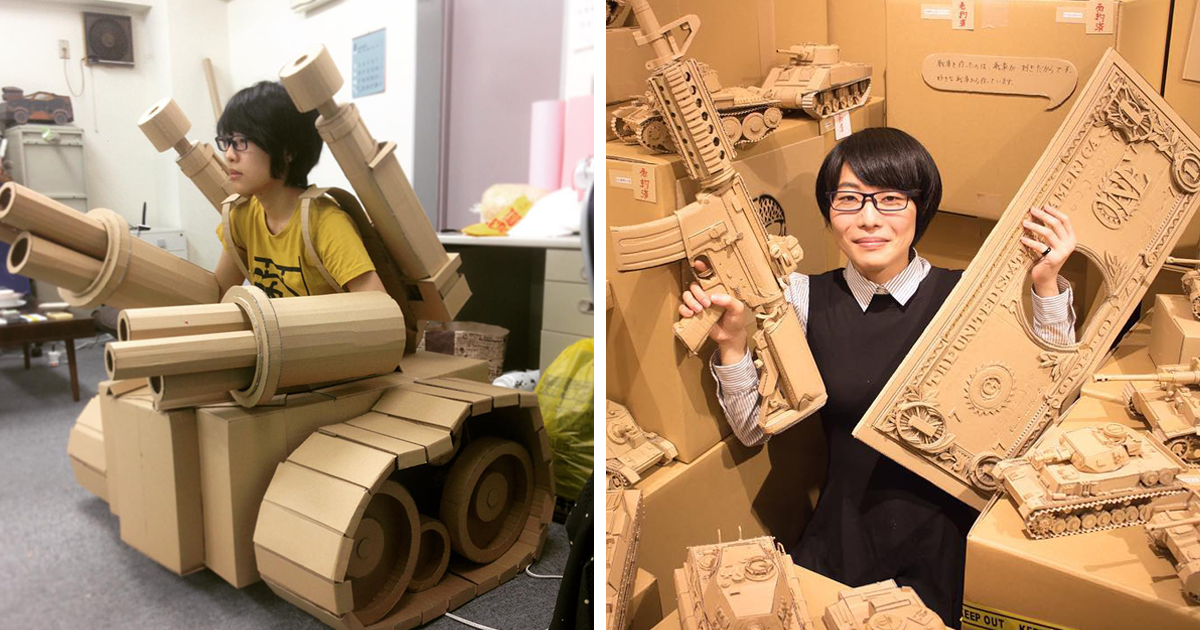
Most people see an Amazon box and think, “Great, another thing I need to flatten before recycling day.” Japanese artist Monami Ohno sees the same brown cardboard and apparently hears it whisper, “Please turn me into a museum-worthy sculpture with more detail than a luxury watch.” And somehow, she does exactly that.
Ohno has become internationally known for transforming discarded cardboard boxes into intricate sculptures that look far too complex to have started life as shipping packaging. Her work includes detailed creatures, pop-culture-inspired objects, food items, shoes, machines, characters, and everyday products recreated with surprising realism. The material is humble, the tools are basic, and the results look like they escaped from a design studio where cardboard has been secretly training for the Olympics.
The title “Japanese Woman Converts Amazon Boxes Into Intricate Sculptures (30 New Pics)” captures why her art keeps going viral: it is instantly understandable, visually satisfying, and slightly ridiculous in the best way. We all know the box. We all receive the box. We all trip over the box in the hallway for three days before pretending we are “saving it for something.” Ohno actually saves it for somethingand that something has scales, textures, curves, tiny parts, and personality.
Who Is Monami Ohno?
Monami Ohno is a Japanese contemporary artist and sculptor best known for working almost entirely with cardboard. She trained in 3D animation in Osaka, and that background shows. Her sculptures are not flat craft projects; they are dimensional builds with structure, proportion, rhythm, and surface detail. They feel designed from the inside out, as if each piece has been digitally modeled in her mind before it ever touches the cutting mat.
Her journey began with practicality rather than a grand artistic manifesto. As a student, she reportedly began using cardboard because it was available, affordable, and flexible enough for school projects. In other words, while some artists begin with marble and bronze, Ohno began with the universal student budget: “What do I already have, and can I avoid buying supplies?”
That practical choice became a signature. Over years of experimentation, she developed a style that celebrates the natural color, grain, folds, and edges of cardboard. Instead of hiding the material under paint, she often lets the brown surface remain visible. The result is part sculpture, part engineering puzzle, and part love letter to packaging that most of us flatten with our feet.
Why Amazon Boxes Make Such Interesting Art Material
Cardboard is everywhere. It arrives at doors, stacks up in closets, protects everything from books to blenders, and then usually disappears into recycling bins. Because it is so ordinary, we often forget that corrugated cardboard is a surprisingly clever material. It is light but strong, stiff but cuttable, inexpensive but structurally capable. That combination makes it ideal for sculpture.
Amazon boxes are especially recognizable because they have become part of daily life. Their logos, labels, tape marks, and familiar brown tone instantly connect the artwork to modern consumer culture. When Ohno turns that material into a detailed sculpture, the transformation feels almost magical. A box that once carried shampoo or phone chargers becomes an object worth staring at.
There is also something refreshing about art that does not try to look expensive. Cardboard has no aristocratic attitude. It does not strut into the room wearing a velvet cape. It says, “I was packaging yesterday, but today I contain multitudes.” That contrast makes Ohno’s sculptures both approachable and impressive.
How Her Cardboard Sculptures Are Made
Ohno’s process sounds simple at first: sketch, cut, fold, glue, shape, and assemble. But that description is like saying a symphony is made by “pressing keys and moving bows.” Technically true, emotionally insulting.
Sketching the Idea
She usually begins by sketching the form directly onto cardboard. This gives her a sense of size, proportion, and how the final structure may come together. Because cardboard has thickness, bend, grain direction, and layering possibilities, every shape has to be planned with the material’s behavior in mind.
Cutting and Layering
The pieces are then cut using simple tools such as scissors and a cutter. Layering is one of the secrets behind the depth of her work. Thin sheets can become raised ridges, armor-like plates, texture, scales, handles, soles, or mechanical-looking panels. A single flat piece of cardboard is modest. Fifty carefully cut pieces stacked together start to look like witchcraft.
Building Texture and Detail
Ohno’s sculptures stand out because of their surface detail. She does not merely make a cardboard outline of an object; she builds its character. A food item might have folds and packaging-like edges. A creature might have tiny layered textures. A sneaker might include laces, soles, curves, and panels. A pop-culture object might include recognizable proportions and decorative details that make viewers lean closer.
The funniest part is that the closer you look, the more obvious the cardboard becomesand the more impressive the work feels. The illusion does not collapse when you notice the material. It gets better. Your brain starts saying, “Wait, that tiny part is cardboard too? Excuse me while I question my entire relationship with scissors.”
The Beauty of Upcycled Art
Ohno’s work belongs to the larger world of upcycled art, where discarded or ordinary materials are reused creatively rather than thrown away. Upcycling is not just recycling with better lighting. It changes the value of an object by giving it a new purpose, often one more beautiful or meaningful than the original.
In a time when online shopping has made packaging a regular household guest, cardboard art feels especially relevant. Corrugated boxes are among the most recycled packaging materials, but recycling is still only one part of the story. Before a box is broken down and remade, it can also become a creative material. Ohno’s sculptures remind us that reuse can be imaginative, not just responsible.
There is an environmental message here, but it is not delivered with a lecture and a dramatic slideshow. Instead, it arrives quietly through craftsmanship. The viewer sees a finished sculpture and realizes that beauty was hiding in waste. That realization is more powerful than another stern reminder to flatten boxes, although yes, please still flatten boxes. Your recycling bin has feelings too.
Why These Sculptures Keep Going Viral
Ohno’s cardboard sculptures are perfect internet art because they pass the “wait, what?” test immediately. You do not need an art history degree to understand the appeal. The before-and-after is built into the material: cardboard box becomes detailed sculpture. That transformation is visually clear and emotionally satisfying.
They Are Familiar and Unexpected
Everyone knows cardboard. That familiarity makes the final artwork feel more surprising. When a sculptor uses marble, we expect elegance. When someone uses bronze, we expect permanence. When someone uses Amazon boxes, we expect a return label. Ohno flips that expectation and gives us something intricate, playful, and technically impressive.
They Reward Close Looking
Many viral images are consumed in half a second. Ohno’s work invites people to pause. The more you inspect the photos, the more details appear: tiny seams, layered edges, folds, curves, and subtle shadows. Her sculptures look good as full objects, but they also reward the zoom-in crowdthe people who treat every image like a detective board.
They Feel Human in a Digital Age
In a world of filters, AI-generated images, and endless digital polish, handmade cardboard sculpture has a special charm. You can sense the time behind it. You can imagine the cutting, adjusting, gluing, waiting, correcting, and probably muttering at least once when a small piece refuses to behave. The work feels patient, tactile, and real.
The Role of Japanese Craftsmanship
Japan has a long cultural relationship with paper, precision, and material respect. From origami and kirigami to packaging design and traditional craft, Japanese visual culture often treats humble materials with remarkable care. Ohno’s cardboard sculptures feel modern, but they also fit into a broader appreciation for patience, detail, and transformation.
That does not mean every Japanese artist works the same way, of course. But Ohno’s practice does echo a familiar idea: material is not merely material. It has behavior, limits, personality, and possibility. A sheet of cardboard is not just a surface; it can become volume, shadow, pattern, and structure.
Her work also has a playful pop sensibility. It is not fragile minimalism whispering in a white room. It is energetic, recognizable, sometimes nerdy, sometimes funny, and often spectacularly detailed. It proves that serious craftsmanship does not have to be emotionally stiff. Art can be disciplined and still have a grin on its face.
Specific Examples That Show Her Range
One of the most impressive things about Ohno’s portfolio is its variety. She has created sculptures inspired by animals, characters, machines, food, footwear, and consumer objects. Some pieces are small and delicate; others are larger and more dramatic. What unites them is the way she uses cardboard’s natural texture as part of the design.
Her creature-like works often show how well cardboard can mimic organic surfaces. Layered pieces create a sense of scales, shells, or rough skin. Food-inspired sculptures show her eye for recognizable packaging and shape. Shoe sculptures reveal how cardboard can imitate soft curves, stitched panels, and structural soles. Pop-culture-inspired builds show her ability to translate familiar forms into a completely different material language.
In many pieces, the cardboard does not pretend to be something else. It remains cardboard, proudly. That honesty makes the sculptures more engaging. Viewers are not fooled; they are amazed because they are not fooled. The whole point is knowing exactly what the material is and still being unable to believe what it has become.
Cardboard as a Serious Sculpture Medium
Cardboard is often treated as a beginner material, something used in classrooms, prototypes, packaging, or emergency “I need a costume by tomorrow” situations. Ohno challenges that assumption. Her work shows that cardboard can support serious sculptural thinking when handled with skill.
The material has real artistic advantages. It can be cut quickly, layered efficiently, bent into curves, scored for folds, and shaped into lightweight structures. Its corrugated interior creates interesting edges and shadows. Its surface absorbs light softly, giving finished pieces a warm, matte quality.
Of course, cardboard also has limitations. It is vulnerable to water, crushing, and long-term wear. But those limitations can become part of the artwork’s character. Unlike metal or stone, cardboard carries a sense of temporary life. It reminds viewers that art does not always need to be permanent to be meaningful.
What Makes the “30 New Pics” So Appealing?
A gallery of 30 new pictures works well for Ohno’s art because each image offers a fresh surprise. One photo might highlight a large, dramatic sculpture. Another might focus on a small object with absurdly precise detailing. Another might show the artist holding a piece, which makes the scale and complexity easier to appreciate.
The phrase “30 new pics” also suggests abundance. This is not a one-time craft experiment that accidentally went well. It is a body of work. Ohno has built a recognizable artistic universe from cardboard, and every new photo adds another piece to that universe.
For readers, the appeal is simple: each picture invites the same delicious reaction. First comes recognition: “Oh, I know what that object is.” Then comes disbelief: “Wait, it is made from cardboard?” Then comes self-reflection: “I used my last Amazon box to store tangled cables and emotional denial.”
Why Her Work Matters Beyond the Wow Factor
The wow factor is real, but Ohno’s art offers more than visual surprise. It encourages people to rethink value. We often judge materials by price, shine, rarity, or tradition. Cardboard has none of those advantages. It is common, dull-colored, and associated with shipping. Yet in Ohno’s hands, it becomes expressive.
That shift is important because creativity often begins with seeing potential where others see leftovers. Artists, designers, teachers, students, and hobbyists can all learn from this approach. The best material is not always the most expensive one. Sometimes it is the one sitting near the front door with packing tape still stuck to it.
Her work also speaks to the joy of making. In an age where many people consume images faster than they can think about them, Ohno’s sculptures slow the viewer down. They are physical evidence of attention. They say: someone spent time here. Someone cared about edges, shadows, and tiny pieces. Someone looked at a box and refused to let it have a boring retirement.
Experiences and Reflections Inspired by Monami Ohno’s Cardboard Sculptures
There is something strangely motivating about seeing an artist turn packaging into elaborate sculpture. It makes you look around your own room differently. Suddenly, the cardboard box by the door is not clutter. It is “raw material.” The cereal box is not trash. It is “thin structural board.” The pile of delivery packaging you were ignoring is not a personal failure. It is an art supply collection with poor branding.
Anyone who has tried to make something from cardboard knows how quickly respect for Ohno’s skill grows. At first, cardboard seems easy. You grab scissors, make a few cuts, fold a piece, add glue, and feel like a genius for approximately twelve seconds. Then the corner bends wrong, the glue dries unevenly, and your “realistic animal sculpture” begins to resemble a confused toaster. That is when you understand that Ohno’s work is not just about patience; it is about control.
One of the best experiences related to this topic is trying a small cardboard project yourself. Start with something simple: a tiny chair, a miniature house, a shoe shape, a decorative mask, or a small animal. The goal is not to create a masterpiece. The goal is to understand the material. You learn that cardboard has a grain. You learn that clean cuts matter. You learn that layering can create strength. You learn that glue is both a friend and a chaotic roommate.
Working with cardboard also changes how you think about design. Because the material is cheap, you become less afraid of mistakes. You can test a shape, ruin it, cut another piece, and keep going. That freedom is valuable. Expensive materials can make beginners nervous, but cardboard gives permission to experiment. It says, “Go ahead. I used to hold batteries.”
This kind of making is also a great reminder that creativity does not require a perfect studio. You do not need rare tools, dramatic lighting, or a table that looks like it belongs in an architecture magazine. Ohno’s practice proves that basic tools can produce extraordinary results when combined with vision and persistence. A cutter, scissors, ruler, glue, tape, and imagination can go surprisingly far.
There is also a relaxing side to cardboard art. Cutting, folding, and assembling pieces can feel meditative. It pulls attention away from screens and into the hands. The process requires focus, but it is not cold or mechanical. Each decision is physical: where to cut, how hard to bend, how long to hold the glued edge, how many layers to add. In that sense, cardboard sculpture is not only visual art; it is a full conversation between hand, eye, and material.
Ohno’s work can inspire families, classrooms, and hobby groups too. Cardboard is accessible, and projects can be scaled to different skill levels. Younger makers can create simple shapes, while advanced artists can explore complex layering and structure. The material invites collaboration because everyone understands it. Nobody is intimidated by a boxat least not until they try to build a perfectly rounded sculpture from it.
Most importantly, her art teaches a generous way of seeing. Instead of asking, “What is this worth?” it asks, “What could this become?” That question applies far beyond cardboard. It applies to old objects, unused skills, unfinished ideas, and even small moments of curiosity. A box can become sculpture. A hobby can become a career. A student project can become an international art practice. Not every Amazon delivery contains a future masterpiece, but after seeing Monami Ohno’s work, it is hard not to check.
Conclusion
Monami Ohno’s cardboard sculptures are captivating because they transform the most ordinary packaging material into something unforgettable. Her work combines technical skill, humor, patience, sustainability, and pop-culture energy in a way that feels both accessible and astonishing. She does not need marble, bronze, or glittering luxury materials to impress viewers. She needs cardboard, tools, time, and an imagination that looks at a shipping box and sees a second life.
“Japanese Woman Converts Amazon Boxes Into Intricate Sculptures (30 New Pics)” is more than a catchy headline. It is a reminder that creativity often begins with what is already nearby. The next time a cardboard box lands on your porch, you may still recycle it. That is perfectly noble. But you might also pause for a second and wonder what it could become in the right hands. In Ohno’s hands, the answer is clear: almost anything.