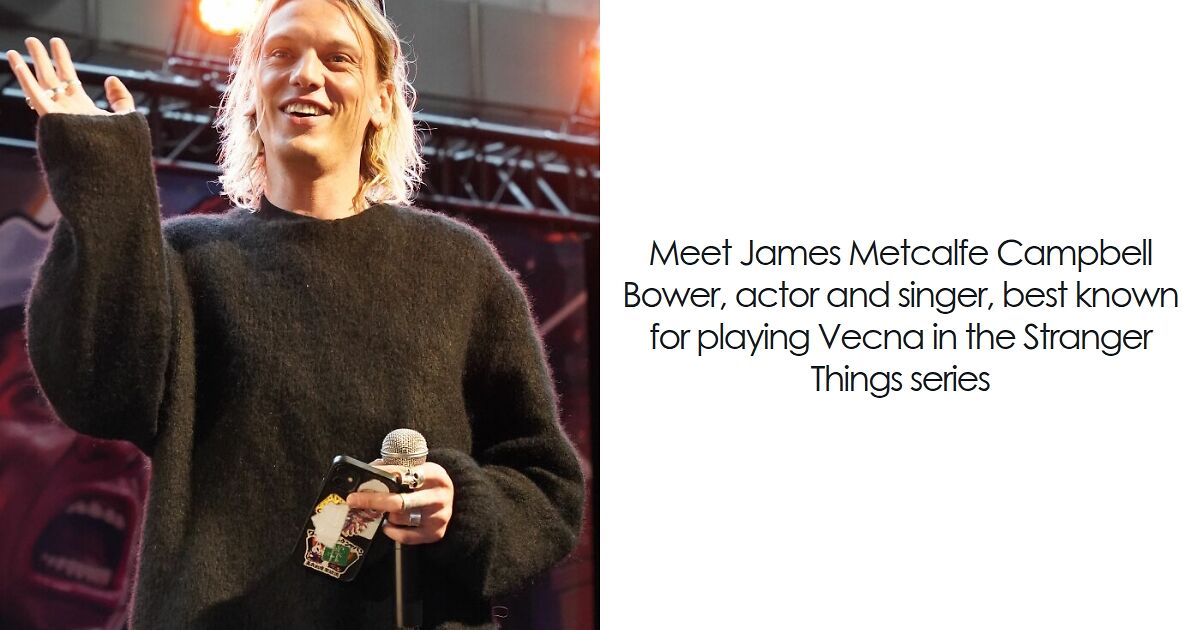
Jamie Campbell Bower is the kind of performer who seems to have been designed in a dramatic laboratory: part gothic rock singer, part fantasy-film regular, part horror villain, and part charming English actor who can somehow make ancient wizards, vampire aristocrats, demon barbers, and Upside Down monsters feel oddly elegant. Born James Metcalfe Campbell Bower in London, England, on November 22, 1988, he has built a career that crosses film, television, music, modeling, and stage-adjacent performance with unusual ease.
For many viewers, Bower became impossible to ignore after his chilling turn as Henry Creel, One, and Vecna in Netflix’s Stranger Things. But long before he was haunting Hawkins, he had already appeared in several major franchises, including Harry Potter, The Twilight Saga, The Mortal Instruments, and Fantastic Beasts. In other words, if pop culture had a fantasy passport, Jamie Campbell Bower’s would be covered in stamps.
This biography explores Jamie Campbell Bower’s early life, acting career, music projects, breakthrough roles, and the creative qualities that have helped him remain relevant across nearly two decades in entertainment.
Early Life And Artistic Roots
Jamie Campbell Bower grew up in an environment where performance and music were not distant dreams but part of everyday life. His mother, Anne Elizabeth Roseberry, worked in music management, while his father, David Bower, was connected to the guitar industry. That background helps explain why Bower’s career has never fit neatly into one category. He was not simply “an actor who sings” or “a musician who acts.” From the beginning, he seemed drawn to storytelling in all its louder, darker, stranger forms.
As a child, Bower studied violin and later attended Bedales School, an independent school known for encouraging creativity. He also became involved with youth theater, including the National Youth Music Theatre and the National Youth Theatre. These early experiences gave him a useful foundation: classical training, musical sensitivity, and the confidence to perform in front of an audience before Hollywood came calling.
That combination would become his signature. Whether he is playing a romantic lead, a corrupted villain, or a punk frontman, Bower brings a theatrical edge to his work. He rarely feels like he is casually walking through a role. He arrives with atmosphere, and occasionally, with enough cheekbone intensity to power a Victorian ghost story.
The Big Break: Sweeney Todd
Jamie Campbell Bower made a major entrance with Tim Burton’s 2007 musical horror film Sweeney Todd: The Demon Barber of Fleet Street. In the movie, he played Anthony Hope, the young sailor who becomes romantically involved with Johanna, the daughter of the vengeful barber Sweeney Todd. Sharing the screen with Johnny Depp, Helena Bonham Carter, Alan Rickman, and other heavyweight performers was not exactly a gentle first step into major cinema. It was more like being dropped into the deep end of a gothic swimming pool and told, “Please sing beautifully while everyone around you looks haunted.”
Bower handled the challenge well. His role required sincerity, vocal ability, and a romantic quality that contrasted with the film’s blood-soaked revenge plot. Sweeney Todd introduced him as a performer with both musical and dramatic range, which became important as his career expanded into fantasy, period drama, and horror.
Entering The Fantasy Franchise Universe
After Sweeney Todd, Bower quickly became familiar to fans of fantasy and supernatural storytelling. He appeared as Caius, one of the Volturi leaders, in The Twilight Saga. The role placed him inside one of the biggest young adult franchises of its era. Caius was cold, aristocratic, and dangerous, which suited Bower’s ability to project elegance with a sharp edge.
He also entered the wizarding world as the young Gellert Grindelwald in Harry Potter and the Deathly Hallows: Part 1. Although the role was brief, it became memorable because Grindelwald is one of the most important dark figures in the larger Harry Potter mythology. Bower later returned to the character in Fantastic Beasts: The Crimes of Grindelwald, creating a rare connection between the original Harry Potter films and the expanded prequel universe.
These appearances helped establish him as an actor who could move comfortably through worlds filled with ancient prophecies, supernatural politics, and characters who absolutely own at least one dramatic cloak.
Camelot, The Mortal Instruments, And Leading-Man Momentum
In 2011, Bower took on one of mythology’s most famous roles: King Arthur in the Starz series Camelot. Playing Arthur meant stepping into a character with centuries of cultural baggage. Every actor who plays him must answer the same impossible question: how do you make a legendary king feel young, flawed, and human?
Bower’s Arthur leaned into youth and uncertainty. Instead of presenting the character as a fully formed ruler, the series explored a young man growing into power. That choice gave Bower room to show vulnerability as well as ambition. Although Camelot lasted only one season, it remains an important step in his career because it gave him a central television role and proved he could lead a large-scale fantasy drama.
In 2013, he starred as Jace Wayland in The Mortal Instruments: City of Bones, opposite Lily Collins. Based on Cassandra Clare’s popular book series, the film brought Bower into another fantasy universe with a built-in fan base. Jace is a Shadowhunter: sarcastic, wounded, stylish, and extremely likely to say something dramatic while holding a weapon. Bower’s performance captured that mix of arrogance and vulnerability, even though the film did not launch the long-running movie franchise fans had hoped for.
For many viewers, The Mortal Instruments remains one of his defining roles. It highlighted his ability to play characters who are beautiful, brooding, and emotionally complicated without turning them into cardboard fantasy posters.
Television Work And Shakespearean Shadows
Bower continued to experiment with television roles, including his performance as Christopher Marlowe in the TNT series Will. The show imagined the world of young William Shakespeare with a punk-rock pulse, making it a natural fit for Bower’s theatrical and musical instincts. As Marlowe, he played a brilliant, provocative writer with dangerous charisma. It was the sort of role that allowed him to be clever, seductive, and slightly alarming all at once.
That performance also reinforced a recurring theme in his career: Bower is often at his best when playing characters who live near the edge of transformation. His characters are rarely simple heroes or villains. They are outsiders, artists, rulers, immortals, or monsters in progress. In short, he has built a résumé around people who look like they have secrets, and in most cases, they absolutely do.
The Stranger Things Breakthrough: Henry Creel, One, And Vecna
Although Jamie Campbell Bower already had an impressive filmography, Stranger Things introduced him to an even wider global audience. In Season 4, he played one of the show’s most complex antagonists: Henry Creel, also known as One and eventually Vecna. The role was not simply a monster performance. It required Bower to play several layers of identity: the calm and helpful orderly, the abused and powerful child grown into a dangerous adult, the first psychic test subject, and the nightmare creature ruling from the Upside Down.
The brilliance of the performance came from how controlled it was. Bower did not play Vecna as a screaming villain from the start. He began with softness, patience, and eerie calm. That made the reveal more disturbing. By the time viewers understood who he really was, the character had already gained their attention through quiet manipulation.
Physically, the role was demanding. The Vecna transformation involved extensive prosthetics, makeup, and performance discipline. Bower’s voice work also became a major part of the character’s impact. His deep, deliberate delivery helped make Vecna feel ancient, wounded, and terrifying. It was the kind of villain voice that sounds like it has been aging in a cursed wine cellar.
By the time Stranger Things reached its final chapter, Bower’s Vecna had become one of the show’s most recognizable images. His performance reminded audiences that great horror villains are not only designed by makeup teams and visual effects artists. They are built through posture, silence, breath, voice, and emotional control.
Music Career: Counterfeit, Solo Work, And BloodMagic
Music has always been central to Jamie Campbell Bower’s identity. He was the lead vocalist and guitarist of the punk rock band Counterfeit, which formed in London and gained a loyal following for its raw, high-energy sound. The band released Together We Are Stronger in 2017, an album that leaned into punk urgency, emotional intensity, and loud guitars. For fans who only knew Bower from fantasy films, Counterfeit was a useful reminder that he was not merely playing intense characters. He was also writing and performing intense music.
Counterfeit split in 2020, after which Bower continued releasing music as a solo artist under the name Jamie Bower. Songs such as “Run On,” “Paralysed,” and “I Am” showed a darker, moodier direction, often blending gothic blues, rock, folk, and cinematic atmosphere. His solo work feels connected to his acting persona without simply copying it. It is dramatic, yes, but not fake-dramatic. It has the quality of someone turning private weather into sound.
In 2024, Bower returned to heavier music with BloodMagic, a project that pushed into hard rock and post-hardcore territory. The debut single “Death / Rebirth” fit neatly into the darker creative world he has cultivated across acting and music. That title alone sounds like it could be a Vecna diary entry, but it also reflects a broader theme in Bower’s career: reinvention.
Why Jamie Campbell Bower Stands Out
He Understands Atmosphere
Some actors simply deliver lines. Jamie Campbell Bower creates atmosphere. Whether he is in a fantasy court, a supernatural council, a Victorian musical, or a monster suit, he brings a strong sense of tone. That is why he fits so well in heightened genres. He understands that fantasy and horror only work when the actor takes the emotional reality seriously.
He Balances Beauty With Menace
Bower’s screen presence often plays with contrast. He can appear refined and dangerous at the same time, which has made him especially effective in roles like Caius, Grindelwald, Jace, Marlowe, and Vecna. His characters often look elegant enough to attend a gala and suspicious enough to be hiding a cursed artifact in the coatroom.
He Is A True Multi-Hyphenate
Many performers use “multi-hyphenate” as a fashionable label, but Bower has genuinely worked across acting, music, modeling, and live performance. His artistic identity is not limited to one medium. That flexibility has helped him build a fan base that follows him from screen projects to music releases and public appearances.
Career Highlights At A Glance
- 2007: Made a major film debut as Anthony Hope in Sweeney Todd: The Demon Barber of Fleet Street.
- 2009–2012: Played Caius in The Twilight Saga.
- 2010: Appeared as young Gellert Grindelwald in Harry Potter and the Deathly Hallows: Part 1.
- 2011: Starred as King Arthur in the Starz fantasy series Camelot.
- 2013: Played Jace Wayland in The Mortal Instruments: City of Bones.
- 2017: Released Together We Are Stronger with Counterfeit.
- 2017: Played Christopher Marlowe in TNT’s Will.
- 2018: Returned as young Grindelwald in Fantastic Beasts: The Crimes of Grindelwald.
- 2022: Gained major acclaim as Henry Creel, One, and Vecna in Stranger Things.
- 2024: Appeared in Kevin Costner’s Western epic Horizon: An American Saga and launched BloodMagic.
- 2025–2026: Continued to be closely associated with the final era of Stranger Things and the legacy of Vecna.
Personal Growth And Public Openness
Another reason fans connect with Jamie Campbell Bower is his openness about personal growth and recovery. He has spoken publicly about sobriety, mental health, and the importance of change. While he does not turn his private life into a constant publicity engine, his willingness to be honest has made him relatable to fans who see him not just as a polished performer, but as a person who has had to work through difficult chapters.
That openness adds depth to his public image. It also connects to the emotional seriousness of his work. Bower often plays characters who are haunted, divided, or searching for identity. The difference, of course, is that his real-life story points toward self-awareness and healing rather than villain monologues in alternate dimensions.
Experiences And Lessons From Jamie Campbell Bower’s Career
Looking at Jamie Campbell Bower’s career, one of the most useful experiences for readers, performers, and creative people is the reminder that careers rarely move in a perfect straight line. Bower did not become globally recognized because of one overnight miracle. His success came from years of varied work: a musical film here, a vampire franchise there, a fantasy television series, a YA adaptation, a punk band, solo songs, and then a horror role that suddenly made the internet collectively whisper, “Wait, that’s him?”
For young actors, his journey offers a practical lesson in patience. A role that seems small at the time can become meaningful later. His appearance as young Grindelwald, for example, was brief but memorable because it connected him to one of the most famous fantasy universes in film history. His role in The Twilight Saga was not the emotional center of the story, but it placed him inside a global pop culture phenomenon. These credits built recognition and kept him visible until the right role arrived.
For musicians, Bower’s experience shows the value of creative reinvention. Counterfeit gave him a loud, physical, communal outlet. His solo work allowed him to explore darker and more personal sounds. BloodMagic gave him another chance to reshape his musical identity. Instead of treating one project’s ending as a final defeat, he turned it into a transition. That is a valuable mindset for any artist: sometimes the next chapter is not a polished upgrade, but a necessary rebirth.
For fans, Bower’s career is also an example of how genre acting can be serious work. Fantasy, horror, and young adult stories are sometimes unfairly dismissed as lightweight entertainment. Yet playing Vecna required vocal control, physical endurance, psychological focus, and the ability to create fear without losing emotional detail. Playing Jace required charisma and vulnerability. Playing Marlowe required intelligence and danger. These are not easy assignments, even if they come with supernatural accessories.
There is also a personal lesson in Bower’s public openness about recovery and mental health. His story suggests that growth is not about pretending the past was simple. It is about acknowledging difficulty, choosing better habits, and continuing to create. In an industry that often rewards image over honesty, that kind of transparency matters.
Finally, Jamie Campbell Bower’s career highlights the power of having a recognizable artistic identity. He does not need to play the same character repeatedly, but there is a clear thread through his work: intensity, darkness, beauty, theatricality, and emotional risk. That consistency helps audiences understand what makes him distinct. Whether he is acting, singing, modeling, or performing live, he brings a sense of gothic electricity. Not every artist needs that exact flavor, of course. The world can only handle so many men who look like they might front a rock band and rule a haunted kingdom. But every creative person can learn from the way Bower has built a career around what makes him unmistakable.
Conclusion
Jamie Campbell Bower’s biography is not just the story of an actor who landed a famous Netflix villain role. It is the story of a performer who has spent years moving through fantasy, horror, music, and drama with a distinctive sense of style. From Sweeney Todd to Twilight, from Harry Potter to The Mortal Instruments, and from Counterfeit to BloodMagic, Bower has built a career around transformation.
His greatest career highlight so far may be Vecna in Stranger Things, but that role works because of everything that came before it: the musical training, the theatrical instincts, the comfort with dark characters, and the willingness to disappear into a role physically and emotionally. Jamie Campbell Bower remains one of the most interesting multi-talented performers of his generation because he does not simply chase fame. He chases atmosphere, intensity, and artistic evolution. Honestly, if his next project involves a haunted castle, a microphone, or both, no one should be surprised.
Note: This article is written for web publication in standard American English and is based on verified public information about Jamie Campbell Bower’s life, acting career, music, and major entertainment projects.