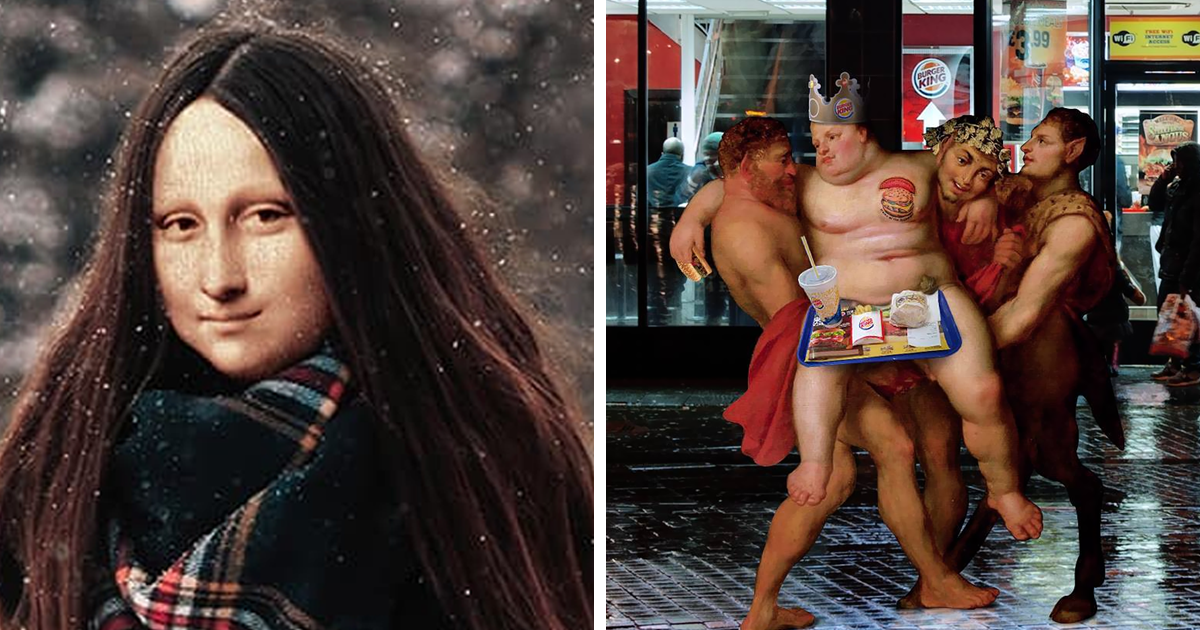
Imagine Vincent van Gogh painting the night sky above Gotham City, the Mona Lisa checking her smartphone, or the solemn couple from American Gothic standing beside a superhero instead of a pitchfork. That is the wonderfully strange territory where my artwork lives.
I create famous artwork mashups that combine recognizable masterpieces with movies, television shows, comic-book heroes, video games, music, memes, and other pieces of contemporary pop culture. The resulting images are playful, but they are not simply visual punch lines. A successful mashup can make an old painting feel newly relevant while revealing something unexpected about the modern character dropped into it.
Art museums can occasionally feel as quiet as libraries where someone has hidden all the chairs. Pop culture is the opposite: loud, fast, colorful, and constantly asking whether you have seen the latest trailer. Combining the two creates a productive collision. History gains a sense of humor, and entertainment acquires a surprisingly elegant frame.
Why Famous Artwork Mashups Feel So Satisfying
A good art mashup is powered by two forces: recognition and surprise. Viewers first recognize the original composition, even when they cannot immediately remember the artist’s name. A familiar pose, dramatic wave, swirling sky, mysterious smile, or lonely diner provides the visual setup. Then the pop-culture element delivers the twist.
The process resembles telling a joke with pictures. Recognition establishes the premise. Contrast creates tension. The unexpected combination provides the payoff. Unlike a disposable gag, however, an effective mashup invites viewers to look again and notice how the two source worlds interact.
Place a science-fiction character inside The Starry Night, for example, and Van Gogh’s turbulent sky may suddenly resemble a cosmic portal. Insert cartoon characters into Edward Hopper’s Nighthawks, and a painting associated with urban loneliness becomes a scene about exhausted fictional celebrities hiding from their own merchandising departments.
That double reading is what makes the image memorable. The historical artwork remains visible, but its emotional temperature changes.
Mashup Art Has Deep Historical Roots
Combining existing images is not an invention of social media. Artists have been borrowing, cutting, quoting, altering, and recontextualizing visual material for generations. Long before digital layers and selection tools, collage artists physically assembled fragments of paper, photographs, advertisements, and printed text into new compositions.
From Collage and Dada to Pop Art
The development of collage in the early 20th century gave artists a direct way to bring everyday printed material into fine art. Dada artists pushed this strategy into satire, using photomontage and found imagery to challenge politics, social conventions, and traditional definitions of artistic value.
Hannah Höch, for instance, recombined material from mass media to critique popular culture and restrictive representations of women. Later artists continued exploring what happened when familiar images were removed from their original surroundings and placed somewhere more provocative.
Pop art brought advertising, celebrities, comics, packaging, television, and consumer products into galleries. Andy Warhol’s soup cans demonstrated that an object from the grocery aisle could become a cultural portrait. Richard Hamilton’s collages gathered imagery from mass-circulation magazines, creating rooms crowded with modern desires, technologies, and commercial promises.
Contemporary digital mashups inherit this history. The tools have changed, but the central question remains: what new meaning appears when two familiar images meet?
Appropriation and the Age of Endless Images
Appropriation describes the intentional borrowing, copying, or alteration of preexisting imagery. It became especially important as photographs, television, magazines, advertisements, and other forms of mass media filled daily life.
Today, the average person encounters an almost comical number of images before lunch. Pictures are posted, reposted, cropped, captioned, filtered, memed, and returned to circulation wearing a tiny digital mustache. Mashup art reflects this environment while slowing it down enough for viewers to consider how visual meaning is manufactured.
How I Choose Artworks and Pop-Culture Characters
The first step is not opening editing software. It is finding a relationship between two images that deserves to exist. Randomness can be funny for a moment, but a stronger mashup contains some visual, emotional, or thematic connection.
I Begin With a Recognizable Visual Structure
Certain masterpieces are ideal foundations because their compositions are instantly readable. American Gothic has two stiffly posed figures, a farmhouse, and a pitchfork arranged with almost architectural precision. Nighthawks offers a glowing diner surrounded by darkness. Hokusai’s The Great Wave builds its drama around a curling wall of water. Michelangelo’s The Creation of Adam centers on two hands approaching one another.
These structures act like stages. They provide spaces where contemporary characters can enter without destroying the original image’s identity.
Then I Look for a Pop-Culture Intruder
The modern subject should add more than familiarity. It needs to create a conversation with the artwork.
A superhero may fit a Renaissance composition because both traditions celebrate exaggerated bodies, dramatic gestures, and mythic storytelling. A movie villain can work inside a formal royal portrait because the portrait’s visual language already communicates power. A cartoon family can replace the figures in American Gothic because both images use domestic life to say something larger about society.
The most entertaining pairings often feel inevitable after they are completed. Viewers may wonder why nobody previously noticed that a centuries-old nobleman had been waiting patiently for a pair of sunglasses.
The Style Must Be Blended, Not Merely Pasted
A recognizable character dropped carelessly onto a painting usually looks like a sticker on a museum postcard. To make the mashup convincing, I study lighting, color, perspective, texture, scale, and edge quality.
If the original artwork uses soft Renaissance shading, the new figure cannot arrive with razor-sharp digital highlights. If the painting contains visible brushwork, perfectly smooth skin will look suspiciously plastic. Shadows must fall in the correct direction, colors should respond to the surrounding palette, and the character’s pose needs to respect the original composition.
The goal is not complete realism. The goal is visual agreement. Every element should appear to belong to the same impossible universe.
Famous Masterpieces That Invite Pop-Culture Reinvention
The Mona Lisa: The Ultimate Straight-Faced Collaborator
Leonardo da Vinci’s famous portrait works beautifully in mashups because the sitter’s expression is so controlled. Almost anything placed around her becomes funnier because she refuses to react.
Give her headphones, a superhero costume, a fast-food order, or a front-row seat at an alien invasion, and she continues offering the same mysterious smile. She has the emotional discipline of someone who has survived five centuries of tourists and is not impressed by your cinematic universe.
The Starry Night: A Ready-Made Portal
Van Gogh’s The Starry Night is dominated by vivid blues, yellows, and energetic movement. The sky already feels animated, making it a natural setting for spaceships, fantasy creatures, animated castles, and science-fiction cities.
The challenge is preserving the emotional intensity of the original. Adding a popular character is easy. Making that character participate in Van Gogh’s rhythm is harder. The best additions follow the curves of the sky instead of sitting awkwardly on top of them.
American Gothic: A Perfect Two-Person Casting Call
Grant Wood’s American Gothic depicts a farmer and his daughter posed with deliberate stiffness. Their serious expressions and carefully arranged clothing have made the painting one of the most frequently parodied images in American art.
Its two-character structure allows almost any famous duo to take over: detectives, animated siblings, movie villains, rock musicians, or rival superheroes. The pitchfork can also become a wand, microphone, lightsaber, guitar, or oversized kitchen utensil, depending on how much dignity the composition is expected to retain.
The Great Wave: Drama With Excellent Timing
Hokusai’s The Great Wave is an icon of world art, with a composition that balances enormous natural power against small human figures. Its curved wave can become a frame for giant monsters, surfers, cartoon boats, or futuristic machines.
Scale is the source of humor and drama. A tiny character may appear heroically determined, while an enormous character may seem responsible for the entire oceanic emergency.
Nighthawks: Where Fictional Characters Go After Hours
Edward Hopper associated Nighthawks with the loneliness of a large city. The diner’s bright interior, dark streets, and suspended narrative make it perfect for characters who appear to be waiting, hiding, recovering, or questioning their life choices at 2 a.m.
Put cheerful animated figures inside the diner and their smiles become strangely melancholy. Add movie monsters and the scene may look almost normal. Even fictional creatures apparently need coffee and a quiet place to reconsider the third act.
Humor Is Only the First Layer
Famous artwork mashups often attract viewers through humor, but comedy is not the only possible result. Recontextualization can also create criticism, nostalgia, discomfort, or social commentary.
A luxury-brand logo placed in a royal portrait might comment on status and consumerism. A smartphone inserted into a historical banquet could highlight modern distraction. A comic-book hero replacing a mythological figure may reveal how contemporary entertainment continues to recycle older ideas about gods, monsters, sacrifice, courage, and power.
Mashups can also expose changes in representation. Replacing a traditional figure with someone historically excluded from museum narratives can transform the composition into a statement about identity, visibility, and ownership of cultural space.
The key is intention. A clever visual connection gives the audience something to discover after the initial laugh.
Copyright, Public-Domain Art, and Responsible Remixing
Many historical masterpieces are in the public domain because their copyright protection has expired. Major institutions such as the Metropolitan Museum of Art, the Smithsonian, and the National Gallery of Art provide large collections of open-access images that users can download, share, and remix.
Contemporary characters, photographs, logos, and entertainment properties may still be protected by copyright or trademark law. Their presence in a transformative artwork does not automatically make every use legal. In the United States, fair use is evaluated case by case by considering factors such as purpose, transformation, the nature of the source material, the amount used, and the potential effect on the market.
Parody and commentary may receive meaningful protection, but there is no magic percentage, editing filter, or “no infringement intended” caption that guarantees fair use. Commercial publication can introduce additional concerns. Artists planning to sell or license mashups should document their process, research the status of every source image, use open-access material whenever possible, and obtain qualified legal guidance when the risk is significant.
Ethical choices matter too. Crediting artists and source institutions helps audiences learn more. Cultural and sacred imagery should be approached with context and respect rather than treated as free decorative material.
Creativity thrives on conversation, but a good conversation still acknowledges who spoke first.
What Making These Art Mashups Has Taught Me
My earliest experiments were much simpler than the images I make now. I would choose a famous painting, place a contemporary character somewhere inside it, and assume the joke had finished the job. Sometimes it had. More often, the result looked like a celebrity had wandered into a museum, tripped over the security rope, and become trapped in the canvas.
That awkward stage taught me the most important lesson: a mashup is not successful merely because two recognizable things appear together. The relationship must feel deliberate. I began spending more time studying the original artwork before deciding what to add. I looked at the direction of a figure’s gaze, the empty spaces in the composition, the shape of the lighting, and the emotional mood created by the colors.
I also learned that the smallest details often determine whether viewers accept the illusion. A shadow that is slightly too dark can make a character float. An edge that is too crisp can make the new element look laminated. A face positioned only a few pixels too high may change an elegant portrait into a person wearing somebody else’s neck.
Matching texture became especially important. When I work with an oil painting, I try to preserve irregularities instead of polishing everything into digital perfection. Historical paintings contain cracks, softened transitions, brush marks, faded pigments, and evidence of age. Those imperfections give the image authority. Removing them would be like restoring an ancient building by covering it in kitchen countertop material.
Audience reactions have also changed the way I think. Viewers frequently notice connections I did not consciously plan. Someone may interpret a funny substitution as a comment on technology, loneliness, fame, or consumer culture. That does not mean every interpretation was secretly encoded in the image. It means visual combinations can create meanings beyond the artist’s original intention.
Another lesson is that familiarity helps, but overfamiliarity can become a trap. The Mona Lisa is instantly recognizable, yet thousands of variations already exist. Creating another version requires a stronger idea than simply handing her a modern object. I now ask what the object changes about her expression, status, setting, or relationship with the viewer.
Research has become one of my favorite parts of the process. Looking for high-quality source images often leads me into museum collections where I discover lesser-known paintings, prints, photographs, and decorative objects. A project that begins with a blockbuster masterpiece may end with an obscure 18th-century portrait that offers a much more original composition.
Working with historical art has also made me more attentive to contemporary visual culture. Movie posters, album covers, game designs, memes, and advertisements borrow constantly from older artistic traditions. Heroic poses echo classical sculpture. Science-fiction cities borrow the scale of Romantic landscapes. Celebrity photographs repeat the authority of royal portraiture.
The conversation between fine art and popular entertainment is already happening. My mashups simply turn up the volume and occasionally give the Mona Lisa a pair of headphones.
Conclusion: History Is Still Available for Collaboration
Famous artwork mashups are more than digital novelties. They belong to a long tradition of collage, appropriation, parody, quotation, and cultural commentary. By placing contemporary pop-culture characters inside historical compositions, artists can reveal connections between old myths and modern superheroes, royal portraits and celebrity branding, dramatic landscapes and cinematic spectacle.
The strongest mashups respect the visual logic of the original while introducing a clear new idea. They use recognition to welcome the audience, humor to hold attention, and transformation to create meaning.
Museums preserve masterpieces so that people can continue learning from them. Open-access collections now allow many of those images to participate in new creative experiments. The past is not a locked gallery. It is an enormous visual conversationand pop culture has arrived wearing sneakers, carrying snacks, and asking where it should stand.