Note: This guide explains how to document Native American ancestry and understand tribal enrollment research. It is not legal advice, and it does not override the rules of any tribal nation.
Family stories are powerful. They get passed around at reunions, tucked into old photo albums, and delivered with the kind of confidence usually reserved for weather forecasts and grandma’s potato salad recipe. But when it comes to proving Native American heritage, family legend is only the opening scene. The real star of the show is documentation.
If you are trying to confirm Native American ancestry, apply for tribal enrollment, request a Certificate of Degree of Indian Blood, or simply sort fact from folklore, the process is more detective work than magic trick. You need names, dates, places, records, and enough patience to survive handwriting from the nineteenth century. The good news is that there is a path forward.
This guide walks you through how to prove Native American heritage in nine practical steps, with clear explanations, real-world examples, and a healthy respect for the fact that tribal citizenship is determined by tribal nations, not wishful thinking, DNA ads, or that one cousin who says, “I’m pretty sure we’re Cherokee.”
Before You Start: Heritage Is Not Always the Same as Tribal Citizenship
This is the first big point, and it matters. You may be able to document Native American ancestry in your family tree without meeting the membership requirements of a federally recognized tribe. On the other hand, some people qualify for tribal citizenship because they can prove lineal descent from an ancestor on a specific base roll, even if their family never talked much about that history.
In other words, there are two related but different goals: proving ancestry and qualifying for tribal enrollment. One is genealogical. The other is political, legal, and cultural, because tribes are sovereign nations that set their own membership rules. Keep that distinction in mind from the beginning and you will save yourself a tremendous amount of confusion later.
Step 1: Start With Yourself and Work Backward
The biggest rookie mistake is leaping straight into old tribal rolls before you can even prove how you connect to your own great-grandparents. Start with the people you know for certain: yourself, your parents, your grandparents, and then earlier generations. Build the tree backward one documented step at a time.
What to gather first
Collect birth certificates, death certificates, marriage records, divorce records, obituaries, military papers, funeral cards, family Bible entries, diaries, letters, old photographs, and handwritten notes tucked into boxes that have not been opened since somebody bought a VCR. Interview older relatives while you still can. Ask for full names, maiden names, nicknames, places lived, churches attended, and stories about migration.
Your goal here is simple: create a clean chain of identity from you to the ancestor you believe had Native American heritage. If one link is weak, the whole chain wobbles.
Step 2: Build a Documented Family Tree, Not a Guessy One
Once you have basic family records, organize them into a research-friendly family tree. You are not just collecting names for decoration. You are building proof of relationships. That means every parent-child connection should ideally be supported by records.
Make a timeline for each ancestor. Include birth date, death date, marriage, residences, census appearances, and known affiliations. Pay special attention to women’s maiden names, alternate spellings, and people who used English names in some records and Indigenous names in others. That sort of record mismatch is common and can make one person look like three different people.
Be ruthless about labeling what is proven, what is likely, and what is just family lore. A solid genealogy file is not a scrapbook of hopes. It is a paper trail with receipts.
Step 3: Gather Vital Records for Every Generation
If Step 2 is building the skeleton, this step adds the bones that matter most. Vital records are often the backbone of proving Native American ancestry because they help establish direct descent. For many enrollment processes, tribes want to see certified or official records connecting each generation.
Key records to prioritize
- Birth certificates
- Death certificates
- Marriage licenses and certificates
- Divorce decrees when relevant
- Delayed birth records
- Probate files, wills, and guardianship records
Do not panic if some records are missing. Older state vital records can be spotty, especially before the early twentieth century. In that case, substitute other evidence such as church baptism records, cemetery records, newspaper notices, land transactions, probate files, school records, and military records. The point is to prove the relationships clearly, even if you need multiple documents to do it.
Step 4: Identify the Specific Tribe or Tribal Community
“Native American” is too broad for enrollment research. You usually need to identify the specific tribe, band, nation, or community with which your ancestor was affiliated. Without that, you are trying to solve a puzzle with half the picture missing.
Look for clues in family records, census entries, obituaries, military registrations, local histories, and oral traditions. A story that your family was “Indian” is not enough. A story that a great-great-grandmother lived near the Qualla Boundary, was connected to the Eastern Cherokee, or had relatives in Indian Territory is much more useful.
This step matters because each tribal nation has its own history and record trail. Cherokee research may involve Dawes or Baker-related records. Navajo research follows a very different path. California tribal research can involve entirely different rolls and judgment records. You are not proving identity in the abstract. You are tracing a connection to a specific people.
Step 5: Search Tribal Rolls and Federal Records the Smart Way
Now you are ready for the record sets that get mentioned all the time in Native American genealogy circles. Yes, the Dawes Rolls are famous. No, they are not the universal answer to every question. Use the right record set for the right tribe and time period.
Common records that may help
- Indian Census Rolls
- Dawes Rolls for the Five Civilized Tribes
- Dawes enrollment cards and application packets
- Guion Miller applications for Eastern Cherokee claims
- Baker Roll for the Eastern Band of Cherokee Indians
- Agency records from the Bureau of Indian Affairs
- Tribal enrollment records where available
These records can reveal names, variant spellings, family members, ages, residences, and sometimes birth, death, marriage, and testimony details. That is the good news. The annoying news is that records can be incomplete, misspelled, misindexed, or missing altogether. Some rolls only cover certain tribes, certain years, or certain categories of people. Some applications were rejected. Some ancestors never enrolled even if they had Native heritage.
So search broadly, search creatively, and search more than once. If “Robert Bluebird” does not appear, try “Robt. Blue Bird,” “Bluebird,” “Bird,” or the family group rather than the individual. Old records loved creative spelling almost as much as modern autocorrect does.
Step 6: Expand Beyond Indian Records
This step surprises people, but it should not. Some of the best evidence for Native American ancestry comes from non-Indian records. County courthouses, churches, schools, libraries, newspapers, and local historical societies often fill gaps that federal rolls cannot.
For example, you might use a county marriage record to connect one generation to the next, a church baptism record to confirm a child’s parents, and a newspaper obituary to place a family in the same community as a tribal affiliation mentioned elsewhere. Land records, probate cases, school records, and military files can all help.
Think of your research like stitching a quilt. A tribal roll might be the center square, but the edges often come from completely different kinds of records. When you combine them carefully, the pattern becomes clear.
Step 7: Treat DNA Tests as Side Notes, Not Golden Tickets
This is where many people hit the brakes. Commercial DNA testing can sometimes suggest Indigenous ancestry, but it usually does not prove connection to a specific federally recognized tribe. That is a huge difference.
If you are trying to prove Native American heritage for tribal enrollment, DNA is usually not the main event. At best, it may support a biological relationship in limited cases if a tribe accepts it. It does not replace documented lineal descent, and it definitely does not issue citizenship cards from the internet gods.
Why DNA can mislead people
Ethnicity estimates shift over time. Regions can be broad. Tribal affiliation is not the same as a genetic category. A tribe may require descent from a base roll, a minimum blood quantum, a lineal tie, or other documentation that DNA simply does not provide. So if your test says “Indigenous Americas,” that may be interesting, but it is not the same thing as proving eligibility with a tribal nation.
Step 8: Contact the Tribal Enrollment Office With an Organized Packet
Once you have identified the likely tribe and assembled your documents, contact the tribal enrollment or registration office directly. This is the moment when organization stops being a nice personality trait and becomes your best friend.
Do not send a chaotic pile of unlabeled photocopies that looks like it survived a windstorm. Instead, prepare a clean packet that includes:
- A short cover letter explaining your goal
- A pedigree chart or family tree
- Copies of records for each generation
- Any known roll numbers, census cards, or enrollment references
- Your contact information
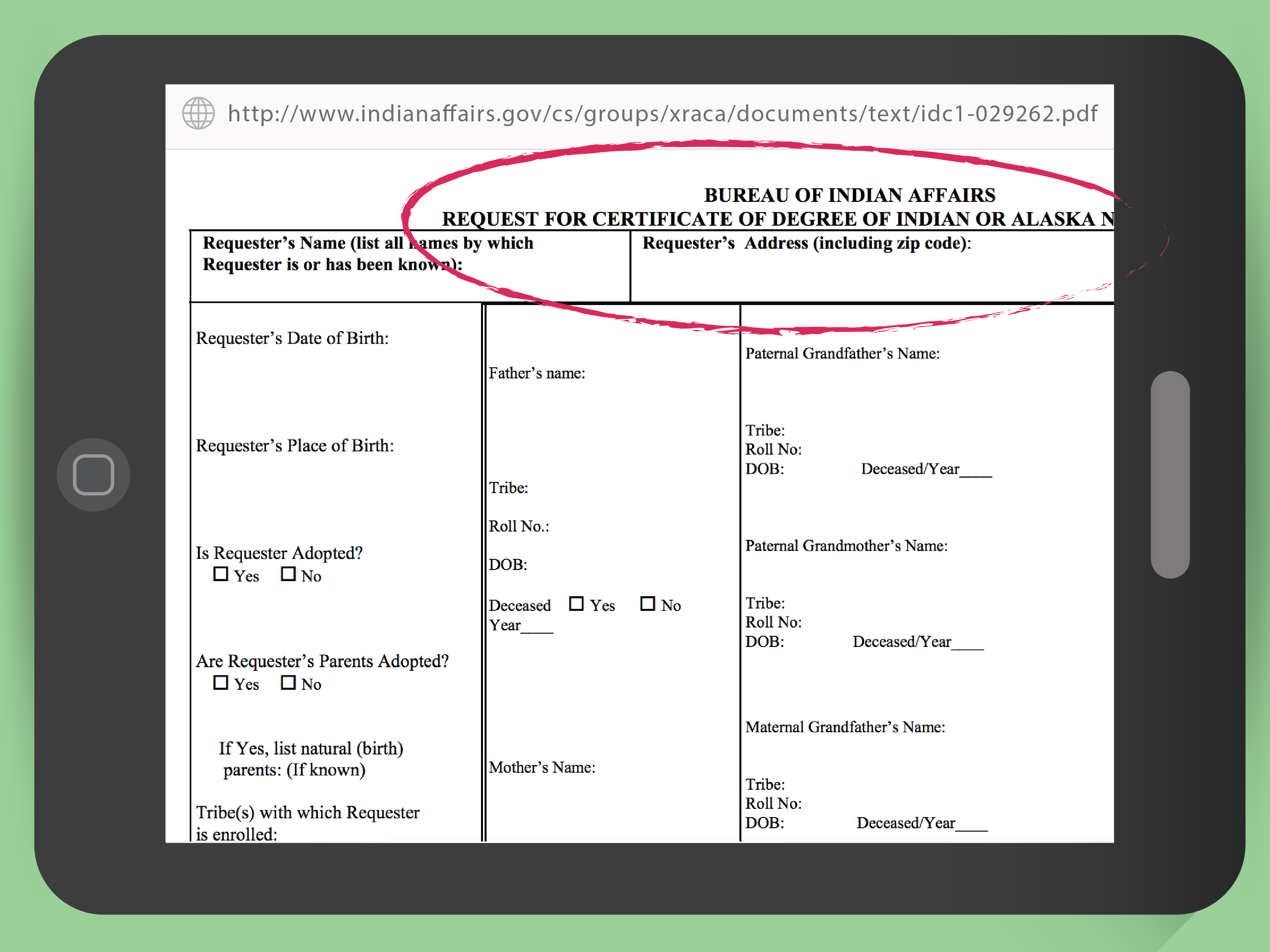
Then ask smart questions. Ask what the tribe considers acceptable proof. Ask whether they require certified copies. Ask whether they use a specific base roll. Ask whether they issue a CDIB or their own citizenship documents. Ask what the timeline looks like.
And remember: the answer may vary widely by tribe. For example, Cherokee Nation citizenship is based on documented lineal descent to an ancestor on the Dawes Rolls and is not based on a minimum blood quantum. The Eastern Band of Cherokee Indians uses the Baker Roll and a blood quantum requirement. Navajo enrollment has its own separate requirements involving enrolled parentage and blood quantum. That variation is the rule, not the exception.
Step 9: Prepare for Any Outcome and Keep Excellent Notes
Sometimes the records confirm the family story. Sometimes they complicate it. Sometimes they knock it sideways and reveal a completely different branch than expected. Genealogy has a way of humbling everybody.
Keep a research log with every search you performed, every archive you checked, every spelling variation you tried, and every result you found or did not find. That prevents duplicate work and helps you spot patterns. It also makes it easier to respond if a tribal office asks for more information later.
Be emotionally ready for several possible outcomes:
- You prove Native American ancestry and qualify for tribal enrollment.
- You prove Native American ancestry but do not meet that tribe’s enrollment rules.
- You find evidence of Native ancestry, but not enough to document it conclusively.
- You discover the family story was mistaken.
None of those outcomes makes the research worthless. The goal is truth, not a prewritten ending. Sometimes the most respectful result is learning exactly where your family story came from and where it does not hold up.
Common Mistakes to Avoid
- Starting with the wrong tribe: a vague claim wastes time fast.
- Assuming the Dawes Rolls cover everyone: they do not.
- Trusting DNA more than documents: exciting, yes; sufficient, usually no.
- Ignoring name changes and spelling variations: old records were not built for tidy databases.
- Confusing ancestry with citizenship: related, but not identical.
- Sending incomplete applications: tribal offices appreciate clarity more than mystery.
Final Thoughts
Proving Native American heritage is rarely a one-afternoon project. It is usually a layered process of family history, public records, tribal-specific research, and respectful communication with the tribe involved. The best approach is careful, patient, and realistic.
Start with yourself. Document every generation. Identify the specific tribe. Use the right rolls and records. Treat DNA as supporting background, not definitive proof. Most importantly, respect tribal sovereignty. Tribal nations decide their own citizenship and enrollment standards, and no shortcut can replace that reality.
If this work feels slow, that is normal. Genealogy often moves at the speed of courthouse mail, faded ink, and one very stubborn name mismatch. Still, when the evidence starts lining up and a family story becomes a documented history, it can be deeply meaningful. Paperwork may not be glamorous, but sometimes it is the closest thing family history has to a treasure map.
Experiences People Often Have While Trying to Prove Native American Heritage
One common experience is that the search begins with a confident family story and quickly becomes a lesson in humility. A person may grow up hearing that a great-grandmother was Cherokee, only to discover that nobody knows her maiden name, where she was born, or which Cherokee community the family meant. At first, that feels frustrating. Then the research starts to sharpen the story. A birth certificate leads to a marriage record. The marriage record leads to a census entry. The census entry leads to a county line the family crossed in the 1890s. Suddenly the legend is no longer just a story told over dinner. It is a trail, and even when it is messy, it is real.
Another frequent experience is running into records that almost match, but not quite. The surname is right, but the first name is spelled differently. The age is off by three years. A father appears in one record under an English name and in another under a different version entirely. This is the part of the journey that makes people stare at old handwriting like it personally offended them. But it is also where good research habits matter most. People who stay patient, compare family groups, track locations, and collect multiple records often find that the contradictions are not dead ends. They are just the normal chaos of historical paperwork.
Many researchers also describe a turning point when they stop searching for a magical single document and start thinking in layers of evidence. Instead of waiting for one perfect paper to fall from the sky, they begin linking a death certificate, a church register, a land record, and a tribal roll reference. That is often when the case starts coming together. It feels less dramatic than uncovering a hidden chest in the attic, but it is far more useful. The truth is that Native American ancestry research is often solved by accumulation, not fireworks.
There is also the emotional side. Some people feel pride when records confirm a long-held family belief. Others feel grief when the story turns out to be incomplete, exaggerated, or wrong. A surprising number of researchers end up somewhere in the middle: they find Indigenous ancestry in the family, but not in the branch they expected, or not in a way that qualifies them for tribal citizenship. That can be difficult, especially if someone began the search hoping for a neat answer. Still, many people say the process gave them something valuable even when it did not produce the outcome they imagined. It replaced guesswork with history.
Finally, people often report that the most meaningful part of the journey is not the application itself but the deeper understanding that comes from doing the work carefully. They learn where ancestors lived, how families moved, how names changed, and how communities survived. They begin to see that proving Native American heritage is not just about checking a box. It is about documenting lineage responsibly and respecting the authority of tribal nations to define their own citizens. That shift in perspective is often the real milestone. The paperwork matters, absolutely. But the deeper experience is learning to approach ancestry with patience, evidence, and respect.