Daily Sequence Octordle is what happens when Wordle walks into a gym, drinks three espressos, and decides that one five-letter mystery word is simply not enough drama for a single day. Instead of solving one word, you are trying to solve eight. Instead of seeing all eight boards at once like regular Octordle, Sequence mode makes you unlock them one by one. It is part puzzle, part memory test, part “why did I guess CRISP when I already ruled out S?”
The good news: Daily Sequence Octordle is very learnable. Once you understand the rules, the color clues, and the best way to manage your 15 guesses, the game becomes less like juggling flaming dictionaries and more like solving a smart, satisfying daily challenge. This guide explains how to play Daily Sequence Octordle, how Sequence mode differs from classic Octordle, and which strategies give you the best chance of finishing all eight words without your keyboard judging you.
What Is Daily Sequence Octordle?
Daily Sequence Octordle is a daily five-letter word puzzle mode within Octordle. In the classic version of Octordle, players solve eight five-letter words at the same time. Every guess applies to every board, and you use the color feedback from all eight puzzles to work toward eight answers.
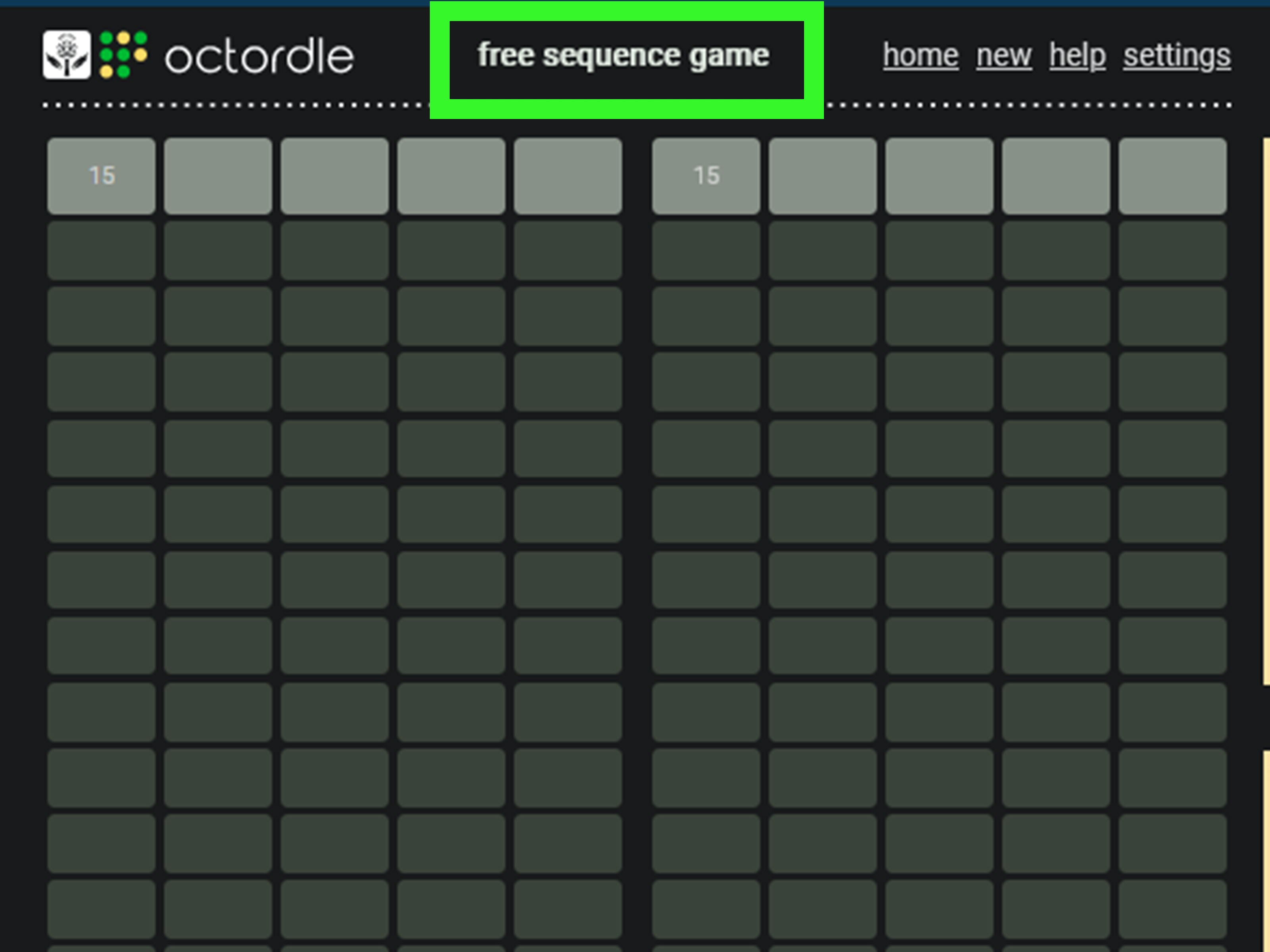
Sequence mode changes the rhythm completely. Instead of showing every unsolved board at once, it reveals only one active unsolved word at a time. After you solve the first word, the second board unlocks. Solve the second, and the third appears. This continues until you either solve all eight words or run out of guesses.
That one-at-a-time structure makes the game feel more focused, but do not be fooled by the calmer screen. Sequence Octordle is often more difficult because you cannot use visible clues from all eight puzzles at once. You are solving a chain of words, and each guess must serve two purposes: help with the current board and preserve enough guesses for the boards you have not even met yet.
Daily Sequence Octordle Rules
1. You must solve eight five-letter words
The goal is simple to say and surprisingly spicy to complete: guess all eight hidden five-letter words. Each answer is a valid five-letter word. Your guesses must also be valid words accepted by the game.
2. You get 15 total guesses
Daily Sequence Octordle gives you 15 guesses for all eight words combined. That means you do not get 15 guesses per word. You get 15 guesses for the entire puzzle. Every exploratory word, every “maybe this is it” guess, and every desperate keyboard prayer counts.
Because there are eight answers and only 15 guesses, efficiency matters. If you use five guesses on the first word, you have only 10 guesses left for seven more answers. That is still possible, but now the puzzle is wearing sunglasses and leaning back in its chair.
3. Only one unsolved board is visible at a time
This is the defining rule of Sequence mode. You can focus on the current active word, but you cannot freely inspect all future boards. Once you solve the active word, the next board unlocks. The game becomes a sequence of mini Wordle-style battles instead of one huge multi-board battlefield.
4. Color clues work like Wordle
After each guess, tiles change color to show how close your guess is:
- Green: The letter is correct and in the correct position.
- Yellow: The letter is in the word but in a different position.
- Gray: The letter is not in the answer for that board, unless duplicate-letter logic is involved.
Duplicate letters can be tricky. If you guess a word with two of the same letter, the game will only mark as many copies as actually appear in the answer. For example, if the answer contains one E and your guess has two Es, one may be colored while the other appears gray. Do not panic. The puzzle is not broken; it is just being very precise, like a tiny spelling accountant.
5. The daily puzzle refreshes every day
The “Daily” part means everyone gets the same daily challenge for that mode, making it fun to compare results with friends, family, coworkers, or that one person online who somehow solves everything in suspiciously few guesses.
How to Play Daily Sequence Octordle Step by Step
Step 1: Start with a balanced opening word
Your first guess should reveal useful information. Strong opening words usually include common consonants and at least one or two vowels. Words such as SLATE, CRANE, TRACE, STARE, RAISE, and CARTE are popular because they test frequent letters without wasting space on repeats.
Avoid opening with words full of rare letters unless you enjoy chaos as a lifestyle. A word like JAZZY may feel fun, but it tests repeated Z and one of the least common letters. That is not strategy; that is tossing a raccoon into a library and calling it research.
Step 2: Read the color feedback carefully
After your first guess, look at what the colors tell you. Green letters are anchors. Yellow letters are puzzle pieces that need new homes. Gray letters are usually eliminated, though you should remember the duplicate-letter caveat.
For example, suppose you guess SLATE and get green on A in the third position, yellow on T, and gray on S, L, and E. You now know the answer pattern includes A in the middle and T somewhere else. You also know S, L, and E are probably not useful for this board. Good next guesses might test letters such as R, N, C, H, O, or P while moving T to another position.
Step 3: Do not solve too slowly
In normal Wordle, using three setup guesses can be a reasonable approach. In Daily Sequence Octordle, it can be dangerous. You need to solve eight words in 15 guesses, so you cannot spend too long gathering information on a single board.
A practical target is to solve most words in one to three guesses after you have useful information. Of course, some answers will fight back. If a word has a pattern like _IGHT, you may have to choose among LIGHT, FIGHT, MIGHT, RIGHT, SIGHT, and NIGHT. These “word families” are where Sequence Octordle quietly steals your lunch money.
Step 4: Use information from earlier guesses
Even though only one unsolved word is visible at a time, your previous guesses still matter. Each word you played has tested letters. Keep a mental note of which letters have appeared often, which letters have been absent, and which common letters have not been tried yet.
If your first few guesses were SLATE, ROUND, and CHIMP, you have already tested many major letters. Later in the puzzle, you may not need another broad “information” guess. You can move faster into targeted solving.
Best Daily Sequence Octordle Strategies
Use a two-phase strategy
The best approach for many players is a two-phase strategy: gather enough information early, then become aggressive. Your first guess should be broad. Your second guess should either solve the word or test another strong group of letters. After that, you should avoid wandering around the alphabet unless the board is genuinely unclear.
Think of it like grocery shopping. First, you scan the aisles. Then you grab what you need. You do not stand in front of the cereal shelf for 17 minutes debating whether “O” has emotional depth.
Favor common letters first
Common letters in five-letter English word games include E, A, R, O, T, L, I, S, N, and C. These letters appear often enough that they deserve early attention. That does not mean every answer will be polite and include them, but starting with common letters gives you better odds than chasing Q, X, Z, and J too soon.
Good opening combinations include:
- SLATE followed by CRONY
- CRANE followed by STOUT
- STARE followed by DOING
- RAISE followed by CLOTH
These are not magic spells. They are simply efficient ways to test common letters and useful vowel/consonant patterns.
Do not overvalue vowels
Many players love vowel-heavy starters like ADIEU or AUDIO. They are not useless, but they can be overrated in Sequence Octordle. Vowels tell you the sound shape of a word, but consonants often reveal structure. Finding S, T, R, L, N, or C early can help you identify common beginnings and endings faster.
A balanced word with two vowels and three strong consonants often gives better practical feedback than a word that tests four vowels and leaves you staring at a pile of consonant blanks.
Watch for common endings
Five-letter words often use familiar endings such as -ER, -ED, -LY, -ING is too long for five letters but can influence forms like THING, and clusters like -ST, -CH, -SH, -CK, and -TH. When you spot a green or yellow letter near the end, test likely endings quickly.
For instance, if you know the word ends in K and has an A somewhere, possible patterns might include _A__K, __ACK, or _A_K_. Suddenly, words like TRACK, BLACK, SHARK, or ANKLE may enter the conversation. Some will be eliminated by previous gray letters, which is why careful tracking is so powerful.
Respect repeated letters
Repeated letters are one of the classic ways Octordle ruins an otherwise elegant morning. Words like LEVEL, ROTOR, COCOA, ERROR, or BELLE can hide in plain sight because players avoid guessing duplicate letters. In Sequence mode, this hesitation can cost precious turns.
If the pattern strongly suggests a repeated letter, trust the pattern. A board showing _E_E_ may absolutely need another E. Do not keep forcing new letters into a word that is clearly asking for a twin.
Avoid “almost the same word” traps
One of the most dangerous moments in Daily Sequence Octordle is the near-solve trap. Imagine you have _OUND. The answer could be FOUND, ROUND, SOUND, HOUND, BOUND, or WOUND. Guessing one at a time can burn your remaining attempts.
When you face a family of possible words, use a strategic tester if you can afford it. For example, if the missing first letters might be F, R, S, H, B, or W, a guess that includes several of those letters can narrow the field. The key phrase is “if you can afford it.” Late in the game, you may have to make the best probability guess and hope the puzzle gods are in a generous mood.
Common Mistakes Beginners Make
Using too many random starter words
Some players open every board with a totally different word just for variety. Variety is nice for sandwiches, less nice for efficiency. A consistent starter helps you learn patterns. Over time, you will understand what certain color combinations usually imply.
Ignoring gray letters
Repeating eliminated letters is one of the fastest ways to lose guesses. If S is gray, do not keep using S unless you have a very specific duplicate-letter reason. Daily Sequence Octordle rewards discipline. The game does not care that SHARE “feels right” if S, H, and E have already packed their bags and left.
Waiting too long to guess the answer
Information is useful, but solving is the goal. If you have four strong clues and only two realistic answers, it is usually time to take the shot. Sequence mode gives you 15 guesses, but those guesses disappear quickly when you are trying to unlock eight boards.
Forgetting the bigger picture
The current board matters, but the whole puzzle matters more. A risky guess may solve one word, but if it teaches you nothing and fails, it can hurt your chances later. Strong guesses either solve the board or reveal enough useful letters to justify the cost.
Example Strategy Walkthrough
Let us say your first guess is CRANE. You receive yellow on R, green on A in the third position, and gray on C, N, and E. Your active pattern may look like __A__, with R somewhere but not in the second position.
A smart second guess might be STORY. This tests S, T, O, and Y while moving R. If R turns green in the fourth position and O turns yellow, you might now have __AR_ or another clearer structure depending on the feedback. From there, possible answers may narrow to words like GUARD, AWARD, HOARD, or SHARP, depending on the exact colors.
The point is not that these exact words will happen. The point is the thinking process: use the first guess to open the map, use the second to test structure, then solve before the board drains too many turns.
Advanced Tips for Better Scores
Think in patterns, not just letters
Letters matter, but patterns win games. If you know A is second and E is fifth, ask what shapes are common: _A__E, _A_E_, __A_E. Then consider consonant blends such as ST, CR, BL, SH, CH, and TR. Pattern thinking is faster than alphabet soup.
Use elimination words carefully
An elimination word is a guess you do not expect to be the answer, but it tests several possible letters. In Sequence Octordle, elimination words can be useful, especially for word families. However, do not overuse them. Every elimination word is one fewer chance to solve an actual board.
Stay flexible with your opener
A favorite starting word is helpful, but do not turn it into a religion. If your normal opener keeps producing weak results, rotate among strong alternatives. Try SLATE, CRANE, STARE, TRACE, or RAISE. The best starter is one you understand well enough to use intelligently after the colors appear.
Slow down on guess 10 and beyond
Late guesses are expensive. Around guess 10, pause and count how many boards remain. If you still have three or four words left, you need efficient solves, not experiments. This is when careful note-taking, mental tracking, and calm pattern recognition matter most.
Extra Player Experience: What Daily Sequence Octordle Feels Like in Real Play
Playing Daily Sequence Octordle regularly teaches you that the puzzle has a personality. Some days it feels friendly, offering clean clues, common letters, and answers that step politely into view. Other days it behaves like a mischievous raccoon wearing a graduation cap. You open with a strong word, get one yellow tile, and suddenly every five-letter word you have ever known vanishes from your brain.
The biggest experience lesson is that Sequence mode rewards emotional control. In classic Octordle, you can jump between boards when one becomes annoying. In Sequence mode, you are stuck with the current word until you solve it. That can create pressure. If the first board takes four guesses, it is easy to feel behind. But panic guesses are rarely good guesses. The better move is to reset mentally and treat the next board as a fresh opportunity.
Another real-world experience is that your first two guesses shape your whole game. When your opener reveals two or three useful letters, the puzzle feels smooth. When it reveals almost nothing, your second guess becomes critical. Experienced players learn to make the second guess broad but not random. For example, after a weak SLATE, a word like CHORD or PRION may test valuable new letters. The goal is not to look clever. The goal is to stop the bleeding.
You also begin to recognize “danger boards.” These are boards with too many possible answers. Patterns like _ATCH, _OUND, _IGHT, and _OWER can become guess-eating monsters. A beginner may try MATCH, then WATCH, then CATCH, then PATCH, while the remaining guesses quietly jump out the window. A stronger player looks for a way to test multiple missing letters before committing.
Daily Sequence Octordle also improves your vocabulary instincts. You start noticing which letter combinations feel natural in English. You learn that H often pairs with C, S, T, or P. You learn that Y may act like a vowel at the end. You learn that E at the end of a word can completely change the structure. Most importantly, you learn humility, because just when you feel like a word-game genius, the answer turns out to be something with double letters and you stare into the distance like a detective in a rainstorm.
For the most enjoyable experience, play at a steady pace. Do not rush just because the daily puzzle is short. Read every clue. Say the pattern out loud if needed. If you have G_A_E, test the realistic options in your head before typing. Could it be GLADE? GRACE? GRADE? Which letters have already been eliminated? This small pause often saves a guess.
Finally, compare results for fun, not self-destruction. Someone will always post a better score. Someone will always claim they solved the entire puzzle while half-asleep and making pancakes. Good for them. Your goal is to improve your own pattern recognition, reduce wasted guesses, and enjoy the satisfying click of unlocking all eight words. Daily Sequence Octordle is challenging because it compresses eight puzzles into one tight sequence, but that is also why finishing it feels so good.
Conclusion
Daily Sequence Octordle is a clever twist on the multi-word puzzle format. It asks you to solve eight five-letter words with only 15 total guesses, while revealing one unsolved board at a time. That structure makes every guess meaningful. A strong opening word, careful color reading, smart use of common letters, and awareness of repeated-letter traps can dramatically improve your results.
The best strategy is not to memorize one perfect formula. Instead, build good habits: start with useful letters, track eliminated options, solve efficiently, and stay calm when a word family tries to eat your score. With practice, Daily Sequence Octordle becomes less intimidating and more addictivein the wholesome “I just need one more puzzle” way, not the “I have named my keyboard” way.