Friday has a special kind of magic. The inbox is slightly less terrifying, the weekend is waving from the driveway, and suddenly that half-finished corner of the house starts whispering, “You know, I could be adorable by Sunday.” This week’s Friday favorites are all about two ideas that make DIY brains light up like a rocket launch: a space bedroom and one board projects.
At first, those may sound like two separate planets orbiting different suns. A space bedroom feels dreamy, imaginative, and full of glow-in-the-dark stars. One board projects feel practical, thrifty, and proudly covered in sawdust. But together, they create a beautiful little universe: a bedroom that sparks curiosity, uses smart storage, and includes handmade details that do not require a professional workshop, a second mortgage, or a mysterious uncle named Earl who owns every tool invented since 1978.
The best part? You do not need to turn the room into a theme park. A great space-themed bedroom can be stylish, calm, educational, and easy to update as kids grow. And one board woodworking projects are perfect for adding custom shelves, display ledges, small book racks, wall hooks, or constellation-inspired decor without dragging home an entire lumber aisle.
Why a Space Bedroom Still Works
Space is one of those rare themes that grows with a child. Dinosaurs may become “too babyish,” superheroes may rotate with movie releases, and unicorns may eventually lose the glitter battle. But planets, stars, rockets, moons, galaxies, and the mystery of the universe have long-term staying power. A toddler may love a rocket pillow. A grade-schooler may study planet facts. A teen may keep the starry ceiling but swap cartoon bedding for navy linen and a modern moon print.
A space bedroom also encourages learning without feeling like homework. Add a solar system poster, a constellation chart, a moon phase wall hanging, or a small reading nook called “Mission Control,” and suddenly the room does more than look cute. It invites questions. Why does Saturn have rings? How big is Jupiter? Why does the moon look like it is slowly being eaten by an invisible cookie monster? Children ask, adults Google, and everyone learns something before bedtime.
Start with a Calm Cosmic Color Palette
The biggest mistake in a themed room is going full blast on every surface. A space bedroom does not need black walls, neon planets, rocket bedding, galaxy curtains, star rugs, astronaut lamps, and a ceiling fan shaped like a UFO. That is not a bedroom; that is a gift shop after a meteor strike.
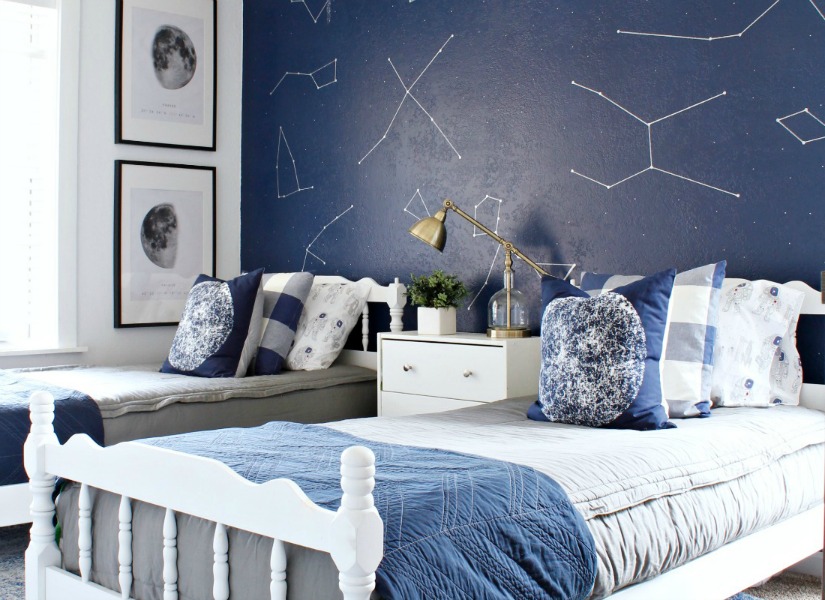
A better approach is to choose one strong base color and two supporting colors. Deep navy, slate blue, charcoal, soft gray, warm white, and muted teal all work beautifully. Navy gives the room that night-sky feeling, while white trim and wood accents keep it from feeling too dark. For a younger child, add cheerful hits of orange, yellow, or sky blue. For an older child, use brass, matte black, walnut, or creamy beige for a more grown-up orbit.
Simple palette ideas
Try navy walls with white bedding and warm wood shelves. Or keep the walls pale gray and use a dark blue ceiling with peel-and-stick stars. Another easy combo is white walls, black constellation decals, natural pine furniture, and a planet mobile over the reading corner. The key is balance: give the theme room to breathe, because even astronauts need personal space.
Create One Big “Wow” Moment
Instead of sprinkling space decor everywhere, build the room around one memorable feature. This could be a moon mural behind the bed, a constellation ceiling, a peel-and-stick galaxy wallpaper panel, or a DIY rocket-shaped growth chart. A single focal point makes the room feel intentional and avoids visual clutter.
A mural does not have to be complicated. A large painted circle behind the headboard can become a moon. Add subtle sponge texture in gray and white, and it looks atmospheric without requiring a fine arts degree. If paint feels risky, framed wallpaper panels or removable decals are friendlier options. They give a custom look and can be changed later when the room’s chief astronaut becomes a moody teenager who suddenly wants “minimalist desert academia,” whatever that means.
Use Real Learning Tools as Decor
One of the smartest space bedroom ideas is to use educational pieces that are attractive enough to display. A solar system print, moon phase poster, star map, or NASA-inspired image can become wall art. Printable activities, posters, and scale solar system projects can also inspire decor that feels connected to real science instead of random cartoon rockets floating around with no supervision.
For example, you can hang a simple planet lineup above a desk or create a bead-and-string solar system garland. Another idea is to make a “planet of the month” frame where kids can rotate facts, drawings, or printed images. This keeps the room interactive. It also gives children a reason to keep caring about the design after the first week, when the novelty usually drops faster than a toy spaceship behind the dresser.
Storage Is the Secret Rocket Fuel
A themed bedroom only works if it can survive real life. Kids come with books, stuffed animals, blocks, art supplies, mysterious plastic parts, and rocks they insist are “special.” If the room has no storage plan, the space theme will quickly become “asteroid field after impact.”
Use zones. The bed is for sleeping. The desk is for homework, drawing, or building tiny satellites from paper clips. The reading nook is for books. The floor is for play, but not for permanent toy settlement. Low shelves, labeled bins, under-bed drawers, wall hooks, and lidded baskets all help kids understand where things belong.
Kid-friendly storage ideas
Install a low book ledge for bedtime stories. Use cube bins for toys and label them with words or pictures. Mount hooks at child height for backpacks, dress-up astronaut suits, or hoodies. Add a narrow shelf above the desk for pencils, models, and small collectibles. In a small bedroom, vertical storage is your best friend. Walls are basically free real estate, and unlike the floor, they do not get covered in socks.
Why One Board Projects Are Perfect for This Room
One board projects are exactly what they sound like: small DIY builds made from a single board or plank. They are ideal for beginners because they limit cost, waste, and complexity. You can buy one pine board, cut it into a few pieces, sand the edges, add screws or wood glue, and end up with something useful. It is DIY with training wheels, but the finished result can still look surprisingly polished.
For a space bedroom, one board projects are especially helpful because they add custom function. Store-bought decor can be cute, but handmade shelves and organizers make the room work better. A one-board display ledge can hold space books. A one-board wall shelf can become a planet station. A one-board peg rail can hold headphones, hats, or a telescope bag. A one-board nightstand tray can keep water, glasses, and a flashlight from disappearing into the black hole beside the bed.
Favorite One Board Project Ideas for a Space Bedroom
1. Mission Control Book Ledge
Use a single 1×4 or 1×6 board to create a slim wall-mounted book ledge. Cut a back piece, bottom piece, and small front lip. Paint it white, navy, or natural wood, then mount it near the bed. Add a small label that says “Mission Control Library.” It is simple, useful, and makes bedtime reading feel like part of the adventure.
2. Moon Phase Display Shelf
A 1×8 board can become a narrow floating-style shelf for small models, rocks, keepsakes, or a moon lamp. Paint the back edge dark blue and add small moon phase decals along the front. This project works beautifully above a desk or dresser, especially if the rest of the room is kept simple.
3. Rocket Launch Peg Rail
Take one board, add wooden pegs or sturdy hooks, and mount it at kid height. Paint the board like a launch platform or add small star decals. Use it for backpacks, robes, hats, or headphones. It is not glamorous, but neither is stepping on a backpack zipper at 6:45 a.m.
4. Constellation Art Rail
Make a long, narrow rail from one board and attach clips along the front. Kids can hang drawings, star charts, school projects, or NASA-inspired coloring pages. This gives their creativity a rotating gallery and prevents the walls from being attacked by 900 pieces of tape.
5. Bedside “Orbit Tray”
Use a short board to make a small wall-mounted tray or shelf beside the bed. It can hold a book, a water bottle, a flashlight, or glow-star stickers waiting for installation. Round the corners well, sand thoroughly, and keep it shallow so it does not become a shin-level hazard with ambitions.
Beginner Tips Before Cutting the Board
Before you start any one board project, measure the room and decide exactly where the finished piece will go. Beginners often buy lumber first and make plans later, which is how you end up holding a giant board in the hallway asking, “What if we made a decorative plank?” Measure twice, cut once, and if possible, sketch the project on paper.
Pine boards are affordable and easy to work with. Poplar is smoother and paints nicely. Oak and maple look beautiful stained but cost more and can be harder on tools. For a child’s room, sand every edge until it feels smooth to the touch. Use wall anchors or fasten shelves into studs when mounting anything that will hold weight. If the project is near a bed or play area, avoid sharp corners and unstable designs.
Finishing matters too. Paint can tie a project into the room’s color scheme. Clear polyurethane can protect natural wood. Stain adds warmth, but test it first because different boards absorb color differently. And always let finishes cure properly before moving the project into a bedroom. A room should smell like fresh laundry, not like a hardware store trying to become a candle.
How to Make the Room Feel Designed, Not Decorated
Decorated means you bought a bunch of themed items. Designed means the room has a plan. The space bedroom should support sleeping, playing, reading, learning, and cleaning up. Start with the bed and storage, then layer in theme elements. Keep the biggest furniture pieces neutral so they can stay for years. Use bedding, wall art, shelves, lamps, and accessories to carry the theme.
Lighting is especially important. A ceiling fixture handles general light, but the room also needs task lighting for reading and soft light for winding down. A moon lamp, star projector used occasionally, or warm bedside sconce can create atmosphere. Just do not rely on flashing galaxy lights every night unless bedtime chaos is your family’s chosen sport.
Budget-Friendly Space Bedroom Upgrades
You can refresh a bedroom without replacing every piece of furniture. Paint one wall. Add removable decals. Swap drawer pulls for star-shaped knobs. Frame printable space art. Build one shelf. Use navy curtains. Add a washable rug with subtle stars. Paint an old dresser in a deep space color and replace the hardware with brass knobs that look like tiny planets.
If the room already has wood furniture, lean into it. Natural wood pairs beautifully with navy, black, white, and gray. A simple pine shelf can look intentional when repeated in two or three places. Matching finishes make DIY projects feel like part of the room rather than random weekend experiments that wandered in from the garage.
Safety and Practicality Still Matter
A child’s bedroom should be imaginative, but it also has to be safe. Secure tall furniture to the wall. Mount shelves properly. Keep cords managed. Avoid heavy decor above the bed. Use low-VOC paints and finishes when possible. Choose washable fabrics because children are basically tiny weather systems with snacks.
Also think about maintenance. A room full of tiny decorative pieces may photograph well, but it is harder to dust and easier to destroy. Bigger, fewer, better pieces usually win. One strong mural, one good shelf, one organized book zone, and one cozy reading corner can do more than twenty small accessories shouting for attention.
Conclusion: The Weekend Project That Actually Feels Worth It
Friday Favorites: Space Bedroom and One Board Projects is the kind of theme that makes a weekend feel productive without turning it into a renovation marathon. A space bedroom gives children a room that feels imaginative, personal, and connected to learning. One board projects add the useful, handmade touches that make the design work in everyday life.
Start small. Choose a color palette. Pick one focal point. Build one useful piece from one board. Add smart storage. Then let the room evolve. The goal is not perfection. The goal is a bedroom where curiosity can land safely, books have a home, toys are less likely to stage a coup, and the weekend ends with something better than a receipt and a sore back.
Personal Experience: What This Theme Feels Like in Real Life
The charm of a space bedroom is that it changes the mood of the whole house. I have seen rooms go from ordinary to unforgettable with just a navy wall, a few well-placed stars, and a small shelf built from leftover lumber. There is something instantly joyful about walking into a child’s room and seeing a moon over the bed or a row of planet books lined up like they are waiting for launch clearance.
The best experience, though, is not the finished photo. It is the process. A child helping choose where Mars should go on the wall will have very serious opinions. Mars cannot be too close to Jupiter. The moon lamp must face the pillow. The rocket print needs to be “higher, but not too high, but higher than that.” These are the kinds of design meetings no adult boardroom can compete with.
One board projects make the process even better because they are manageable. There is a satisfying rhythm to picking one board, marking the cuts, sanding the corners, and turning a plain piece of wood into something that belongs in the room. A simple book ledge may not look dramatic on the workbench, but once it is mounted beside the bed with space books on it, it feels custom. It feels like the room asked for that exact piece and you answered with a drill.
There is also a confidence boost that comes from building something small. Many people avoid DIY because they imagine complicated plans, expensive tools, and projects that somehow require both geometry and emotional resilience. A one board project lowers the stakes. If the first cut is a little crooked, you can usually fix it. If the paint color is wrong, repaint it. If the shelf is too short, congratulations, you have invented a smaller shelf.
In real homes, the most successful projects are usually the useful ones. A constellation art rail gives school papers a place to go. A peg rail keeps bags off the floor. A bedside orbit tray keeps books from sliding into the under-bed wilderness. These are not just cute additions; they solve daily problems. That is why they last longer than novelty decor.
Another lesson from space-themed rooms is that restraint works. The first instinct is to buy every star-shaped item available, but the better room often has fewer pieces. A calm wall color, warm lighting, one educational poster, and two handmade wood accents can feel more special than a room packed with themed merchandise. The child still gets the magic. The adult still gets a room that does not visually scream at 7 a.m.
Finally, the room should leave space for change. Children grow. Interests shift. One year it is rockets, the next year it is robotics, then maybe astronomy, coding, music, or art. A flexible space bedroom can handle that. The same shelf that holds planet books today can hold model airplanes later. The same peg rail can hold headphones, sports gear, or a camera bag. The same navy wall can become a backdrop for stars, posters, or framed photos.
That is the real favorite here: not just the space theme, and not just the one board projects, but the combination of imagination and usefulness. It is a reminder that a home project does not need to be huge to matter. Sometimes one wall, one board, and one free weekend are enough to make a room feel like it has lifted off.