North Korea is one of those places people talk about in extremes. It is described as mysterious, isolated, controlled, frozen in time, and sometimes almost unreal. But when you step away from the slogans and look at the small scenes of daily lifethe bicycle leaning against a wall, the schoolchildren walking in neat lines, the woman carrying vegetables home from a market, the quiet apartment windows glowing after sunsetyou begin to see something more complicated.
This article is written as a travel-style photo essay about everyday life in North Korea, based on real observations commonly reported by photographers, travelers, researchers, and public sources. It is not a postcard version of the country, and it is not a spy thriller either. It is an attempt to describe the ordinary moments that appear between official monuments, carefully planned tours, and the many rules that shape what visitors can and cannot see.
To understand daily life in North Korea, you have to hold two truths at the same time. First, ordinary people do ordinary things: they go to work, ride buses, buy food, take children to school, laugh with friends, and wait for the elevator like the rest of us. Second, those ordinary things happen inside one of the most tightly controlled societies in the world, where movement, information, expression, and even casual conversations can carry weight.
The First Impression: Quiet Streets, Giant Symbols
The first thing many visitors notice in Pyongyang is space. Wide boulevards stretch across the city, often cleaner and less crowded than capitals elsewhere in Asia. The skyline mixes pastel apartment blocks, monumental towers, public squares, and carefully placed portraits. Everything feels arranged, as if the city has been told to stand up straight for inspection.
In photographs, Pyongyang can look oddly calm. There are fewer advertisements, fewer neon shop signs, fewer random billboards shouting about fried chicken discounts. For someone used to American or East Asian city noise, the visual silence is almost loud. You may find yourself thinking, “Where are the coffee chains? Where are the messy storefronts? Where is the chaos?” The answer is that public space is not designed around consumer choice in the same way. It is designed around the state, national identity, and controlled presentation.
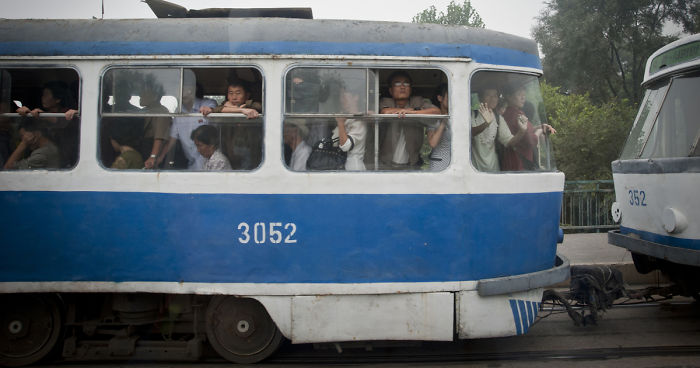
Yet life still moves. People cross streets with purpose. Students in uniforms hurry past. Cyclists glide through intersections. A trolleybus squeaks by with the seriousness of a museum exhibit that still has a full-time job. The city may be staged in parts, but the people living inside it are not props. They are workers, parents, students, grandparents, vendors, soldiers, and commuters making the best of the day in front of them.
Commuting in Pyongyang: Buses, Bikes, and Patience
Transportation offers one of the clearest windows into everyday life in North Korea. In Pyongyang, people rely on buses, trolleybuses, trams, the metro, bicycles, and walking. The metro stations are famously deep, decorated with chandeliers, murals, and polished stone. They are not just transit stops; they are public theater with escalators.
Outside the capital, movement can be slower and more limited. Roads often appear emptier than in neighboring countries. In rural areas, bicycles, carts, and walking remain important. Trains exist, but service can be inconsistent, and travel between regions is not simply a matter of buying a ticket and wandering off. Internal movement is controlled, and citizens generally need permission to relocate or travel far from home.
One detail that has changed in recent years is the growing visibility of cars in Pyongyang. Private car ownership is still nothing like what Americans would recognize, but reporting has shown more vehicles, congestion, and even parking problems in the capital. That may sound normalparking complaints are practically a universal languagebut in North Korea it signals something specific: the rise of a small, better-off class with access to money, connections, and state-approved channels of consumption.
Markets: The Everyday Economy Behind the Official One
If you want to understand how North Koreans survive daily life, you have to talk about markets. Officially, the country has long promoted a state-centered socialist economy. In reality, informal and semi-legal markets, often called jangmadang, have become essential to daily survival for many families.
Markets are where people buy food, household goods, clothing, shoes, snacks, and small imported items. They are also places where social information circulates. A market stall is never just a market stall; it is a tiny weather station for prices, rumors, shortages, family needs, and quiet opportunity.
Women have played a particularly important role in North Korea’s market life. Because many men have historically been tied to assigned workplaces, military service, or state obligations, women often became the practical managers of household survival. They traded goods, built informal networks, negotiated with officials, and learned how to make small margins matter. A bag of rice, a pair of socks, a bicycle part, a cooking potthese are not glamorous objects, but they can tell you more about a country than a parade ever will.
Markets also reveal inequality. In Pyongyang and other better-connected areas, some people have access to imported goods, restaurants, smartphones, taxis, and nicer apartments. In poorer regions, households may struggle with food insecurity, unreliable electricity, and limited cash. North Korea is often described as isolated, but isolation is not evenly experienced. Some people are much more insulated from hardship than others.
Food: Simple Meals, Seasonal Pressure, and Social Meaning
Food is one of the most sensitive parts of everyday life in North Korea. Meals vary widely depending on location, class, season, family connections, and access to markets. Rice, corn, noodles, cabbage, radish, potatoes, tofu, bean paste, soups, and kimchi-like side dishes are common themes. Meat is less frequent for many ordinary families, though it appears more often among the better-off or during special occasions.
For visitors on organized tours, meals can be misleading. Tour groups may be served generous dishes in selected restaurants, sometimes with more variety than many local residents would normally enjoy. A traveler can leave thinking, “The food seemed fine,” while missing the broader reality of shortages, regional inequality, and the pressure families face when harvests are poor or prices rise.
Food in North Korea is not only nutrition; it is also status, security, and strategy. Families plan around availability. Market prices matter. Rural households may depend on kitchen gardens or small-scale private activity. City families may rely on relatives, trading, and side work. A simple bowl of noodles can carry a whole backstory of labor, negotiation, and luck.
Schoolchildren and Public Discipline
One of the most common images visitors capture is children walking in groups, wearing uniforms, carrying backpacks, or practicing performances. North Korean children are often presented as cheerful, disciplined, and talented. In public settings, that image can be striking. Music performances, synchronized dancing, and school presentations are polished enough to make the average school talent show look like a chair fell over and everyone gave up.
Education is deeply ideological. Students learn reading, math, science, history, music, and sports, but they also grow up inside a system that emphasizes loyalty, national struggle, and reverence for the ruling family. Public discipline is visible from a young age: orderly lines, group activities, and collective identity matter.
At the same time, children remain children. They whisper, fidget, stare at foreigners, giggle, and sometimes look just as bored as kids anywhere else when adults make speeches. That ordinary humanity is important. A child adjusting a red scarf or chasing a friend across a courtyard reminds you that real life always leaks through official choreography.
Homes and Apartments: What Visitors Rarely See Fully
Housing in North Korea varies sharply. Pyongyang has showcase apartment blocks, including newer high-rise developments built to display modernity. Some apartments have bright facades, balconies, and better access to services. But beyond the capital and outside elite circles, housing can be modest, aging, and affected by heating, water, and electricity problems.
Visitors rarely get a full, unscripted look inside ordinary homes. When home visits happen, they are usually arranged. That does not make every detail fake, but it does mean the view is selective. A clean living room, family photos, a television, and neat bedding may be real, but the larger question is what remains outside the frame.
Everyday domestic life likely revolves around practical routines: cooking, washing, heating, storing food, helping children study, maintaining clothes, and managing shortages. In countries with reliable infrastructure, people complain when the Wi-Fi drops for six minutes. In North Korea, the basic concerns can be far more serious: electricity, fuel, water, food, medicine, and permission.
Electricity After Dark: The Country Changes at Night
Nighttime tells a different story. Satellite images and energy research have long shown that North Korea has far lower electricity availability than South Korea, China, or Japan. On the ground, this can mean dim streets, dark apartment windows, limited heating, and a city that quiets early.
Pyongyang has more light than many other parts of the country, but even there, the evening mood can feel subdued. A few buildings glow. Monuments may be illuminated. Restaurants for visitors may stay bright. But ordinary neighborhoods can fade into darkness much faster than outsiders expect.
Small solar panels have become part of the story in some areas. For households that can afford them, solar panels can help charge batteries, lights, or small devices. That detail says a lot: when the grid is unreliable, people improvise. Energy is not just a national statistic; it is whether a student can read after sunset or whether a family can keep warm.
Phones, Internet, and the Strange Shape of Connection
North Korea is not completely disconnected, but it is connected in a way that feels unfamiliar to people who live online. Domestic mobile phones exist, and mobile use has grown over the years. However, ordinary citizens do not have open access to the global internet. Communications are monitored, international contact is restricted, and information control remains central to the state’s power.
For travelers, this creates a strange contrast. A visitor may carry a smartphone, take photos under supervision, and perhaps access limited services depending on rules and arrangements. Meanwhile, most citizens live inside a tightly controlled information environment. The average person cannot simply search the web, compare news sources, watch global entertainment freely, or message someone abroad without risk.
This makes everyday conversation feel different. People may be friendly, curious, and warm, but there are invisible walls around what can safely be said. A smile may be real. A joke may be real. A silence may also be real.
Public Spaces: Parks, Monuments, and Carefully Shared Leisure
North Koreans do have leisure time, though it is shaped by politics, class, and access. In Pyongyang, visitors may see families in parks, couples taking wedding photos, people enjoying picnics, children skating, or groups playing music. These scenes are often among the most human and memorable because they show people outside strict work routines.
Wedding photography is especially striking. Couples pose at scenic or symbolic locations, sometimes with relatives standing nearby. The clothes may be formal, the posture careful, the background monumental. But the nervous smiles are universal. Love, family expectation, and the awkwardness of being photographed in fancy clothes appear to have no borders.
Parks and public squares can also become stages for collective celebration. Dancing, national holidays, and mass events present unity and discipline. Visitors may be invited to observe or even join a dance. It can feel joyful and controlled at the same time, which is one of the recurring contradictions of travel in North Korea.
Photography: What the Camera Can and Cannot Tell You
Taking photos in North Korea is not like wandering through New York or Tokyo with a camera. Visitors are commonly accompanied by guides, and photography rules can change depending on location. Military sites, construction areas, poverty, certain officials, or scenes considered unflattering may be restricted. Even when photography is allowed, the photographer is often aware of being watched.
That does not mean every photo is useless. A street scene can still reveal clothing styles, transport patterns, architecture, public behavior, and small details of daily life. But photographs from North Korea should be read carefully. They show what was visible, not necessarily what was typical. They show a moment, not the whole system.
The most powerful images are often the least dramatic: a man cycling past fields, a child looking out a bus window, women selling goods, a worker sweeping a sidewalk, commuters waiting under gray morning light. These scenes do not “solve” North Korea, but they resist the lazy idea that the country is only missiles, leaders, and military parades.
The Guided Trip Problem: Seeing Clearly Through a Narrow Window
Any article about visiting North Korea must be honest about one major limitation: foreign visitors usually see the country through a guided and restricted itinerary. That means the route, restaurants, hotels, monuments, schools, farms, and factories may be selected to create a certain impression.
This does not make travel observations worthless, but it does mean they need context. A visitor may see a clean classroom, a cheerful guide, a well-stocked shop, and a lively restaurant. Those things may be real. But they do not automatically represent the daily reality of everyone in the country.
Think of it like judging American life after being shown only Times Square, a model school, a military museum, and a steakhouse. You would learn something, yes. You would not understand rent, medical bills, rural poverty, internet culture, local politics, or why everyone argues about tipping. North Korea’s guided tours create an even narrower window.
Everyday Life Under Control
The central fact of everyday life in North Korea is control. Control over movement. Control over media. Control over speech. Control over work assignments. Control over public memory. Control over what can be photographed, published, watched, and repeated.
Human rights organizations and international bodies consistently describe North Korea as one of the most repressive countries in the world. Reports point to surveillance, arbitrary detention, forced labor, severe punishment, censorship, and deep restrictions on civil liberties. These are not abstract issues. They shape ordinary decisions: what to say, where to go, whom to trust, and how much curiosity is safe.
That is why “everyday life” in North Korea cannot be treated as just a lifestyle topic. A morning commute, a market purchase, or a school performance may look ordinary, but the background conditions are extraordinary. Daily life is not only what people do; it is what they must avoid doing.
What Stayed With Me Most
The scenes that linger are not always the grand ones. Yes, the monuments are huge. Yes, the boulevards are wide. Yes, the official buildings are designed to make you feel small. But the moments that stay are quieter.
A cyclist balancing a load that looks slightly too large. A child sneaking a glance at a foreign camera. A woman adjusting goods at a market stall. A guide laughing politely at a harmless joke. A street going dark earlier than expected. A train platform where everyone seems to know the rhythm except you.
North Korea is often discussed as a geopolitical problem, and for good reason. But it is also home to more than 26 million people. Their lives are shaped by forces far bigger than themselves, yet they still build routines, families, friendships, habits, and private hopes. That human layer is easy to miss if you only look at headlines.
Additional Travel-Style Reflections: The Small Details That Made the Biggest Impression
The longer I thought about everyday life in North Korea, the more I realized that the most revealing details were not the ones my camera naturally chased. Big monuments demand attention. They stand there like architectural exclamation points, practically shouting, “Photograph me or I will be offended.” But everyday life hides in the corners: the worn edge of a bus seat, the careful sweep of a shopkeeper’s broom, the way people wait without scrolling through phones, the quietness of a street where you expect noise.
One of the strangest feelings was the absence of commercial clutter. In many countries, daily life is wrapped in advertising. Soda signs, phone plans, burger posters, delivery apps, sale banners, influencer faces, pharmacy discountsmodern streets often look like they are trying to sell you six things before you cross the road. In North Korea, that layer is largely missing. The result is not peaceful in a simple way; it is controlled. Public messages exist, but they serve political and social purposes rather than consumer choice.
That absence changes how you look at people. Without the usual background noise of brand culture, small personal differences stand out more: a hairstyle, a bag, a pair of shoes, a child’s expression, a bicycle repair, a lunch container. You begin to notice how much individuality can survive even in a place built around collective identity.
Another detail was time. Daily rhythms seemed less frantic than in hyperconnected cities, but not necessarily easier. People waited. People walked. People queued. People moved in groups. The pace could look calm, yet beneath that calm was a practical toughness. When infrastructure is unreliable, when information is limited, when opportunity depends on permission and connections, patience is not a personality trait. It is a survival tool.
I also kept thinking about photography itself. In most places, taking a picture is casual. You see something, you snap it, maybe you delete it later because your thumb was in the frame looking like a mysterious pink mountain. In North Korea, the act of photographing feels heavier. You wonder what is allowed, what is respectful, what is risky, what is being hidden, and what your own assumptions are adding to the image.
The camera can make you feel powerful, but in North Korea it often makes you feel limited. You can capture a cyclist, but not his full story. You can photograph a market street, but not the private negotiations behind it. You can frame a smiling student, but not the curriculum that shaped her worldview. You can document a city block, but not the permissions that decide who gets to live there.
That limitation may be the most honest lesson. Everyday life in North Korea cannot be fully captured by a visitor’s lens. It can only be approached carefully, with humility and context. The goal is not to pretend that a guided trip reveals everything. The goal is to notice what can be noticed, question what cannot be seen, and remember that behind every political system are ordinary people trying to get through ordinary days under extraordinary constraints.
Conclusion: A Country Seen in Glimpses
Everyday life in North Korea is a study in contrasts. It is ordinary and unusual, calm and tense, staged and sincere, disciplined and improvised. A traveler may see clean boulevards, school performances, markets, apartment blocks, bicycles, parks, and quiet evenings. But behind those scenes are restrictions that shape nearly every part of life.
The most responsible way to write about North Korea is neither to sensationalize it nor to soften it. The country is not a cartoon villain’s lair, and it is not a misunderstood tourist gem. It is a real place where real people live under a highly controlled system. The images that matter most are not only the dramatic ones. They are the everyday moments that remind us how human life continues, even when freedom is limited and the world outside feels very far away.