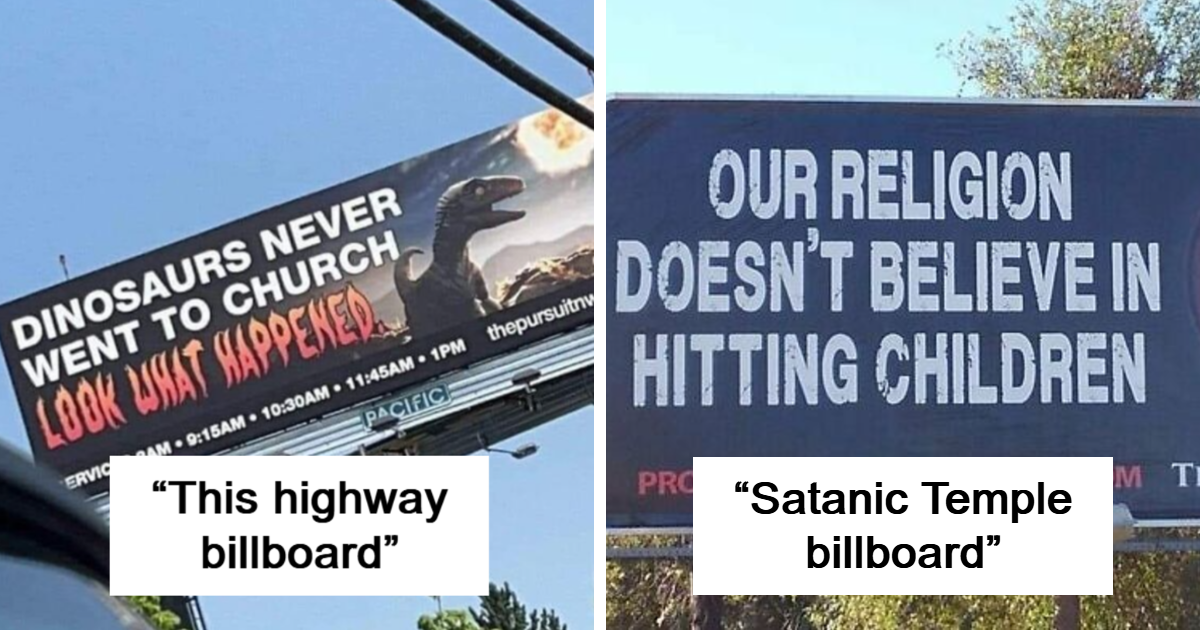
There are two kinds of billboards in the world: the ones you forget before the next traffic light, and the ones that make you laugh so hard you briefly forgive rush hour. The viral-style roundup “Dinosaurs Never Went To Church”: 50 Hilarious And Creative Billboards From “Scroll The World” belongs firmly in the second category. It celebrates the strange, sharp, and wildly creative signs people spot on highways, city streets, fast-food corners, rural roads, and places where someone clearly said, “Yes, let’s put that joke twelve feet in the air.”
At first glance, funny billboards look like quick entertainment. A dinosaur joke here. A church sign there. A savage fast-food placement above a rival drive-thru. But behind the laughs is a surprisingly smart lesson in communication. Outdoor advertising has only a few seconds to work. Drivers are moving, pedestrians are distracted, and nobody has time to read a novel about your discount tire sale. That is why the best creative billboards operate like tiny comedy sketches: one setup, one punchline, zero wasted words.
This article explores why the “Scroll The World” collection connects with readers, what makes these funny billboard messages so memorable, and why brands, local businesses, churches, public service campaigns, and regular people with questionable impulse control keep turning roadside signs into mini cultural events.
Why Funny Billboards Still Stop Us in a Scroll-Happy World
We live in an era where people can skip ads, block ads, mute ads, and scroll past ads with Olympic-level thumb speed. Billboards are different. They are part of the real world. You cannot install an ad blocker on Interstate 40. You cannot close a pop-up that is bolted to the skyline. That physical presence gives outdoor advertising a unique kind of power.
Out-of-home advertising, often called OOH advertising, continues to grow because it catches people during daily routines: commuting, shopping, walking downtown, waiting for the bus, or sitting in traffic wondering if moving to a cabin in Montana would solve everything. Industry research shows that OOH remains a major advertising channel, with digital billboards, transit ads, street furniture, and large-format signs helping brands build awareness in public spaces.
But awareness alone is not enough. A billboard has to earn attention quickly. That is where humor comes in. Funny outdoor ads cut through the visual clutter because laughter is a shortcut to memory. When a sign surprises us, we do not just read it; we retell it. We text a picture to a friend. We post it online. We become the unpaid distribution team, wearing seatbelts and holding iced coffee.
The Genius Behind “Dinosaurs Never Went To Church”
The title example, “Dinosaurs Never Went To Church,” works because it is absurd, provocative, and instantly visual. You do not need a marketing degree to picture a solemn billboard using extinct reptiles as a moral lesson. Whether someone reads it as sincere, satirical, strange, or accidentally hilarious, it does what most ads fail to do: it creates a reaction.
That is the secret sauce of creative billboard advertising. The message does not have to please everyone. In fact, many memorable signs succeed because they make people do a double take. A bland billboard whispers, “We exist.” A great billboard shouts, “You are absolutely telling someone about this later.”
The dinosaur-church line also highlights how billboards often borrow from local culture. In some regions, roadside religious signs are common. In others, they stand beside fast-food ads, political slogans, injury lawyers, fireworks stores, and mysterious exits promising “antiques” that may or may not include haunted dolls. When an unexpected message appears in that environment, the context becomes part of the joke.
What the “Scroll The World” Billboard Roundup Reveals About Modern Humor
The most entertaining billboards in the collection are not funny in the same way. Some use wordplay. Some rely on placement. Some use visual tricks. Some are unintentionally hilarious because two unrelated signs accidentally form a comedy duo. Together, they show how wide the comedy toolbox can be when the canvas is a roadside rectangle.
1. Placement Can Be the Punchline
One of the funniest billboard categories is accidental placement. A fast-food ad beside a cremation service. A safety warning placed near something that makes the warning look even darker. A burger chain billboard sitting above a competitor’s drive-thru like it paid rent specifically to be petty. These examples prove that location is not just a media-buying detail; it can be the entire joke.
In outdoor advertising, context matters. A billboard for coffee near a morning commute route makes sense. A gym ad near an elevator might be cheeky. A Wendy’s sign above a McDonald’s drive-thru is not just an ad; it is a tiny public roast with a parking lot.
2. Short Copy Wins the Road
Billboard experts commonly recommend short, simple copy because viewers usually have only a few seconds to process the message. The best examples in the roundup understand this. They do not explain the joke. They land it.
That is why “Dinosaurs Never Went To Church” works better than a paragraph beginning with, “Paleontological evidence suggests that ancient reptiles lacked formal religious institutions…” By the time that version finished, the driver would be three exits away and possibly asleep.
3. Visual Surprises Make People Look Twice
Some creative billboards go beyond words. A hair-color billboard that changes visually with sunlight. A sundial-style fast-food sign that uses shadows to point to menu items at different times of day. A sports billboard that makes an athlete seem to burst through the frame. These concepts use the physical environment instead of fighting it.
That is one reason outdoor advertising can be so fun. Unlike a phone screen, a billboard can interact with sunlight, buildings, road angles, weather, and distance. The world becomes part of the design.
Why People Love Sharing Weird Billboard Photos
Funny billboards are made for sharing because they feel discovered. When you see a strange sign on the road, it feels like finding a joke the universe left specifically for you between a gas station and a mattress warehouse. That sense of discovery makes people want to document it.
Collections like “Scroll The World” tap into that pleasure. They turn everyday public spaces into a gallery of human creativity, bad timing, local humor, and occasional chaos. A person who would never click on a traditional ad may happily scroll through 50 billboard photos because the content feels less like marketing and more like cultural treasure hunting.
There is also a democratic charm to it. Some signs are made by polished brands with huge budgets. Others look like a local business owner, a church committee, or a group of friends had an idea and refused to be talked out of it. That mix is part of the fun. Not every memorable billboard is elegant. Some are memorable because they are gloriously unhinged.
The Marketing Lessons Hidden Inside the Laughs
Behind the jokes, the best hilarious billboards offer practical lessons for brands, creators, and anyone trying to communicate in public.
Know the Audience
A billboard has to match the people passing by. A joke that works near a college campus may not work outside a retirement community. A rural highway sign may lean into local references, while an urban digital board may rely on bold visuals and instant recognition. The audience determines the tone.
Make One Point, Not Seven
Many bad billboards try to do everything at once: introduce the brand, list services, add a phone number, include a website, mention a discount, squeeze in a testimonial, and somehow fit a logo the size of a dinner plate. Great billboard design is ruthless. One idea. One message. One reason to remember it.
Use Humor With Purpose
Humor works best when it supports the message rather than replacing it. A funny sign for a barstool store can make people remember the store. A funny safety billboard can make a serious warning more noticeable. But if people remember the joke and forget the brand, the ad becomes a public comedy donation.
Let the Environment Help
Billboards are not floating in a vacuum. They sit beside highways, restaurants, neighborhoods, stadiums, hospitals, churches, and shopping centers. Smart advertisers use that environment. The funniest signs in the roundup often gain power from where they appear, not just what they say.
Examples of Billboard Humor That Actually Works
The “Scroll The World” collection includes several types of billboard humor worth studying. A safety awareness sign with a startling visual can turn a serious reminder into something impossible to ignore. A local billboard in Richmond, Virginia, uses social commentary to make a point quickly. A Kansas City Royals billboard uses sports imagery in a way that feels energetic and location-specific. A group of friends who put a studio portrait on a hometown billboard proves that sometimes the product is simply friendship with too much confidence.
Fast-food examples are especially strong because restaurant brands understand quick recognition. McDonald’s, Wendy’s, and other chains can use color, icons, and short phrases because people already know the brand language. A pair of golden arches or a red-haired mascot does not need a long introduction. The billboard can jump straight to the joke.
Then there are the strange local ads: job-seeking billboards, awkwardly stacked signs, church messages, funeral-home warnings, and animal-themed gags. These may not look like polished agency work, but they often feel more human. They remind us that advertising is not only about selling. Sometimes it is about making a town laugh on the way to the grocery store.
Why “Bad” Billboards Sometimes Become the Best Ones
Not every viral billboard is good in the traditional design sense. Some are poorly placed. Some are weirdly worded. Some are funny by accident. But online audiences love them because imperfection feels authentic. A billboard that tries too hard can feel corporate. A billboard that accidentally creates comedy can feel like a gift.
This is why “weird billboards” and “funny billboard signs” perform so well online. They combine visual proof with a quick emotional payoff. You do not need background knowledge. You see the image, understand the absurdity, and react. In a digital environment overloaded with opinions, a funny sign is refreshingly simple.
The Fine Line Between Clever and Confusing
Of course, not every odd billboard is successful. Some are confusing, offensive without purpose, or so packed with text that reading them feels like taking an eye exam in a moving vehicle. Creativity still needs clarity.
A strong creative billboard should answer three questions quickly: What is the idea? Why should I care? Who is behind it? If the viewer can only answer one of those questions, the billboard may get attention without delivering value. That is the marketing equivalent of wearing a chicken costume to a business meeting: memorable, yes, but possibly not helpful.
Why Billboards Feel More Human Than Digital Ads
Part of the charm of outdoor advertising is that it exists in shared space. People experience it together. A funny billboard can make two strangers laugh at the same red light. A clever sign can become a landmark. A weird local message can turn into neighborhood folklore.
Digital ads are often personalized, private, and fleeting. Billboards are public, physical, and stubborn. They stand in the weather. They become part of commutes. They photobomb cities. When they are funny, they create a shared joke. That communal quality is hard to replicate on a phone screen.
Creative Billboards as Tiny Pieces of Public Art
The best funny billboards do more than advertise. They decorate the daily routine. They give people a reason to look up. They turn blank roadside space into a moment of surprise. Some use illustration. Some use scale. Some use typography. Some use nothing but a brutal sentence and confidence.
That is why collections like “Dinosaurs Never Went To Church” are more than internet filler. They document how public messaging reflects culture: our jokes, anxieties, beliefs, rivalries, food cravings, and deep national inability to resist a good pun.
Experiences Inspired by “Dinosaurs Never Went To Church” and Other Funny Billboards
Anyone who has spent enough time on American roads has probably developed a personal relationship with billboards. They become part of the trip. You may not remember every mile marker, but you remember the sign that made everyone in the car laugh, the restaurant billboard that appeared exactly when hunger reached emergency levels, or the strange local message that sparked a twenty-minute debate no one asked for.
The experience of seeing a billboard like “Dinosaurs Never Went To Church” is different from seeing a joke online. Online, you expect punchlines. On the road, you expect exits, gas prices, and warnings about merging traffic. So when a billboard delivers a line that sounds like it escaped from a prehistoric Sunday school argument, it feels delightfully out of place. That surprise is what makes it stick.
There is also something wonderful about the timing. You may be sitting in traffic, annoyed at brake lights and the person ahead who treats green lights as philosophical suggestions. Then a billboard appears with a ridiculous message, and suddenly the commute has a plot twist. The sign does not solve traffic, but it makes the moment lighter. Sometimes that is enough.
Funny billboards also create shared car memories. One passenger reads it aloud. Another person misses it and demands an explanation. Someone in the back seat says, “Wait, what did the dinosaur do?” Then everyone becomes an amateur copywriter, pitching better versions of the sign. Before long, the billboard has done something most ads never accomplish: it has started a conversation that has nothing to do with a sales funnel and everything to do with being human.
For marketers, that experience is gold. A billboard that makes people laugh can travel far beyond its physical location. Someone snaps a photo, posts it, and suddenly a local roadside joke reaches readers across the country. The original audience may have been drivers on one highway, but the secondary audience becomes everyone scrolling during lunch. That is the magic of modern outdoor advertising: the sign lives outside, but the story travels online.
For everyday viewers, these billboards are a reminder that creativity does not have to be complicated. A short phrase, a clever placement, or a weird image can make an ordinary drive feel memorable. The world is full of messages competing for attention, but the ones we remember are often the ones that respect our time and reward us with a laugh.
So the next time you pass a billboard that makes you smirk, groan, or question the decision-making process of an entire marketing department, appreciate it. Someone managed to turn a few seconds of your day into entertainment. In the grand museum of roadside America, that deserves at least a polite nod, maybe a photo, and definitely a group chat caption.
Conclusion: Why These Hilarious Billboards Keep Winning Attention
“Dinosaurs Never Went To Church”: 50 Hilarious And Creative Billboards From “Scroll The World” works because it captures the best side of public advertising: bold ideas, fast jokes, strange placements, and messages that refuse to be boring. The funniest billboard messages are not just signs; they are tiny stories designed for people in motion.
For brands, the lesson is clear. Be simple. Be visual. Be brave enough to have a personality. For readers, the joy is even simpler: the world is still full of unexpected jokes, and some of them are large enough to see from the highway.
Note: This article is written as original web content based on real public examples of humorous billboards, outdoor advertising principles, and current OOH marketing knowledge. It does not copy source text or include unnecessary citation placeholders.