Note: This article is based on a fresh synthesis of reputable library, architecture, travel, cultural, and official institution sources. Direct source links are intentionally omitted for clean web publishing.
Why the Best Libraries in the World Still Feel Magical
The best libraries in the world are not just buildings full of books. They are memory palaces, civic living rooms, architectural showpieces, research engines, and, occasionally, excellent places to look mysteriously intelligent while holding a notebook you have not opened yet.
In an age when almost every question can be tossed into a search bar, great libraries still matter because they offer something the internet cannot fully replace: atmosphere, trust, depth, and a sense of belonging. A world-class library can preserve a 9th-century manuscript, welcome a student who needs free Wi-Fi, host public exhibitions, protect national archives, and make a traveler whisper “wow” before they even reach the front desk.
This guide explores the best libraries in the world based on collection importance, architecture, cultural influence, accessibility, historical value, and visitor experience. Some are ancient in spirit. Some are sleek enough to look like they were designed by a very well-read spaceship. All of them prove that libraries are far from dusty relics. They are alive, evolving, and still one of humanity’s best ideas.
How We Chose the Best Libraries in the World
Ranking libraries is a little like ranking sunsets: subjective, slightly impossible, and guaranteed to start a polite argument among people who own too many tote bags. Still, a few standards help separate a good library from a truly unforgettable one.
The libraries below were selected for a combination of size, historical significance, architectural beauty, public access, research value, innovation, and cultural impact. A great library does not need to be the biggest. It needs to offer a memorable relationship between people, knowledge, and place.
Best Libraries in the World to Know and Visit
1. Library of Congress Washington, D.C., United States
The Library of Congress is often described as the largest library in the world, and it earns that reputation with a collection that stretches across books, manuscripts, maps, photographs, recordings, films, newspapers, and digital materials. For researchers, it is a treasure vault. For visitors, the Thomas Jefferson Building is a full theatrical production in marble, murals, columns, staircases, and ceiling art.
The Main Reading Room is the star. Its circular layout, domed ceiling, and glowing desk lamps create the kind of scene that makes you want to research something important immediately, even if your original plan was just to take a photo and find lunch. The Library of Congress is not only a national institution; it is a symbol of how seriously a society can take knowledge when it chooses to build beauty around it.
2. The New York Public Library, Stephen A. Schwarzman Building New York City, United States
Guarded by the famous stone lions, Patience and Fortitude, the New York Public Library’s flagship building is one of the most iconic libraries in the world. Its Beaux-Arts architecture gives Fifth Avenue a grand literary pause between shopping, traffic, and people walking very fast while pretending not to be lost.
The Rose Main Reading Room is legendary. With long oak tables, high ceilings, chandeliers, and murals of blue skies and clouds, it feels less like a study room and more like the headquarters of serious thought. Yet the building is not just beautiful. It is a working research library with major humanities and social science collections, exhibitions, public programs, and free access that reflects the democratic spirit of great public libraries.
3. British Library London, England
The British Library is one of the world’s great research institutions, holding an enormous collection that includes books, newspapers, sound recordings, manuscripts, maps, patents, stamps, and digital archives. As a legal deposit library, it receives copies of works published in the United Kingdom and Ireland, helping preserve the written record of entire societies.
Its collection includes landmark cultural items such as historic manuscripts, literary drafts, early printed books, and rare documents that shaped global history. For visitors, the building near St. Pancras is practical rather than palace-like, but that practicality is part of its power. This is a library built for serious use: reading rooms, exhibitions, research services, and enough material to keep a curious person busy for several lifetimes.
4. Trinity College Dublin Old Library Dublin, Ireland
The Old Library at Trinity College Dublin is famous for two reasons: the Book of Kells and the Long Room. Either one would be enough to make it one of the best libraries in the world. Together, they make it nearly irresistible.
The Book of Kells is a richly decorated medieval manuscript, widely admired as one of Ireland’s greatest cultural treasures. After seeing it, visitors enter the Long Room, a soaring 18th-century chamber lined with dark wood shelves, marble busts, and rows of historic books. It is the kind of room that makes silence feel natural. Even enthusiastic tourists tend to lower their voices, as if the books themselves have raised an eyebrow.
5. Bodleian Library Oxford, England
The Bodleian Library is one of Europe’s oldest and most important libraries. First opened to scholars in 1602, it forms the heart of Oxford’s scholarly identity. Together, the Bodleian Libraries hold millions of printed items, and the institution has long served as a major research library for students, academics, and visiting scholars.
Its appeal comes from both intellect and atmosphere. The Bodleian is not one building but a historic network, including spaces such as Duke Humfrey’s Library, the Divinity School, the Radcliffe Camera, and the Weston Library. Walking through Oxford with the Bodleian nearby feels like stepping into a city designed by footnotes.
6. Bibliotheca Alexandrina Alexandria, Egypt
The Bibliotheca Alexandrina is a modern tribute to the ancient Library of Alexandria, one of the most famous libraries in human history. The current library opened in the 21st century as a major cultural complex, combining reading areas, museums, exhibitions, research centers, digital projects, and public programs.
Its architecture is dramatic: a vast circular form with a slanted roof that seems to lean toward the Mediterranean. The design suggests both a rising sun and a bridge between ancient learning and modern knowledge. The Bibliotheca Alexandrina is not a replica of the ancient library. It is something more interesting: a contemporary attempt to revive the idea that a library can be a meeting point for cultures, languages, science, and imagination.
7. Seattle Central Library Seattle, Washington, United States
Seattle Central Library looks like a glass-and-steel puzzle box, and that is meant as a compliment. Designed by OMA and LMN Architects, with Rem Koolhaas and Joshua Prince-Ramus closely associated with the project, the building redefined what a public library could look like in the digital age.
Instead of hiding its functions behind a traditional facade, the library turns programs, movement, and information flow into architecture. The result is bold, angular, bright, and surprisingly useful. It includes reading areas, public computers, meeting rooms, book stacks, and open spaces that make the library feel like an urban information hub. It is one of the best libraries in the world for people who love modern architecture and civic experimentation.
8. Helsinki Central Library Oodi Helsinki, Finland
Oodi is one of the clearest examples of the library as a modern public living room. Located in central Helsinki, it offers books, meeting spaces, studios, workshops, events, cafés, and areas for families, students, remote workers, and curious wanderers. It is warm, open, and designed around the idea that public space should be generous.
The building’s wood, glass, and steel exterior gives it a flowing, contemporary look. Inside, the atmosphere is friendly rather than intimidating. Oodi proves that the best libraries in the world are not only about preserving old knowledge; they are also about supporting daily life. You can read, learn, create, meet friends, attend events, or simply sit somewhere beautiful without being expected to buy anything. That alone feels quietly revolutionary.
9. Stuttgart City Library Stuttgart, Germany
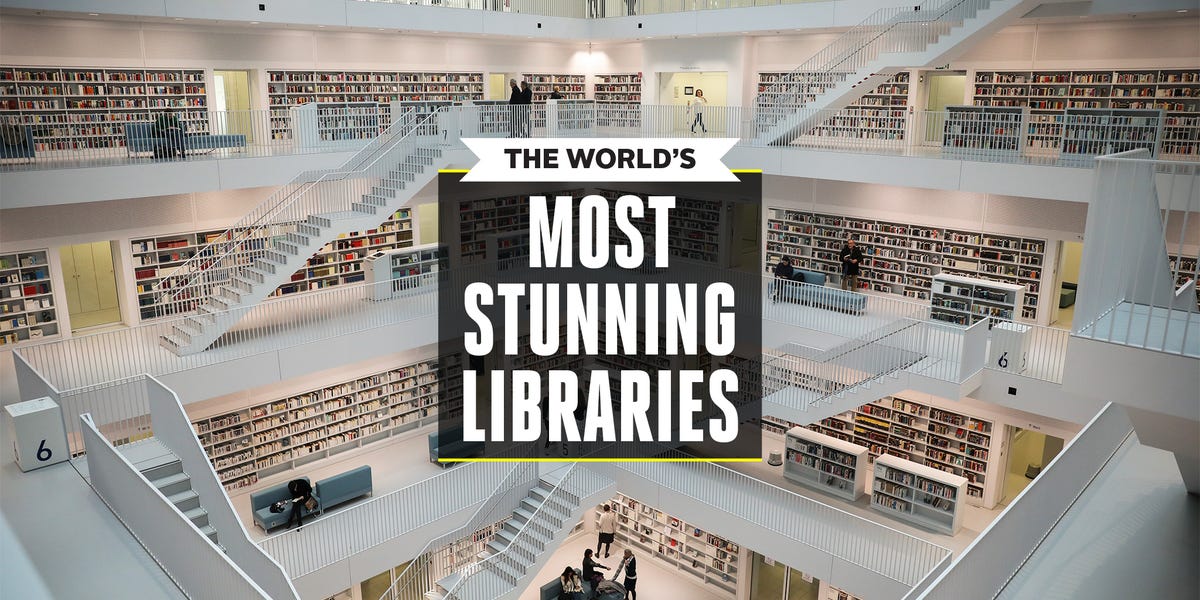
Stuttgart City Library is famous for its minimalist cube-like exterior and luminous white interior. Designed by Eun Young Yi, the building opened in 2011 and quickly became a favorite among architecture lovers, photographers, and readers who appreciate clean lines with their catalog searches.
The central atrium is the visual highlight. White staircases, geometric symmetry, open balconies, and natural light create a calm, almost meditative environment. Some libraries feel cozy; Stuttgart City Library feels like entering the inside of a beautifully organized idea. Its design is simple, but not plain. It creates a sense of order that makes browsing feel ceremonial.
10. Royal Portuguese Cabinet of Reading Rio de Janeiro, Brazil
The Royal Portuguese Cabinet of Reading is one of the most stunning historic libraries in the world. Its Neo-Manueline architecture, ornate wooden shelves, stained glass, carved details, and towering walls of books create a dramatic setting that feels part cathedral, part literary dream sequence.
The library is especially known for its Portuguese-language collection and its deep cultural connection to Portugal and Brazil. Visitors often come for the architecture, but the building’s real significance lies in the way it preserves language, identity, and literary heritage across continents. It is proof that a library can be both a visual masterpiece and a cultural bridge.
11. Admont Abbey Library Admont, Austria
Admont Abbey Library is one of the grandest monastic libraries in the world. Its Baroque hall is filled with frescoes, sculptural details, gilded ornament, and elegant shelves that turn books into part of a larger spiritual and artistic composition.
The room is not subtle. It does not whisper, “Please enjoy this modest reading nook.” It announces, “Knowledge is glorious, and we have painted the ceiling to prove it.” The library reflects a time when learning, faith, art, and architecture were deeply connected. Today, it remains one of the world’s great library experiences for travelers who want beauty with historical depth.
12. Tianjin Binhai Library Tianjin, China
Tianjin Binhai Library is one of the most futuristic libraries on the planet. Designed by MVRDV with local partners, it became globally famous for its enormous white atrium, curving shelf-like terraces, and central spherical auditorium known by many visitors as “the eye.”
While some of its early fame came from the building’s dramatic visual impact, the library is more than an Instagram backdrop. It represents a broader trend in contemporary library design: libraries as civic landmarks, social spaces, and symbols of urban ambition. Tianjin Binhai Library shows how the best libraries in the world can inspire debate, excitement, and public curiosity simply by refusing to look ordinary.
What Makes a Library One of the Best in the World?
The best libraries in the world usually combine several qualities. First, they preserve knowledge at a serious scale. That might mean millions of books, rare manuscripts, national archives, digital collections, or specialized research materials.
Second, they create memorable spaces. Architecture matters because it shapes how people feel about learning. A beautiful reading room can make research feel noble. A welcoming public floor can make a teenager, traveler, retiree, or new parent feel included. A library that looks futuristic can remind a city that knowledge is not stuck in the past.
Third, great libraries serve people. The most impressive collection in the world means little if no one can use it. Public programming, exhibitions, research support, children’s services, technology access, and community spaces all help turn a library from a storage facility into a living institution.
Tips for Planning a Library-Themed Trip
If you want to visit famous libraries around the world, plan ahead. Some reading rooms require registration, tickets, timed entry, guided tours, or restrictions on photography. Historic libraries may limit access to protect fragile materials, while modern public libraries may be easier to explore freely.
Check opening hours before you go, especially around holidays, renovations, university schedules, and special events. Many world-famous libraries have exhibitions worth seeing, so leave extra time. Also, bring patience. The best library visits are not meant to be rushed. A library is one of the few travel attractions where sitting quietly for half an hour counts as doing it correctly.
Experiences Related to Visiting the Best Libraries in the World
Visiting the best libraries in the world is different from visiting many other landmarks. At a castle, you admire power. At a museum, you admire objects. At a library, you feel the presence of human curiosity stacked in every direction. It is quieter, but somehow bigger.
The first experience many travelers notice is the change in pace. Outside, a city may be loud, expensive, crowded, and determined to test your map-reading skills. Inside a great library, the rhythm slows. People move more gently. Chairs scrape softly. Pages turn. Even the air seems to have read a few classics. In places like the Rose Main Reading Room in New York or the Long Room in Dublin, visitors often pause not because a sign tells them to, but because the room itself asks for respect.
Another unforgettable experience is the feeling of scale. At the Library of Congress or the British Library, the mind struggles to understand the size of the collections. Millions upon millions of items are not just numbers; they represent lifetimes of writing, recording, printing, collecting, cataloging, preserving, and asking questions. You may arrive looking for one exhibit or one famous room, then leave with the strange comfort that humanity has been paying attention for a very long time.
Modern libraries offer a different but equally powerful experience. At Oodi in Helsinki or Seattle Central Library, the thrill comes from seeing how flexible a library can be. These are not silent temples where every cough sounds illegal. They are active public spaces with families, students, freelancers, tourists, makers, readers, and people simply enjoying a warm place to sit. The experience feels democratic. No velvet rope separates knowledge from everyday life.
There is also a personal kind of inspiration that happens in great libraries. You may not suddenly become a novelist, historian, architect, or scholar after visiting one, but you might feel a little more capable of becoming your next version of yourself. Libraries make ambition feel calm. They suggest that big things can be built page by page, note by note, shelf by shelf.
For travelers, libraries are also wonderfully grounding. They are excellent places to escape bad weather, reset after sightseeing, or enjoy beauty without the pressure to consume. In a world of ticketed experiences and crowded attractions, the library remains refreshingly generous. It says: come in, look around, learn something, rest your feet. Honestly, that is better hospitality than many airports manage.
The best library experience is not only visual. It is emotional. You remember the smell of old wood, the glow of lamps, the hush of a reading room, the confidence of a modern atrium, or the sudden realization that books are not just objects. They are evidence that people keep trying to understand the world and leave something useful behind.
Conclusion: The World’s Best Libraries Are More Than Beautiful Buildings
The best libraries in the world prove that knowledge needs places, not just platforms. From the monumental Library of Congress to the cinematic Long Room at Trinity College Dublin, from the scholarly Bodleian to the futuristic Tianjin Binhai Library, each institution tells a different story about how people collect, protect, share, and celebrate ideas.
Some libraries impress through size. Others win your heart through atmosphere. Some are historic, some are experimental, and some are public living rooms disguised as architectural landmarks. Together, they remind us that libraries are not fading away. They are adapting, expanding, and continuing to offer one of the most valuable experiences in the world: free or meaningful access to knowledge in a place designed for human curiosity.