Every artist has heard it: “Wow, you’re so talented. I can barely draw a stick figure.” It is usually meant as a compliment, but hidden inside that sentence is a tiny misunderstanding wearing a party hat. Great drawing is not only talent. It is time, patience, repetition, observation, and the ability to keep working after the first version looks like it was attacked by a nervous raccoon.
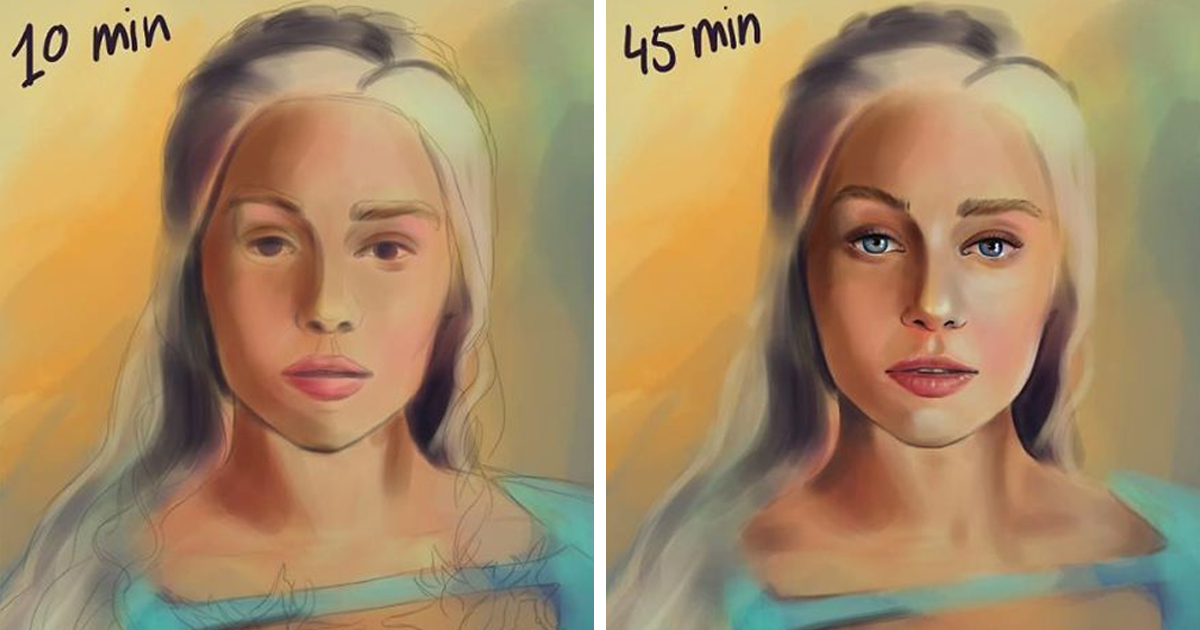
That is why the viral drawing experiment by Dutch artist floortjesart caught so much attention. In a series of time-based drawing examples, she showed how the same subject changes when an artist spends different amounts of time on it. A quick sketch may capture the idea. A longer drawing adds structure. More time brings shading, texture, color, refinement, and tiny details that make viewers lean closer to the screen and whisper, “How?”
The real magic of the project is not that it proves one drawing must take forever. It proves that time changes what an artist can see. The longer an artist stays with a subject, the more information becomes visible: the curve of a lip, the weight of an eyelid, the shadow under a strand of hair, the soft transition between light and form. Perfecting a drawing is less like pressing a button and more like slowly convincing chaos to behave.
Why This Timed Drawing Experiment Feels So Satisfying
People love before-and-after transformations because they make progress visible. In drawing, progress is usually private. We see the polished portrait, the glowing digital painting, or the finished pencil sketch, but we rarely see the awkward middle stage where the artist questions every life decision that led to this page.
Timed drawing comparisons break the illusion. They reveal that a 30-second sketch, a 5-minute study, a 15-minute drawing, and a multi-hour finished piece are not simply “good” or “bad.” They each serve a different purpose. A fast sketch captures gesture and energy. A short study tests proportion. A longer session builds value and texture. A polished drawing brings all the decisions together into one clean visual statement.
This is especially helpful for beginners. Many new artists assume that if their drawing does not look impressive after ten minutes, they have failed. In reality, ten minutes is often just enough time to locate the problem. The masterpiece phase has not even clocked in yet.
What Actually Happens During the First Few Minutes
The earliest stage of a drawing is not about perfection. It is about placement. The artist is asking basic but essential questions: Where does the subject sit on the page? How large should it be? What is the angle? Where are the major shapes? What should be left out?
In a portrait, this might mean lightly mapping the head shape, checking eye placement, and blocking in the nose and mouth. In a drawing of hair, it may involve identifying the largest masses before any individual strands are added. In an animal drawing, the artist may focus on posture and silhouette before touching fur texture.
At this point, the drawing may look unimpressive to outsiders. That is normal. The first layer is scaffolding. Nobody looks at a building covered in construction beams and says, “Hmm, not cozy enough.” The same logic applies to art.
The 30-Second Drawing
A 30-second drawing is mainly about movement. The artist does not have time to fuss over details. She must notice the biggest shapes and commit quickly. These sketches often look loose, messy, and energetic. They may not win a realism contest, but they train the eye to prioritize what matters first.
The 5-Minute Drawing
Five minutes allows slightly more structure. The artist can correct proportions, refine outlines, and add simple shadows. The drawing begins to feel intentional. It may still be rough, but the subject is recognizable, and the artist has more control over the composition.
The 15-Minute Drawing
At around 15 minutes, form starts to appear. Shading becomes more deliberate. Edges become cleaner. The artist can compare light and dark areas, soften transitions, and suggest texture. This is where viewers often begin to say, “Wait, that already looks good.” The artist, meanwhile, is usually thinking, “Cute, but we are not done.”
Why the Final Drawing Takes So Much Longer
The final stretch of a polished drawing is where time behaves strangely. The first 20% of the work may make the subject recognizable. The next 40% may make it attractive. But the last 40% can be spent on details so tiny they seem almost ridiculous: smoothing a cheek shadow, adjusting the catchlight in an eye, deepening one crease, sharpening one edge, or fixing a color transition that only the artist can see.
This is why viewers are often surprised when a realistic drawing takes hours. They may see a finished eye, but the artist sees dozens of decisions: the shape of the iris, the gloss of the pupil, the direction of eyelashes, the skin texture around the lid, the reflected light, the cast shadow, and the difference between a hard edge and a soft edge.
The same is true in digital art. A quick digital sketch can happen fast, but a refined piece may involve layers, blending modes, color adjustments, texture brushes, edge cleanup, and repeated zooming in and out. Digital tools can speed up some tasks, but they do not replace artistic judgment. The undo button is helpful, yes, but it is not a tiny wizard living inside the tablet.
Time Does Not Automatically Equal Quality
Here is the twist: spending more time on a drawing does not always make it better. Time only helps when the artist knows how to use it. A confident 20-minute sketch can feel more alive than a stiff drawing that took six hours. A loose line can carry personality. A rough study can communicate mood. A polished drawing can still feel dull if the structure underneath is weak.
That is why experienced artists balance speed and patience. They practice quick sketches to train observation, then slow studies to build control. They learn when to stop. They learn when a line should stay imperfect because it has character. They learn that “finished” does not always mean “covered in details until the paper files a complaint.”
The Hidden Skills Behind a Perfect Drawing
When viewers look at a polished drawing, they usually notice the surface first. They see realistic hair, smooth skin, expressive eyes, or dramatic lighting. But the most important skills are often invisible.
Observation
Strong drawing begins with seeing accurately. Artists train themselves to notice angles, distances, negative space, light, shadow, and proportion. A beginner may draw what they think an eye looks like. An experienced artist draws the specific eye in front of them, including its asymmetry, folds, reflections, and tiny irregularities.
Layering
Many polished drawings are built in layers. The artist may begin with a loose sketch, then add midtones, deepen shadows, refine edges, and finish with highlights. In colored pencil or digital painting, layering can create richness and depth that a single pass cannot achieve.
Value Control
Value means lightness and darkness. It is one of the biggest reasons a drawing looks three-dimensional. A face, hand, or object can look flat if all the tones are too similar. Strong value control helps the viewer understand form, light direction, and depth.
Edge Control
Edges can be sharp, soft, lost, or broken. A sharp edge pulls attention. A soft edge suggests roundness or atmosphere. Great artists use edges like punctuation. Too many hard edges can make a drawing feel cut out. Too many soft edges can make it look like it is disappearing into fog.
Patience
Patience may be the least glamorous art supply, but it is also one of the most important. Perfecting a drawing means staying with the work long enough to solve problems. It means stepping back, checking proportions, adjusting mistakes, and resisting the urge to declare the piece finished just because dinner is ready.
Why Social Media Makes Art Time Confusing
Online art videos are entertaining, but they can distort expectations. A 12-hour drawing may be compressed into a 20-second reel. Viewers watch the page transform instantly and forget that the artist spent an entire afternoon building the image. Add upbeat music and a satisfying brush transition, and suddenly hard work looks like a magic trick.
Timed drawing posts are valuable because they slow the illusion down. They remind viewers that the finished result is not born fully formed. It develops through stages. It gets corrected. It gets layered. It gets improved. Sometimes it gets abandoned, resurrected, and improved again after snacks.
For artists, this transparency is healthy. It removes pressure to be instantly brilliant. For viewers, it builds appreciation. Once you understand how much time can go into one polished drawing, you stop asking, “Why does art cost so much?” and start asking, “Did the artist remember to stretch their wrist?”
What Beginners Can Learn From the Experiment
The biggest lesson is simple: do not judge your drawing too early. A rough beginning is not proof that the final piece will fail. It is just the beginning doing beginning things.
Beginners can also use timed exercises to improve faster. Try drawing the same subject for 30 seconds, 2 minutes, 10 minutes, and 1 hour. Compare the results. The short drawings will reveal what you notice first. The longer drawings will reveal what you tend to avoid. Maybe you skip hands. Maybe you rush shadows. Maybe every nose becomes the same nose, which is impressive in a suspicious way.
This kind of practice teaches artists how time affects decision-making. It also builds confidence. Once you realize that a messy first sketch is normal, you stop panicking and start problem-solving.
How Professionals Decide When a Drawing Is Finished
Knowing when to stop is one of the hardest parts of art. A drawing can be underdeveloped, but it can also be overworked. Too much blending can remove energy. Too many details can flatten the focal point. Too much correction can make the work feel stiff.
Professional artists often stop when the drawing communicates the intended idea clearly. That does not mean every inch must be equally detailed. In fact, selective detail is usually stronger. The focal point may be highly refined, while surrounding areas stay loose. This guides the viewer’s eye and keeps the artwork from feeling busy.
A useful test is to step away from the drawing. Look at it from across the room. Flip it horizontally if it is digital. Take a photo and view it smaller. Fresh perspective reveals problems that tired eyes ignore. The drawing may not be perfect, but it should feel resolved.
The Real Meaning of “Perfect” in Art
Perfect is a tricky word. In art, perfection does not mean flawlessness. A completely flawless drawing may look impressive but lifeless. The best artwork often has a balance of control and personality. It shows skill, but it also shows a human hand.
When an artist shows how much time she needs to perfect one drawing, she is not saying every piece must be polished to the moon. She is showing the relationship between time and depth. More time allows more observation. More observation allows better decisions. Better decisions create stronger art.
That is an encouraging message. It means improvement is not reserved for mysterious geniuses who were born holding a pencil. It is available to anyone willing to practice, study, revise, and keep going through the stage where the drawing looks like it needs emotional support.
Additional Experiences Related to Perfecting One Drawing
Anyone who has tried to finish a serious drawing knows that the hardest part is not always starting. Starting can feel exciting. You sharpen the pencil, open a fresh page, pick a reference, and imagine the final result looking museum-worthy. The first few marks feel full of possibility. Then the drawing enters its awkward teenage phase, and suddenly the eyes are uneven, the shadows look muddy, and the mouth has the emotional range of a confused potato.
This middle stage is where many beginners quit. But experienced artists learn that awkwardness is part of the process. A drawing often looks worse before it looks better because the artist is moving from simple shapes into more complex information. Values are not balanced yet. Edges are not refined. Details are floating without structure. It is like making soup before the seasoning has joined the group chat.
One helpful experience is setting a timer and working in focused passes. For example, spend 10 minutes only on proportion. Then spend 20 minutes on large shadows. Then spend another session refining edges. This prevents the common mistake of drawing eyelashes before the face is correctly placed. Details are tempting because they feel productive, but they cannot save a weak foundation. A beautifully shaded eye in the wrong position is still in the wrong position, just with confidence.
Another lesson comes from taking breaks. When staring at the same drawing for too long, your brain starts accepting mistakes as roommates. Step away for 15 minutes, and suddenly the crooked jawline becomes obvious. Many artists keep a piece nearby for a day or two before calling it finished. Fresh eyes are brutally honest, but in a useful way.
Materials also change the experience. Graphite is forgiving and excellent for gradual shading. Charcoal creates bold darks but can smudge if handled carelessly. Colored pencils reward patience because layers build slowly. Digital drawing offers flexibility, but it can also tempt artists to zoom in forever and fix pixels no human viewer will ever inspect. Each medium teaches a different kind of discipline.
Perhaps the most important experience is learning that speed and slowness both matter. Quick sketches teach confidence, gesture, and observation. Long drawings teach patience, accuracy, and finish. An artist who only works quickly may struggle with polish. An artist who only works slowly may become afraid of bold decisions. The best growth often comes from mixing both: fast practice for the eye, slow practice for the hand, and occasional silly doodles to remind the soul that art is supposed to be fun.
Perfecting one drawing is ultimately a conversation between the artist and the image. The drawing asks for more shadow here, less pressure there, a softer edge, a darker background, a better highlight. The artist listens, adjusts, argues a little, takes a snack break, and returns. That process is not wasted time. It is the artwork becoming itself.
Conclusion
The viral timed drawing experiment works because it makes the invisible visible. It shows that a polished artwork is not a single moment of talent but a sequence of decisions. A quick sketch captures energy. A longer drawing builds structure. A finished piece requires observation, layering, value control, edge work, and patience.
For beginners, the lesson is wonderfully practical: give your drawings enough time to grow. Do not panic when the first version looks rough. Do not compare your 10-minute sketch to someone else’s 10-hour masterpiece. Most importantly, keep practicing. Every polished drawing begins as a few uncertain marks, and every skilled artist has made plenty of drawings that deserved to be quietly placed in a drawer and forgiven.