Note: This article is an original, fully rewritten synthesis based on real cultural reporting, public museum resources, natural hair history, and contemporary conversations about Black beauty, African heritage, and visual art.
When Natural Hair Becomes a Universe
An Afro is already a masterpiece. It has height, texture, architecture, attitude, and the kind of gravitational pull that can stop a room mid-sentence. But when visual artist Pierre Jean-Louis began transforming photos of Black women’s natural hair into blooming galaxies, forests, and cosmic floral landscapes, the Afro became something even larger: a universe of memory, beauty, resistance, and pride.
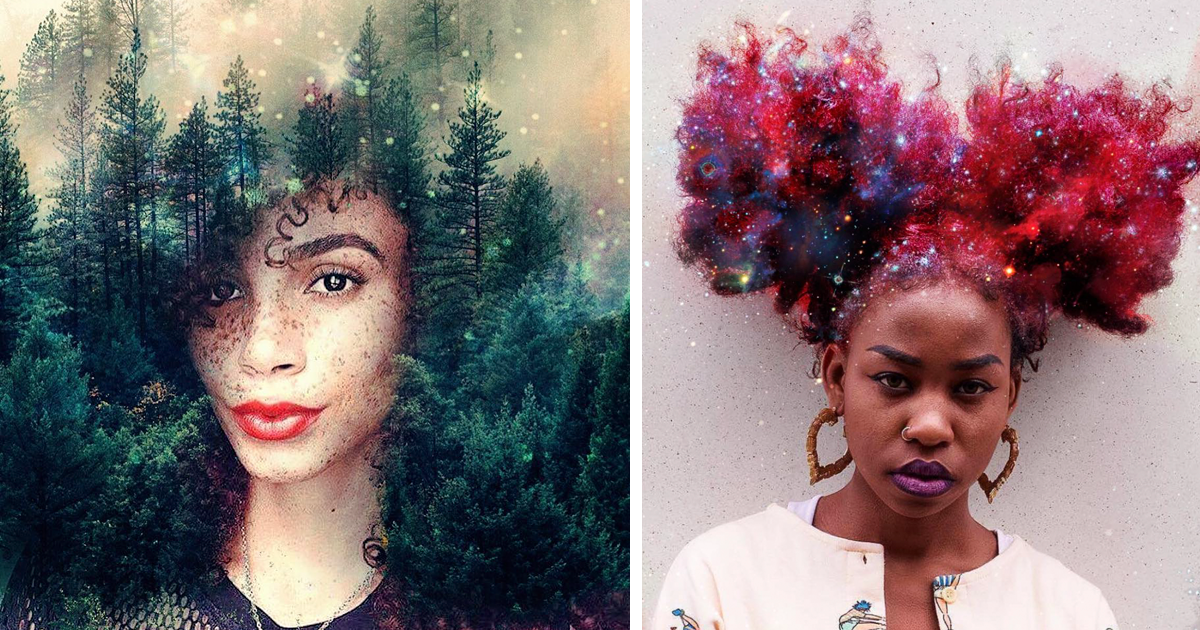
The series, widely associated with the phrase Black Girl Magic, turns natural hair into dreamlike digital art. In one portrait, curls become a midnight sky dusted with stars. In another, coils open into pink blossoms, vines, and petals. Some images look like a garden decided to attend a royal gala. Others look like outer space got invited to a family cookout and came dressed correctly.
Behind the beauty is a deeper message. These images celebrate Black women who wear their natural hair proudly and connect that choice to African heritage, self-love, and cultural identity. The Afro is not treated as a “trend,” a costume, or a styling experiment. It is honored as a crown, a canvas, and a living symbol.
The Artist Behind the Flowery Galaxy Afro Portraits
Pierre Jean-Louis is a visual artist known for digitally transforming portraits of Black women by turning their hair into scenes filled with flowers, galaxies, forests, waterfalls, and other natural wonders. His work became widely shared online because it combines two things people rarely scroll past: stunning visual fantasy and a message that actually means something.
The heart of the project is appreciation. Jean-Louis created the work to uplift Black women who embrace natural hair and African-rooted beauty. Instead of editing hair to appear smaller, smoother, or closer to Eurocentric beauty standards, he expands it. He lets it bloom. He lets it take up space. He lets it become the sky.
That artistic choice matters. For generations, Black women have been pressured to straighten, hide, tame, or explain their hair. These portraits push back with color, softness, scale, and joy. They say: your hair does not need to be corrected. It needs to be celebrated. Preferably with flowers, stars, and a little bit of cosmic drama.
Why the Afro Carries So Much Cultural Power
To understand why these images resonate, it helps to understand the history carried in Black hair. In many African societies, hairstyles have long communicated identity, family background, age, beauty, social status, spirituality, and community belonging. Braids, coils, locs, knots, wraps, and sculptural forms were never “just hair.” They were language.
In the United States, that language was repeatedly attacked by slavery, racism, assimilation pressure, workplace discrimination, school rules, and beauty industries that often treated straight hair as the price of being considered “polished.” For many Black women, hair became a daily negotiation: What is safe? What is accepted? What will be judged? What will be called professional? What will make Auntie raise one eyebrow and say, “So this is what we’re doing today?”
The Afro gained major political and cultural visibility in the 1960s and 1970s during the Black Power and “Black is Beautiful” movements. It became a proud visual rejection of the idea that Black features needed fixing. Wearing an Afro could be personal, political, fashionable, spiritual, or all of the above before breakfast.
That history gives Jean-Louis’s work its emotional weight. A flower-filled Afro is not just pretty. A galaxy Afro is not just clever digital editing. It is part of a long conversation about who gets to be seen as beautiful, powerful, feminine, artistic, and worthy without shrinking themselves.
Black Girl Magic, But Make It Botanical and Interstellar
The phrase Black Girl Magic became popular in the 2010s as a way to celebrate the brilliance, resilience, beauty, and creativity of Black women and girls. It quickly moved through social media, essays, poetry, fashion, music, and everyday conversation. At its best, the phrase works like a love note: a reminder that Black women’s existence is not only struggle, but also genius, humor, softness, style, invention, and joy.
Jean-Louis’s portraits translate that idea into visual form. The “magic” is not a sparkle filter slapped onto a selfie. It is the transformation of natural hair into a world. The Afro becomes a garden because Black women have always grown beauty in unlikely places. It becomes a galaxy because Black women have always contained more than outsiders cared to see. It becomes a forest because roots matter.
Flowers as Symbols of Growth and Soft Power
Flowers are often used to symbolize beauty, rebirth, femininity, and tenderness. In these Afro portraits, flowers do not make the women look delicate in a fragile way. They make them look abundant. The flowers seem to grow from the hair naturally, as if the subject is not wearing decoration but producing life.
This matters because Black women are too often flattened into stereotypes: too strong, too loud, too angry, too difficult, too much. Floral Afro art offers a visual counterargument. It says softness and strength can live in the same body. A rose has petals, yes, but it also has thorns. Please act accordingly.
Galaxies as Symbols of Limitless Identity
Galaxies bring a different kind of symbolism. They suggest mystery, scale, imagination, and infinite possibility. When an Afro becomes a galaxy, the image makes a bold claim: Black womanhood is not small enough to fit inside society’s lazy categories.
The cosmic imagery also turns the hair into something sacred and expansive. It reminds viewers that heritage is not a dusty museum label. Heritage is alive. It is carried in the body, in style, in memory, in family photographs, in protective hairstyles, in Sunday wash days, in the scent of oils and creams, and in the decision to walk outside exactly as you are.
Natural Hair Art and the Rise of Digital Self-Representation
One reason the Afro galaxy portraits spread so widely is that they were made for the visual language of the internet. Social media gave artists, photographers, stylists, and everyday people a way to bypass traditional gatekeepers and create their own galleries. Suddenly, Black beauty did not need permission from a magazine editor, a runway casting director, or a brand that discovered inclusivity five minutes ago and would now like applause.
Projects like Jean-Louis’s sit alongside other natural hair art movements, including floral Afro photography, Afrocentric portraiture, and digital illustrations that center Black women as queens, goddesses, futurists, mermaids, warriors, healers, and ordinary people who happen to look extraordinary while buying oat milk.
This digital visibility matters because representation shapes imagination. When young Black girls see hair like theirs turned into galaxies, they receive a very different message from the one many older generations heard. Instead of “manage that,” the message becomes “look at what it can become.”
Why These Images Make Black Women Proud of African Heritage
Pride does not come from pretending history has been easy. It comes from recognizing that beauty survived anyway. Black hair has endured policing, mockery, exotification, appropriation, and discrimination. Yet it keeps reinventing itself. The Afro, in particular, remains one of the most recognizable symbols of Black cultural pride because it refuses to apologize for texture, volume, or presence.
By turning Afros into flowers and galaxies, the artwork connects natural hair to African heritage in a way that feels celebratory rather than academic. It does not lecture. It enchants. It invites viewers to feel the pride before they analyze it. That is powerful because art often reaches the heart before the brain has time to put on its little professor glasses.
Hair as a Crown
The phrase “hair is a crown” is especially meaningful in conversations about Black hair. A crown signals dignity, authority, and belonging. In these portraits, the crown is not made of diamonds. It is made of coils, petals, stars, and cultural memory.
The message is clear: Black women do not need to borrow royalty from European fairy tales. Their crowns have roots of their own.
Hair as Resistance
Natural hair can also be a form of resistance. Not because every Black woman wearing an Afro is trying to make a political statement every time she leaves the house, but because society has made Black hair political by trying to control it. When schools or workplaces label Afros, braids, locs, twists, or Bantu knots as “unprofessional,” the issue is not hair. The issue is whose culture gets treated as normal.
The CROWN Act movement, which seeks to protect people from race-based hair discrimination, shows that this conversation is not merely symbolic. Hair bias can affect education, employment, confidence, and public life. That reality makes joyful hair art even more important. Celebration and protection are not opposites. They are teammates.
The Afro as a Living Canvas
What makes Jean-Louis’s approach so visually satisfying is that he does not erase the structure of the Afro. He uses it. The roundness of the hair becomes a planet. The density becomes a forest canopy. The texture becomes fertile ground for flowers. The volume becomes space for stars.
This is smart visual storytelling because it treats Black hair as the source of the fantasy, not a problem to solve. The art does not say, “Here is beauty despite the Afro.” It says, “Here is beauty because of the Afro.” That difference is everything.
It also reflects a larger trend in contemporary Black art: reclaiming images that were once marginalized and placing them at the center. Whether through photography, painting, illustration, film, or digital collage, many artists are building worlds where Black women are not background figures. They are the landscape, the mythology, the main character, and occasionally the entire solar system.
Specific Examples of Meaning in the Imagery
Afro Filled With Flowers
A flower-filled Afro suggests growth, beauty, and renewal. It can remind viewers of gardens, springtime, fertility, family roots, and the idea that natural hair is alive with possibility. It is a soft image, but not a weak one. Think less “fragile bouquet” and more “botanical queen who knows exactly where the receipts are.”
Afro Turned Into a Galaxy
A galaxy Afro suggests vastness and imagination. It frames Black women as cosmic, mysterious, and impossible to reduce. The image also works beautifully because coily hair already has movement, depth, and pattern. Add stars, and suddenly the hair looks like it has been keeping NASA secrets.
Afro Transformed Into a Forest
A forest Afro brings in themes of ancestry, roots, shelter, and survival. Forests are ecosystems. They hold history. They protect life. They regenerate. When hair becomes a forest, it suggests that heritage is not a single branch but a living network.
Why This Art Still Feels Relevant Today
Although the viral moment around these portraits began years ago, the message remains fresh because the issues remain current. Black women continue to navigate beauty expectations, hair discrimination, texturism, cultural appropriation, and the pressure to be “acceptable” in spaces that were not built with them in mind.
At the same time, natural hair visibility has grown tremendously. Social media tutorials, Black-owned hair care brands, celebrity red carpet moments, museum exhibitions, and community conversations have helped normalize textured hair in more public spaces. But normalization is not the finish line. Pride is bigger than tolerance. Nobody wants their hair merely “allowed.” The goal is respect, freedom, and joy.
That is why Afro galaxy art feels so good. It does not beg for acceptance. It celebrates from the first pixel.
Experiences Connected to Afro Galaxy Art and Natural Hair Pride
For many Black women, seeing Afros transformed into flower-filled galaxies can feel surprisingly emotional. At first glance, the images are simply beautiful. Then the meaning lands. A viewer may remember being told her hair was “too big” for school picture day, “too distracting” at work, or “too difficult” for a stylist who never learned how to care for tight curls. Suddenly, the portrait is not just digital art. It is a correction.
Imagine a young girl scrolling through images online and seeing hair like hers turned into a galaxy. She may not know the full history of the Black Power movement, the politics of the Afro, or the legal battles against hair discrimination. She may simply think, “That looks like me, and it looks magical.” That moment matters. Confidence often begins with a small visual permission slip.
For mothers, aunties, sisters, and grandmothers, the art may stir a different kind of memory. Many grew up in eras when straightening hair was treated as the default path to looking neat, employable, elegant, or safe. Some remember hot combs on the stove, relaxer burns, rollers, scarves, kitchen-chair styling sessions, and the complicated mix of love and pressure that surrounded Black hair care. Seeing an Afro expanded into flowers and stars can feel like watching a family story receive a brighter ending.
In salons and natural hair communities, images like these often spark conversation. They remind people that wash day is not just a chore, even if it sometimes feels like a full-time job with no paid vacation. Detangling, moisturizing, twisting, picking, shaping, and protecting natural hair can become rituals of care. The process may involve patience, YouTube tutorials, three products that promised miracles, one product that actually delivered, and at least one moment of staring into the mirror like, “We are going to make it through this together.”
The art also speaks to women who are transitioning from chemically straightened hair to natural texture. That journey can be joyful, awkward, empowering, and occasionally confusing. New growth arrives with its own personality. Curl patterns may change. Family opinions may arrive unsolicited, as family opinions tend to do. In that stage, Afro galaxy portraits offer encouragement. They suggest that natural hair is not a problem waiting for a solution. It is a relationship waiting for patience.
For Black women in professional spaces, the images can feel especially affirming. In offices where natural hair is still misunderstood, the idea of an Afro as a galaxy is quietly radical. It reframes volume as elegance, texture as artistry, and cultural identity as an asset rather than a risk. It says that professionalism should not require cultural erasure. A person can lead a meeting, close a deal, teach a class, argue a case, run a lab, or build a company with coils, locs, braids, twists, or an Afro intact.
Finally, these images create a shared experience across the African diaspora. Whether someone’s roots trace through the United States, the Caribbean, West Africa, East Africa, Latin America, or multiple places at once, natural hair often becomes a bridge between personal identity and collective memory. The flowers and galaxies are fantasy, but the pride is real.
Conclusion: A Crown Big Enough for Flowers, Stars, and History
Afros Turned Into Flowery Galaxies To Make Black Women Proud Of Their African Heritage is more than a catchy title. It describes a visual movement that takes something historically judged, controlled, and misunderstood, then reimagines it as limitless beauty. Pierre Jean-Louis’s work celebrates Black women by refusing to make their hair smaller. Instead, he makes it bloom. He makes it cosmic. He makes it impossible to ignore.
The power of these portraits lies in their joyful defiance. They do not argue that Black natural hair deserves respect in a whisper. They declare it in petals, planets, forests, and stars. They remind viewers that African heritage is not locked in the past. It is alive in the present, growing from the scalp, shaping identity, inspiring art, and giving future generations a mirror that finally knows how to compliment them properly.