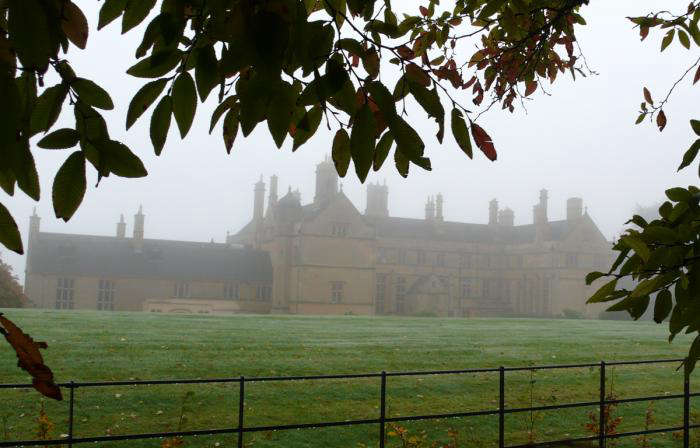
At Batsford Arboretum in the English Coehind a velvet rope. It drips from mossy stone, curls around bamboo, flashes scarlet through Japanese maples, and occasionally appears to be hiding in a fog bank. Created by Algernon Bertram Freeman-Mitford, the garden combines Victorian ambition, East Asian inspiration, family mythology, and enough theatrical atmosphere to make an ordinary woodland walk feel like the opening chapter of a very stylish mystery.
Where the Gothic Mood Begins
Batsford Arboretum lies near Moreton-in-Marsh in Gloucestershire, where the Cotswolds are famous for honey-colored stone, soft hills, old estates, and weather that can turn “light mist” into a full costume drama before lunch. Spread across roughly 60 acres, Batsford is known for rare trees, shrubs, bamboo, Japanese flowering cherries, and a landscape that rewards slow wandering rather than competitive power walking. The arboretum is beautiful in bright weather, but mist gives it a special advantage: distant trunks dissolve, paths become uncertain, and every stone ornament suddenly looks as though it knows the family secrets.
The word “Gothic” here describes atmosphere more than a strictly medieval garden style. Batsford Park’s dramatic neo-Tudor house, steep roofs, shadowed woodland, rockwork, cave-like features, water, and architectural curiosities create a romantic darkness. This is not a garden filled with plastic ravens and discount-store tombstones. Its drama comes from age, scale, weather, and suggestionthe far more convincing special-effects department.
A Landscape Designed to Be Discovered
Unlike a formal garden that reveals itself in one grand geometric view, Batsford unfolds in episodes. A path bends. Bamboo screens the next scene. Water appears, disappears, and reappears farther downhill. A Japanese rest house waits among trees. Bronze figures occupy the landscape without explaining themselves. The result is theatrical but not stiff, and carefully arranged without looking overly controlled.
The Mitford Who Built the Garden
The famous Mitford sisters tend to dominate any mention of the family, but the key figure at Batsford was their grandfather, Algernon Bertram Freeman-Mitford, later the 1st Baron Redesdale. Often called Bertie, he was a diplomat, writer, traveler, collector, and serious plantsman. His years in China and Japan gave him direct exposure to plants, landscapes, and cultural traditions that were still unfamiliar to many British landowners. He later drew on those observations when reshaping Batsford’s grounds into a naturalistic “wild garden.”
After inheriting the estate, Mitford replaced the earlier Georgian mansion with the imposing house now associated with Batsford Park. Built between 1888 and 1892, the residence was designed by Sir Ernest George and Harold Peto. Its neo-Tudor character supplied an architectural backdrop with gables, mass, and just enough brooding grandeur to make the arboretum’s more mysterious corners feel inevitable rather than staged. Historic England records both the house and the designed park as significant heritage assets.
Victorian Wealth Meets East Asian Inspiration
Mitford’s project belonged to a wider Victorian and Edwardian fascination with Japanese plants and design. After Japan’s ports opened to wider international exchange in the nineteenth century, plants, books, artworks, garden ornaments, and design ideas circulated through Britain, Europe, and the United States. British “Japanese gardens” were often hybrids: part observation, part adaptation, and part fashionable interpretation.
Kew notes that publications such as Josiah Conder’s Landscape Gardening in Japan helped shape British garden-making, while historians describe a broader movement fueled by plant introductions, exhibitions, travel writing, and Japonisme.
Batsford should therefore be understood as Japanese-inspired, not as a perfect reproduction of a traditional Japanese garden. Its genius lies in translation. Mitford applied ideas of naturalistic movement, framed views, water, asymmetry, botanical collecting, and surprise to a Cotswold estate. The accent was international; the grammar remained thoroughly English.
The Features That Give Batsford Its Spell
Mitford did not merely plant a few exotic trees near the terrace and declare victory. He reorganized the landscape. The official history credits him with creating a roughly 600-meter artificial watercourse along the western side of the garden, as well as rockeries, a hermit’s cave, a thatched cottage, and a Japanese rest house topped by a dragon intended to ward off evil spirits.
Chinese characters near the entrance celebrate bamboo, while imported bronze figures include a Buddha, deer, and a mythical guardian often described as a Foo Dog. These objects make the landscape feel collected, traveled, and intriguingly eccentric rather than uniformly designed.
The Watercourse: Movement Without Hurry
Water is one of the garden’s best narrative devices. It leads the eye, softens sound, reflects foliage, and persuades visitors that something important may be waiting around the next bend. At Batsford, the artificial stream does not read like a municipal drainage project wearing a decorative hat. It helps organize the slope and ties separate scenes together, making the garden feel larger and more mysterious.
The watercourse also prevents the walk from becoming a simple procession of labeled trees. Visitors repeatedly encounter the same ribbon of water from different angles and elevations. It becomes a quiet guide through the arboretum, connecting woodland, ornamental structures, and planted slopes.
The Rest House and Its Dragon
The Japanese rest house is among Batsford’s most memorable structures because it sits somewhere between architecture and fantasy. Its rooftop dragon introduces a playful note into a landscape that could otherwise become overly solemn.
The building also demonstrates how nineteenth-century estate owners used garden structures as destinations. A path needs a reason to continue, and “there may be a dragon ahead” remains an excellent reason in any century.
The Hermit’s Cave: Gothic Marketing Before Social Media
Hermitages and grottoes had already appeared in European landscape traditions long before Batsford. They offered controlled wildness: rough stone, shadow, solitude, and the agreeable illusion that civilization had briefly lost the argument.
Batsford’s hermit’s cave strengthens the Gothic mood while giving visitors a physical contrast to open lawns and airy tree canopies. It is a small architectural feature doing a surprisingly large amount of emotional work.
A Living Collection, Not a Historical Stage Set
Batsford’s atmosphere may be historic, but the arboretum is a living collection that requires constant renewal. Trees age, storms remove specimens, diseases alter planting decisions, and collections must be documented, propagated, and replaced.
Batsford has held the National Collection of Japanese flowering cherries since 2002, representing at least 70 percent of known cultivars. Because ornamental cherries are not exceptionally long-lived, plant material is periodically grafted to preserve the collection.
Japanese Maples and Seasonal Color
Japanese maples are another major attraction, especially in fall, when their leaves shift through crimson, scarlet, orange, copper, and wine-dark purple. Their fine foliage contrasts with the heavier forms of mature beeches, oaks, magnolias, and conifers.
Magnolias provide structure and dramatic spring flowers, often forming a backdrop for the Japanese cherries. Bamboo contributes sound and movement, while sorbus trees add flowers, berries, and delicate foliage. Pines provide evergreen mass when the deciduous collection has dropped its leaves and decided to take the winter off.
Why Informality Matters
A collection garden can easily feel like an outdoor filing cabinet: one specimen, one label, repeat until the café. Batsford avoids that problem by preserving a sense of informality. Trees overlap, branches lean across paths, and understory planting softens the transitions.
The visitor receives useful botanical information without losing the emotional pleasure of woodland. Labels explain what is growing, but they do not interrupt the composition. The plants are allowed to create scenes instead of standing like contestants at a horticultural spelling bee.
The Famous Mitfords Arriveand Leave
When Bertie died in 1916, Batsford passed to his son David Freeman-Mitford, the 2nd Baron Redesdale, known within the family as “Farve.” David and his wife Sydney were the parents of Nancy, Pamela, Diana, Unity, Jessica, Deborah, and their brother Tom.
The children would become one of the twentieth century’s most discussed sibling groups: novelists, political rebels, society figures, and magnets for controversy. The family contained almost every possible ideological disagreement except, apparently, a dispute about becoming less interesting.
Their residence at Batsford was brief. The enormous costs of maintaining the estate, combined with financial pressures following World War I, led to its sale. In 1919, the family moved to Asthall Manor, another Cotswold house that later influenced Nancy Mitford’s fictional Alconleigh in The Pursuit of Love.
This distinction matters. Batsford’s arboretum is the grandfather’s great horticultural legacy, while much of the sisters’ best-known childhood mythology belongs to Asthall and later Swinbrook.
Why the Mitford Name Still Changes the Visit
Even a short family connection can color a place. Knowing that the young Mitfords once occupied the great house adds a layer of social history to the landscape. Their later lives ranged across literature, aristocracy, communism, fascism, journalism, and public scandal.
The contrast is irresistible: calm water, disciplined trees, and a family future that would be anything but tranquil.
Nancy helped turn family life into literature, while Jessica later became a celebrated investigative writer in the United States. Modern biographies continue to revisit the sisters because their private loyalties, political divisions, humor, privilege, and contradictions make them difficult to compress into a tidy moral.
Batsford, meanwhile, remains serenely untidy in a more botanical sense. ection>
How the Garden Survived Beyond the Mitfords
The story did not end when the estate changed hands. Gilbert Wills, later the 1st Lord Dulverton, purchased Batsford, and Lady Dulverton took a strong interest in the gardens, particularly the formal areas and walled garden. Later generations added trees and protected the collection.
After wartime and postwar decline, the 2nd Lord Dulverton inherited the estate in 1956 and began a new phase of restoration. The Batsford Foundation emerged in the 1980s, helping secure the arboretum’s future as a public, educational, and conservation-minded landscape.
This continuity explains why Batsford feels layered rather than frozen. One owner established the essential vision; others repaired, expanded, adapted, and conserved it. Great gardens rarely survive through purity. They survive because somebody in each generation notices that the roof leaks, the path is disappearing, and the irreplaceable tree is looking unwell.
What Batsford Teaches About Gothic Garden Design
Home gardeners cannot casually install a 60-acre arboretum, a neo-Tudor mansion, and a dragon-topped rest house before the weekend. They can, however, borrow Batsford’s design principles.
Use Concealment to Create Curiosity
Do not reveal the entire garden from the back door. Use shrubs, small trees, screens, arches, or changes in level to hide part of the route. Mystery needs editing. A visitor should sense that something is ahead without seeing the recycling bins auditioning for the role.
Build Contrast With Texture
Combine fine foliage with broad leaves, smooth trunks with rough stone, clipped shapes with loose planting, and open light with deep shade. Gothic atmosphere depends less on black flowers than on contrast. A pale trunk in a dark grove can be more dramatic than an entire border planted like a vampire’s wedding.
Give Paths a Destination
A bench, urn, small pavilion, sculptural stone, water basin, or specimen tree can pull a person through the space. The object does not need to be expensive. It needs to be placed with intention and partly withheld from view.
Let Weather Participate
Choose plants and materials that become more interesting in rain, frost, fog, and low winter light. Mossy stone, glossy evergreen foliage, colored bark, ornamental grasses, berries, and sculptural seed heads prevent a moody garden from becoming merely a summer photograph.
Mix Structure With Controlled Wildness
A mysterious garden still needs organization. Strong evergreens, defined paths, stone steps, and carefully positioned focal points provide structure. Looser planting can then spill, lean, soften, and occasionally behave as though it has never met a pruning tool.
When to Visit for the Strongest Effect
Each season changes Batsford’s personality. Early bulbs and magnolias bring delicacy to spring, followed by clouds of Japanese cherry blossom. Summer emphasizes shade, bamboo, and the cool interior of the tree canopy.
Autumn is the headline act, with maples and other deciduous trees producing a long display of saturated color. Winter pares the garden back to bark, branches, stone, and structurethe season when its Gothic bones are easiest to read.
For atmosphere, a damp or misty day is not necessarily bad luck. It reduces long views and intensifies nearby details: dripping leaves, dark trunks, wet stone, and bright berries. Bring practical shoes. Romantic gloom is less enchanting when experienced through soaked socks.
A Visitor’s Experience: Five Hundred Words Among Fog, Maples, and Mitford Ghosts
The most satisfying way to experience Batsford is to arrive without demanding instant spectacle. At first, the landscape may appear simply generous: mature trees, sloping ground, a broad canopy, and paths slipping away from the entrance. Then the garden begins its quiet campaign. A maple glows through the gray. Water murmurs below the path. Bamboo lifts and rattles in a breeze that seems to have traveled from another century.
You follow the route downhill and realize that the garden is controlling your speed. Straight lines are scarce, and the next view is rarely obvious. This is mildly inconvenient for anyone determined to “complete” the arboretum in 45 minutes, but excellent for everyone else. Batsford is not a checklist with roots. It is a sequence of pauses.
The Gothic feeling grows through accumulation. Wet stone darkens. Tree trunks stand like columns in a roofless cathedral. The mist removes the modern landscape beyond the garden, leaving only the near world: moss, bark, water, a flash of bronze, and the crunch of gravel.
Then the Japanese rest house appears, embellished by its rooftop dragon. The effect is both theatrical and oddly convincing. You may smile at the dragon, but you do not dismiss it. It has been on duty longer than most security companies.
Near the historic ornaments, the garden’s cultural mixture becomes especially clear. This is not Japan transplanted intact into Gloucestershire. It is a Victorian interpretation formed by travel, collecting, curiosity, wealth, and the assumptions of its period.
That complexity makes the visit more interesting. The landscape is beautiful, but it also prompts questions about how plants and ideas moved around the world, who possessed the resources to collect them, and how foreign aesthetics were translated for British taste.
Farther along, botanical knowledge and pure sensation begin to overlap. Labels identify cherries, maples, sorbus, magnolias, or bamboo, yet the memorable experience is often simpler: the red tree behind the green one; the pale berries shining in shade; the branch arching low enough to turn an ordinary path into a doorway.
The garden teaches without insisting that visitors take an exam afterward.
The Mitford association arrives less as a visible exhibit than as a mental soundtrack. One imagines the family in the great house, not yet divided by the ideologies and scandals that would later define them. Their presence at Batsford was short, and the arboretum’s true author was their grandfather, but the name adds narrative electricity. A tranquil grove becomes the prologue to a famously unruly family saga.
By the time you climb back toward the entrance, Batsford feels less like a collection of individual attractions and more like one long composition. The watercourse, trees, structures, slopes, and hidden views have worked together. Nothing shouted, yet the garden has rearranged your attention.
You leave noticing silhouettes, bark, damp air, and the dramatic possibilities of a path that refuses to explain where it is going.
That may be Batsford’s greatest experience: it makes mystery feel cultivated rather than artificial. The garden is maintained, labeled, conserved, and open to study, yet it retains the emotional charge of a half-discovered place.
It proves that horticultural knowledge and romantic atmosphere do not have to quarrel. They can share the same foggy pathpreferably with a dragon nearby.
Conclusion: A Garden With More Than One Story
A Gothic garden visit courtesy of the Mitfords is really a journey through overlapping histories. Batsford is a Victorian wild garden shaped by international travel, a Japanese-inspired landscape adapted to the Cotswolds, a major living tree collection, a survival story, and a brief opening scene in the saga of the Mitford family.
Its charm does not depend on one famous surname. The deeper attraction is the union of horticulture and atmosphere. Maples provide fire, bamboo provides movement, water provides continuity, stone provides age, and mistwhen availablehandles public relations.
Batsford shows that the most memorable gardens are not merely planted. They are paced, framed, layered, and allowed to keep a few secrets.