Founders love building. Founders love shipping. Founders love saying “we’re still refining the product” while quietly avoiding a sales call like it’s a raccoon in the server room. But as Dave Kellogg’s advice makes painfully clear, sales is not an optional business accessory. It is where your elegant product theory meets real buyers, real budgets, real objections, and real silence after your third follow-up email.
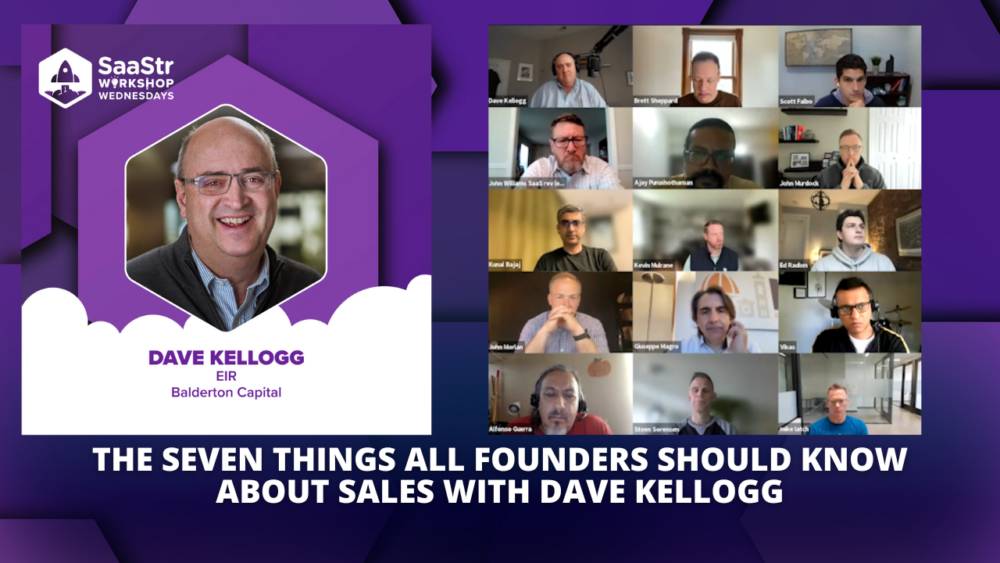
In the video “7 Things All Founders Should Know About Sales with Dave Kellogg,” the former SaaS CEO, CMO, board member, Balderton Executive in Residence, and author of Kellblog breaks sales down into something founders can actually respect: a disciplined operating system. Not charisma. Not jazz hands. Not “relationship magic.” Sales is learning, listening, diagnosing, qualifying, and managing mutual commitment.
This article expands those seven lessons for startup founders, especially B2B SaaS founders, technical founders, and early-stage CEOs trying to move from founder-led sales to a repeatable sales process without accidentally lighting their runway on fire.
Why Founders Must Learn Sales Before Hiring Sales
The first uncomfortable truth is simple: you cannot outsource customer understanding. Hiring a VP of Sales before you understand why customers buy is like hiring a chef before discovering whether your restaurant serves tacos, sushi, or emotionally supportive oatmeal.
Founder-led sales is the discovery lab for your business. Every sales conversation teaches you something about your ideal customer profile, urgency, budget, decision process, competitive alternatives, and product gaps. A good founder does not merely pitch on calls; they study them. They listen for repeated pain, confusing language, hidden stakeholders, and the exact phrase a buyer uses when the product finally clicks.
Dave Kellogg’s larger body of work often frames SaaS as a distribution business as much as a product business. That is a useful mental reset. A startup can have brilliant engineering, beautiful design, and a roadmap that makes investors nod thoughtfully, but if nobody knows why to buy, how to buy, or why to buy now, the business stalls.
The 7 Sales Lessons Founders Should Know
1. Get Out There and Sell
The first rule is not glamorous: founders need to get on sales calls. Not once. Not as a ceremonial activity before retreating to product strategy. Repeatedly. Early sales calls are where “corporate pitchmanship meets field reality.” In plain English, this is where your homepage copy gets punched in the nose by actual buyer questions.
When founders sell directly, they learn what messaging works, which objections are real, and whether the customer’s problem is urgent enough to deserve budget. A founder who sells early can later hire salespeople with better judgment because they know what good looks like. They can recognize whether a rep is uncovering pain or merely narrating the feature list like a museum audio guide.
Example: imagine selling workflow software to finance teams. Your pitch says, “We automate approvals.” The buyer says, “My real problem is that approvals get stuck with regional managers during quarter close.” That one sentence changes the demo, the positioning, the target persona, and possibly the product roadmap. You do not learn that from a dashboard. You learn it by talking to humans.
2. Customers Buy Solutions to Problems, Not Products
Founders often want to explain the product. Buyers want to eliminate pain. That gap is where many sales calls go to nap.
Kellogg’s point is that customers do not wake up craving software. Nobody opens their calendar and says, “Today feels perfect for evaluating a cross-functional enterprise platform with configurable workflows.” They buy because something is broken, expensive, slow, risky, embarrassing, or strategically important. Your product is the vehicle. The destination is the solved problem.
This matters even more for platform companies. Applications often solve a visible problem; platforms can solve many problems, which sounds powerful but can become vague. A founder selling a platform must translate flexibility into specific business outcomes. Instead of saying, “Our platform is highly extensible,” say, “Your operations team can launch new approval flows without waiting six weeks for engineering.” One is a feature. The other is a reason to care.
3. Sales Is 57% Listening
Great salespeople are not the people who can talk forever. Those people are called podcast hosts. In B2B sales, the strongest conversations usually create room for the buyer to explain their world.
Gong’s widely cited sales-call research popularized the idea that top-performing sales conversations involve more listening than talking, often summarized as a 43% talk and 57% listen ratio. The exact number should not be treated like a sacred spell, but the principle is gold: if the buyer is not talking, you are not learning.
For founders, listening is more than politeness. It is market research, qualification, product feedback, objection handling, and positioning work happening at the same time. Listen for business pain, emotional pain, timing, internal politics, budget ownership, and the words the buyer uses naturally. Those words belong in your sales deck, website, onboarding emails, and investor updates.
The founder’s job is not to win the monologue contest. It is to create a conversation where the buyer reveals enough truth for both sides to know whether there is a real fit.
4. The Best Sellers Are Curious About the Problem and the Process
Most founders are curious about the problem. Fewer are curious about the buying process. That is dangerous because deals rarely die only from product mismatch. They die from unclear ownership, missing budget, legal delays, security reviews, executive vetoes, procurement mazes, and the mysterious committee member known only as “Janet from compliance.” Janet is powerful. Respect Janet.
A curious seller asks about both pain and process. What triggered the search? Who owns the problem? Who signs? Who influences? What happens after the demo? What evaluation criteria will be used? What could stop the project? Is there an existing vendor? Is there a deadline tied to a business event?
This kind of curiosity is not pushy. It is professional. A serious buyer usually appreciates a seller who understands how complex purchases actually happen. When founders learn the customer’s process, they stop forecasting deals based on vibes and start managing opportunities based on evidence.
5. Ask Open-Ended Questions
Closed questions are useful for confirmation, but open-ended questions create discovery. “Do you need better reporting?” gets you a yes, a no, or a polite shrug. “How are executives currently getting visibility into regional performance?” opens a door.
Open-ended questions help founders avoid pitching too early. They invite buyers to explain the current state, business impact, previous attempts, internal pressure, and desired future. Useful openers include: “Can you walk me through how this works today?” “What happens when that process breaks?” “How are you measuring the cost of the problem?” “What would a successful outcome look like six months from now?”
The best open-ended questions are simple, specific, and buyer-centered. They do not sound like a consulting robot wearing a blazer. They sound like a smart person trying to understand before prescribing.
6. Manage the Sales Process as a Quid Pro Quo
Enterprise sales can become strangely one-sided. The prospect asks for a custom demo, a security questionnaire, a pricing scenario, a workshop, a sandbox, a second workshop, and possibly a small parade. The founder says yes to everything because revenue is nearby and dignity can wait.
Kellogg’s “give-to-get” idea restores balance. If you give something valuable, you should get something valuable in return. If your team invests time in a custom demo, ask for access to the economic buyer. If you run a technical workshop, ask the buyer to confirm decision criteria. If you prepare a proposal, ask for a mutual close plan.
This is not about being difficult. It is about testing commitment. Real buyers understand mutual effort. Unqualified prospects often disappear when asked for reciprocal action. That disappearance is not a tragedy; it is pipeline hygiene wearing a tiny graduation cap.
7. Do Not Talk About the Competition Unless Asked
Founders know their competitors. Sometimes too well. They have read every comparison page, studied every pricing plan, and can deliver a dramatic courtroom speech about why RivalCo is technically inferior. Resist the urge.
Talking about competitors too early can introduce options the buyer was not considering, make you sound defensive, or shift the conversation away from the customer’s problem. The safest rule is simple: do not name competitors unless the buyer brings them up first.
When competition does come up, stay truthful, calm, and customer-focused. A strong response sounds like, “They are a credible company, and teams often compare us. The main difference we usually see for your use case is implementation speed and finance-team control. Would it help to walk through that based on your criteria?” That is confident. A rant is not.
How These Lessons Create a Repeatable Sales Process
The seven lessons are not random tips. Together, they form the foundation of a repeatable startup sales strategy. First, founders sell directly to learn. Then they define the customer problem clearly. Next, they improve discovery through listening, curiosity, and open-ended questions. After that, they qualify opportunities through mutual commitment. Finally, they handle competition with discipline rather than panic.
This is how a startup moves from heroic founder selling to scalable B2B sales. A repeatable process is not created by hiring ten account executives and hoping one of them owns a lucky blazer. It is created by documenting who buys, why they buy, how they buy, what proof they need, what objections appear, and what actions predict a real deal.
Founders should record calls, review transcripts, update messaging, and build a simple sales playbook. The playbook does not need to be a 90-page shrine to revenue operations. In the beginning, it can include target personas, discovery questions, qualification criteria, common objections, demo flow, pricing guidance, and next-step rules.
Common Founder Sales Mistakes
Mistake 1: Selling Features Before Diagnosing Pain
Feature-first selling feels efficient, but it often forces the buyer to do the translation work. Founders should connect every feature to a business problem. “Automated alerts” becomes “your team finds exceptions before the CFO asks why the number is wrong.” Much better. Fewer yawns.
Mistake 2: Confusing Interest with Intent
A prospect can love your product and still not buy. Interest sounds like, “This is cool.” Intent sounds like, “We need this in place before our next audit, and our VP Finance owns the budget.” Founders must learn the difference or the pipeline becomes a fantasy novel.
Mistake 3: Hiring Sales Too Early
If founders have not closed early customers, validated messaging, and learned the buying motion, a salesperson may only accelerate confusion. Sales hires need a working pattern to improve. They cannot magically convert a fog bank into annual recurring revenue.
Mistake 4: Avoiding Hard Qualification
Early-stage founders hate disqualifying opportunities because every logo feels precious. But bad-fit deals consume time, distort product priorities, and create unhappy customers. A narrower pipeline with real urgency is healthier than a giant pipeline full of “maybe someday.”
Practical Sales Framework for Founders
Founders can apply Kellogg’s lessons with a simple call structure:
- Set the agenda: Explain the goal of the call and ask what the buyer wants to cover.
- Discover pain: Use open-ended questions to understand the current process and business impact.
- Map the process: Ask who is involved, what the timeline is, and how decisions are made.
- Connect value: Demonstrate only the parts of the product tied to the buyer’s stated problem.
- Confirm fit: Ask what seems useful, unclear, or missing.
- Create mutual next steps: Trade your effort for buyer commitment, such as access to stakeholders or a defined evaluation plan.
This structure keeps the call focused without making it stiff. The founder remains human, but the conversation has a spine.
Founder Field Notes: of Real-World Sales Experience
The most useful founder sales lesson is that buyers rarely behave like the neat personas in your pitch deck. In the deck, the buyer has a title, a pain point, a budget, and a clean decision journey. In real life, the buyer has a boss who is traveling, a procurement team that moves like a sleepy glacier, an internal project with the same name as your product, and a spreadsheet from 2017 that everyone hates but nobody is brave enough to kill.
That is why founder-led sales feels messy. It is supposed to. The mess is the information. On one call, a founder may discover that the “user” loves the product but has no authority. On another, the economic buyer may care less about elegant automation and more about reducing audit risk. On a third, the company may already have budget, but only if the product can pass security review before the quarter ends. These details decide deals.
One helpful practice is to write a short sales memo after every meaningful call. Capture the buyer’s exact words, the pain, current workaround, urgency, stakeholders, next step, and your confidence level. After twenty calls, patterns appear. You may learn that mid-market customers buy quickly but churn easily, while enterprise customers move slowly but expand. You may discover that one industry understands the problem immediately while another needs too much education. That is not just sales data; it is company strategy.
Another experience many founders share is the awkward transition from “I built this” to “I sell this.” At first, selling can feel like begging. It is not. Good sales is not begging someone to buy something useless. It is helping a qualified buyer understand whether your solution can solve a real problem. When you believe that, your posture changes. You stop chasing everyone. You start looking for fit.
The best founders also learn to enjoy objections. An objection is not always rejection. Sometimes it is a request for clarity. “This seems expensive” may mean the buyer does not yet understand value. “We need legal approval” may mean the deal is real enough to enter process. “We already use another vendor” may reveal a displacement opportunity if the pain is strong enough. The founder’s job is to stay curious instead of getting defensive.
Finally, founders should remember that sales is a team sport even before there is a sales team. Product, marketing, customer success, finance, and leadership all shape revenue. Sales calls should influence roadmap priorities, website messaging, onboarding, pricing, packaging, and investor narratives. When founders treat sales as learning, the whole company gets smarter. When they treat sales as a department they will hire later, the company may build beautifully in the wrong direction.
Conclusion: Sales Is the Founder’s Reality Check
Dave Kellogg’s seven sales lessons are especially valuable because they remove the fog around selling. Sales is not mystical. It is not reserved for extroverts with heroic handshakes. It is a learnable discipline built on customer understanding, structured curiosity, careful listening, mutual commitment, and strategic restraint.
For founders, the message is direct: get on the calls. Hear the pain. Ask better questions. Learn the buying process. Trade value for commitment. Avoid competitor theater. Build a sales process before trying to scale a sales team.
The companies that win are not always the ones with the flashiest product. They are often the ones that understand the customer’s problem most clearly and make buying feel like the logical next step. That may not sound as romantic as “changing the world,” but it is how many world-changing companies get their first purchase order.
Note: This article is a fully rewritten educational synthesis based on real public information about Dave Kellogg’s founder sales guidance, B2B SaaS sales best practices, and current sales research. It is designed for web publishing without copied source text or unnecessary citation artifacts.