In Beijing, a chair can carry more history than a small museumand still give you somewhere comfortable to drink tea. Communist era-inspired furniture draws from the practical desks, folding chairs, steel shelving, and compact seating that furnished Chinese homes, offices, schools, and factories during the socialist decades of the twentieth century.
Today, designers are revisiting those familiar objects without simply copying them. They preserve the economical silhouettes and hard-working spirit while improving the wood, upholstery, joinery, and proportions. The result is a distinctive category of modern Chinese furniture: restrained, useful, slightly nostalgic, and far more sophisticated than the phrase “Communist furniture” might suggest.
What Is Communist Era-Inspired Furniture?
The label generally describes contemporary furniture influenced by objects used in China from the 1950s through the late 1970s. It is a convenient term, but not a perfectly precise design classification. Furniture from this period was shaped by several forces, including socialist manufacturing policies, limited household space, material shortages, traditional Chinese craftsmanship, and international modernism.
Factories were expected to produce functional objects efficiently and at accessible prices. Decorative flourishes rarely survived the meeting. A chair needed to be sturdy, economical, and relatively easy to repair. A desk needed to accommodate work rather than impress visitors with a small forest of carved dragons.
Common characteristics included:
- Compact proportions suited to small apartments and shared rooms
- Straightforward frames made from elm, walnut, beech, or steel
- Minimal ornament and exposed structural elements
- Dark green, brown, gray, burgundy, and muted red finishes
- Practical upholstery such as corduroy, wool, canvas, or vinyl
- Furniture designed for offices, factories, schools, and collective housing
Despite the political association, the style is not usually about decorating a room with slogans or turning the living room into a revolutionary stage set. Its appeal lies in honest materials, recognizable forms, and the idea that everyday objects can become cultural records.
How Socialist China Shaped Everyday Furniture
After the founding of the People’s Republic of China in 1949, furniture production became increasingly connected to state factories and standardized manufacturing. Designers had to balance domestic needs, export opportunities, and chronic material constraints. Timber was valuable, so manufacturers experimented with steel tubing, plastics, plywood, and economical folding structures.
Historical research on Chinese furniture exports shows that wardrobes, dressing tables, folding chairs, and other household goods were shipped abroad during the 1950s and 1960s. The 7469A folding chair, introduced by the Beijing Northern Suburbs Furniture Company in 1974, became an especially recognizable late-Mao-era design. Its combination of timber and red plastic demonstrated how factories could conserve resources while creating a portable, mass-produced object.
These pieces did not emerge in an aesthetic vacuum. Traditional Chinese furniture had already developed sophisticated frame-and-panel construction and carefully balanced proportions. Meanwhile, modern European and Japanese furniture circulated through photographs, trade fairs, imports, and adaptations. Socialist-era Chinese furniture therefore became a practical hybrid: part local craft, part industrial necessity, and part international modernism translated several times.
That history explains why a vintage Chinese office chair may look faintly Scandinavian from across the room. Move closer, however, and the wood, dimensions, upholstery, and accumulated adaptations tell a distinctly Chinese story.
Lost & Found and Beijing’s Revival of Everyday Design
One of the best-known examples of this revival was Lost & Found, a Beijing shop created by American designer Paul Gelinas and his local partner, Xiao Mao. Rather than treating old domestic furniture as disposable evidence of an unfashionable past, they examined its proportions, construction, and emotional familiarity.
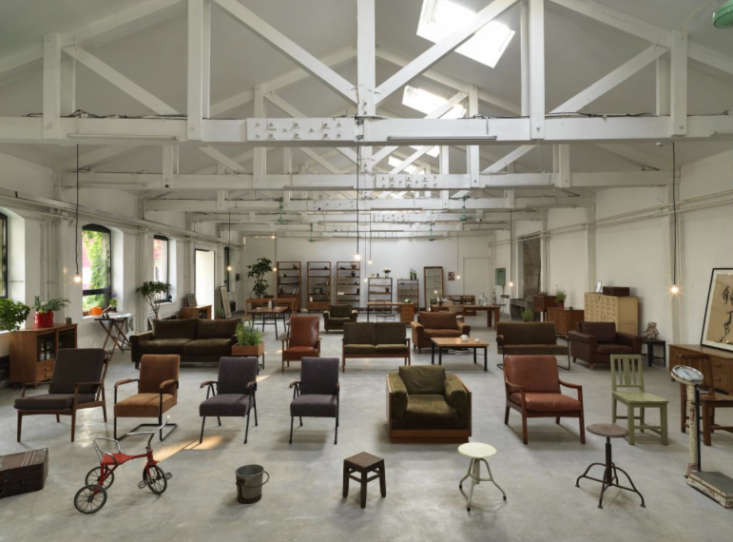
The shop occupied a renovated former dumpling restaurant on one of Beijing’s older streets. Gelinas and architect Phil Dunn, working through New Architecture Office, reshaped the historic building into a layered series of intimate rooms. It felt more like entering several compact homes stacked together than marching through a conventional showroom.
Lost & Found collected, studied, and reissued furniture connected to twentieth-century Chinese life. Its limited-production pieces were made locally, often using better-quality materials than those available to the original factories. Instead of polishing away every historical irregularity, the designers retained the recognizable character of the source objects.
The approach was neither strict restoration nor retro theater. It was closer to translation. A familiar office chair could receive a solid elm frame, salvaged teak armrests, and custom-woven upholstery. Industrial shelving could be rebuilt with Chinese walnut. The outline remained modest, but the construction received considerably more attentionrather like sending an old work uniform to a very talented tailor.
Signature Pieces and the Stories Behind Them
The Iron Pipe Chair
Inspired by office seating seen in Shanghai around the 1970s, the Iron Pipe Chair represented the practical side of Communist era-inspired furniture in Beijing. The original type could later be found serving less glamorous duties on sidewalks or outside neighborhood businesses.
Lost & Found’s version elevated the form without making it precious. An elm inner frame supported upholstered cushions, while salvaged teak formed the armrests. Corduroy or washed wool softened the chair’s industrial outline. It remained visually humble, but it no longer felt like something borrowed from the accounting department.
The Danish Chair and Footstool
This design illustrated how furniture ideas travel. Lost & Found described its ancestry as a Chinese interpretation of a Japanese interpretation of a Danish chair. With each round of adaptation, literal details faded while the essential silhouette grew more pronounced.
The result had the low stance, open arms, and visual lightness associated with midcentury modern furniture, yet its proportions and execution reflected Chinese domestic life. It challenged the assumption that modern design moved neatly from Europe to the rest of the world. In reality, designs migrate, get copied, meet new materials, and develop regional accents.
Angle-Iron Shelving
Angle-iron storage systems were common in factories and warehouses because they were inexpensive, modular, and sturdy. Lost & Found refined that utilitarian framework with Chinese walnut shelves. The combination of dark metal and warm wood captured the wider appeal of Beijing industrial furniture: visible structure paired with tactile materials.
The Work Desk
Built with raw steel and Chinese walnut, the Work Desk combined a clean midcentury profile with the toughness of workshop furniture. It offered enough character to anchor a room without becoming the sort of desk that demands its own dramatic lighting and personal publicist.
Prices reported for these pieces in 2014 ranged from roughly 3,200 yuan for the Iron Pipe Chair to 4,800 yuan for the Work Desk. Those figures should be treated as historical references rather than current retail prices or evidence of present availability.
A Design Language Built on Useful Materials
The strongest Communist era-inspired furniture avoids superficial nostalgia. Its identity comes from construction and materials rather than an excess of red paint.
Elm and Chinese Walnut
Elm has a long history in northern Chinese furniture. It is durable, visually expressive, and well suited to pieces intended for daily use. Chinese walnut provides a darker, more refined surface while retaining warmth and visible grain. Both materials connect contemporary furniture to regional woodworking traditions.
Raw and Painted Steel
Steel communicates industrial efficiency immediately. Slender metal frames also reduce visual weight, which is useful in Beijing’s compact urban interiors. Designers may leave the surface raw, paint it black, or use subdued institutional colors.
Corduroy, Wool, and Canvas
Textured fabrics help prevent the furniture from feeling overly severe. Corduroy is especially effective because it belongs comfortably to both domestic and institutional worlds. It looks familiar, wears visibly, and becomes more relaxed with age.
Why the Style Still Feels Relevant
Beijing is a city where imperial courtyards, socialist apartment blocks, repurposed factories, glass towers, and experimental interiors exist within the same urban conversation. Furniture that combines history with modern practicality feels entirely at home in this environment.
The renewed interest also reflects a larger shift in Chinese design. Younger studios increasingly draw from local materials, memories, architecture, and craft instead of relying exclusively on imported styles. Historical references can be subtle: the curve of an armrest, the spacing of a backrest, a folding mechanism, or a joinery method rather than an obvious symbol.
Sustainability adds another layer. Reissuing a durable form, using salvaged timber, or restoring an existing chair can be more responsible than chasing a disposable trend. A well-made object with a repairable frame has a better chance of remaining useful after the next fashionable color has been renamed three times.
How to Use Communist Era-Inspired Furniture at Home
This style works best when it is allowed to provide contrast. Filling every room with vintage institutional furniture can make a home resemble a very tidy administrative office. A few carefully chosen pieces create a stronger result.
- Pair steel with natural texture: Place an iron-framed chair beside linen curtains, a wool rug, or a plaster wall.
- Mix periods intelligently: A socialist-era desk can sit comfortably near a contemporary lamp or a restrained Ming-inspired stool.
- Keep the palette muted: Walnut, black steel, olive green, oxblood, cream, and tobacco brown allow the silhouettes to stand out.
- Leave useful wear visible: Small scratches and softened edges can add authenticity, provided the frame remains structurally sound.
- Avoid propaganda overload: One historical graphic may create context. Twenty may suggest that the dining room has developed a political platform.
For small apartments, look for open arms, raised legs, narrow shelving, and folding components. These features preserve sightlines and make a room feel less crowded.
Buying Vintage and Reissued Chinese Furniture Responsibly
Not every worn chair advertised as “Mao-era” has a reliable history. Ask sellers about provenance, restoration, replacement parts, and approximate manufacturing dates. Examine joints, corrosion, wood movement, upholstery, and signs of insect damage.
It is also important to distinguish Communist-era furniture from much older Chinese antiques. The Cultural Revolution caused extensive damage to historic objects and cultural sites, and surviving antique furniture may carry complicated ownership and export histories. Buyers should request documentation and avoid encouraging questionable removal or aggressive alteration of genuine heritage pieces.
A high-quality reproduction can be the wiser choice when it clearly identifies its inspiration, supports skilled craftspeople, and improves durability without being marketed as an original.
Experiencing Communist Era-Inspired Furniture in Beijing
Exploring this furniture in Beijing is less like visiting a single grand museum and more like assembling a story from scattered clues. Begin in an older hutong neighborhood, where the scale of the lanes immediately explains why compact furniture mattered. Courtyard rooms could be narrow, multifunctional, and shared across generations. A chair with open arms and a desk with slender legs were not merely elegant; they were spatial problem-solvers.
Inside a thoughtfully renovated shop or studio, allow time for your eyes to adjust to the quietness of the designs. The first impression may be almost too simple: a dark wooden chair, an iron shelf, a rectangular desk. Then the details begin to speak. You notice the angle of a rear leg, the way an armrest has been rubbed smooth, or how a steel frame keeps a heavy cabinet from dominating the room.
Sit down when permitted. Communist era-inspired furniture often makes more sense through the body than through photographs. A low chair changes your posture and creates an informal conversation zone. A compact work desk keeps everything within reach. Some pieces feel upright and businesslike; others reveal surprising comfort beneath their serious expressions. The chairs may look as if they are about to assign homework, but many are perfectly happy to host an afternoon coffee.
Next, compare a reissued piece with genuinely old furniture at a reputable market or specialist dealer. Panjiayuan, commonly called the Dirt Market, is often associated with vintage objects, replicas, crafts, and Mao-era collectibles. It can be visually fascinating, but descriptions should not automatically be treated as verified provenance. Approach it as a place to observe forms and materials, ask questions, and practice healthy skepticismnot as a guaranteed shortcut to a museum-grade discovery.
Look for signs of different lives. A school chair may have scratches around its feet. An office cabinet may contain changed hardware or layers of paint. Repairs can reveal how owners valued usefulness over purity. In this context, an imperfect patch is not necessarily a flaw; it can be evidence that the object remained necessary.
Balance the market experience with Beijing’s contemporary design scene. Visit studios, galleries, adaptive-reuse projects, and furniture showrooms housed in old industrial buildings. A former textile warehouse or factory complex allows modern furniture to converse directly with Mao-era architecture. Exposed brick, concrete frames, steel structures, and pitched roofs provide a physical record of the industrial environment that shaped many utilitarian designs.
Pay attention to how contemporary designers reinterpret rather than reproduce. One studio may use traditional joinery in a modern lounge chair. Another may take the outline of a municipal bench and rebuild it in walnut. A third may create modular furniture for young renters, continuing the socialist-era concern with limited space but answering a completely different social reality.
Finish the experience by sitting in a café or quiet courtyard and reviewing photographs of the objects that stayed in your mind. The most memorable piece may not be the rarest or most expensive. It may be an unassuming chair whose proportions seem inevitable, as if nobody designed it at all. That apparent simplicity is the real achievement. Communist era-inspired furniture in Beijing reveals how political history, resourcefulness, craftsmanship, and ordinary domestic habits can become embedded in objects people use every day.
Conclusion
Communist era-inspired furniture in Beijing is not simply retro décor. It is a living form of design archaeology. By rebuilding office chairs, factory shelves, folding seats, and modest desks with better materials and careful craftsmanship, designers preserve overlooked chapters of Chinese daily life.
The best examples neither romanticize the Mao era nor erase its complexity. They show how useful objects absorb history and how thoughtful redesign can carry that history forward. Sometimes the most revealing monument to an era is not made of stone. Sometimes it is a walnut chair with slightly stern posture and surprisingly comfortable upholstery.